Why Knowing Which Home Generator Brand Is Better for Colorado Could Save Your Home This Winter

When the power goes out during a Colorado blizzard, you don't want to be guessing about your backup power. Whether you're on the Front Range, up in the foothills, or further out in a rural area, a winter outage isn't just an inconvenience — it can mean frozen pipes, failed medical equipment, and days without heat.
Colorado homeowners searching for the best standby generator brand have two strong options worth serious consideration:
| Brand | Best For | Key Strength |
|---|---|---|
| Generac | Most Colorado homes | Parts availability, dealer network, Mobile Link monitoring |
| Cummins | Heavy-duty performance needs | Commercial-grade engine, durable enclosure, quiet operation |
Quick answer: For most Colorado Front Range homeowners, Generac is the most practical choice due to its wide dealer network, fast parts availability, and strong local technical support. Cummins is an excellent alternative for homeowners who prioritize industrial-grade durability and quieter operation. Either brand, when professionally installed with a cold weather kit, will reliably protect your home.
Colorado's climate adds layers to this decision that don't apply in warmer states. Sub-zero temperatures, high altitude, and multi-day winter storm outages all affect how a generator performs — and how quickly it can be serviced when something goes wrong. The brand matters, but so do installation quality, proper sizing, and access to local support when you need it most.
I'm David Meyer, Vice President of Courtesy Electric, a Colorado electrical contractor with roots going back to 1976, and helping Front Range homeowners figure out which home generator brand is better for Colorado is something our team handles every day. In the sections below, I'll walk you through everything you need to make a confident, well-informed decision.
Evaluating Which Home Generator Brand Is Better for Colorado
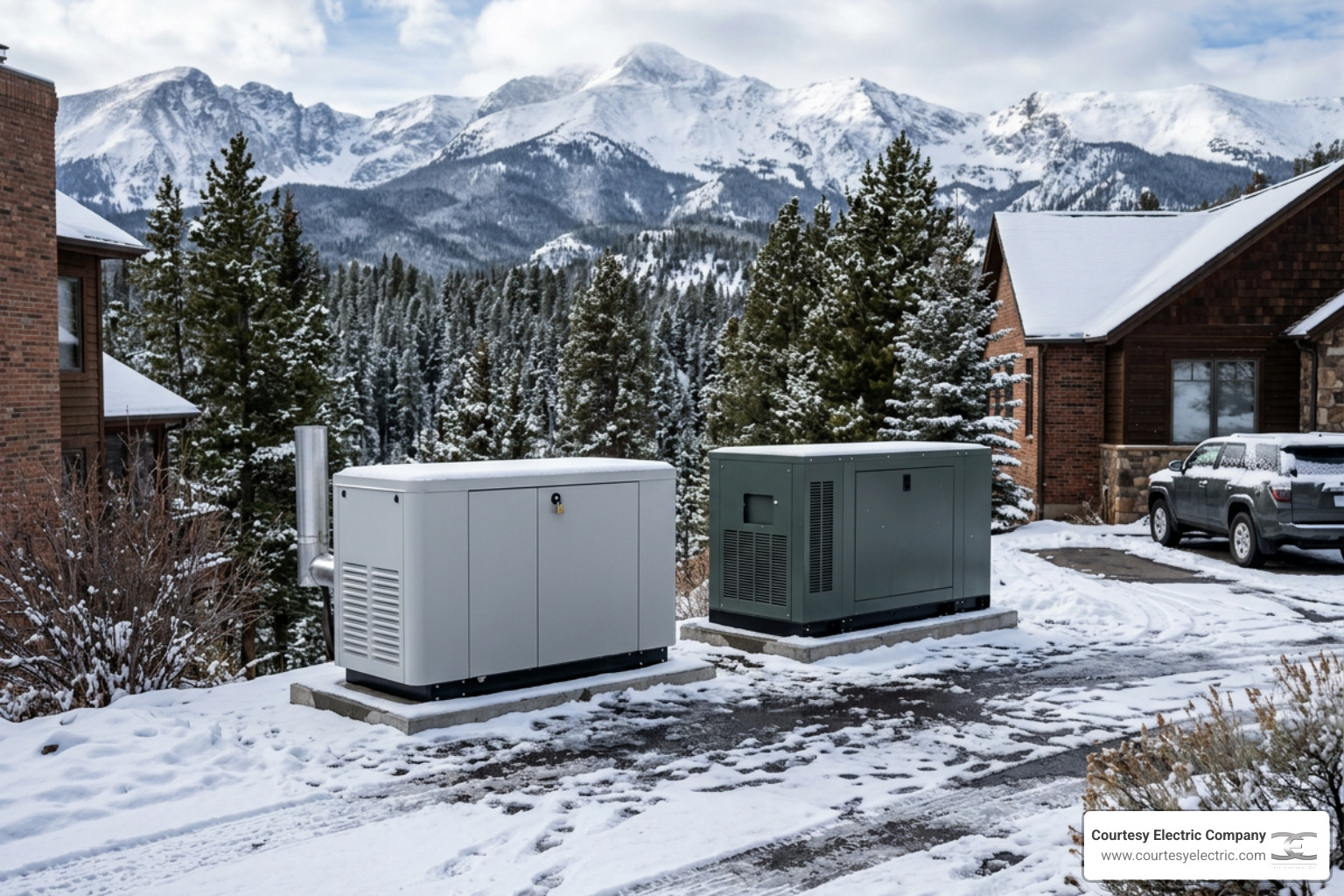
Choosing a standby generator in the Denver metro area, Parker, Highlands Ranch, or Black Forest requires looking past standard marketing brochures. Our local environment throws unique challenges at mechanical equipment. High-altitude air is thinner, which naturally reduces engine horsepower. Our winters are freezing, and our spring storm seasons bring heavy, wet snow that snaps utility lines.
When evaluating brands, we look closely at how their engineering holds up to our local climate, how easily we can source parts during an emergency, and how extensive their local support network is.
| Feature | Generac Guardian Series | Cummins QuietConnect |
|---|---|---|
| Engine Type | Purpose-built residential G-Force | Commercial-grade heavy-duty |
| Enclosure Material | Corrosion-resistant aluminum | Galvanized steel or aluminum |
| Standard Warranty | 5-year limited | 5-year comprehensive |
| Altitude Performance | Excellent with proper derating | Exceptional high-altitude stability |
| Decibel Level (Exercise) | Very quiet (Quiet-Test mode) | Extremely quiet patented design |
| Local Parts Availability | Outstanding (Highest volume) | Strong (Excellent commercial network) |
To understand the broader landscape of residential backup power, you can explore our comprehensive Generator Brand Comparison for Homeowners. However, for most of our clients along the Front Range, the decision narrows down to a head-to-head matchup. You can dive deeper into this specific matchup in our Generac vs Cummins Home Generator Comparison.
Deciding Which Home Generator Brand Is Better for Colorado: The Case for Generac
Generac is the undisputed volume leader in residential standby power, and there are very practical reasons why they are the default choice for many homes in Denver, Highlands Ranch, and Parker.
First and foremost is parts availability. Because Generac systems are the most widely installed units in North America, local supply houses and certified technicians keep a massive inventory of replacement parts on hand. If your generator throws a warning code at two o'clock in the morning during a sub-zero January blizzard, the speed of your repair depends entirely on whether the technician has the replacement part in their service truck. With Generac, the answer is almost always yes.
Generac's technical support and dealer training are also exceptionally robust. Their systems feature Mobile Link monitoring, which allows you to track your generator's status from your smartphone and automatically alerts our team if a maintenance issue arises. Their purpose-built G-Force engines are highly reliable, pressurized-lubricated systems designed to handle the rigors of sudden, cold-weather startups.
Understanding the Power of Cummins Standby Generators for Colorado Homes
While Generac dominates residential market share, Cummins brings an legendary industrial heritage to your backyard. Known worldwide for heavy-duty commercial diesel and natural gas engines, Cummins designs their residential QuietConnect standby generators with the same robust DNA.
If you live in a high-altitude area like Black Forest, or if your property has a high electrical demand—such as running a private well pump, multiple air conditioning units, and a large home layout—Cummins is a phenomenal powerhouse. Their engines are built for extreme durability and long runtimes.
Additionally, Cummins units are engineered to be exceptionally quiet. Their enclosures feature advanced sound-dampening technology that minimizes the low-frequency rumble during operation, making them highly popular in quiet suburban neighborhoods in Highlands Ranch and Parker where close property lines make noise levels a key concern.
Key Factors for Colorado Standby Generator Performance
Operating a standby generator in Colorado is vastly different than operating one at sea level in a mild climate. There are two environmental realities every Front Range homeowner must prepare for: altitude derating and extreme cold.
The Altitude Derating Factor
Engines need oxygen to burn fuel. Because the air is thinner at higher elevations, all internal combustion engines experience a drop in performance as altitude increases. Standby generators typically lose about 3.5% of their rated power capacity for every 1,000 feet of elevation above sea level.
If you live in Denver (around 5,280 feet), a generator will naturally produce roughly 17% to 18% less power than its face-value rating. If you are up in Black Forest (climbing past 7,000 feet), that derating factor increases. This is why professional sizing is so critical. We must calculate your home's electrical load and size the generator to compensate for this high-altitude power loss.
Cold Weather Protection
During a severe winter freeze, engine oil thickens and battery chemistry slows down. Without intervention, a standby generator might struggle to crank over or fail to start entirely when the grid goes down. To ensure your system starts instantly in sub-zero temperatures, we recommend installing a cold weather kit. These kits include thermostatically controlled battery warmers and oil heaters that activate automatically when temperatures plummet, keeping the critical components warm and ready to run.
Natural Gas vs. Propane
For most properties along the Front Range, natural gas is the preferred fuel source. Because municipal gas lines run underground, they are highly resilient and continue to flow even when severe storms knock out overhead electrical grids. This provides an unlimited runtime during extended outages.
However, for rural properties or areas without natural gas service, liquid propane (LP) is an outstanding alternative. Propane burns highly efficiently and stores safely in large on-site tanks.
To learn more about how whole-home backup power protects your property's infrastructure, read about the Whole Home Generator Benefits for Colorado Homeowners. For those living in higher mountain elevations, you can find tailored advice in our Generators Fraser Co Complete Guide and learn about our specialized services in the region by checking out the Best Generators Services in Fraser Co.
Standby Generators vs. Battery Backup Systems in the Front Range
As smart home technology advances, many Front Range homeowners ask us whether they should install a traditional standby generator or a modern battery storage system, such as Franklin battery storage.
The right answer depends entirely on your backup goals, your home’s energy usage, and the typical duration of local power outages.
- Standby Generators: These systems run on natural gas or propane, providing virtually unlimited runtime as long as fuel is supplied. If a severe blizzard knocks out power lines for four or five days, a generator will keep your heating system, refrigeration, and well pumps running without interruption.
- Battery Backup Systems (e.g., Franklin Battery Storage): Batteries offer completely silent operation, zero local emissions, and integrate beautifully with solar panel arrays. They are incredible for managing daily peak energy rates and backing up essential circuits during short-term outages (typically 12 to 24 hours). However, unless paired with a very large solar array that can recharge the batteries during winter daylight hours, they cannot provide the indefinite, heavy-duty runtime required during multi-day winter grid failures.
For a comprehensive breakdown of how these technologies compare, check out our guide on Battery Storage vs Generator Which Is Better for Backup. To help determine which system matches your family's needs, read our detailed analysis on Generator or Battery for Power Outages Is a Generator or Battery Better for Power Outages.
Essential Maintenance for Colorado Home Generators
A standby generator is a significant investment in your home's safety, and like any machine with an internal combustion engine, it requires regular upkeep to perform reliably. Think of it like your car: you wouldn’t drive a vehicle for years without changing the oil or checking the battery, and your generator is no different.
To ensure your system is prepared to handle sudden grid failures, we recommend a consistent maintenance schedule:
- Bi-Weekly Self-Tests: Both Generac and Cummins generators are programmed to run a short, automatic self-test (usually 5 to 15 minutes) every week or two. This circulates the oil, keeps the engine lubricated, and runs diagnostics to ensure all systems are green.
- Annual Professional Service: Once a year, a certified technician should perform a comprehensive service. This includes changing the engine oil and oil filter, replacing the spark plugs, checking or replacing the air filter, and testing the battery charge.
- Pre-Storm Season Inspections: Before our heavy winter blizzards or spring storm seasons arrive, it is wise to do a quick visual check. Ensure the enclosure vents are free of autumn leaves, snow drifts, or debris, and verify that the battery heater is plugged in and functioning.
Implementing a proactive care routine is the single best way to protect your equipment. You can explore our essential Generator Maintenance Tips for Homeowners to keep your system in top shape.
To prepare your system for our wild seasonal shifts, read about performing Generator Maintenance Before Colorado Storm Season. Proper upkeep pays off over time; learn more at How Proper Maintenance Extends Generator Life.
If you are wondering about service intervals, we answer that in How Often Should You Service Your Standby Generator. Finally, don't forget to clear out the winter grime by following our guide on Spring Generator Maintenance After Winter.
Frequently Asked Questions About Colorado Home Generators
Navigating the installation of a home standby generator can feel overwhelming. Understanding the basic mechanics is a great starting point; you can read our guide on How Does a Standby Generator Work to demystify the process.
When you are ready to move forward, we outline the step-by-step journey in Generator Installation What to Expect. Once your system is up and running, keep an eye out for the Signs Your Generator Needs Professional Attention to prevent unexpected failures.
Below, we have answered some of the most common questions we hear from Front Range homeowners.
What size generator do I need for a typical Colorado home?
There is no one-size-fits-all answer because generator sizing is based on your home's unique electrical load rather than square footage alone. A professional sizing process involves a detailed load calculation.
If you only want to back up essential circuits—such as your furnace blower, refrigerator, internet router, and a few lights—a smaller unit (typically 14 kW to 18 kW) may be sufficient. However, if you want a true whole-home backup experience that can seamlessly power heavy loads like central air conditioning, double ovens, electric clothes dryers, or a deep-well pump, you will likely need a larger unit ranging from 22 kW up to 26 kW or more, especially when accounting for high-altitude power loss.
Why is a cold weather kit necessary for Colorado generators?
A cold weather kit is essential because our winter temperatures regularly drop below freezing. When engine oil gets extremely cold, it becomes thick and viscous, making it difficult for the engine starter to turn the crankshaft. Additionally, cold temperatures drastically reduce a battery's cranking power.
A cold weather kit solves this by using thermostatically controlled heating elements. When temperatures drop, the kit automatically warms the battery and the engine oil, ensuring the generator starts smoothly and transfers power to your home within seconds of an outage, protecting your system from starter motor strain.
Do standby generators increase Colorado home resale value?
Yes, they do. A permanently installed standby generator is a highly attractive feature for prospective homebuyers, particularly in areas like Parker, Highlands Ranch, and Black Forest where mature trees and winter storms can lead to localized power outages.
Beyond adding to the home's tangible buyer appeal, a standby generator provides immediate peace of mind. Buyers recognize that the home is fully protected against frozen pipes, spoiled food, and heating failures, making it a premium upgrade that stands out in the Colorado real estate market.
Conclusion
Determining which home generator brand is better for Colorado ultimately comes down to your property’s specific layout, your power priorities, and your access to local service. Both Generac and Cummins build exceptional, reliable standby generators that can easily weather a Front Range winter when paired with a cold weather kit and sized correctly for our high altitude.
At Courtesy Electric Company, we take great pride in helping our neighbors throughout Denver, Parker, Highlands Ranch, and Black Forest secure their homes against unpredictable grid failures. As a longstanding Colorado contractor with decades of local experience, our mission is built on quality, integrity, and dependability. We provide end-to-end support—from initial load calculations and site design to final permitting and professional installation.
If you are ready to protect your home and family with a reliable backup power solution, we invite you to request a free estimate. Contact our expert team today or visit our https://www.courtesyelectric.com/electrical-service page to learn more about how we can keep your lights on, no matter what the Colorado weather throws our way.


