
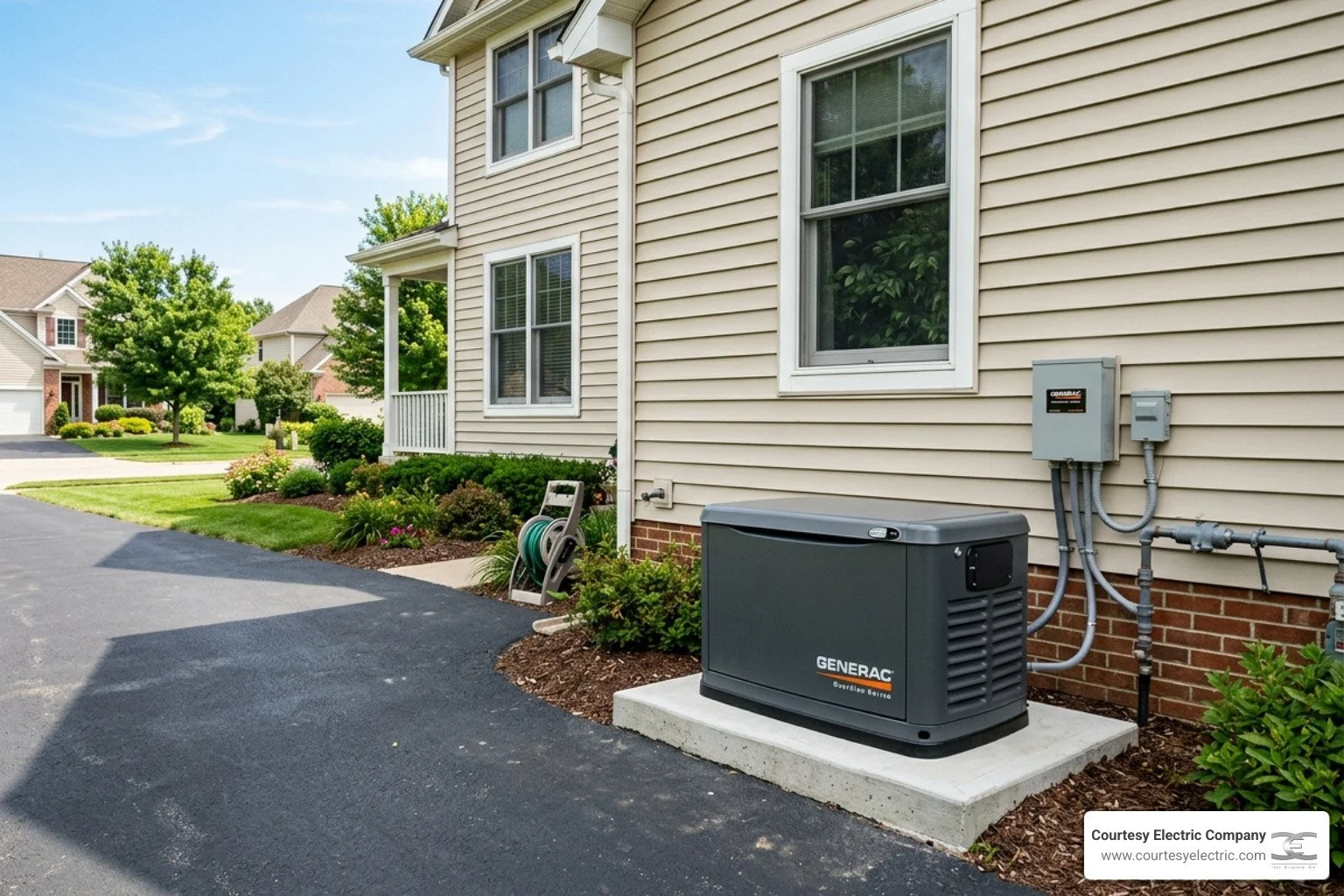
How Does a Standby Generator Work — And Why It Matters for Colorado Homeowners
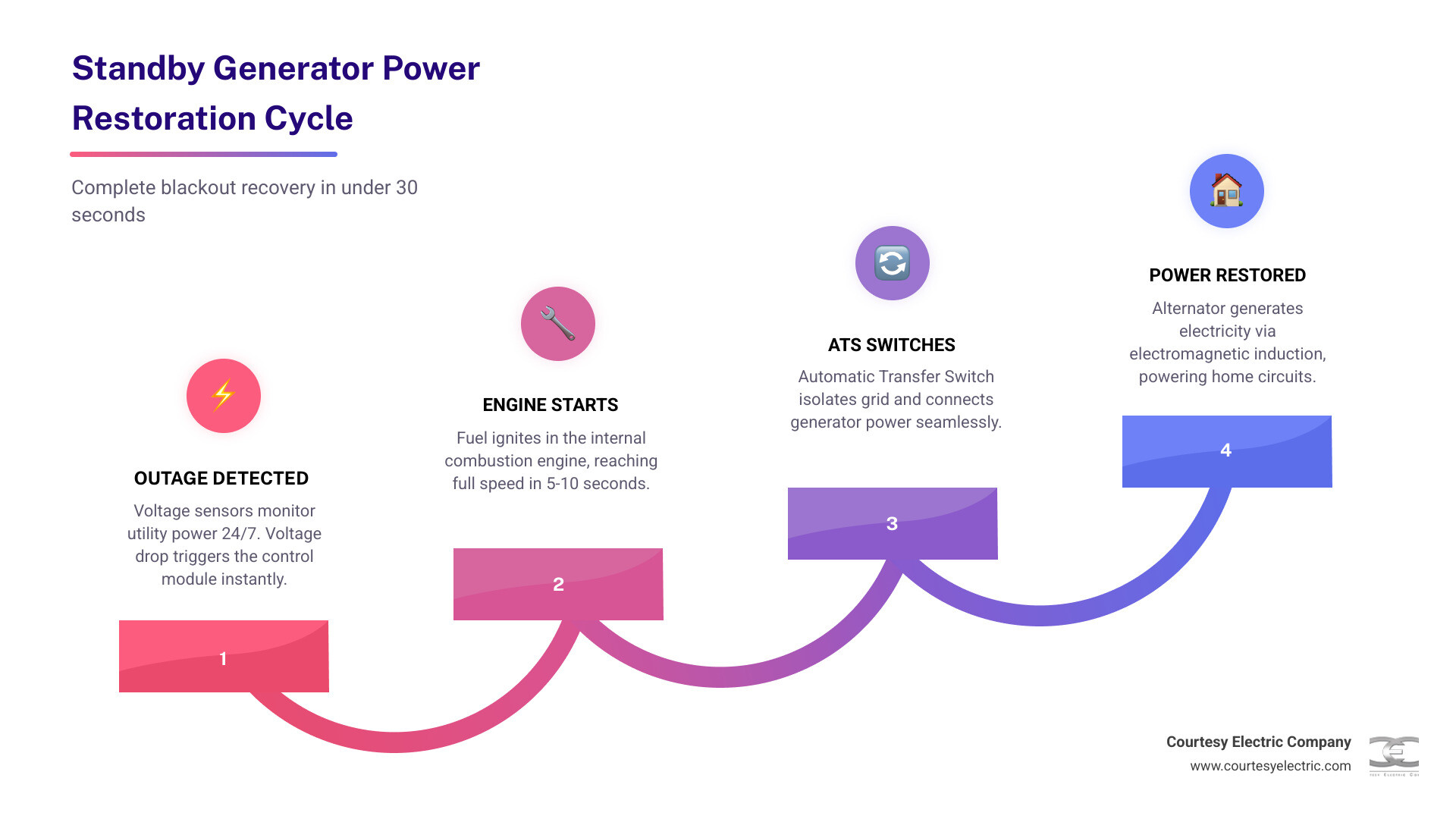
How does a standby generator work is a straightforward question with a surprisingly elegant answer. When the grid goes down, your standby generator detects the outage, starts its engine, and restores power to your home — all within 10 to 30 seconds, and all without you lifting a finger.
Here is the quick version:
- Power loss detected — Built-in sensors continuously monitor your utility feed. The moment voltage drops, the control module registers the outage.
- Engine starts automatically — The generator's engine fires up, typically reaching operating speed within seconds.
- Transfer switch activates — The automatic transfer switch (ATS) disconnects your home from the dead utility grid and connects it to the generator.
- Power flows to your home — Electricity is produced through an alternator and distributed to your circuits, keeping appliances, lights, and heating running normally.
- Grid power returns — Once utility power stabilizes, the ATS switches your home back to the grid.
- Generator cools down and stands by — The engine runs a brief cool-down cycle, then shuts off and returns to standby mode, ready for the next outage.
For Colorado Front Range homeowners, this sequence matters more than most people realize. Severe winter storms, high-wind events, and aging grid infrastructure across the Denver metro area mean that outages can arrive without warning and last for hours — or days. A permanently installed standby generator removes the uncertainty entirely. Your home stays on. Your food stays fresh. Your sump pump keeps running. Your family stays comfortable.
The adoption numbers tell the story: in 2002, fewer than 1% of U.S. homes had a backup generator installed. By 2023, that figure had climbed to nearly 6% — and it continues to rise as homeowners prioritize energy resilience.
I'm David Meyer, Vice President of Courtesy Electric, and I've spent my career in the field working on standby generator systems, electrical panels, and backup power infrastructure across Colorado — so I understand exactly how a standby generator works from both the technical and practical sides. Let me walk you through everything you need to know.
Defining the Standby Generator System
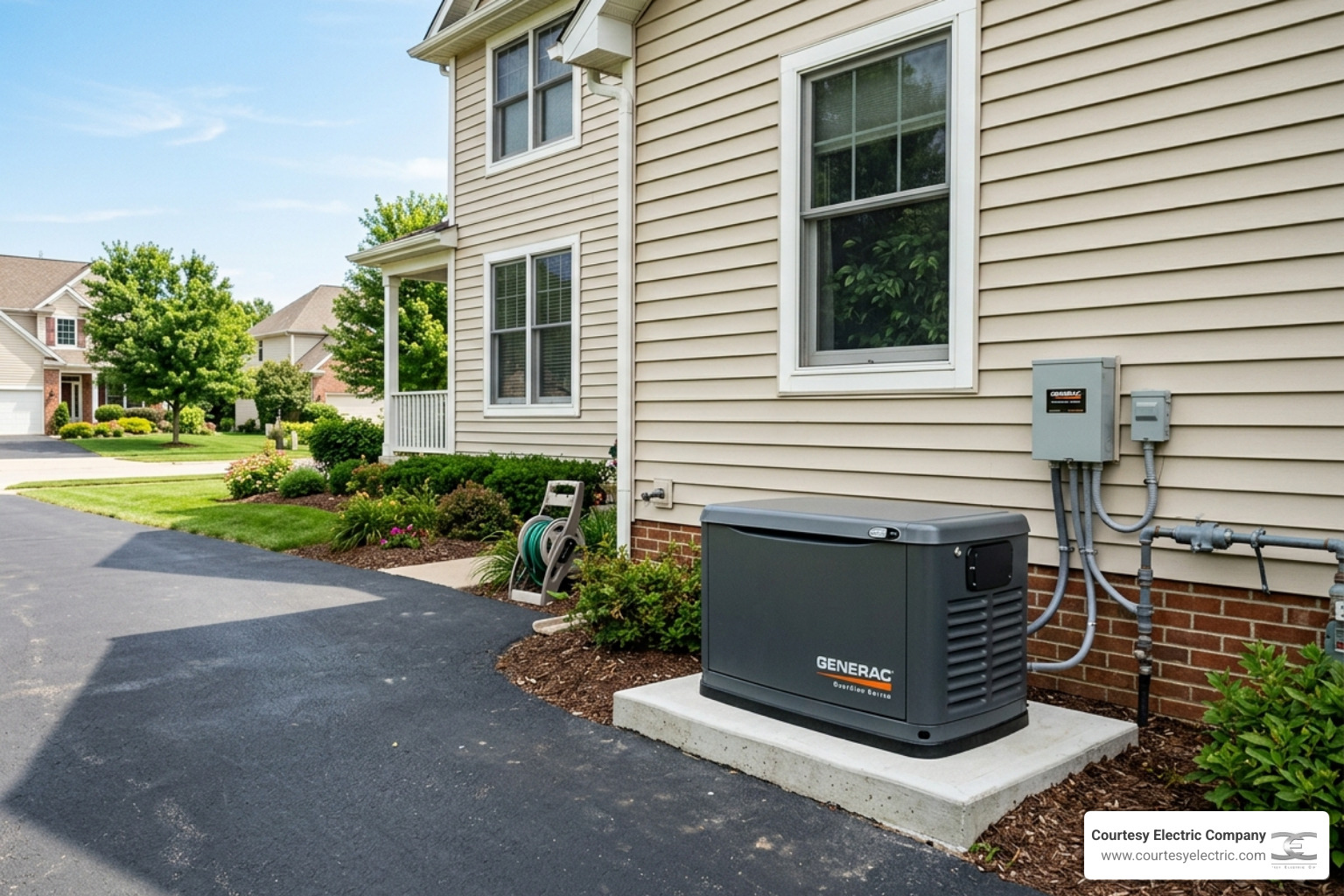
When we talk about a standby generator, we aren’t talking about that noisy machine you pull out of the garage and chain to a tree. A standby generator is a permanent piece of home infrastructure. Much like a central air conditioning unit, it sits on a concrete or composite pad outside your home, housed in a weather-resistant enclosure designed to withstand the brutal Colorado sun and heavy Front Range snow.
These systems are stationary power plants. They are hardwired into your home’s electrical system and connected directly to a fuel source, such as a natural gas line or a large liquid propane tank. This direct connection is what allows them to act as a seamless safety net. For a deeper look at the various types of power solutions available in our region, you can explore our Generators Fraser CO Complete Guide.
Distinguishing Standby from Portable Units
The differences between standby and portable units are night and day. While a portable generator requires you to be home, head outside in the storm, fill it with gasoline, and run extension cords to your fridge, a standby unit is fully autonomous.
- Automatic Start: Standby units use an Automatic Transfer Switch (ATS) to start without human intervention.
- Fuel Supply: Because they use natural gas or propane, there’s no "gas station run" required during a blizzard.
- Circuit Integration: Standby generators can power your entire home—including hardwired items like your furnace, sump pump, and water heater—whereas portables are usually limited to what you can plug into them.
- Wattage Capacity: Standby units offer significantly higher wattage, typically ranging from 7.5 kW to 26 kW for residential use, compared to the much smaller output of most portable models.
How Does a Standby Generator Work to Restore Power?
The magic happens in the sequence. To understand how does a standby generator work, you have to look at it as a conversation between the machine and your home. The system is always "listening" to the utility grid.
When a transformer blows in Highlands Ranch or a line goes down in Parker, the generator doesn't just "turn on"—it executes a programmed operational sequence. Within 10 to 30 seconds, the engine reaches the correct RPM, the alternator begins producing a clean electrical sine wave, and the transfer switch flips the "source" of your home's power from the grid to the generator.
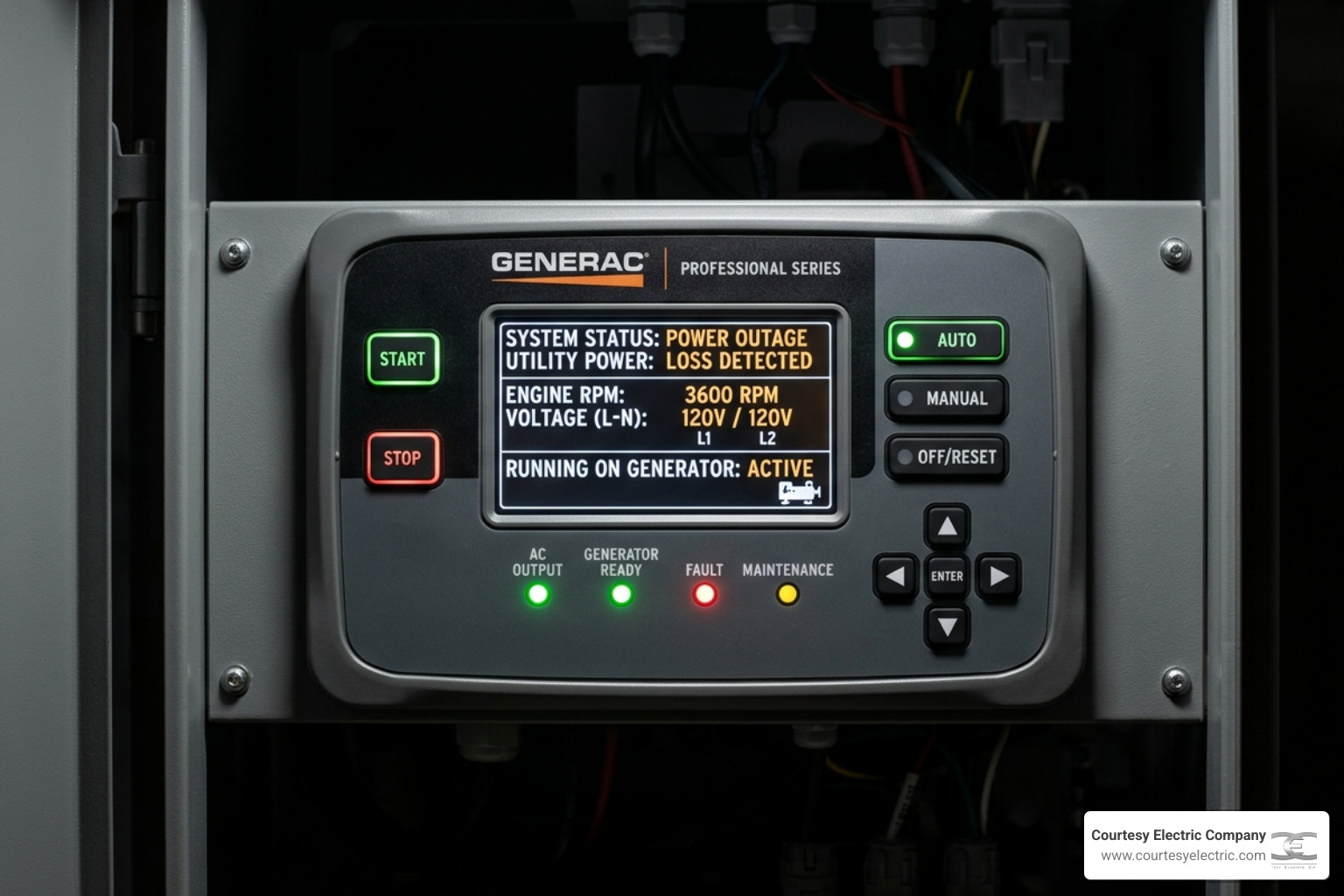
How does a standby generator work to detect a blackout?
The "brain" of the system is the control module. It acts as a 24/7 sentry. Using sophisticated voltage sensors, it continuously monitors the incoming utility power. It isn't just looking for a total blackout; it also watches for dangerous fluctuations or "brownouts" that could damage your sensitive electronics.
When the voltage from the utility drops below a safe threshold, the control module initiates a signal. It processes this data in milliseconds, ensuring that a momentary flicker doesn't trigger a full start-up, but a legitimate outage does.
How does a standby generator work to produce electricity?
Once the engine is humming, the alternator takes over. This is where mechanical energy becomes electrical energy through a process called electromagnetic induction.
Inside the alternator, an internal combustion engine spins a rotor (a moving magnetic field) inside a stator (stationary coils of copper wire). As the magnetic field sweeps across the wires, it forces electrons to move, creating an electrical current.
However, raw electricity isn't safe for your laptop or smart fridge. That’s why modern units from brands like Generac and Cummins include an Automatic Voltage Regulator (AVR). This component ensures the power is steady and "clean," preventing the surges that often occur when utility power is restored.
The Critical Function of the Automatic Transfer Switch (ATS)
If the generator is the heart of the system, the Automatic Transfer Switch (ATS) is the brain. You cannot safely run a standby generator without one. Its primary job is grid isolation.
When the generator starts, the ATS physically disconnects your home from the utility lines before connecting it to the generator. This prevents "back-feeding," a dangerous situation where electricity from your generator travels back into the grid, potentially electrocuting utility workers trying to fix the lines. For more on the technical side of this setup, check out our guide on Generators Installation in Fraser CO.
Managing the Return to Utility Power
The ATS is also responsible for the "handoff" back to the grid. It doesn't switch back the instant it sees a spark of life from the utility company. Instead, it waits for several minutes to ensure the grid power is stable and not just flickering.
Once stability is confirmed, the ATS reconnects your home to the grid. The generator doesn't just stop abruptly; it enters a "cool-down cycle." It runs for about five minutes without a load to let the engine components shed heat gradually. After the cool-down, it shuts off and returns to standby mode, waiting for the next time it's needed.
Essential Components and Fuel Options
To keep your home running during a Colorado winter, several components must work in harmony. The engine (the muscle), the cooling system (to prevent overheating during long summer outages), and the fuel system (the lifeline) are all critical.
We often recommend specific brands because of their reliability in high-altitude environments like the Front Range. You can read more about our preferred systems in the Best Generators Services in Fraser CO article.
Fuel Comparison Table
| Fuel Type | Advantages | Disadvantages |
|---|---|---|
| Natural Gas | Continuous supply; clean-burning; no tank to refill. | Dependent on utility pipelines; slightly lower power output. |
| Propane (LP) | Clean-burning; high energy density; independent of pipelines. | Requires a large on-site tank; needs refilling after long use. |
| Diesel | Very efficient; handles heavy loads; long engine life. | Requires fuel delivery logistics; louder; fuel can degrade over time. |
Sizing Your System for Denver Homes
Sizing a generator is not a "one size fits all" process. If you undersize the unit, it will stall when your AC kicks on. If you oversize it, you're paying for capacity you don't need.
We calculate your needs based on starting wattage vs. running wattage. For example, a 3-ton central air conditioner might only need 5,000 watts to run, but it could require 12,000 watts just to start the compressor. We typically recommend a 20% safety cushion to account for unexpected loads, like someone accidentally turning on the microwave while the dryer is running.
Ensuring Reliability Through Maintenance and Sizing
A standby generator is an investment that can last 15 to 30 years, but only if it’s maintained. Most modern units are programmed to perform a "weekly self-test." This is a 20-minute exercise where the generator starts up and checks its own systems. It’s the equivalent of taking a car for a quick drive to keep the battery charged and the oil circulating.
Routine maintenance is also vital. In Colorado, we recommend professional inspections every six months. This includes changing the oil and filters, checking the spark plugs, and ensuring the battery is healthy enough to start the engine in sub-zero temperatures. For a full checklist, see our Generators Maintenance Guide Fraser CO.
Frequently Asked Questions about Standby Generators
How long does a standby generator last?
With proper care and routine maintenance, a high-quality standby generator can easily last 15 to 25 years. Industrial-grade models can sometimes push 30 years if they aren't subjected to excessive runtimes.
Can a standby generator power my entire house?
Yes. Whole-home generators (typically 20kW to 26kW) are designed to handle everything from your HVAC system and kitchen appliances to your home office and security systems. We can also set up "managed power" systems that prioritize essential circuits if you choose a smaller unit.
Does the generator run automatically when I am not home?
Absolutely. That is the primary benefit of a standby system. Whether you are at work in Denver or on vacation in the mountains, the system will detect an outage and restore power automatically, protecting your home from frozen pipes or spoiled food.
Conclusion
Understanding how does a standby generator work is the first step toward true energy independence. In the Colorado Front Range, where the weather is as unpredictable as the power grid, having a system that thinks for itself can be the difference between a minor inconvenience and a major household disaster.
At Courtesy Electric Company, we’ve been the Denver electrical experts since 1976. We specialize in the installation of Generac and Cummins generators, as well as modern smart home integrations like Franklin battery storage and SPAN panels. We are here to ensure that when the lights go out in your neighborhood, they stay on in your home.
Ready to secure your home’s power? Request expert electrical services in Denver today for a free estimate and let us help you find the perfect backup solution for your family.


