
Why Choosing the Right Backup Power for Colorado Is Different From Anywhere Else

Choosing the right backup power for Colorado means weighing factors that simply don't apply in most other states — extreme altitude, unpredictable winter storms, wildfire-related utility shutoffs, and a grid under growing strain.
Here's a quick guide to help you decide:
| Your Situation | Best Starting Point |
|---|---|
| Frequent short outages, want quiet operation | Battery storage system |
| Multi-day winter outages, whole-home coverage | Standby generator |
| Have or plan to add solar panels | Solar + battery system |
| Budget-conscious, occasional outages | Portable generator or portable battery unit |
| Medical equipment, can't risk any interruption | Standby generator or large battery system |
| Mountain home above 7,000 ft | Upsized standby generator or battery system |
| Energy independence is a priority | Solar + battery system |
When the grid goes dark in Colorado, it's rarely just a minor inconvenience. In 2024 alone, Xcel Energy intentionally cut power to more than 55,000 Front Range customers during high-wind events. Then in December 2025, Public Safety Power Shutoff events left over 100,000 Colorado homes without electricity for up to five days. Add in winter ice storms, mountain snowfall, and one of the highest lightning strike rates in the country, and it becomes clear: backup power in Colorado isn't a luxury — it's a practical necessity.
Colorado also has unique physical conditions that directly affect how backup systems perform. Gas-fired generators lose roughly 4% of their rated output for every 1,000 feet of elevation above sea level. That means a generator that works fine at sea level is already delivering significantly less power when installed in Fort Collins at 5,000 feet — and even less in mountain communities. Battery systems bring their own cold-weather considerations. Every technology choice comes with trade-offs that are amplified by where you live in the state.
I'm David Meyer, Vice President of Courtesy Electric, and with nearly five decades of hands-on electrical contracting experience across Denver and the Colorado Front Range, I've helped hundreds of homeowners navigate choosing the right backup power for Colorado based on their real-world needs — from elevation and home size to energy goals and outage history. In the sections below, we'll break down each backup power option clearly so you can make a confident, informed decision.
Key Factors in Choosing the Right Backup Power for Colorado
When evaluating your backup power options, there is no one-size-fits-all solution. A system that works perfectly for a suburban home in Highlands Ranch might not be the best fit for a property nestled in the Black Forest. To find your ideal match, you must weigh several intersecting factors:
- Outage Duration: Do your local outages typically last for an hour or two, or are you in an area prone to multi-day blackouts after major blizzards?
- Home Size and Electrical Load: Sizing a system to power a large home with multiple air conditioning units, a well pump, and EV chargers requires a different strategy than backing up a compact, energy-efficient townhouse.
- Medical Needs: If anyone in your household relies on life-saving medical equipment, seamless, uninterrupted power transfer becomes your absolute top priority.
- Energy Goals: Are you strictly looking for emergency backup, or do you want to actively manage your daily energy consumption, lower your utility bills, and reduce your carbon footprint?
Understanding these priorities is the first step in the decision-making process. For a comprehensive breakdown of how these technologies stack up side-by-side, explore our detailed guide on Battery Storage vs Generator: Which is Better for Backup.
Why Altitude Matters When Choosing the Right Backup Power for Colorado
One of the most overlooked aspects of choosing the right backup power for Colorado is our geography. Our high altitude has a direct, physical impact on combustion engines. Standby and portable generators rely on oxygen to burn fuel efficiently. As elevation increases, the air becomes thinner, meaning there is less oxygen available for combustion.
This physical reality results in a phenomenon known as elevation derating. Gas-fired equipment loses approximately 4% of its rated output for every 1,000 feet of elevation above sea level.
To put this into perspective:
- At Fort Collins' elevation of approximately 5,000 feet, a generator delivers roughly 20% less power than its manufacturer's nameplate rating.
- In Denver and Parker, sitting around 5,280 feet, you can expect a loss of about 21%.
- In mountain communities at 9,000 feet, the reduction in generator output reaches a staggering 36%.
If you install a generator without accounting for this derating, your system will be severely undersized. It will struggle, overheat, or fail to start when you try to run your essential household appliances during an outage. This is why working with a local Colorado contractor who understands how to size a generator for our thin air is absolutely vital.
How Winter Weather Influences Choosing the Right Backup Power for Colorado
Colorado winters are legendary, bringing heavy snow, ice, and freezing temperatures that can snap power lines in an instant. This freezing weather affects generators and batteries in very different ways.
Standby generators running on natural gas or propane are highly resilient in cold temperatures, provided they are equipped with cold-weather kits (such as battery warmers and oil heaters). However, if you rely on a portable generator that runs on gasoline, freezing temperatures can make manual starting difficult, and storing fresh fuel safely becomes an ongoing chore.
Battery storage systems, on the other hand, are sensitive to extreme cold. Standard lithium-ion chemistries experience reduced efficiency and slower charging rates when exposed to freezing temperatures. To combat this, high-quality battery systems must be installed in a conditioned space, like a basement or a temperature-controlled garage, or feature built-in thermal management systems.
Furthermore, winter weather brings specific solar limitations. Colorado boasts an average of 300 sunny days per year, making solar-plus-storage systems incredibly effective. However, during a multi-day winter storm, your solar panels may be covered in heavy snow, or thick cloud cover might limit their output. If your battery system relies solely on solar panels to recharge during an extended outage, you could find yourself out of power once the battery drains.
To learn more about how these systems perform when the snow starts falling, read our analysis on whether a Generator or Battery for Power Outages: Is a Generator or Battery Better for Power Outages.
Comparing Backup Power Technologies for Front Range Homes
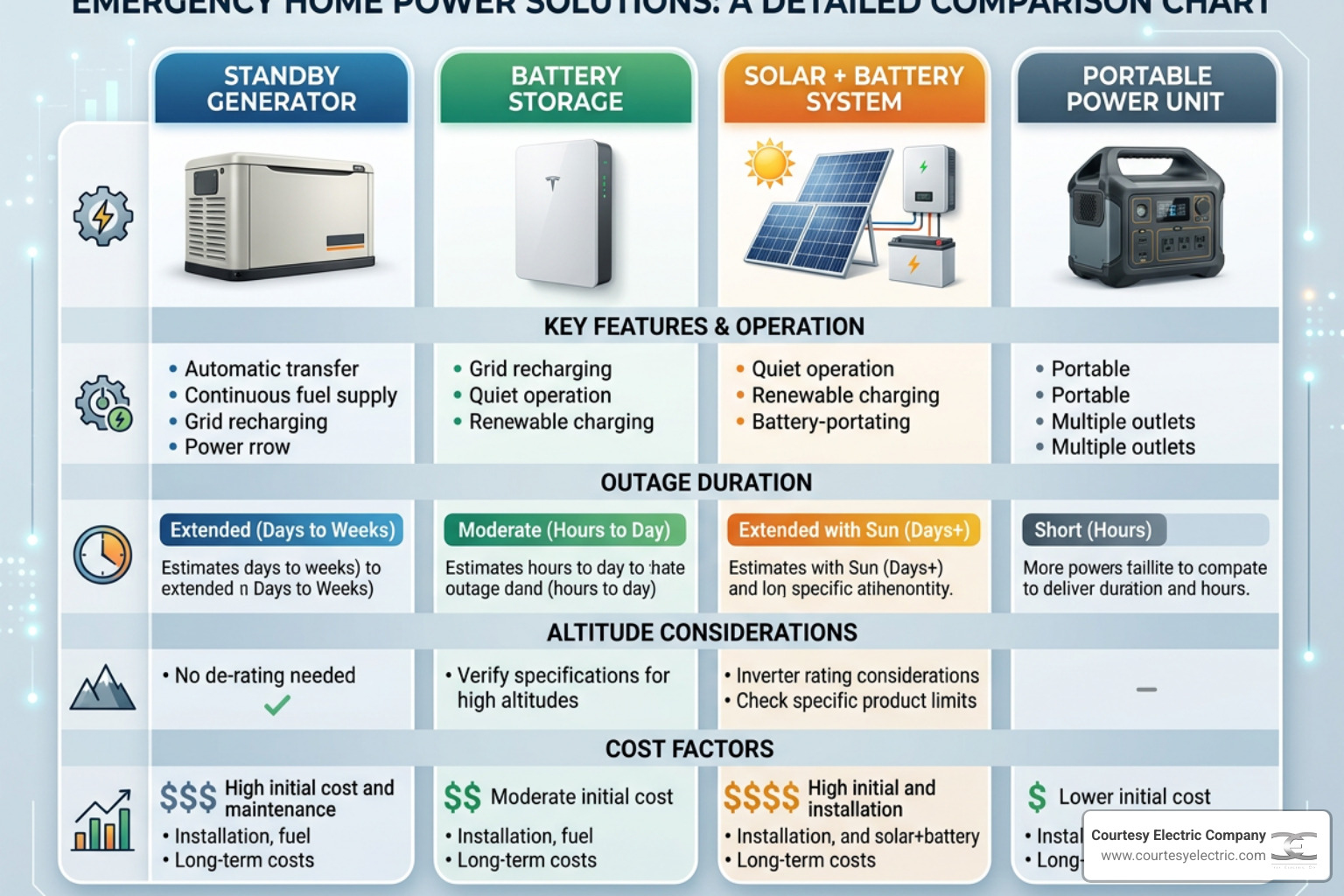
To make the best decision for your home, it helps to understand the full spectrum of backup power technologies available today. Each has distinct advantages and operational profiles.
- Standby Generators: Permanently installed outside, these systems connect directly to your home’s electrical panel and natural gas or liquid propane line. They feature an automatic transfer switch (ATS) that detects a utility failure and restores power to your home within seconds.
- Battery Storage Systems: These silent, emissions-free systems store electricity from the grid or your solar panels. When the grid goes down, they instantly discharge power to your home.
- Solar-Plus-Storage: By pairing solar panels with a battery system, you create a self-sustaining microgrid. The solar panels power your home and recharge the battery during the day, while the battery keeps your lights on through the night.
- Portable Units: Smaller, manual systems like portable gas generators or portable power stations (such as EcoFlow or Jackery) offer a lower-cost entry point. They require manual setup, running extension cords, or using a manual transfer switch.
- Vehicle-to-Home (V2H): An emerging option where compatible electric vehicles (like the Ford F-150 Lightning or Chevrolet Silverado EV) use bidirectional charging to feed power from the vehicle's massive battery pack back into your home's electrical system.
| Feature | Standby Generator | Battery Storage (Grid-Charged) | Solar-Plus-Storage | Portable Gas Generator | Vehicle-to-Home (V2H) |
|---|---|---|---|---|---|
| Fuel Source | Natural Gas / Propane | Grid Electricity | Solar Energy / Grid | Gasoline | EV Battery |
| Runtime | Indefinite (with fuel supply) | Limited to battery capacity | Potentially indefinite (weather permitting) | Limited by fuel on hand | 3 to 10 days (depending on use) |
| Noise Level | Moderate (60-70 decibels) | Silent | Silent | Loud | Silent |
| Maintenance | High (regular oil/filter changes) | Low (software updates) | Low | High (fuel stabilization) | Low |
| Automatic Startup | Yes (under 10 seconds) | Yes (instantaneous) | Yes (instantaneous) | No (manual setup) | No (manual connection) |
For a deeper dive into the financial and operational trade-offs of these systems over time, check out our Standby Generator vs Battery Backup Cost Comparison.
Standby Generators and Altitude Derating
Standby generators remain the gold standard for continuous, high-output backup power, particularly during extended winter outages. Because they hook up directly to your natural gas line or a large propane tank, they do not require manual refueling.
However, as we discussed, combustion engines require careful calibration for Colorado's altitude. When we install a Generac or Cummins standby generator along the Front Range, we must perform precise calculations to offset the elevation derating. This often means specifying a generator with a larger engine capacity than would be required for an identical home at sea level.
For example, a home that requires a 20 kW generator at sea level might need a 24 kW or 26 kW unit in Parker or the Black Forest to safely handle the same electrical load. To explore how standby generators perform in specific mountain climates, see our Generators Fraser Co Complete Guide and learn about the Whole Home Generator Benefits for Colorado Homeowners.
Battery Storage Systems and Solar Integration
Battery storage systems, particularly those utilizing Lithium Iron Phosphate (LFP) chemistry, have surged in popularity across Denver and the Front Range. Systems like Franklin Battery Storage or the Tesla Powerwall 3 offer seamless transitions during power outages—switching over in less than 20 milliseconds, which is fast enough to prevent computers from resetting or digital clocks from flashing.
When integrated with solar panels, these batteries unlock true energy independence. Instead of sending your excess solar generation back to the grid for a basic credit, you can store that energy to use during peak evening hours when utility rates are at their highest. This practice, known as Time-of-Use (TOU) arbitrage, allows you to actively lower your monthly electric bills even when the grid is functioning perfectly.
To see how battery storage works in specific Front Range neighborhoods, check out our Battery Storage Guide Centennial Co and read these practical Battery Storage Installation Fraser Co Tips.
Sizing Your System: Whole-Home vs. Critical Circuits
One of the most important decisions you'll make when choosing the right backup power for Colorado is determining how much of your home you actually want to power during an outage.
- Whole-Home Backup: This approach is designed to keep your entire house running exactly as it does under normal conditions. You can run your central air conditioning, use your electric oven, charge your EV, and run the clothes dryer all at once. This requires a large standby generator or a stacked, multi-battery storage system.
- Critical Circuits Backup: This is a more focused, cost-effective strategy. Instead of backing up every single outlet, we isolate your most essential loads onto a dedicated subpanel (or manage them via a smart panel).
For most Colorado homeowners, critical circuits include:
- The heating system (furnace blower or boiler pumps)
- Refrigerator and freezer
- Well pump (essential for properties in areas like the Black Forest)
- Internet router and charging outlets for phones and laptops
- A few key lighting circuits and a bathroom outlet
By focusing strictly on these essential loads, you can significantly reduce the size, complexity, and initial investment of your backup system. To explore how to manage your home's electrical loads dynamically, take a look at the Energy Management Options for Colorado Homes.
Sizing for High-Performance and Energy-Efficient Homes
If you live in a high-performance or energy-efficient home, such as a Passive House, the math behind sizing your backup power changes dramatically. These homes feature superior insulation, airtight building envelopes, and high-efficiency appliances that can reduce total energy consumption by 60% to 80% compared to a conventional home of the same size.
Because these homes require very little energy to heat or cool, they don't need massive generators or extensive battery banks. A single battery storage unit or a highly compact standby generator is often more than enough to keep a high-performance home comfortable for days during a winter storm.
Pairing these efficient homes with a smart electrical panel, like SPAN, allows you to monitor and control your circuits in real time from your phone, dynamically shedding non-essential loads to stretch your backup power even further. Discover how these modern systems work by reading about How Energy Management Reduces Your Electric Bill.
Environmental Impact, Noise, and Maintenance Differences
Beyond power capacity, the daily reality of owning and maintaining your backup system should play a major role in your decision.
- Noise Levels: Standby generators are powered by internal combustion engines and typically produce 60 to 70 decibels of noise during operation—similar to a loud vacuum cleaner or a lawnmower. If you live in a suburban neighborhood with close neighbors or strict HOA rules, noise can be a major issue. Battery storage systems are completely silent, making them ideal for dense residential areas.
- Emissions and Carbon Footprint: Generators burn fossil fuels, releasing carbon monoxide and greenhouse gases. A standard natural gas standby generator can emit significant amounts of carbon dioxide during an extended run. Battery systems produce zero localized emissions and, when paired with solar, help reduce your home's overall carbon footprint.
- Maintenance Requirements: Standby generators are complex mechanical systems that require regular, hands-on maintenance. They must self-test weekly to keep their parts lubricated, and they require professional oil and filter changes every 6 to 12 months (or after every 100-200 hours of continuous operation). Battery storage systems are solid-state devices that require virtually no routine physical maintenance aside from occasional automatic software updates.
Local Requirements, Permits, and Incentives in Colorado
Installing a backup power system along the Front Range requires navigating local building codes, municipal permitting, and utility regulations. For example, local jurisdictions have strict rules regarding where a standby generator can be placed on your property—often requiring it to be positioned at least five feet from any home opening (such as windows and doors) and set back from property lines to comply with local noise ordinances.
Fortunately, Colorado offers several programs to help offset the initial investment of upgrading your home's electrical infrastructure and adding backup resilience. While the federal tax credit structure changed at the start of 2026, making standalone battery systems installed in 2026 or later ineligible for the older Section 25D credit, Colorado homeowners can still take advantage of valuable state-level incentives.
These include the Colorado state tax credit for eligible energy storage equipment, local municipal rebates, and utility-specific programs like Xcel Energy's Renewable Battery Connect. This program allows you to earn ongoing incentives by allowing the utility to pull power from your battery during periods of peak grid demand. To find out what programs are active in your area, read our guide on Colorado Energy Rebates for Electrical Upgrades.
Frequently Asked Questions About Colorado Backup Power
Can solar panels power my home during an outage without a battery?
No. Standard grid-tied solar systems are designed to automatically shut down when the grid goes offline. This is a crucial safety regulation designed to prevent your solar panels from backfeeding electricity into downed power lines, which could severely injure or kill utility technicians working to restore power. To run your home on solar energy during an outage, your panels must be paired with a battery storage system or a grid-forming inverter.
How does Colorado's high altitude affect standby generators?
Because the air is thinner at higher elevations, combustion engines cannot pull in as much oxygen, which reduces their power output. Standby generators lose roughly 4% of their capacity for every 1,000 feet above sea level. When installing a system in Denver, Parker, or the surrounding mountain areas, the generator must be upsized and properly calibrated during installation to ensure it can handle your home's electrical load.
Are battery backup systems safe to install indoors?
Yes. Modern residential battery storage systems, such as Franklin Battery Storage, utilize Lithium Iron Phosphate (LFP) chemistry, which is highly stable and resistant to thermal runaway. Because batteries do not burn fuel, they produce zero emissions or carbon monoxide, making them completely safe for indoor installation in a basement, utility closet, or garage.
Conclusion
Choosing the right backup power for Colorado requires finding the perfect balance between local weather patterns, your home's elevation, your family's daily electrical needs, and your long-term energy goals. Whether you opt for the raw, continuous power of a Generac or Cummins standby generator, the silent efficiency of a Franklin battery storage system, or a smart panel upgrade with SPAN, having a reliable plan in place is the key to weathering the next Front Range storm with confidence.
At Courtesy Electric Company, we have been serving the Denver metro area and the Colorado Front Range since 1976. As a trusted local contractor, we specialize in end-to-end design and professional installation of residential electrical systems, standby generators, and battery storage solutions.
Ready to secure your home's power supply? Schedule a consultation with Courtesy Electric Company today for a free estimate on your backup power installation.


