
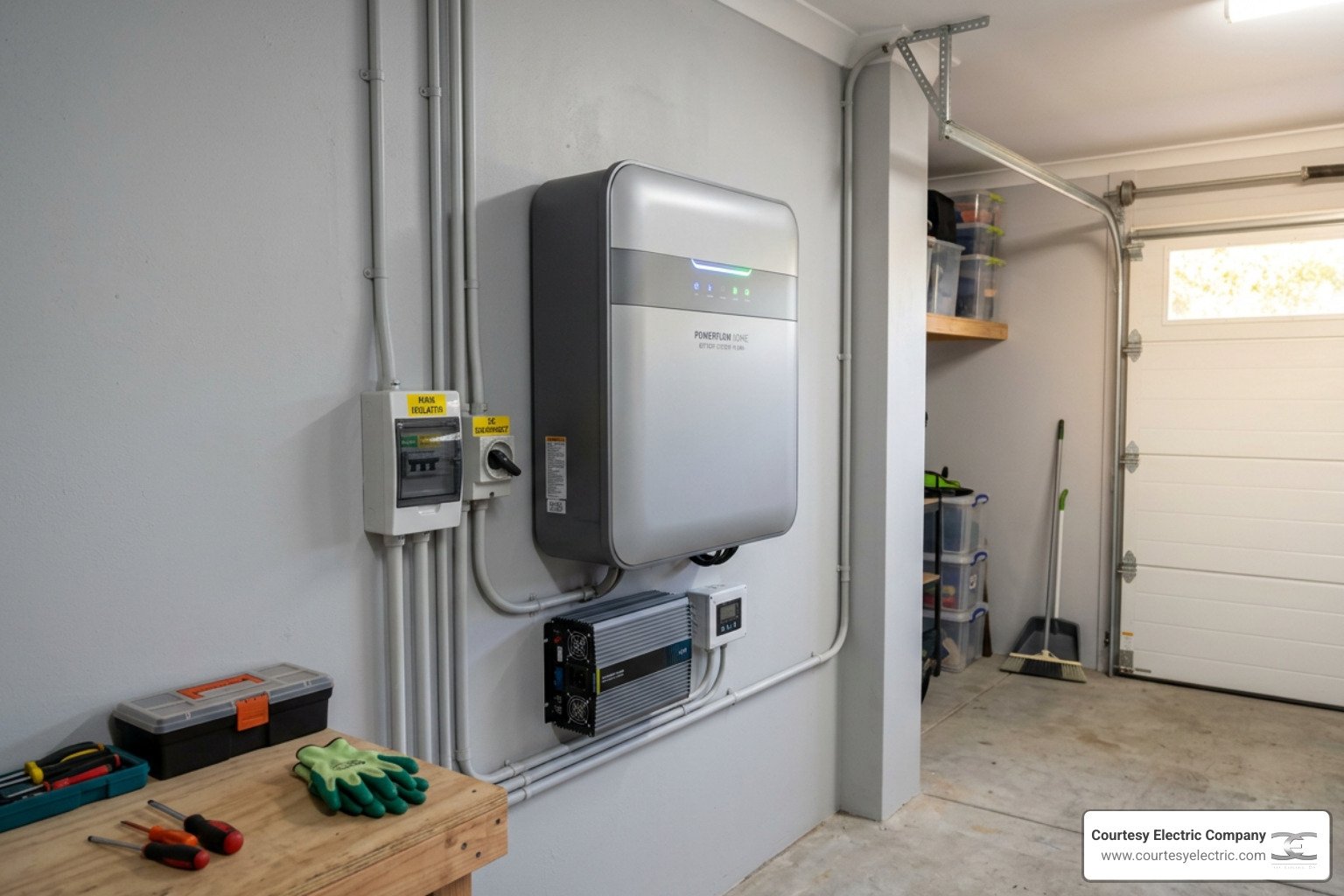
What to Expect From Home Battery Storage Installation: A Quick Overview

If you're researching home battery storage installation what to expect, here's a quick summary before we dive into the details:
What happens during a home battery storage installation:
- Site assessment - A licensed electrician evaluates your electrical panel, energy usage, and the best mounting location for the battery.
- System design and permitting - Your installer pulls the required electrical permits and files utility interconnection paperwork.
- Electrical upgrades (if needed) - Your main panel may need an upgrade or a critical loads panel may be added.
- Physical installation - The battery is mounted, wired, and integrated with your electrical system — typically taking 1 to 2 days on-site.
- Commissioning - The system is tested, firmware is updated, and your monitoring app is set up.
- Inspections and utility approval - A local inspector signs off, and your utility grants Permission to Operate (PTO).
- System activation - Your battery goes live and begins protecting your home.
Total timeline from contract to operation: roughly 4 to 12 weeks, depending on permitting speed and equipment lead times in your area.
Home batteries have shifted from a niche upgrade to a genuinely practical investment for Colorado homeowners. Whether you're trying to protect your family from the Front Range's unpredictable weather, reduce your dependence on the grid, or get more value from a solar array, a battery storage system can do all three. But the installation process involves more moving parts than most homeowners expect — permits, load calculations, utility approvals, and multiple site visits all happen before your system ever powers a single light bulb.
That's not a reason to hesitate. It's a reason to go in prepared.
I'm David Meyer, Vice President of Courtesy Electric Company, and I've spent my career in the field working on electrical systems — including battery wall installations and backup energy systems across Denver and the Colorado Front Range. Understanding home battery storage installation what to expect at every stage is exactly what this guide is built to help you with, so let's walk through the full process together.

Pre-Installation: Site Assessment and System Sizing
The physical installation day is actually the middle of the journey. The real work begins with a detailed evaluation of your home's unique energy footprint. Every house is wired differently, and every family has different power priorities.

A successful setup relies on a thorough site assessment and load evaluation. When we look at a home's readiness for storage, we inspect the main electrical panel capacity, the physical space available for the battery, and how the existing electrical infrastructure is configured.
If you are planning to keep your home running smoothly through a winter blizzard or a summer grid failure, you need a clear baseline of your current electrical environment. This baseline helps us determine whether your home can support modern energy storage right away or if it requires minor foundational upgrades first. You can read more about how these systems function in our comprehensive Battery Storage Guide Centennial Co.
Additionally, integrating energy storage is often the first step toward a fully optimized home. Modern storage does not just sit in standby mode waiting for a blackout; it actively manages your power. Integrating storage with your home's systems offers significant advantages, which we discuss in our breakdown of Energy Management System Benefits for Homeowners.
Preparing Your home battery storage installation what to expect During the Site Visit
During the pre-installation site visit, a specialized technician or master electrician will spend roughly 30 to 60 minutes evaluating your home. Here is exactly what we focus on during this visit:
- Load Calculations: We review your historical energy bills to calculate your average daily kilowatt-hour (kWh) consumption.
- Electrical Panel Capacity: We check your main service panel to see if it is rated for 100 amps, 200 amps, or more, and determine if there is physical space for new breakers.
- Physical Placement Planning: We identify the optimal location for the battery—typically a garage, utility room, or a protected exterior wall that stays within recommended operating temperatures.
- Smart Panel Integration: We evaluate whether your home would benefit from a smart electrical panel, such as a SPAN panel, which allows you to dynamically manage which circuits are backed up on the fly.
Upgrading your panel or installing a smart energy management system alongside your battery can qualify you for significant federal incentives. To understand how these incentives can help offset the cost of your project, take a look at our guide on Federal Tax Credits for Battery Storage and Span Panels.
Determining the Right Battery Size and Backup Configuration
Sizing a battery system is not about matching the total square footage of your home; it is about matching your specific backup goals. During this phase, we help you choose between two primary paths:
- Essential Loads Backup: This configuration powers only your critical circuits—such as your refrigerator, internet router, heating system controls, water pumps, and select lights and outlets.
- Whole-Home Backup: This configuration is designed to run your entire house, including heavy-draw appliances like central air conditioning, electric clothes dryers, and vehicle chargers.
To determine the right size, we look at three critical technical metrics:
- Usable Capacity (measured in kWh): This is the total amount of electricity stored in the battery that your home can actually use. For example, a typical modern battery provides around 13.5 kWh of usable storage.
- Continuous Power Output (measured in kW): This is the maximum amount of electricity the battery can deliver constantly. This determines how many appliances you can run at the exact same time.
- Peak Power Output (measured in kW): This is the brief burst of power the battery can provide for a few seconds to start up motorized appliances, such as a well pump or refrigerator compressor.
If you are trying to decide whether a chemical battery or a traditional fuel-powered system is better suited for your family's needs, you can find a direct comparison in our article Battery Storage vs Generator Which is Better for Backup.
The Step-by-Step home battery storage installation what to expect
Once the engineering design is finalized and the permits are approved, the actual installation can begin. For most homes in the Denver metro area, the physical work on-site takes between 1 and 3 business days, depending on the complexity of your electrical setup.
Our installation teams follow a highly structured, step-by-step process to ensure every wire, conduit, and connection is perfectly executed. If you want to see a detailed breakdown of local installation timelines, check out our Battery Storage Installation Guide Centennial Co.
For many of our clients, we recommend high-performance systems like the FranklinWH energy storage solution. To understand why this particular technology is highly suited for Colorado's climate, read our overview of Franklin Battery Storage Benefits Explained.
Phase 1: Electrical Infrastructure and Panel Upgrades
The first day of the physical installation focuses almost entirely on your home's electrical infrastructure. Before the battery can be mounted, we must prepare the path for power to flow safely.
- Installing the Automatic Transfer Switch (ATS) / Gateway: This intelligent device acts as the brain of your system. It constantly monitors the utility grid. If it detects a grid failure, it disconnects your home from the utility lines in less than 100 milliseconds, preventing dangerous electrical backfeeding and instantly switching your home to battery power.
- Wiring the Critical Loads Panel: If you are not opting for a smart panel or whole-home backup, we will install a secondary sub-panel. We then physically move the wires for your essential appliances (fridge, lights, furnace fan) from your main panel into this new backup panel.
- Main Panel Upgrades: In some older Front Range homes, the existing main service panel must be upgraded to safely handle the bidirectional power flow of a battery system.
These foundational electrical upgrades can often be paired with state-specific financial programs. You can explore these opportunities in our guide to Colorado Energy Rebates for Electrical Upgrades.
Phase 2: Mounting, Wiring, and Integration
With the electrical infrastructure prepared, the team moves on to installing the actual battery units.
- Physical Mounting: Home batteries are incredibly heavy, often weighing several hundred pounds. We secure heavy-duty mounting brackets directly into your wall studs (usually in the garage or on an exterior wall). The battery enclosures are then lifted and locked into place.
- Conduit Routing and Wiring: We run heavy-duty, weather-resistant conduit between the battery units, the system inverter, and your main electrical panels.
- Integrating the Inverter: The battery inverter converts the Direct Current (DC) stored in the battery into the Alternating Current (AC) used by your home's appliances.
- Utilizing LFP Technology: Most modern home batteries utilize Lithium Iron Phosphate (LFP) chemistry. LFP has become the industry standard because it is highly stable, resists thermal runaway, and offers a significantly longer lifespan than older battery chemistries.
For a closer look at how these components come together in mountain and foothill communities, see our Battery Storage Fraser Co Complete Guide.
Permitting, Inspections, and System Commissioning
After the physical components are mounted and wired, the system cannot simply be turned on. There is a vital phase of safety checks, local inspections, and utility approvals that must be completed.
Because home batteries handle massive amounts of electrical energy, safety is our absolute highest priority. Every step of the physical installation must comply with the National Electrical Code (NEC) and local municipal guidelines. For general safety practices every homeowner should be familiar with, read our list of Electrical Safety Tips Every Homeowner Should Know.
Post-Physical home battery storage installation what to expect During Commissioning
Once the wiring is complete, our technicians perform a process called "commissioning." This is where we bring the system to life in a controlled environment:
- System Testing: We perform a simulated power outage (a "ride-through" test) by physically disconnecting your home from the grid. We verify that the gateway detects the outage instantly and transfers your home's power source to the battery without your lights even flickering.
- Firmware Updates: We connect the battery system to your home's Wi-Fi network and download the latest manufacturer firmware updates to ensure optimal performance, security, and battery management.
- Monitoring App Setup: We help you download the system's mobile app on your phone. This app allows you to see real-time solar production, battery charge levels, and home energy consumption.
- The Inspection and PTO Process: We coordinate with your local building department (such as Denver, Parker, or Highlands Ranch) to schedule a physical safety inspection. Once the inspector signs off, we submit the final paperwork to your utility provider (such as Xcel Energy or CORE Electric Cooperative) to secure your official Permission to Operate (PTO).
To learn more about how this commissioning process works in specific Colorado service areas, you can read our localized article on Battery Storage in Granby Co.
Frequently Asked Questions About Battery Storage
Do I need to be home during the installation, and how disruptive is it?
You do not need to stand next to the technicians all day, but we do require an adult to be home for at least part of the installation. We will need access to your garage, main electrical panel, and occasionally your home's interior to route communication wires or set up the monitoring system.
In terms of disruption, the physical mounting of the battery involves some drilling into studs, which creates moderate noise. The most significant disruption occurs when we connect the new gateway and battery system to your main electrical panel. This requires us to temporarily shut down power to your entire house. We always coordinate this power interruption with you in advance, and it typically lasts between 2 and 4 hours on the main installation day.
Can I install a battery without solar panels?
Yes, you absolutely can. Installing a battery without solar panels is called a "standalone battery installation." In this configuration, the battery charges directly from the utility grid when electricity rates are low (usually overnight).
Once charged, the battery can be used in two ways:
- Time-of-Use (TOU) Optimization: The system discharges the stored, inexpensive power into your home during peak evening hours when utility rates are at their highest, saving you money on your monthly bill.
- Backup-Only Mode: The battery remains at 100% capacity, waiting silently to protect your home the moment a storm or grid failure causes a power outage.
What ongoing maintenance and warranties should I plan for?
Modern lithium iron phosphate (LFP) home batteries are solid-state systems, meaning they have no moving parts and require virtually no active maintenance. You do not need to water them, vent them manually, or perform regular service calibrations. We recommend a simple visual inspection once a year to ensure the cooling vents remain free of dust, debris, or spiderwebs.
Most premium battery systems come with a robust 10-year to 15-year manufacturer warranty. These warranties typically guarantee that the battery will retain at least 70% of its original energy capacity at the end of the warranty period. The physical product lifespan of an LFP battery is often much longer, frequently delivering reliable service for 15 to 20 years before gradual capacity degradation becomes noticeable.
Conclusion
Investing in a home battery system is one of the most effective ways to take control of your home's energy management, secure reliable backup power, and protect your family from grid instability. While the process involves detailed engineering, precise electrical craftsmanship, and strict local permitting, working with an experienced team makes the entire journey seamless.
At Courtesy Electric Company, we have been serving homeowners across Denver, Highlands Ranch, Parker, Black Forest, and the wider Colorado Front Range for decades. Our team specializes in end-to-end management of your battery project—from the initial load calculations and custom system design to the physical mounting, smart panel integration, and final utility commissioning.
If you are ready to explore how a battery storage system can benefit your home, Schedule a residential electrical consultation with Courtesy Electric Company today. We will provide a clear, professional evaluation of your home's electrical system and help you design a backup power solution built to last.


