Is Smart Energy Management Worth It Over a Traditional Panel?

When comparing smart energy management vs traditional panel setups, here is the short answer most Colorado homeowners need:
| Feature | Smart Panel | Traditional Panel |
|---|---|---|
| Real-time energy monitoring | Yes, per circuit | No |
| Remote control via app | Yes | No |
| Load shedding / prioritization | Automatic | Manual (breaker only) |
| Solar & battery integration | Native, optimized | Possible, but limited |
| EV charger management | Dynamic, automatic | Static, may need upgrade |
| Outage backup control | App-based circuit priority | Requires rewiring changes |
| Works without internet | Yes, as a standard panel | Yes (always) |
| Upfront cost | Higher | Lower |
| Best for | Homes with solar, batteries, EVs, or high loads | Simple homes with stable, low electrical demand |
Bottom line: If your home runs on gas appliances and has no plans for solar, batteries, or an EV charger, a traditional panel still works fine. But if you are adding high-draw devices or want real control over how your home uses power, a smart panel pays for itself in ways a traditional breaker box simply cannot.
Most homeowners only think about their electrical panel when a breaker trips. For decades, that was fair — the traditional breaker box was designed for a simpler era, when homes ran on a predictable mix of lights, outlets, and gas appliances. But residential electricity use in the U.S. has increased 15 times over since 1950, and today's homes are a different story entirely. EV chargers, heat pumps, solar arrays, battery storage systems, and smart appliances are all competing for power through the same panel that was never designed to manage them.
That shift is exactly why smart energy management has moved from a niche upgrade to a practical necessity for many Colorado Front Range homeowners. The question is no longer just "does my panel have enough capacity?" It is "can my panel think?"
I'm David Meyer, Vice President of Courtesy Electric — a Colorado electrical contractor with nearly 50 years of experience helping Front Range homeowners navigate exactly these kinds of decisions, including smart energy management vs traditional panel upgrades for homes adding solar, battery storage, and EV charging. Let me walk you through everything you need to know to make the right call for your home.
What is a Smart Electrical Panel and How Does It Work?
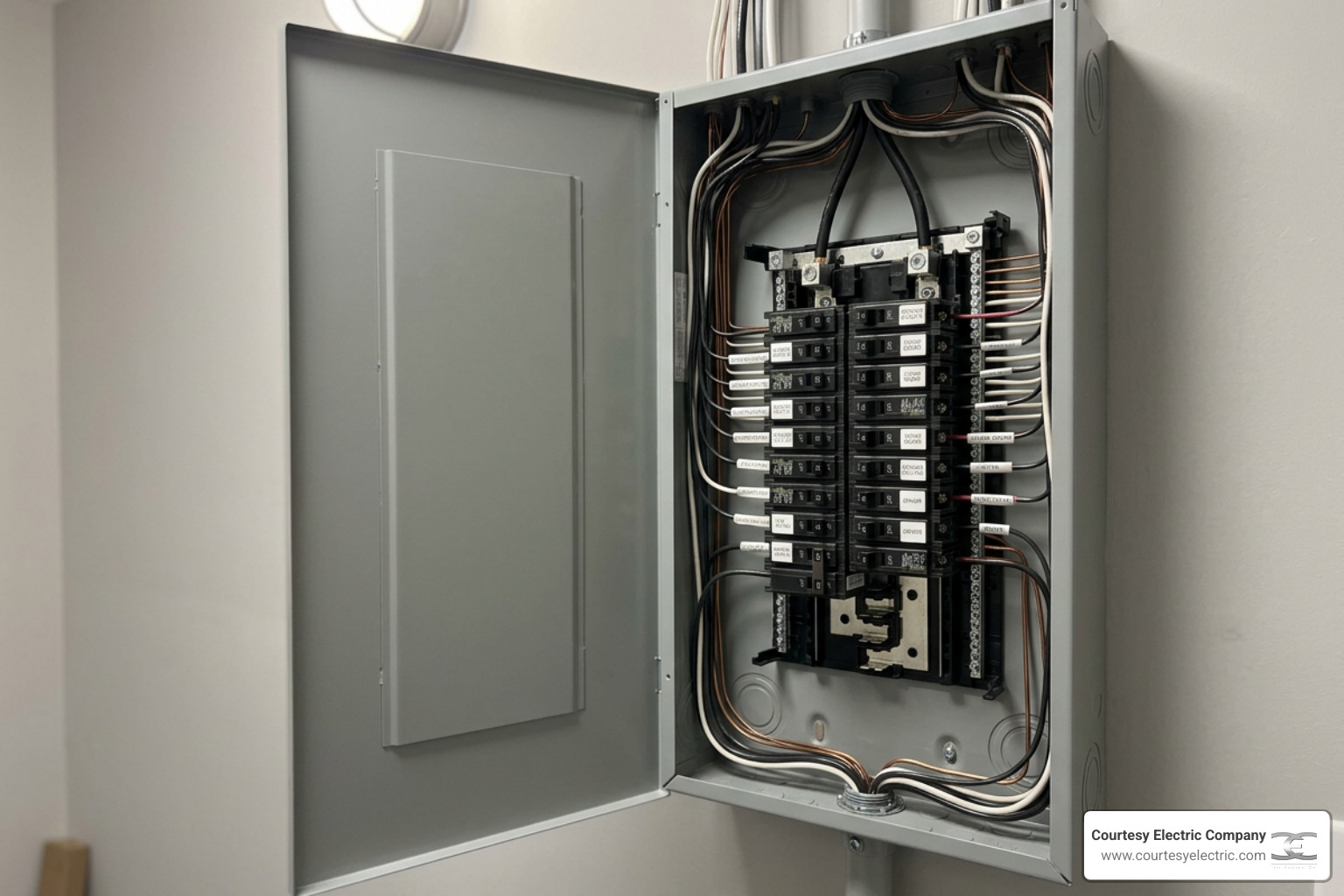
To understand a smart electrical panel, it helps to look at what the traditional version does. A standard breaker box is a passive safety device. Its primary job is to distribute utility power to the various circuits in your home and trip (shut off power) if a circuit draws too much current, protecting your wiring from overheating and causing a fire. It is completely reactive, mechanical, and silent until something goes wrong.
A smart electrical panel, by contrast, is an active energy controller. It serves as the "central nervous system" of your home's electrical network. While it still contains physical, code-compliant breakers to protect your home from overloads, it integrates advanced hardware and software that allow you to monitor and control every single circuit in real time.
At the heart of a smart panel is Wi-Fi, cellular, or Ethernet connectivity. This allows the panel to communicate directly with an app on your smartphone. Instead of guessing which appliances are draining your power, you can open your phone and see exactly how many watts your air conditioner, refrigerator, or entertainment center is drawing at any given second.
This level of insight is crucial for modern homeowners trying to pinpoint phantom loads—those sneaky appliances that draw power even when turned off. For a deeper look at managing these individual loads, you can read our guide on How to Track and Control Energy Use Room by Room.
Beyond simple monitoring, a smart panel gives you digital circuit control. This means you can remotely toggle individual circuits on or off from anywhere in the world. If you leave for a summer vacation in the mountains and realize you left a high-draw appliance running, you do not have to drive back to Parker or Highlands Ranch to flip the physical switch; you simply tap a button in your app.
Smart Panel Sub-Types and Modular Options
If you are considering upgrading your home's energy infrastructure, you do not necessarily have to replace your entire electrical setup. There are several ways to introduce smart energy management to your home, depending on your current system and long-term goals:
- Full Smart Panel Replacement: This is the gold standard for home electrification. You completely remove your old breaker box and install a fully integrated smart panel, such as a SPAN panel. This replaces your entire main service panel, giving you smart monitoring and control over every single circuit in your home from day one.
- Smart Sub-Panels: If your main panel is in good physical shape but you want to isolate and manage a specific group of high-load circuits—such as your EV charger, heat pump, and solar battery storage—we can install a smart sub-panel. This sits next to your existing panel and handles dynamic load management for those critical systems.
- Smart Breaker Systems: Some manufacturers offer load centers where the "smarts" live inside the individual breakers rather than the panel enclosure itself. You install a compatible panel and populate it with smart, connected breakers. While flexible, this option can require a significant layout of specialized parts.
- Retrofit Add-On Modules: For homeowners who want smart features without replacing their existing panel, modular add-on controllers can be wired directly into your current breaker box. These modules use current transformers (CT clamps) to monitor electricity flow and physically interrupt specific circuits when commanded, offering a middle-ground solution.
Smart Energy Management vs Traditional Panel: Key Differences
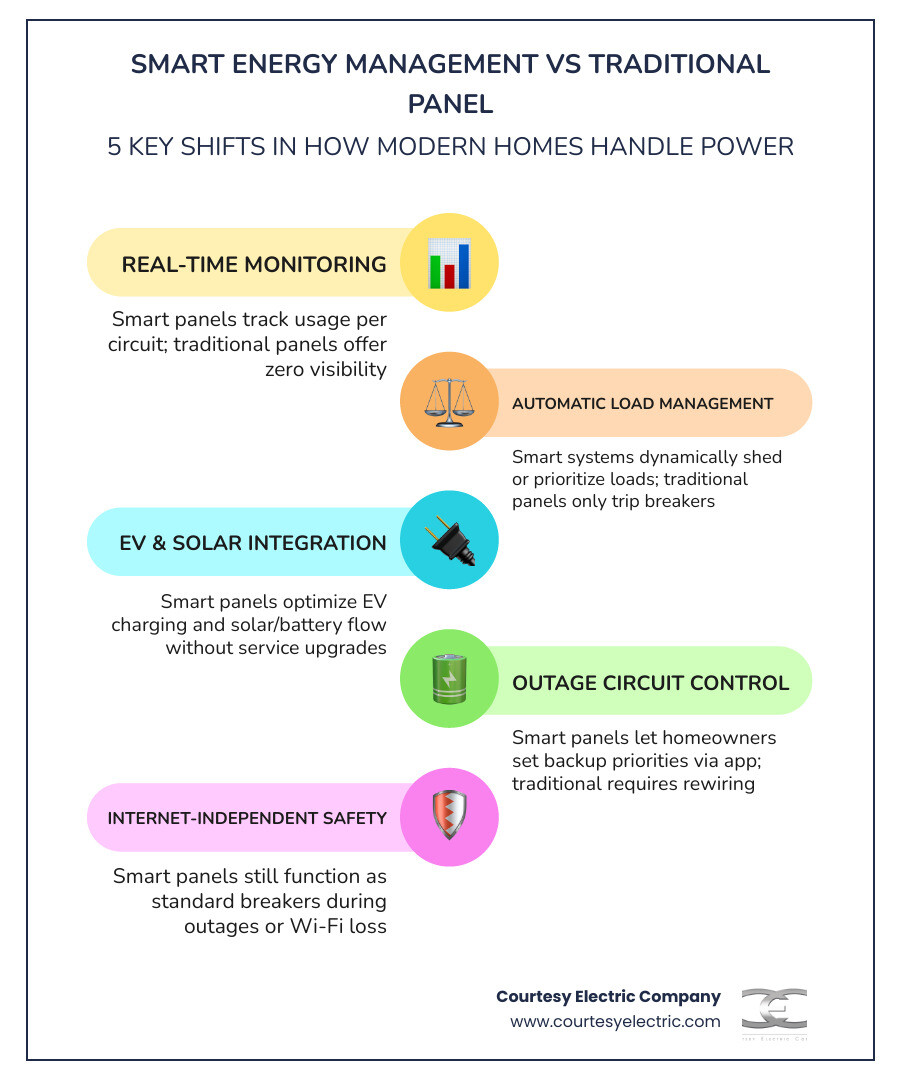
When evaluating smart energy management vs traditional panel systems, the differences come down to active intelligence versus passive distribution. A traditional panel is a gatekeeper; a smart panel is a traffic controller.
Traditional breaker boxes operate on static limits. If you have a 100-amp or 200-amp service, you cannot exceed that total draw at any one time without tripping your main breaker. If you run your electric dryer, your range, your air conditioner, and your EV charger simultaneously, a traditional panel has no way to balance that load. It simply trips, leaving you in the dark.
A smart panel manages this through automated load shedding and circuit prioritization. You can program the panel to recognize when your home is approaching its maximum capacity. If the total demand gets too high, the smart panel will automatically pause non-essential circuits—like your EV charger or guest bedroom outlets—until your high-draw appliances finish their cycle. Once the load drops, it seamlessly restores power to those paused circuits without you ever having to walk down to the basement.
This level of control offers incredible advantages for home efficiency and budget management. To explore these benefits further, check out our article on Energy Management System Benefits for Homeowners.
Additionally, smart panels are designed for bidirectional energy flow. Traditional panels were built assuming electricity only flows one way: from the utility grid into your home. In a modern Colorado home equipped with solar panels and battery storage, electricity flows in multiple directions. A smart panel acts as a digital gatekeeper, safely coordinating power from the grid, your solar array, and your battery backup, ensuring that you never backfeed power dangerously onto the grid during a local utility outage.
Integrating Solar, Battery Storage, and EV Chargers
In the Denver metro area and across the Front Range, residential solar and battery storage systems have transitioned from luxury upgrades to standard home features. Colorado's abundant sunshine makes solar incredibly productive, but managing that power efficiently requires modern infrastructure.
When you pair solar panels and a home battery—like a Franklin Battery Storage system—with a traditional electrical panel, you are forced to make hard compromises. Because a traditional panel cannot dynamically manage loads during an outage, your electrician must install a dedicated "critical loads" sub-panel. During the installation, you must choose a handful of essential circuits (usually your refrigerator, some lights, and a few outlets) to wire into this sub-panel. If the power goes out, only those pre-wired circuits will receive battery power. If you want to change your mind during a winter storm in Black Forest and power your home office instead of the guest bedroom, you are out of luck without a physical visit from an electrician.
A smart panel completely eliminates this limitation. By integrating natively with your solar inverter and Franklin battery system, a smart panel allows you to adjust your backup priorities on the fly through your smartphone app. If a storm knocks out the grid, you can instantly turn off non-essential circuits to stretch your battery's run time, or prioritize specific rooms based on your immediate needs.
For a comprehensive overview of how these systems fit together in our state, explore our guide on Energy Management Options for Colorado Homes.
Optimizing Outage Performance with Smart Energy Management vs Traditional Panel Setups
During a power outage, a smart panel acts as an intelligent islanding controller. It instantly disconnects your home from the utility grid to prevent dangerous feedback, then coordinates your backup power sources.
If you have a standby generator (such as a Generac or Cummins system) alongside your battery storage, a smart panel can manage both seamlessly. It can run your home on stored solar battery power during the quiet evening hours, then command your generator to kick on only when the battery runs low or when a massive load (like a well pump or air conditioner) demands heavy startup current.
This level of automation also helps keep your day-to-day utility bills low during normal grid operation. By tracking local time-of-use (TOU) rates, a smart panel can automatically run your home on battery power during peak pricing hours, then recharge your battery when rates drop overnight. For practical tips on using technology to lower your bills, read about How to Reduce Your Summer Electric Bill with Smart Technology.
Avoiding Costly Utility Service Upgrades
One of the most significant, yet overlooked, benefits of choosing a smart panel is its ability to save you from expensive utility service upgrades.
Many older homes along the Colorado Front Range—especially those built before the 1990s—were installed with a 100-amp electrical service. While 100 amps was plenty of power for a home running on natural gas heat and basic appliances, it quickly becomes a bottleneck when you try to add modern all-electric upgrades.
A single Level 2 EV charger can draw 30 to 50 amps on its own. Add an electric heat pump, an induction cooktop, and a electric water heater, and your home's potential simultaneous demand can easily exceed 300 amps. Under standard National Electrical Code (NEC) load calculations, adding these appliances to a traditional panel forces you to upgrade your utility service to 200 or even 400 amps.
A utility service upgrade is not always simple. It often requires your local utility company to trench new underground lines, replace the transformer on your street, and install a new meter socket, which can quickly turn into a massive logistical headache.
To understand if your current setup is ready for these additions, you can read our article: Does Your Electrical Panel Support an EV Charger.
A smart panel solves this problem through intelligent load throttling. Because the panel can monitor total home draw in real time, it can dynamically throttle your EV charger or temporarily pause your heat pump's auxiliary heat strips if you turn on your electric oven. By ensuring that your home's total draw never exceeds your physical service limit, a smart panel allows you to safely run an all-electric home on your existing 100-amp or 200-amp service, completely sidestepping the need for a costly utility upgrade.
Reliability, Internet Outages, and Incentives
A common concern among homeowners evaluating smart panels is long-term reliability. If your electrical panel relies on software and an internet connection, what happens if your local Wi-Fi router crashes or your internet service provider goes down?
Fortunately, smart panels are designed with a "fail-safe" physical architecture. They are certified by Underwriters Laboratories (UL) and comply fully with the National Electrical Code. At their core, they still utilize physical, mechanical circuit breakers.
If your internet goes completely offline, your smart panel continues to function exactly like a traditional breaker box. Your power stays on, your breakers will still trip safely if a circuit overloads, and you can still manually control your power. You simply lose the ability to monitor real-time usage or toggle circuits via the smartphone app until your internet connection is restored. Think of it like an escalator: if the power goes out, it doesn't disappear; it simply becomes a set of stairs.
When it comes to making this investment, there are several financial incentives available to help offset the cost. Under the federal Inflation Reduction Act (IRA), standalone electrical panel upgrades can qualify for significant tax credits under Section 25C.
Even better, if you install a smart panel (like a SPAN panel) in conjunction with a home battery storage system (like Franklin Battery Storage), the panel can qualify for the 30% Residential Clean Energy Credit (Section 25D), which covers both equipment and installation labor. To learn more about how to navigate these savings, read our detailed breakdown of Federal Tax Credits for Battery Storage and Span Panels.
Frequently Asked Questions about Smart Panels
What happens to a smart panel if the internet goes down?
If your home loses internet connection, your smart panel will continue to operate safely as a standard electrical panel. The physical circuit breakers will still protect your home from overloads and short circuits. While you will temporarily lose access to app-based features, remote control, and real-time data tracking, your home's power will remain completely unaffected. Once your Wi-Fi or cellular connection is restored, the panel will automatically reconnect to the cloud and resume its smart functions.
Can a smart panel help me avoid upgrading to a 200-amp service?
Yes, in many cases, a smart panel can help you avoid upgrading your main utility service. By utilizing dynamic load balancing and smart load shedding, the panel ensures your total household electrical draw never exceeds your safe service limit. For example, if you have a 100-amp service and want to add an EV charger, the smart panel can automatically pause or slow down your vehicle's charging rate whenever other high-draw appliances (like your stove or air conditioner) are running, keeping your home compliant with National Electrical Code safety standards.
Do I need solar panels to benefit from smart energy management?
No, you do not need solar panels to benefit from a smart panel. Even on standard grid power, a smart panel provides immense value by letting you track energy consumption down to the individual circuit level. This transparency helps you identify inefficient appliances, eliminate phantom energy draws, and shift your heavy energy usage to cheaper off-peak hours if your utility provider uses Time-of-Use rates. For more information on how tracking your usage can lower your monthly costs, see our guide on How Energy Management Reduces Your Electric Bill.
Conclusion
The debate between smart energy management vs traditional panel installations ultimately comes down to how you plan to use power in your home over the next decade. If you are committed to keeping your home's energy footprint simple, a traditional electrical panel remains a reliable, time-tested option.
However, if you are planning for the future—whether that means installing solar panels, upgrading to a Franklin battery storage system, adding a standby generator, or buying an electric vehicle—a smart panel is the single best way to maximize your investment. It transforms your electrical system from a passive safety box into an active, cost-saving asset that keeps your home resilient, efficient, and future-ready.
At Courtesy Electric Company, we have been serving homeowners across Denver and the Colorado Front Range since 1976. Whether you live in Parker, Highlands Ranch, Black Forest, or anywhere in between, our team of licensed professionals can help you design and install the perfect energy management system for your home.
Ready to take control of your home's energy future? Contact Courtesy Electric Company today for a free estimate on your smart panel or backup power installation. We look forward to helping you power your modern Colorado home with quality, integrity, and dependability.


