Is Your Home's Electrical Panel Ready for an EV Charger?

Does your electrical panel support an EV charger? Here's the quick answer most Colorado homeowners need:
| Your Panel Size | Likely Outcome |
|---|---|
| 200-amp panel | Usually compatible — most homes can add a Level 2 charger without upgrades |
| 150-amp panel | Often compatible — depends on your existing electrical load |
| 100-amp panel | May need a workaround or upgrade — depends on your appliances and daily usage |
| 60-amp panel | Almost always needs an upgrade before EV charger installation |
The short version: about 40–50% of homes can install a Level 2 EV charger without any panel changes. If you have a modern 200-amp panel and aren't running a full suite of high-draw electric appliances, you're likely in good shape. If you have an older 100-amp panel, it's not an automatic no — but you'll need a professional load calculation to know for sure.
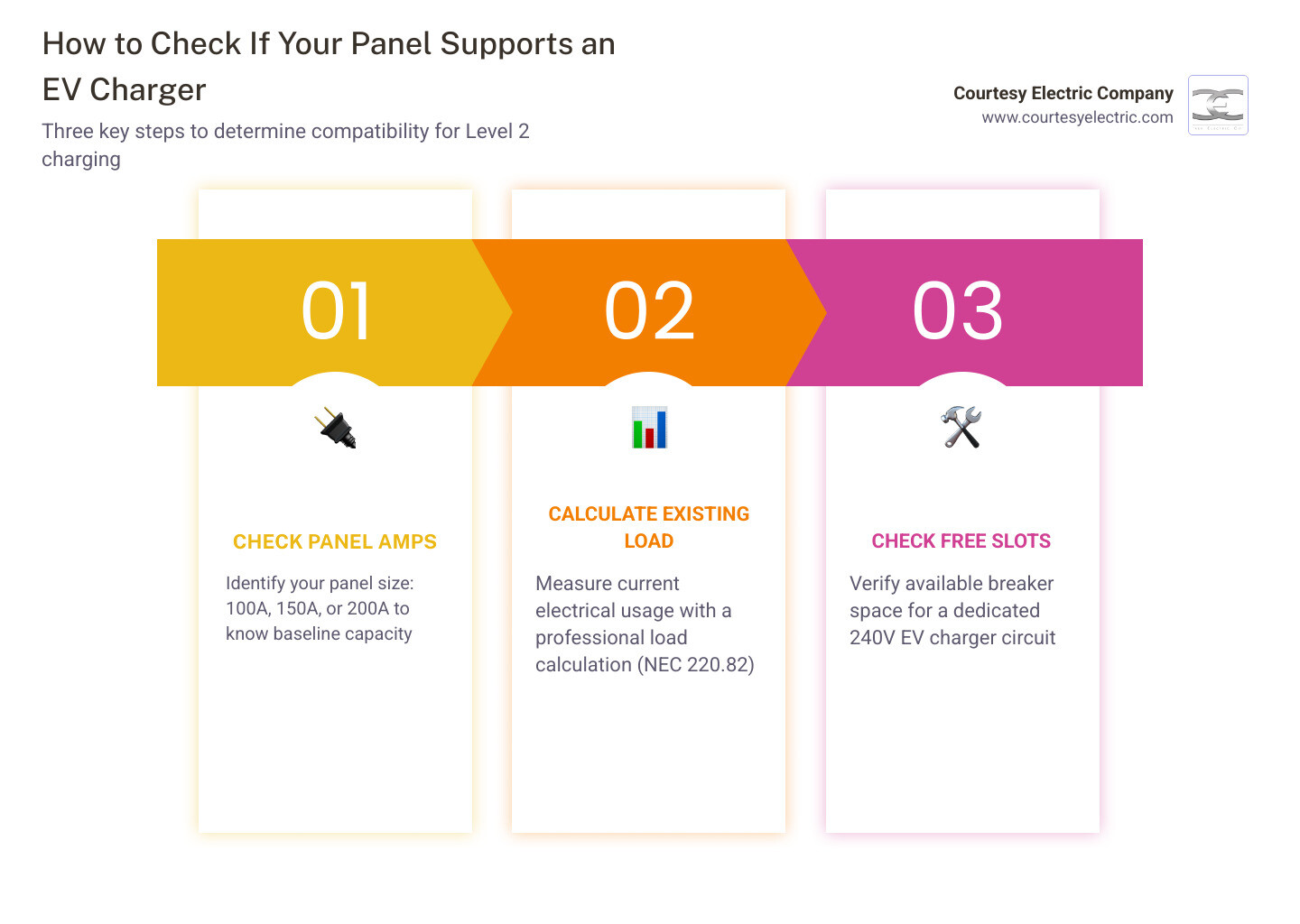
For homeowners on the Colorado Front Range, the answer often comes down to three things: your panel's amperage rating, how much electrical load your home already draws, and whether you have a free circuit slot for a dedicated 240-volt circuit. Older homes — especially those built before the 1990s — are more likely to need some level of electrical work before a Level 2 charger can go in safely.
I'm David Meyer, Vice President of Courtesy Electric, a Colorado electrical contractor with roots going back to 1976. Through decades of panel upgrades, EV charger installations, and smart energy projects across Denver and the Front Range, I've seen how often homeowners are unsure whether their electrical panel supports an EV charger — and how a straightforward assessment can save them from either unnecessary upgrades or real safety risks. In the sections below, I'll walk you through exactly how to find out where your home stands.
How to Determine: Does Your Electrical Panel Support an EV Charger?

Determining whether your electrical system can handle the addition of a Level 2 electric vehicle charging station requires looking at your home's electrical capacity as a whole. An EV charger is not like a standard household appliance. Under the National Electrical Code (NEC Article 625), electric vehicle supply equipment (EVSE) is classified as a continuous load.
This classification means the charger can pull its maximum current for three hours or more continuously. Because of this sustained, high-power draw, the NEC requires that the branch circuit breaker and wiring be oversized to 125% of the charger's continuous rating. For example, if you want to charge your vehicle at 40 amps, the circuit breaker and electrical infrastructure must be rated for at least 50 amps (40 x 1.25 = 50). This continuous draw places a massive demand on your electrical panel, which is why we must carefully evaluate your home's total capacity.
The table below outlines how different panel sizes generally interact with home EV charging systems:
| Panel Amperage | Total Wattage Capacity (at 240V) | Typical Level 2 EV Compatibility | Key Considerations |
|---|---|---|---|
| 100 Amps | ~24,000 Watts | Marginal / Limited | Works well if the home uses natural gas for heating, cooking, and water heating. May require a lower-amperage charger or smart load management. |
| 150 Amps | ~36,000 Watts | Good | Usually supports a standard 32-amp or 40-amp charger unless the home has heavy electrical loads like a hot tub or electric resistance heating. |
| 200 Amps | ~48,000 Watts | Excellent | The modern residential standard. Easily supports full-speed Level 2 charging alongside typical household appliances. |
Key Factors: Does Your Electrical Panel Support an EV Charger?
When we evaluate a home in Denver, Highlands Ranch, or Parker, we look at several fundamental factors to answer the big question: does your electrical panel support an EV charger?
- Amperage Rating: Your main electrical service panel dictates the total volume of electricity your home can safely draw from the utility grid at any given moment. Older homes in established Front Range neighborhoods often have 100-amp panels, while newer construction standardizes on 200-amp service.
- Existing Household Load: The size of your panel is only half the equation; we also have to look at what you are already running. A 100-amp panel in a home with a natural gas furnace, gas water heater, and gas range will have plenty of leftover capacity for an EV charger. However, that same 100-amp panel in a home with central air conditioning, an electric clothes dryer, an electric range, and an electric water heater is likely already operating near its limit.
- Dedicated Circuit Requirements: EV chargers cannot share a circuit with other household appliances. They require a dedicated 240-volt circuit run directly from your main panel (or an approved sub-panel) to the charging station. This means you must have physical space in your panel for a double-pole breaker.
- Wiring and Conduit Requirements: Sizing the wiring correctly is paramount for safety. A 50-amp circuit typically requires heavy-duty #6 AWG copper wire (or #8 AWG depending on wire type and installation conditions) to safely handle the continuous electrical current without overheating.
If you want to dive deeper into the physical setup, check out our comprehensive EV Charger Installation Guide for Homeowners to see how these components come together in your garage or driveway.
Professional Assessment: Does Your Electrical Panel Support an EV Charger?
While you can get a general idea of your panel's capacity by looking at the main breaker, the only way to safely confirm compatibility is through a professional load calculation.
When our licensed electricians perform this assessment, we follow the guidelines laid out in NEC Article 220.82 (the Optional Calculation Method for existing dwelling units). This method is much more accurate than simply adding up the numbers printed on your individual circuit breakers. If you were to add up every breaker in your panel, the sum would likely far exceed your main breaker's rating—and that is normal because you never run every light, appliance, and outlet in your home at the exact same moment.
The NEC Article 220.82 load calculation takes into account:
- The total square footage of your home (to calculate general lighting and receptacle loads).
- The small appliance branch circuits (usually kitchen and laundry outlets).
- The nameplate ratings of all major fixed appliances (your air conditioner, electric range, clothes dryer, water heater, and hot tub).
- A demand factor (where the first 10 kVA of load is calculated at 100%, and the remaining load is calculated at a diversified 40%).
- The continuous load of the proposed EV charger calculated at 125%.
We also evaluate the physical condition of your service entrance cables and check for available physical slots in the panel. If your panel is completely full of breakers, we cannot simply add another double-pole breaker without making physical modifications, such as installing tandem breakers or adding a sub-panel.
Understanding these technical nuances is why having a professional eye on your system is so valuable. To learn more about when you can tackle home electrical projects yourself versus when you need to bring in a licensed professional, read our guide on When to Call an Electrician vs DIY.
Signs Your Electrical Panel Cannot Handle an EV Charger
Adding a heavy, continuous electrical load to a system that is already struggling is a recipe for system failure. If your electrical panel supports an EV charger but is pushed past its safe operating limits, your home's electrical infrastructure will begin to show clear warning signs. Ignoring these warning signs can lead to severe issues, including damaged appliances, complete system blackouts, and electrical fires.
Some of the most common warning signs that your panel is overloaded or outdated include:
- Frequent Circuit Breaker Trips: If your main breaker or individual appliance breakers trip when you run multiple household items—such as the microwave and the hair dryer, or the air conditioner and the clothes dryer—your system is already telling you it has reached its capacity.
- Flickering or Dimming Lights: If your lights flicker or momentarily dim when your central air conditioner or refrigerator kicks on, your electrical system is experiencing temporary voltage drops. Adding a continuous EV charging load will only worsen this issue, potentially damaging sensitive electronics.
- Physical Warmth or Unusual Odors: Your electrical panel should never feel warm to the touch, and it should never emit a musty, fishy, or burning plastic odor. Warmth and odors are direct indicators of overheating wires, loose connections, or failing breakers.
- Corrosion, Rust, or Moisture Damage: If you notice rust on the panel enclosure or on the circuit breakers themselves, moisture has penetrated the panel. Water and electricity do not mix; corrosion increases electrical resistance, which generates dangerous heat.
- Outdated Panel Brands or Wiring Methods: If your home still utilizes an old fuse box, or if you have a panel manufactured by Federal Pacific Electric (FPE) or Zinsco, these systems are widely recognized as safety hazards that often fail to trip during an overload.
If your home has older electrical components, it is critical to address these issues before plugging in an electric vehicle. You can read more about how older systems impact your household safety in our articles on How Outdated Wiring Increases Fire Risk and How to Spot Electrical Problems Before They Become Dangerous.
Smart Alternatives to a Full Electrical Panel Upgrade
If a load calculation reveals that your current electrical service cannot support a new, high-amperage dedicated circuit, you do not always have to jump straight to a costly, full-scale electrical service upgrade. Modern electrical technology offers several highly effective, code-compliant alternatives that can help you safely charge your vehicle on your existing panel.
- Dynamic Load Management Devices: These smart devices monitor the real-time electrical consumption of your entire home. When your household power demand is low (such as in the middle of the night), the system allows your EV charger to draw maximum power. If you turn on a heavy load like an electric oven or a clothes dryer, the load management system instantly throttles back the power going to your EV charger to keep your total panel load within safe limits. Once the household appliance cycles off, the system automatically ramps your charging speed back up.
- Smart Panels (The SPAN Panel): Instead of a traditional, passive circuit breaker panel, we can install a smart energy management panel like SPAN. A smart panel gives you complete digital control over every circuit in your home via a smartphone app. It allows you to prioritize circuits dynamically, automatically shedding non-essential loads (like a guest bedroom AC or a water heater) to free up power for your EV charger when needed.
- Circuit-Sharing Devices: If you have an electric clothes dryer in your garage, you can install an intelligent circuit-sharing switch. This device allows your dryer and your EV charger to share the same 240-volt outlet safely. The switch automatically prioritizes your clothes dryer; when the dryer is running, the EV charger pauses. When the dryer finishes its cycle, power safely flows back to your vehicle.
- Sub-Panel Installation: If your main electrical panel has plenty of raw amperage capacity (such as a 200-amp service) but simply lacks the physical space to insert a new double-pole breaker, we can install a sub-panel. This smaller secondary panel adds physical breaker slots without requiring a change to your overall utility service.
- Lowering the Charger Amperage: Many homeowners assume they must install a 48-amp or 40-amp charger. However, installing a 16-amp or 24-amp Level 2 charger still provides a substantial speed upgrade over a standard 120-volt wall outlet. A lower-amperage charger draws far less power, often fitting comfortably into a 100-amp panel's existing headroom while still fully charging your vehicle overnight.
Utilizing these smart alternatives requires a solid understanding of home electrical distribution. For more guidance on keeping your home's electrical system in top shape, check out our Electrical Safety Tips Every Homeowner Should Know.
Frequently Asked Questions About EV Charger Panel Compatibility
Can I install a Level 2 EV charger on a 100-amp panel?
Yes, in many cases you can. Whether a 100-amp panel is compatible depends entirely on your home's existing electrical appliances and your charging habits. If your home uses natural gas for major heating and cooking appliances (gas furnace, gas water heater, gas range), your baseline electrical usage is relatively low. This leaves plenty of electrical headroom on a 100-amp service to safely support a 24-amp or 30-amp Level 2 charger.
Additionally, you can utilize smart load-management devices to prevent overloading, or simply schedule your vehicle to charge exclusively overnight when household power consumption is at its lowest. To help offset the costs of setting up your home charging station, look into local programs through our guide on Colorado EV Charger Rebates and Incentives.
Do I need a permit and inspection for an EV charger installation in Colorado?
Yes. In Denver, Parker, Highlands Ranch, Black Forest, and throughout the Colorado Front Range, installing a new 240-volt circuit for an EV charger requires an electrical permit and a final safety inspection. Skipping the permit process is a major risk; unpermitted electrical work can void your homeowner's insurance policy in the event of a fire, and it can complicate the sale of your home in the future.
Furthermore, local jurisdictions often have specific codes that out-of-state or unpermitted installers may not know. For example, cities like Fort Collins and other Front Range municipalities have local amendments requiring the installation of a heat detector in the garage alongside an EV charger. You can learn more about navigating these local requirements and finding financial support through our resource on Colorado EV Charger Incentive Programs.
What is the difference between a panel upgrade and a sub-panel?
A panel upgrade (or service upgrade) completely replaces your existing electrical panel with a new, larger unit and increases the total amount of electrical current your home can draw from the utility grid (for example, upgrading from a 100-amp service to a 200-amp service). This process typically involves replacing the meter socket, the service entrance cables on the outside of your home, and coordinating directly with your local utility provider (such as Xcel Energy or CORE Electric Cooperative) to disconnect and reconnect the power.
A sub-panel, on the other hand, is a secondary breaker box that connects to your existing main panel. It does not increase your home's total electrical capacity from the grid. Instead, it simply expands the physical space available for circuit breakers. If your main panel has plenty of amperage capacity but is physically full, a sub-panel is an excellent, cost-effective solution. To explore our full range of panel services, visit our Electrical Service page.
Conclusion
Determining if your electrical panel supports an EV charger is the crucial first step toward enjoying the convenience of charging your vehicle at home. While many modern homes with 200-amp panels are ready for a Level 2 charger right away, older homes or homes with extensive electric appliances require a careful, calculated approach. Whether you need a straightforward circuit installation, a sub-panel expansion, a smart load-management solution, or a complete electrical panel upgrade, our team is here to help.
At Courtesy Electric Company, we have been serving homeowners and builders across Denver, Parker, Highlands Ranch, Black Forest, and the wider Colorado Front Range since 1976. We specialize in everything from basic residential service work to advanced smart home technology, including SPAN smart panels, Franklin battery storage, and home standby generators. We are dedicated to providing safe, reliable, and code-compliant installations tailored to your home's unique needs.
Ready to find out if your home is ready for an EV charger? Schedule a professional panel assessment with Courtesy Electric Company today, and let our experienced team provide you with a free estimate for a safe, reliable installation.


