
Are Colorado EV Charger Rebates and Incentives Worth It? Here's What You Need to Know

Colorado EV charger rebates and incentives can put real money back in your pocket when you install a home charging station — and right now, there are more programs available than most homeowners realize.
Here's a quick look at what's available in 2026:
| Program | Who It's For | Benefit |
|---|---|---|
| Federal 30C Tax Credit | Homeowners installing Level 2 chargers | 30% of cost, up to $1,000 |
| Xcel Energy Wiring Rebate | Xcel residential customers | Up to $1,300 on home wiring |
| CARe Program (Xcel areas) | Xcel customers with ENERGY STAR charger | Up to $200 (up to $2,000 for V2B) |
| Black Hills Energy Ready EV | Black Hills customers | $500–$1,300 depending on income |
| United Power EV Home Charge | United Power members | Up to $1,000 on installation |
| Holy Cross Energy | Holy Cross customers | Up to $549 |
| Gunnison County Electric | Gunnison County members | 50% of cost, up to $1,250 |
| Poudre Valley REA | Poudre Valley members | Up to $1,000 |
| La Plata Electric | La Plata customers | Up to $1,000 total |
And if you're also buying an EV, the savings stack even further. Income-qualified Coloradans can combine the Vehicle Exchange Colorado (VXC) program with the state EV tax credit for up to $12,250 in combined vehicle savings alone — before adding any charger incentives on top.
Colorado has set ambitious goals for EV adoption, aiming to put nearly 1 million electric vehicles on the road by 2030. To get there, the state has built one of the most layered incentive systems in the country — and that's good news for homeowners who want to charge at home without absorbing the full upfront cost.
The key is knowing which programs apply to you, how to combine them, and what steps to take before and after installation.
I'm David Meyer, Vice President of Courtesy Electric, a Colorado electrical contractor with roots going back to 1976 — and helping homeowners navigate Colorado EV charger rebates and incentives is something our team works through with clients on a regular basis. Whether it's pulling the right permits, sizing your panel for a Level 2 charger, or making sure your installation qualifies for the rebates you're counting on, we've seen how the details make or break the savings.
Understanding Colorado EV Charger Rebates and Incentives at the State Level
When it comes to lowering the cost of transitioning to an electric vehicle, the Centennial State has established itself as a national leader. The state's strategy focuses on reducing both the upfront cost of the vehicle and the ongoing infrastructure expenses needed to keep it charged.
To start, Colorado taxpayers are eligible for a $750 state tax credit when purchasing or leasing a new EV with an MSRP up to $80,000. If you purchase a highly affordable electric vehicle with an MSRP under $35,000, you are eligible for an additional $2,500 credit, bringing your total state tax credit up to $3,250. Because this state credit is refundable, you receive the full benefit even if your total state tax liability is lower than the credit amount.
For income-qualified residents looking to recycle an older, high-emitting vehicle, the Vehicle Exchange Colorado (VXC) program offers a massive point-of-sale rebate. Under VXC, eligible participants can receive a $9,000 rebate toward a new Battery Electric Vehicle (BEV) or Plug-in Hybrid Electric Vehicle (PHEV), or $6,000 toward a used BEV or PHEV. To qualify, your current vehicle must be model year 2014 or older (for applications submitted in 2026) or have failed a Colorado emissions test. This program has already helped thousands of Coloradans swap out older gas-powered cars for cleaner electric models.
When it comes to charging infrastructure, the state-backed Colorado’s Affordable Residential Energy (CARe) program provides direct support for home charging equipment. Operating primarily in Xcel Energy service territories, the CARe platform offers rebates of up to $200 for installing an ENERGY STAR certified Level 2 charger. If you are looking toward the future of energy management and decide to install a bi-directional vehicle-to-building (V2B) charger, the CARe program can provide rebates up to $2,000.
By utilizing these state programs in tandem with local utility offerings, homeowners can dramatically offset the cost of making their homes EV-ready. To see a complete breakdown of how these state programs operate, check out our guide on Colorado EV Charger Incentive Programs.
Federal and Utility-Specific EV Charger Programs
While state programs provide a strong foundation, some of the most accessible savings come from the federal government and your local electric utility.
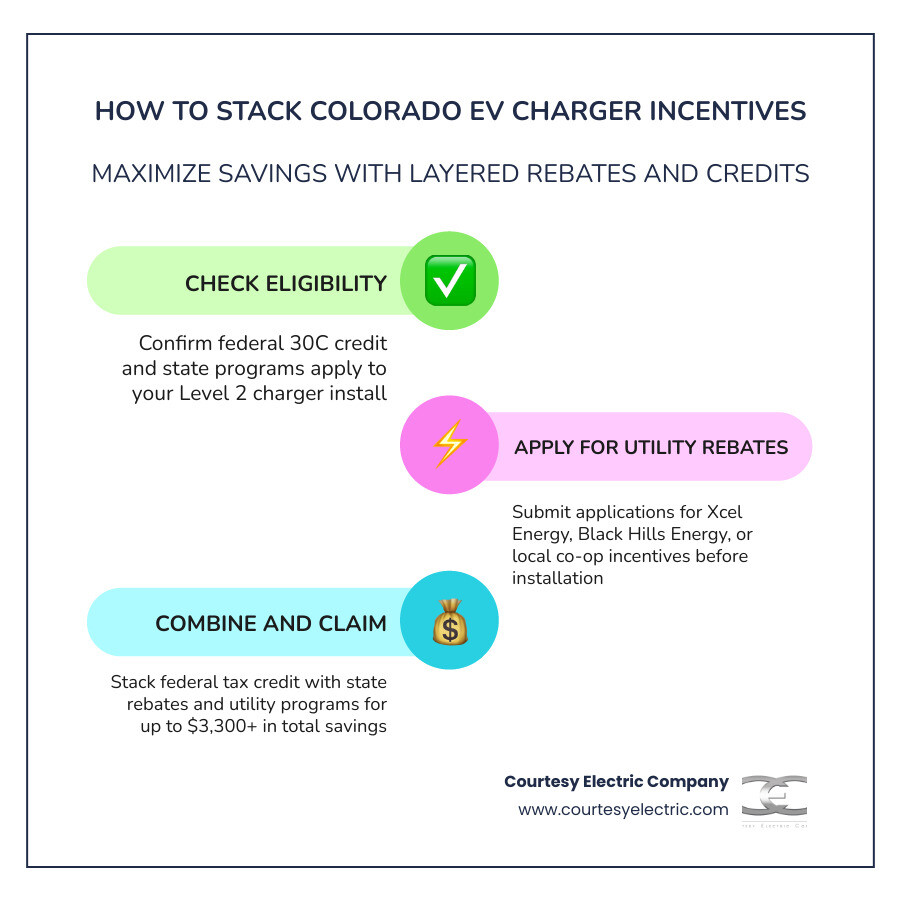
At the federal level, the Alternative Fuel Vehicle Refueling Property Credit (often referred to as the 30C tax credit) is highly beneficial for residential installations. This credit covers 30% of the purchase and installation costs of an at-home Level 2 charger, up to a maximum credit of $1,000. To claim this incentive, you must file IRS Form 8911 with your federal tax return. It is important to note that this federal tax credit is currently set to expire on June 30, 2026, making the first half of this year an ideal window to complete your home installation.
The real magic happens when you stack these federal tax credits with local utility rebates and home energy upgrades. Many homes in the Denver metro area and the Front Range require an electrical service panel upgrade to safely handle the continuous 40-amp or 50-amp load of a Level 2 charger.
Fortunately, you can combine federal tax credits for your charger with incentives for upgrading your electrical infrastructure. For example, installing a smart electrical panel or adding residential battery storage can unlock separate federal and state tax credits. You can learn more about how these infrastructure incentives work by reading about Federal Tax Credits for Battery Storage and Span Panels.
Additionally, local programs support these necessary infrastructure upgrades, ensuring that your panel is fully prepared for the increased demand of an EV charger. To explore how to offset the costs of upgrading your home's electrical service, refer to our resource on Colorado Energy Rebates for Electrical Upgrades.
Xcel Energy and Black Hills Energy Colorado EV Charger Rebates and Incentives
For homeowners living in Denver, Parker, Highlands Ranch, and across the Front Range, Xcel Energy offers some of the most robust utility incentives in the state. Xcel Energy provides residential customers with rebates of up to $1,300 to cover the home wiring costs associated with installing a Level 2 charger. If you qualify as an income-qualified customer or live in a designated Disproportionately Impacted Community (DIC), Xcel's wiring rebate can cover up to $2,300 of the installation costs.
To qualify for Xcel’s rebates, customers must enroll in a Time-of-Use (TOU) pricing plan or a smart charging program like "Optimize Your Charge." Under TOU rates, charging your EV during off-peak hours (typically overnight and weekends) is highly economical, with rates dropping significantly.
In Southern Colorado, including areas near Black Forest, Black Hills Energy offers its "Ready EV" program. This program provides residential customers with a $500 rebate for a Level 2 charger, which increases up to $1,300 for income-qualified households. Black Hills Energy also utilizes a Time-of-Day rate structure and offers an "EVolved" charging incentive, which pays customers a $10 monthly bill credit simply for committing to charge their vehicles during designated off-peak hours.
Cooperative Utility Colorado EV Charger Rebates and Incentives
If your home is served by an electric cooperative, you still have access to excellent incentives. Colorado’s co-ops are highly proactive in supporting residential electrification:
- United Power (Brighton, Mead, North Metro): Offers an EV Home Charge program utilizing state grant funding. Members can receive a wiring rebate of $250 to $500 (which increases to $500–$1,000 if enrolled in their smart EV program). They also offer a flat $500 rebate specifically for panel upgrades if a service upgrade is required to support the charger.
- Holy Cross Energy (Vail, Aspen, Glenwood Springs): Provides rebates of up to $549 for a Level 2 charger, plus a $50 annual reward for participating in their smart charging program.
- Gunnison County Electric Association: Offers a generous rebate covering 50% of the purchase and installation cost of an EV charger, up to $1,250.
- La Plata Electric Association (Durango area): Provides up to $1,000 in total incentives, split as a $500 rebate for the charger and up to $500 for the installation costs.
- Poudre Valley REA (Northern Colorado): Offers rebates ranging from $250 up to $1,000 depending on the specific charger type and smart-charging capabilities.
- San Isabel Electric Association: Offers a $500 rebate for EV purchases and supports home charging through discounted off-peak TOU rates.
- Yampa Valley Electric Association: Provides a $250 rebate for qualifying home charger installations.
Comparing Level 2 Charger Incentives to Other Charger Types
When planning an EV charging setup for your home, it is important to understand the differences between the three main tiers of charging and how incentives apply to each.
- Level 1 Charging (120V): This involves plugging your vehicle into a standard household outlet. While it requires no special equipment or electrical upgrades, it is incredibly slow, adding only about 3 to 5 miles of range per hour. Because it does not require dedicated infrastructure, there are no state, federal, or utility rebates available for Level 1 charging.
- Level 2 Charging (240V): This is the gold standard for home charging. Utilizing a 240-volt circuit (similar to a clothes dryer or electric range), a Level 2 charger can fully charge a standard EV overnight. For example, at an average home electricity rate of $0.13 per kilowatt-hour in Colorado, fully charging a Tesla Model 3 at home costs approximately $10.66 for up to 350 miles of range. This represents a savings of up to 75% compared to purchasing equivalent gasoline. Level 2 chargers are the primary target for residential utility rebates, federal tax credits, and state programs.
- DC Fast Charging (DCFC): These high-powered chargers bypass the vehicle's onboard charger to deliver direct current straight to the battery, fully charging a vehicle in 20 to 45 minutes. However, DC fast chargers require commercial-grade three-phase power and are not feasible for single-family homes. Consequently, residential rebates do not cover DCFC equipment. Instead, programs like the Colorado Energy Office's "Charge Ahead Colorado" grant fund DCFC installations for businesses, multifamily communities, and public plazas.
To maximize your home's charging efficiency, installing a smart Level 2 charger is highly recommended. These chargers communicate with your utility provider to automatically charge your car when rates are lowest. To understand the physical installation process and what to expect when upgrading your garage, read our EV Charger Installation Guide for Homeowners.
Furthermore, integrating a smart charger with an energy management system allows you to balance your home's electrical loads dynamically, preventing the need for costly utility service upgrades. You can learn about these advanced home systems in our article on Energy Management System Benefits for Homeowners.
| Charger Type | Voltage | Typical Charging Speed | Primary Target Audience | Available Residential Incentives |
|---|---|---|---|---|
| Level 1 | 120V AC | 3–5 miles of range per hour | Emergency / Occasional drivers | None |
| Level 2 | 240V AC | 12–60 miles of range per hour | Daily commuters, homeowners | 30% Federal Tax Credit, State CARe rebates, Utility wiring rebates |
| DC Fast Charging | 480V+ DC | 100–300+ miles of range per hour | Commercial fleets, public plazas, highway corridors | Commercial grants (Charge Ahead CO, NEVI funding) |
Frequently Asked Questions About Colorado EV Charging
Do I need a permit to install an EV charger in Colorado?
Yes. Installing a Level 2 EV charger requires running a dedicated 240-volt circuit from your electrical panel to your charger location. Under Colorado law and local municipal building codes, this work requires an electrical permit and a subsequent safety inspection by a local building inspector.
Attempting to install a charger without a permit can void your homeowner's insurance policy, create a fire hazard, and disqualify you from receiving utility rebates or federal tax credits. Most utility companies require proof of a passed electrical inspection before they will issue your rebate check. Working with a licensed, insured electrical contractor ensures that your permit is pulled correctly and that the installation meets the National Electrical Code (NEC).
Can I stack federal, state, and utility EV charger rebates?
In almost all cases, yes! You can combine the federal 30C tax credit (which covers 30% of your total out-of-pocket costs up to $1,000) with your local utility company's wiring and equipment rebates.
For example, if you live in Xcel Energy's service territory, you can receive up to $1,300 back for the wiring installation, utilize the CARe platform for an additional $200 rebate on an ENERGY STAR certified charger, and then claim the remaining out-of-pocket expenses on your federal taxes to receive a 30% credit. This multi-layered stacking strategy can significantly reduce the net cost of upgrading your home's charging capability.
How do Colorado EV incentives compare to California?
While California has historically been viewed as the national leader in electric vehicle adoption, Colorado has rapidly closed the gap with highly aggressive, consumer-friendly policies.
California boasts an extensive catalog of regional and municipal incentives, but many of its state-level rebates are subject to strict income caps or frequent funding depletion. In contrast, Colorado has streamlined its incentives, offering a highly accessible, refundable state tax credit of up to $3,250 that applies to all residents, regardless of income.
Additionally, Colorado’s Vehicle Exchange program is highly competitive, offering up to $9,000 for income-qualified buyers. Combined with $57 million in federal NEVI (National Electric Vehicle Infrastructure) funding to build out public fast-charging corridors along I-25 and I-70, Colorado has established one of the most robust, easy-to-navigate EV ecosystems in the United States.
Conclusion
Upgrading your home with a Level 2 electric vehicle charger is one of the smartest investments you can make in 2026. Not only does it provide the convenience of waking up to a fully charged vehicle every morning, but it also allows you to take advantage of low off-peak electricity rates that save you up to 75% compared to the cost of gasoline. Best of all, with the right combination of federal tax credits, state programs, and local utility rebates, a significant portion of the installation can be offset.
Because many of these programs — including the federal 30C tax credit — have critical deadlines in 2026, acting sooner rather than later is highly recommended.
At Courtesy Electric Company, we have been serving homeowners across Denver, Parker, Highlands Ranch, Black Forest, and the wider Colorado Front Range since 1976. Our team specializes in complete residential electrical services, from standard panel upgrades to advanced smart home integrations. Whether you want to install a Level 2 smart charger, upgrade your home with a SPAN smart electrical panel, or integrate a backup Franklin battery storage system, we are here to help.
We provide high-quality installations and offer free estimates on all new electrical projects. Let us handle the permits, the wiring, and the technical details so you can maximize your savings and enjoy a seamless transition to electric driving.
Ready to make your home EV-ready? Contact us today to schedule your free estimate for our residential electrical services.


