Why the Generac vs Cummins Home Generator Comparison Matters for Colorado Homeowners
When making a generac vs cummins home generator comparison, most homeowners want a straightforward answer. Here it is:
| Factor | Generac | Cummins |
|---|---|---|
| Market Share | ~70% residential | ~15% residential |
| Noise Level | 66-68 dB | 65 dB |
| Warranty | 5 years | 5 years |
| Cold Weather Rating | No published sub-zero rating | -40°F with cold weather kit |
| Natural Gas Output | Derates 5-10% on natural gas | Consistent output |
| Dealer Network | Largest in the U.S. | Smaller but capable |
| Best For | Budget-conscious homeowners, broad service access | Quiet operation, cold climates, commercial-grade durability |
Bottom line: Generac wins on price and service availability. Cummins wins on noise, cold-weather performance, and industrial-grade build quality. For most Colorado Front Range homeowners, the right choice depends on your climate exposure, lot size, and how much you value quiet operation.
Power outages on the Colorado Front Range are not a rare inconvenience — they are a regular reality. Winter storms knock out neighborhoods for hours. Summer thunderstorms trip substations without warning. When the grid goes down at 11 p.m. on a Tuesday, a sump pump that stops working can mean water at your basement door by morning. That is exactly the kind of situation a home standby generator is designed to prevent.
Choosing the right generator brand, though, is not always simple. Generac and Cummins are two of the most recognized names in home backup power, and they take genuinely different approaches to engine design, noise management, fuel efficiency, and cold-weather readiness. Understanding those differences before you buy can save you from an expensive mismatch between your home's needs and your generator's capabilities.
I'm David Meyer, Vice President of Courtesy Electric Company, and after decades of installing and servicing backup power systems across Denver and the Front Range, I've seen how a generac vs cummins home generator comparison plays out in real Colorado conditions — and which factors actually matter once the power goes out. Let's break it all down so you can make a confident, informed decision.
Generac vs Cummins Home Generator Comparison: Key Differences in Engineering and Performance
To truly understand how these two giants stack up, we have to look under the hood. While both brands are designed to do the same core job—keep your lights on when the utility grid fails—their engineering philosophies come from two very different places.
Generac is a consumer-first powerhouse. They built their empire by focusing squarely on the residential backup market, optimizing their designs for high-volume production, user-friendly operation, and cost efficiency. They are the household name for a reason: they made standby power accessible to the average homeowner.
Cummins, on the other hand, is an industrial legend. Founded in 1919, Cummins built its reputation on heavy-duty commercial diesel engines, powering everything from semi-trucks and marine vessels to hospital backup systems and cellular towers. When they designed their QuietConnect residential standby series, they brought that exact same commercial-grade, heavy-duty engineering philosophy down to the residential level.
When evaluating a Generator Brand Comparison for Homeowners, these differing backgrounds translate directly into how the machines handle real-world stress. To understand how they compare in action, it helps to understand How Does a Standby Generator Work under heavy loads. Generac units are highly optimized, utilizing custom-designed engines built specifically for the demands of emergency standby use. Cummins units lean into robust, slightly heavier engine blocks designed to handle continuous, demanding run times with minimal wear and tear.

Fuel Efficiency and Natural Gas vs Propane Performance in a Generac vs Cummins Home Generator Comparison
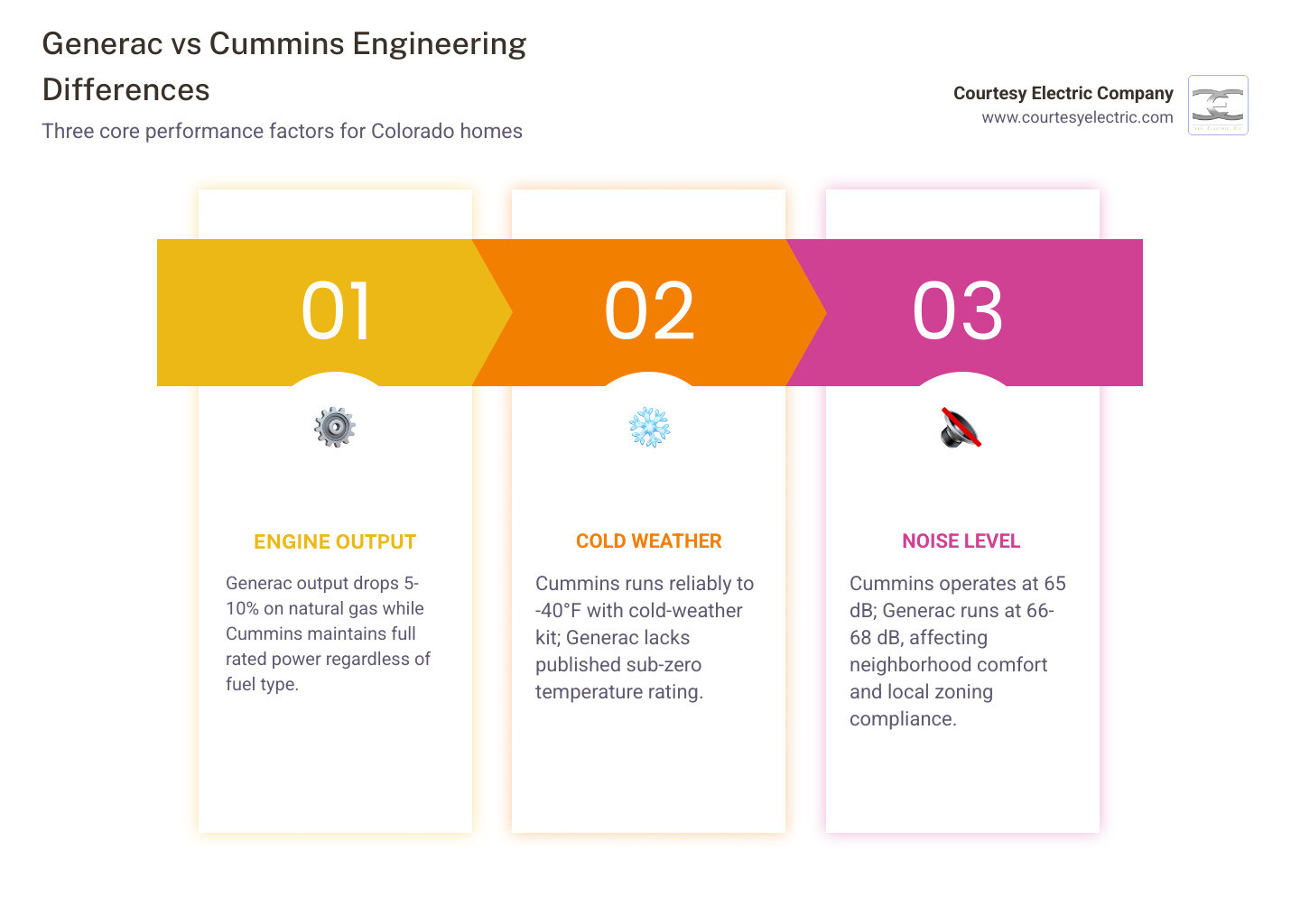
Standby generators run on either natural gas (NG) or liquid propane (LP). However, these fuels do not behave the same way inside an engine. Natural gas has a lower energy density per cubic foot than propane, which means most generators experience a drop in power output when connected to a natural gas line.
In a head-to-head generac vs cummins home generator comparison, this "derating" factor is a crucial consideration:
- Generac Guardian Series: These units typically experience a 5% to 10% derating in total power output when running on natural gas compared to propane. If you are close to your maximum electrical load capacity, you must account for this drop during the sizing phase.
- Cummins QuietConnect Series: Cummins engines are highly optimized for fuel efficiency and fuel-type transitions. Thanks to advanced engine control modules and robust displacement designs, Cummins units maintain exceptionally stable power outputs and excellent fuel efficiency on both fuel sources.
Furthermore, Cummins utilizes sophisticated load-sensing technology. This system constantly monitors the electrical demand of your home and adjusts the engine's performance dynamically. When your home's power demands are low, the generator optimizes its fuel consumption, which can save you a substantial amount of fuel during a prolonged, multi-day outage.
Noise Levels and Operational Decibels in a Generac vs Cummins Home Generator Comparison
Let's be honest: no one wants a generator that sounds like a jet engine taking off in their side yard, especially at 2 a.m. Noise level is one of the most common complaints homeowners have after their first major outage, and it is a major point of contention for local HOAs in Front Range communities like Highlands Ranch and Parker.
When it comes to quiet operation, Cummins holds a clear engineering advantage:
- Cummins QuietConnect RS Series: These units run at a remarkably quiet 65 decibels (dB) across the entire residential lineup. For context, 65 dB is roughly equivalent to the volume of a normal household conversation. Cummins achieves this through advanced sound-attenuating enclosures and a design that minimizes low-frequency vibration.
- Generac Guardian Series: Generac units typically operate between 66 and 68 dB. While a difference of two to three decibels might sound negligible on paper, the decibel scale is logarithmic—meaning a 3 dB increase represents roughly a 50% increase in relative sound energy.
During routine weekly exercise cycles—which generators run automatically to keep their parts lubricated and battery charged—Generac units can sound a bit more metallic and loud. If your generator must be installed close to a bedroom window or a neighbor's property line, the quieter, smoother hum of a Cummins unit is often worth the consideration.
Reliability, Warranties, and Cold-Weather Performance
Living along the Colorado Front Range means preparing for weather extremes. A generator that works perfectly during a mild spring afternoon is useless if it fails to start during a sub-zero blizzard in Black Forest. Ensuring your system is ready for these sudden shifts requires proper planning, including Generator Maintenance Before Colorado Storm Season and executing a thorough Spring Generator Maintenance After Winter.
Cold-Weather Operation and Accessories
Cold temperatures place extreme stress on a standby generator. Motor oil thickens, batteries lose their cranking power, and fuel regulators can freeze up.
This is an area where Cummins' commercial heritage shines brightly. Cummins QuietConnect generators are designed to operate flawlessly down to 0°F in their standard configuration. When equipped with the official Cummins Extreme Cold Weather Kit—which includes specialized oil heaters and battery warmers—they are certified to start and run in temperatures as low as -40°F.
Generac does not publish a comparable, certified sub-zero rating for its standard Guardian air-cooled line. While Generac does offer cold-weather accessories (such as battery pads and oil warmers) that are highly recommended for Colorado homes, their units generally require more attention and careful maintenance to ensure reliable cold-starts when the thermometer plummets below zero.
Warranty Coverage and Long-Term Durability
Both Generac and Cummins stand behind their residential products with a standard 5-year limited warranty, covering parts and labor for major components. However, their long-term durability profiles differ slightly due to their build quality:
- Generac Lifespan: With regular, professional maintenance, a Generac Guardian generator has an expected operational lifespan of 20 to 30 years. Because they are built primarily with residential-grade components, they are highly reliable but are optimized for intermittent emergency use rather than continuous, heavy-duty run times.
- Cummins Lifespan: Cummins units are built with a heavier, industrial-grade engine block and robust internal components. With proper annual servicing, a Cummins QuietConnect generator easily achieves a 25 to 30+ year lifespan. Their commercial heritage means they are designed to run continuously for days—or even weeks—at a time without experiencing premature engine wear.
Smart Monitoring, Sizing, and Installation Considerations
A standby generator is only as good as its installation and your ability to monitor its health. Modern smart home integration has changed how homeowners interact with their backup power systems, turning what used to be a passive piece of machinery into an active, intelligent home appliance.
Before the physical unit ever arrives at your home, understanding Generator Installation What to Expect is key to a smooth project. Proper planning ensures you maximize the Whole Home Generator Benefits for Colorado Homeowners, from protecting your property to maintaining seamless daily routines.
Remote Monitoring Apps and Smart Features
Both brands offer remote monitoring platforms that allow you to check your generator's status, view exercise history, and receive maintenance alerts directly on your smartphone.
- Generac Mobile Link: Generac's mobile platform is widely considered the most user-friendly, consumer-focused app in the industry. It features an intuitive dashboard, clear status indicators (green for ready, yellow for warning, red for attention), and seamless Wi-Fi connectivity. Generac also offers cellular accessory upgrades, which are incredibly valuable because standard Wi-Fi routers often go offline during a power outage.
- Cummins Connect Cloud: Cummins utilizes the Connect Cloud platform. It is highly robust, providing deep technical diagnostics and real-time operational data. However, the interface leans slightly more technical and industrial compared to Generac's polished, consumer-friendly app. It is incredibly reliable but has a slightly steeper learning curve for the average homeowner.
Sizing for Whole-Home Backup vs Essential Circuits
Sizing a generator is not about matching the square footage of your home; it is about calculating the starting and running electrical loads of the appliances you need to power. When a large motor—like your central air conditioner's compressor—starts up, it draws three to seven times its normal running current. This is known as motor-starting kVA, and your generator must have the surge capacity to handle it.
- Essential Circuits Only: If you only need to back up critical loads (your sump pump, refrigerator, furnace fan, internet router, and a few lights), a smaller 13kW to 16kW unit is usually sufficient.
- Whole-Home Backup: If you want to run your entire home without lifestyle compromises—including multiple central AC units, electric clothes dryers, well pumps, and electric ranges—you will need a larger 22kW to 26kW unit.
At Courtesy Electric Company, we take sizing a step further by integrating standby generators with modern energy management systems. By pairing your generator with advanced solutions like SPAN smart electrical panels or Franklin battery storage, we can create an intelligent, dynamic load-shedding system. This allows a smaller, more fuel-efficient generator to power your entire home by automatically pausing non-essential loads (like an EV charger or hot tub) when a heavy appliance (like your AC) kicks on.
Maintenance, Dealer Networks, and Local Service Support
No matter how reliable a machine is, it will eventually require maintenance. Standby generators are complex engines that require routine oil changes, spark plug replacements, and battery checks.
| Feature | Generac Guardian Series | Cummins QuietConnect Series |
|---|---|---|
| Standard Warranty | 5 Years Limited | 5 Years Limited |
| Enclosure Material | Corrosion-resistant aluminum | Durable, sound-attenuated gel-coat |
| First Service Interval | After first 25 hours of run time | After first 25 hours of run time |
| Routine Maintenance | Every 100 hours or annually | Every 100-250 hours or annually |
| Dealer & Parts Network | Massive (70% market share) | Smaller, specialized network |
Keeping your system running smoothly requires following a strict Generac Generator Maintenance Schedule Explained (or the equivalent Cummins schedule). Understanding How Often Should You Service Your Standby Generator and why How Proper Maintenance Extends Generator Life is the secret to protecting your investment for decades to come.
Because Generac commands roughly 70% of the residential market, their dealer network is massive. Parts are incredibly easy to source, and almost every certified generator technician in Colorado is trained to service them. Cummins has a smaller residential dealer footprint, but because of their massive commercial presence, their parts distribution network is incredibly efficient, and their authorized dealers are highly specialized, commercial-grade technicians.
Frequently Asked Questions About Standby Generators
Which generator brand is generally recommended for most homeowners?
For the majority of homeowners on the Colorado Front Range, Generac is the most common recommendation. This is not necessarily because it is a "better" machine in every category, but because of its outstanding balance of value, user-friendly technology, and unmatched local service footprint. If a part breaks, a replacement is usually readily available nearby.
However, if you live in an HOA with strict noise regulations, experience extreme sub-zero winds in open areas like Black Forest, or simply want a machine with an industrial, commercial-grade engine block, Cummins is an exceptional upgrade. When choosing between a Generator or Battery for Power Outages Is a Generator or Battery Better for Power Outages, a standby generator remains the gold standard for long-term, multi-day outages where solar recharging is not guaranteed.
How often does a standby generator require professional maintenance?
Your standby generator should receive a comprehensive professional service at least once a year. This annual tune-up includes changing the engine oil and oil filter, replacing the air filter and spark plugs, testing the battery's cranking voltage, and verifying the automatic transfer switch (ATS) operates correctly.
Between professional visits, homeowners should keep an eye out for Signs Your Generator Needs Professional Attention, such as warning lights, fluid leaks, or unusual sounds during the weekly exercise cycle. Following basic Generator Maintenance Tips for Homeowners—like keeping the area around the enclosure clear of snow, ice, and debris—will prevent emergency failures when you need the power most.
Do I need a permit to install a standby generator in Colorado?
Yes. All municipalities across Denver and the Colorado Front Range require building and electrical permits for standby generator installations. These codes exist to ensure the unit is safely set back from windows and property lines, the gas plumbing is sized correctly to prevent pressure drops, and the electrical connections are safely isolated from the utility grid to protect utility line workers.
When you work with a professional, licensed electrical contractor, they will handle the entire permitting process, coordinate with the local building department, and schedule the final inspections on your behalf.
Conclusion
At the end of the day, a generac vs cummins home generator comparison does not produce a single, universal winner. Generac is the market leader for a reason, offering incredible value, simple smart-home integration, and a massive support network. Cummins appeals to the homeowner who values industrial-grade engineering, whispering-quiet operation, and certified sub-zero reliability.
At Courtesy Electric Company, we have been serving Denver and the Colorado Front Range since 1976. As a full-service electrical contractor, we specialize in complete power backup solutions, from professional Generac and Cummins generator installations to advanced Franklin battery storage and SPAN smart panel integrations. We do not believe in one-size-fits-all solutions; we believe in designing the right system for your specific home, family, and budget.
Ready to protect your home from Colorado's unpredictable grid? Contact us today to schedule a free estimate for our professional electrical services and standby power installations. We will help you size, select, and install the perfect backup system so that the next time the Front Range goes dark, your home stays bright.


