Why Outdated Wiring Is One of the Biggest Fire Risks Hiding in Your Home
How outdated wiring increases fire risk comes down to a simple mismatch: old wires designed for a handful of lights and appliances are now being asked to power smart TVs, EV chargers, home offices, and high-draw kitchen appliances — all at once. The result is overheating, arcing, and in too many cases, fire.
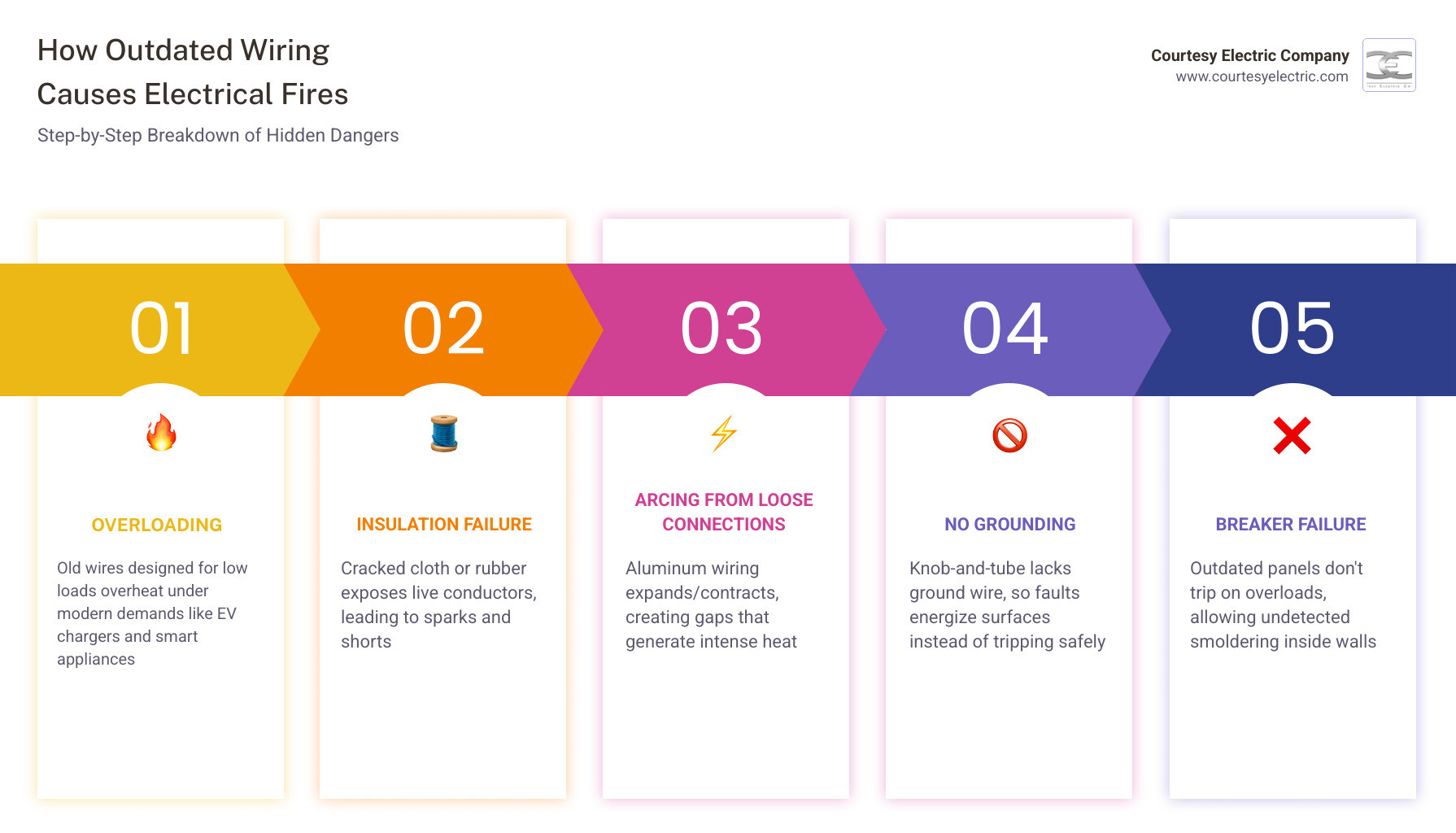
Here is a quick breakdown of the main ways aging wiring puts your home at risk:
- Overheating — Old wires cannot handle today's electrical loads and heat up dangerously inside walls where you cannot see them
- Deteriorating insulation — Cloth and rubber coatings crack over time, exposing live conductors that can spark or arc
- Loose connections — Aluminum wiring expands and contracts with temperature changes, creating gaps that generate heat and arcing
- No grounding — Older systems like knob-and-tube wiring lack a ground wire, so faults have nowhere safe to go
- Failed breakers — Outdated panels, especially certain brands, may not trip when a circuit is overloaded, letting wires overheat undetected
- Code non-compliance — Aging systems lack modern safety devices like AFCI breakers and GFCI outlets that catch dangerous faults early
According to the U.S. Fire Administration, an estimated 23,700 electrical fires occurred in U.S. homes in 2023 alone — with aging wiring among the leading contributors. If your Denver-area home was built more than 40 years ago and the electrical system has never been updated, there is a real chance you are living with one or more of these hazards right now.
I'm David Meyer, Vice President of Courtesy Electric, and understanding how outdated wiring increases fire risk has been central to my work throughout my career — from hands-on field experience to overseeing large-scale residential electrical upgrades across the Colorado Front Range. In the sections below, I'll walk you through exactly what to look for, why it matters, and what to do about it.
Identifying the Culprits: Common Types of Outdated Wiring in Older Homes
When we walk into a historic home in Denver or a mid-century ranch in Highlands Ranch, the first thing we look at isn't the paint or the crown molding—it’s what is happening behind the drywall. Many homes in the Colorado Front Range still rely on infrastructure that was cutting-edge when the radio was the primary source of entertainment.
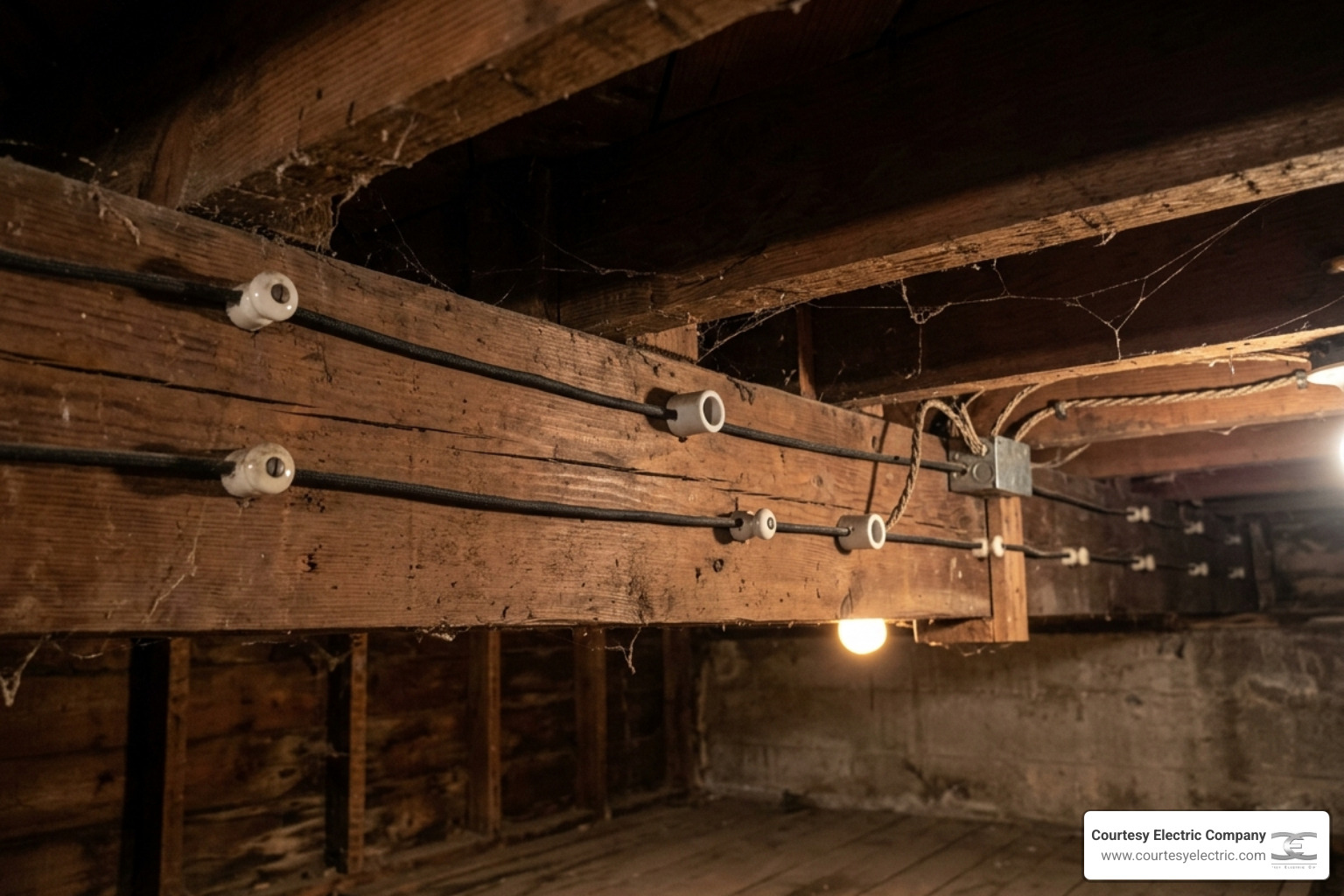
The three most common types of outdated wiring we encounter are:
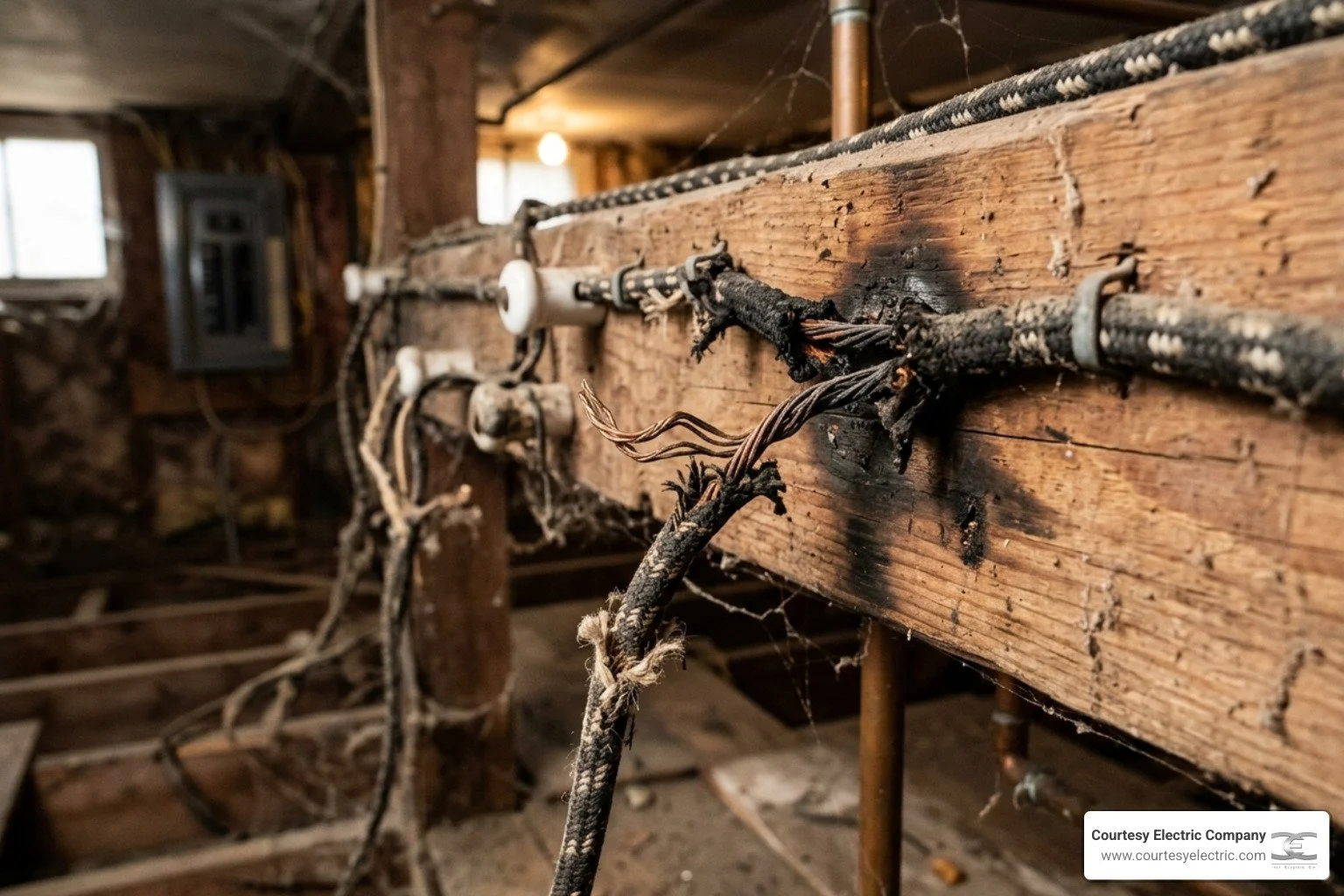
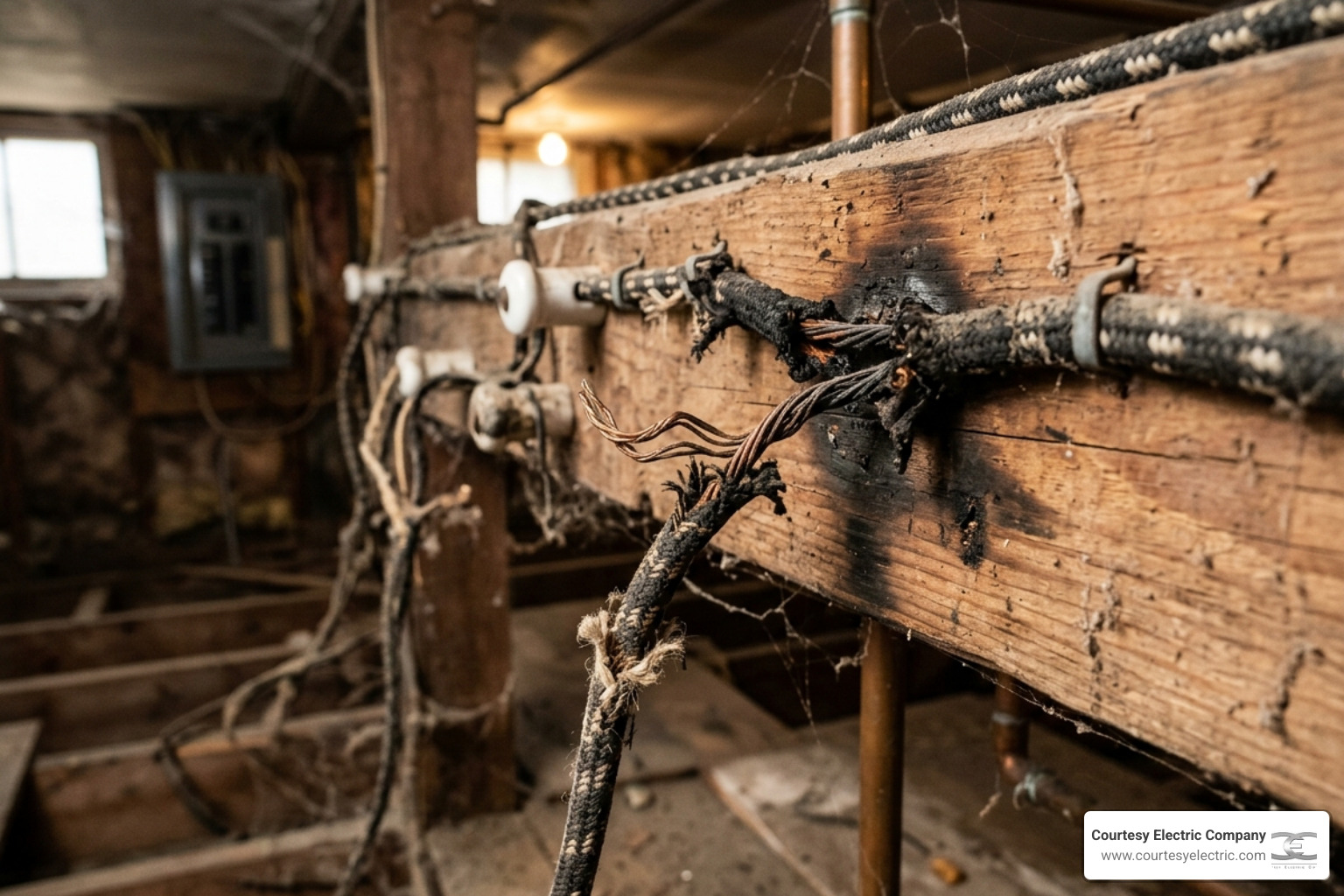
- Knob-and-Tube (K&T): Prevalent in homes built before the 1950s, this system uses porcelain "knobs" to support wires and "tubes" to protect them as they pass through wood framing.
- Aluminum Wiring: Common in homes built between the mid-1960s and the late 1970s due to a copper shortage.
- Cloth-Insulated Cables: Used primarily before the 1960s, these wires rely on rubber and cloth jackets that become brittle with age.
The danger in all three isn't just their age; it’s how they interact with the massive electrical demands of 2026. For more information on how we handle these systems, check out our Electrical Service page.
The lack of grounding: Why knob-and-tube and how outdated wiring increases fire risk
The biggest fundamental flaw with knob-and-tube wiring is the total absence of a grounding conductor. In modern three-wire systems, the ground wire provides a safe "emergency exit" for electricity if a fault occurs. Without it, that excess energy has nowhere to go.
If a wire becomes loose or insulation fails, the electricity may seek a path through nearby wood, insulation, or even a person. Furthermore, K&T wiring was designed to dissipate heat into open air. Over the decades, many homeowners have added blown-in insulation to their attics to combat Colorado winters. When you bury K&T wiring in insulation, you trap that heat, which is a primary reason how outdated wiring increases fire risk. It’s essentially like wrapping a heating element in a blanket and leaving it on 24/7.
Oxidation hazards: Aluminum connections and how outdated wiring increases fire risk
Aluminum wiring was a popular alternative to copper for a brief window, but it came with a significant catch: aluminum expands and contracts much more than copper when it carries a current. This constant "breathing" at the connection points—like outlets and switches—causes the wires to wiggle loose over time.
Once a connection is loose, electricity has to "jump" across the gap to complete the circuit. This is called arcing. Arcing generates intense heat—often exceeding 1,000 degrees Fahrenheit—which can ignite the plastic of the outlet or the wood studs inside your walls. Additionally, aluminum oxidizes. Unlike copper rust, which is still somewhat conductive, aluminum oxide is an insulator. This creates resistance, which generates even more heat, further illustrating how outdated wiring increases fire risk in homes built during the disco era.
Understanding how outdated wiring increases fire risk in modern homes
To understand why your 1970s wiring is struggling, we have to look at the math. In 1976, a typical home might have had a refrigerator, a few lamps, and a small television. Today, we are charging electric vehicles, running high-end gaming computers, and powering smart home hubs.
| Electrical Feature | 1970s Home Demand | 2026 Smart Home Demand |
|---|---|---|
| Typical Panel Capacity | 60 - 100 Amps | 200 Amps |
| Primary Appliances | Fridge, Stove, Radio | Smart Fridge, Induction Cooktop, EV Charger |
| Safety Devices | Standard Fuses/Breakers | AFCI, GFCI, Surge Protection |
| Common Wiring | Aluminum or early Copper | High-grade Copper (THHN/Romex) |
| Home Office | None (maybe a typewriter) | Multiple Monitors, Servers, High-speed Mesh |
This massive increase in load creates "amperage overload." When you pull more power through a wire than it was rated for, the wire itself becomes a heating element. Over time, this heat cooks the insulation from the inside out until it fails completely.
The danger of brittle cloth insulation
If your home was built before the 1960s, there’s a high probability your wiring is wrapped in rubber and a cloth braid. By 2026, that cloth has likely become "mummified." It’s dry, brittle, and prone to flaking off at the slightest touch.
We often see "rodent damage" in these older systems. Squirrels and mice in the Front Range love the texture of old cloth insulation. Once they chew through that outer layer, you have exposed live conductors sitting inches away from dry wood or nesting material. This is a recipe for a "silent" fire that starts in the attic or crawlspace and spreads before the smoke detectors even go off.
Incompatibility with modern safety devices
Modern electrical codes require Ground Fault Circuit Interrupters (GFCIs) in wet areas and Arc Fault Circuit Interrupters (AFCIs) in living areas. These devices are designed to "sense" a problem and shut off power in milliseconds.
Outdated wiring often lacks the necessary configuration to support these devices. For example, an AFCI breaker is specifically designed to detect the "signature" of a spark (arcing) and trip before a fire starts. If your wiring is too old to handle an AFCI, you lose that critical layer of protection, which is another way how outdated wiring increases fire risk.
The Role of Outdated Electrical Panels in Home Safety
If the wiring is the "veins" of your home, the electrical panel is the "heart." In many older Denver homes, that heart is failing. We frequently encounter panels from manufacturers that have been out of business for decades because their products were found to be inherently dangerous.
Brands like Federal Pacific Electric (FPE) and Zinsco are notorious in the electrical industry. Documented studies have shown that FPE "Stab-Lok" breakers have failure rates exceeding 60%. This means that when a short circuit occurs, the breaker simply refuses to trip. Instead of cutting the power, it allows the electricity to continue flowing, turning your wiring into a red-hot wire that can ignite your home in seconds.
At Courtesy Electric, we stand behind our replacements with a robust Warranty because we know a modern panel is the single most important safety upgrade you can make.
Why old breakers fail to trip
A circuit breaker has one job: to stop the flow of electricity if it becomes unsafe. In older panels, the mechanical components can corrode or "weld" together. When this happens, the breaker might look like it's in the "on" position, but internally, it has lost the ability to move.
This leads to "internal smoldering." The wires inside the wall get hotter and hotter, the insulation melts, and a fire starts—all while the breaker stays stubbornly "on." This lack of protection is a terrifying example of how outdated wiring increases fire risk when paired with a failing panel.
Upgrading to 200-amp service for 2026 technology
Most homes built 40 or 50 years ago were outfitted with 60-amp or 100-amp service. In 2026, that is barely enough to run a central air conditioner and a microwave at the same time. If you’re looking to install an EV charger in Parker or a smart kitchen in Black Forest, you likely need a 200-amp upgrade.
Upgrading your service isn't just about "more power"; it's about "safer power." A 200-amp upgrade involves installing a modern panel with AFCI and GFCI protection on every circuit, providing a level of safety that was literally impossible when your home was built. It’s the ultimate way to future-proof your property while eliminating fire hazards.
Warning Signs Your Denver Home Needs an Electrical Upgrade
You don't always need an electrician to tell you there’s a problem. Your home is likely already sending you signals. If you notice any of the following "red flags," it’s time to take action before a minor issue becomes a major disaster.
- Flickering or Dimming Lights: This often happens when a high-draw appliance (like the AC) kicks on, indicating your system can't handle the load.
- Burning Smells: An acrid, "fishy," or plastic-burning smell near an outlet or the panel is a sign of active arcing or melting insulation.
- Discolored Outlets: Scorched or brown marks on an outlet cover mean heat is building up behind the wall.
- Buzzing Sounds: Electricity should be silent. A buzzing or hissing sound indicates a loose connection or a failing breaker.
- Frequent Breaker Trips: If you’re visiting the garage to reset a breaker once a week, your system is crying for help.
- Warm Switch Plates: If an outlet or light switch feels warm to the touch, there is a dangerous level of resistance inside.
Steps to Safely Upgrade Your Home’s Electrical System
Upgrading your home’s electrical system is a structured process that requires professional expertise. This isn't a weekend DIY project—it involves high-voltage components and strict adherence to the National Electrical Code (NEC).
- Professional Inspection: We start by using thermal imaging cameras to "see" heat signatures behind your walls. This helps us identify exactly how outdated wiring increases fire risk in your specific home.
- Load Calculation: We calculate your home's total power needs, accounting for everything from your refrigerator to your future EV charger.
- Permit Acquisition: We handle the paperwork with local authorities in Denver, Parker, or Highlands Ranch to ensure the work is legal and inspected.
- Copper Rewiring: We replace old, dangerous aluminum or K&T wiring with modern, high-grade copper conductors.
- Panel Replacement: We swap out the old "heart" of your home for a modern 200-amp panel, often recommending smart solutions like SPAN panels for better energy management.
- Whole-Home Surge Protection: We install a device at the panel that protects your sensitive electronics from Colorado’s frequent lightning strikes and power surges.
The benefits of a professional electrical overhaul
Beyond the obvious benefit of not having your house catch fire, a professional upgrade offers several practical advantages. First, it significantly increases your property value. In a competitive market like the Front Range, a "fully rewired" home is a major selling point.
Second, it impacts your wallet through insurance. Many insurance companies in Colorado will outright refuse to cover homes with knob-and-tube or aluminum wiring. By upgrading, you not only become eligible for better coverage but often qualify for lower premiums. Finally, there is the "Peace of Mind" factor. Knowing that you can plug in your devices without worrying about what’s happening inside your walls is priceless.
Frequently Asked Questions about Electrical Fire Risks
How often should I have my home's wiring inspected in Denver?
For homes over 40 years old, we recommend a professional safety inspection every 1 to 2 years. If your home is newer (built after 1990), every 3 to 5 years is generally sufficient, unless you notice warning signs like flickering lights or buzzing outlets.
Will my homeowners insurance be canceled if I have knob-and-tube wiring?
It is a strong possibility. Many modern insurers view knob-and-tube as an "unacceptable risk." If they don't cancel your policy, they may significantly raise your rates or exclude any fire damage caused by the electrical system. Upgrading to modern copper wiring is the best way to protect your coverage.
Can I replace my own electrical panel to save on costs?
We strongly advise against this. Working inside a main service panel involves "live" electricity that cannot be turned off by a simple switch. A single mistake can lead to fatal electrocution or a fire that levels the home. Furthermore, unpermitted electrical work can void your insurance policy and make it impossible to sell your home in the future.
Conclusion
At Courtesy Electric Company, we’ve been serving the Denver and Colorado Front Range region since 1976. We’ve seen how outdated wiring increases fire risk, and we’ve dedicated our careers to helping our neighbors stay safe. Whether you are in a historic bungalow in Denver or a growing estate in Black Forest, your safety is our top priority.
From installing Generac standby generators to upgrading you to a SPAN smart panel, we provide the quality, integrity, and dependability you deserve. Don't wait for a spark to tell you there's a problem. Schedule your professional electrical service today and let us give your home the modern, safe infrastructure it needs for 2026 and beyond.


