
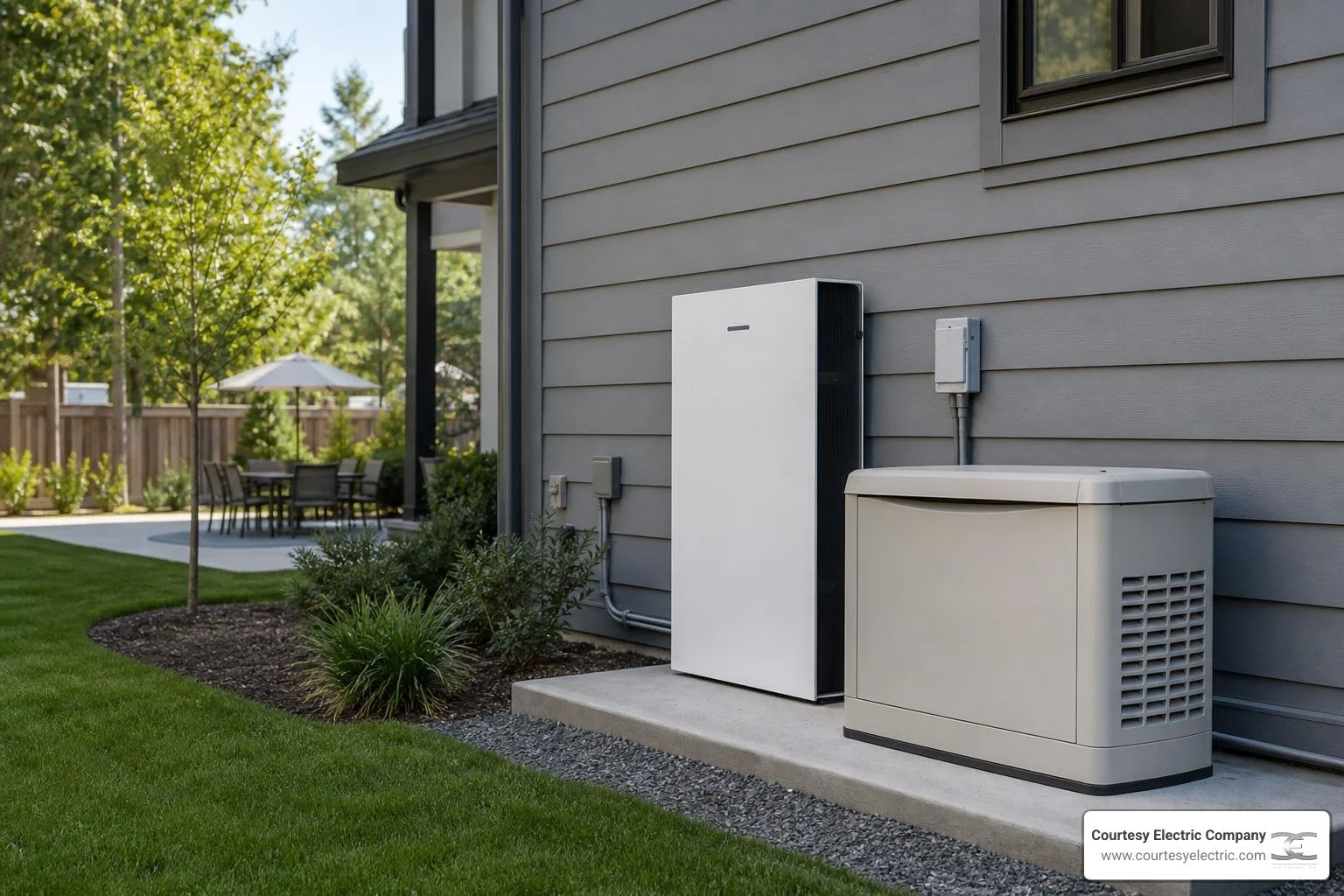
Is Battery Storage or a Generator Better for Backup Power?
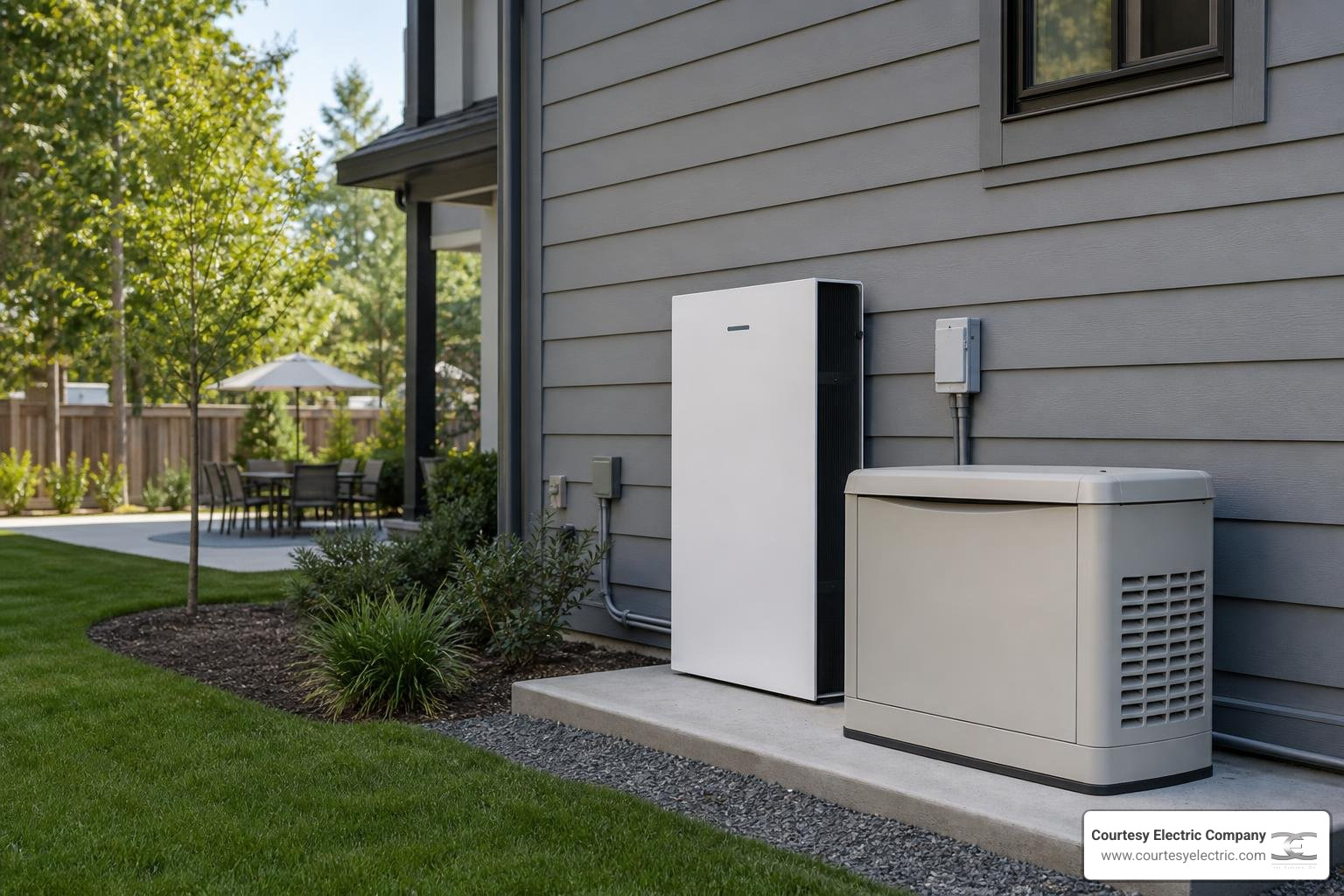
When it comes to battery storage vs generator which is better for backup, the short answer depends on your situation — but here's a quick breakdown to help you decide fast:
| Factor | Battery Storage | Standby Generator |
|---|---|---|
| Best for | Short-to-medium outages, daily savings | Extended outages, high-power loads |
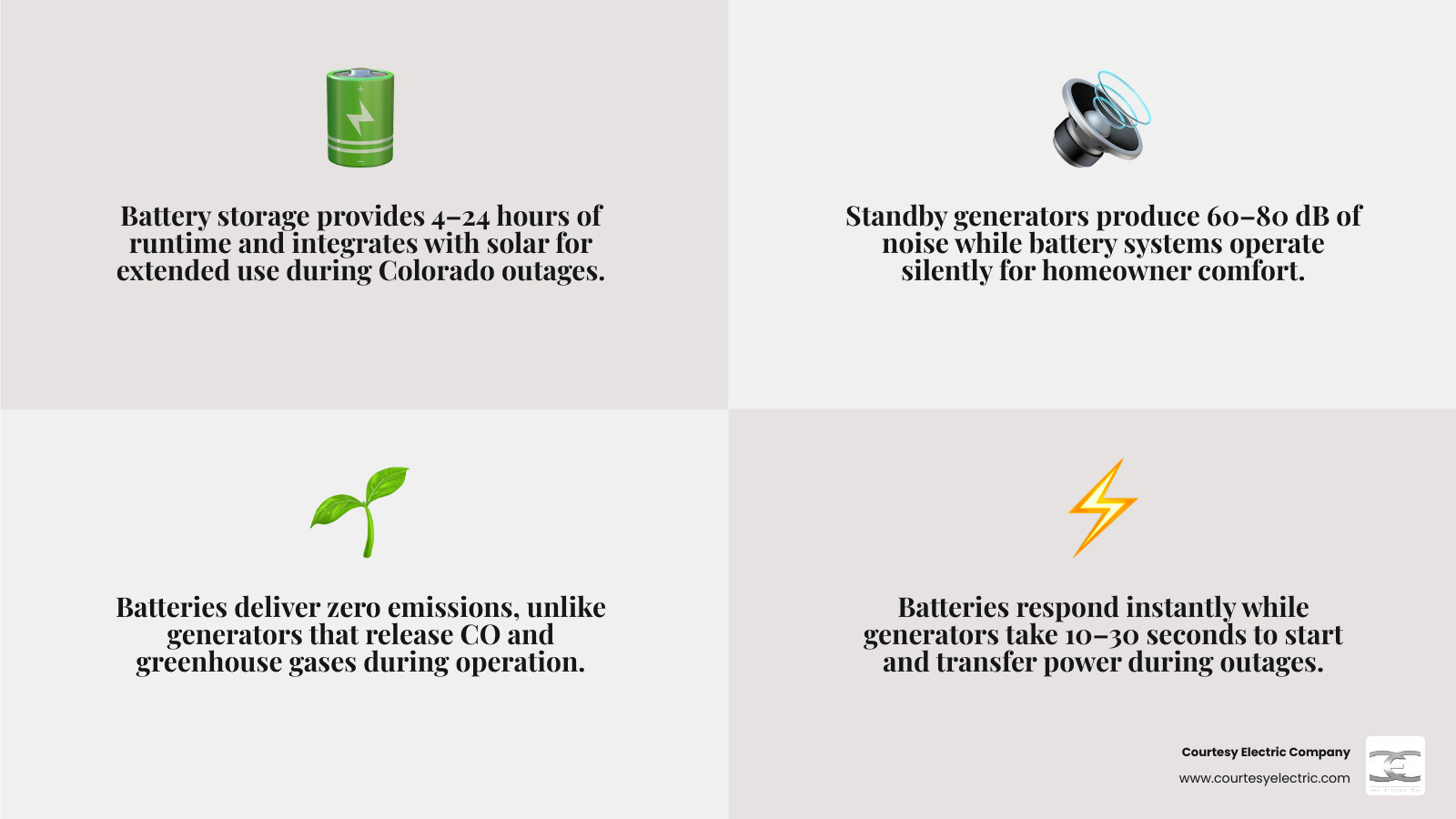
| Runtime | 4–24 hours (more with solar) | Days, as long as fuel is available |
| Noise | Silent | 60–80 dB (loud) |
| Emissions | Zero | CO and greenhouse gases |
| Maintenance | Minimal | Regular (oil, filters, spark plugs) |
| Response time | Instant | 10–30 seconds |
| Daily value | Yes (bill savings, peak shaving) | No (only works during outages) |
| Upfront cost | Higher | Lower |
For most Colorado Front Range homeowners, a battery storage system wins on safety, convenience, and long-term value. A standby generator wins when you need to power your whole home through a multi-day outage.
Power outages are getting worse across the U.S. — lasting 38% longer from 2023 to 2024, according to the U.S. Census Bureau. Here in Colorado, that means wind storms, wildfires, and aging grid infrastructure are no longer just inconveniences. They're real risks to your home, your food, your comfort, and in some cases, your safety.
That's why more Colorado homeowners are asking the same question: should I install a battery storage system or a whole-home generator? Both protect you when the grid goes down. But they work very differently — and the right choice depends on how long your outages last, what you need to power, and how you want your backup system to work day to day.
I'm David Meyer, Vice President of Courtesy Electric, and over my career I've seen how the right — or wrong — backup power decision plays out for Colorado homeowners asking exactly this battery storage vs generator which is better for backup question. In the sections below, I'll walk you through everything you need to make a confident, informed choice.
Battery Storage vs Generator Which Is Better for Backup in Colorado?
Living along the Colorado Front Range—whether in the bustling neighborhoods of Denver, the scenic expanses of Parker and Highlands Ranch, or the heavily wooded, high-wind areas of Black Forest—presents a unique set of energy challenges. Our weather is famously unpredictable. We experience intense spring blizzards, severe summer thunderstorms, high-wind events, and an ever-present wildfire risk.
In recent years, local utilities have increasingly relied on Public Safety Power Shutoffs (PSPS) to mitigate wildfire risks during dry, windy conditions. These preemptive grid shutdowns can leave tens of thousands of homes without electricity for days at a time. When the grid goes dark, having a reliable backup power strategy is no longer a luxury; it is a necessity for protecting your family and property.
Choosing the right system requires evaluating how each technology handles our local climate and grid conditions. To help you weigh your options, we must look at how these systems compare side-by-side in real-world scenarios.
To dive deeper into this initial comparison, you can read our comprehensive analysis on Generator or Battery for Power Outages: Is a Generator or Battery Better for Power Outages?.
Comparison Matrix: Battery Storage vs. Standby Generators
| Feature | Battery Storage (e.g., FranklinWH) | Standby Generator (e.g., Generac / Cummins) |
|---|---|---|
| Energy Source | Electricity (stored from Grid or Solar) | Fossil Fuels (Natural Gas or Liquid Propane) |
| Grid Independence | High (especially when paired with solar panels) | Complete (independent of grid infrastructure) |
| Power Delivery | Instantaneous, seamless transition | 10 to 30-second delay before startup |
| Operational Noise | Completely silent | Quiet lawnmower level (50–80 dB at proximity) |
| Environmental Impact | Zero localized emissions | Carbon dioxide and carbon monoxide emissions |
| Lifespan | 10–15 years (gradual capacity degradation) | 20–30 years (with proper engine care) |
| Ongoing Costs | Virtually zero operating or maintenance costs | Regular fuel consumption and engine servicing costs |
Understanding How Each System Works
To determine which backup solution fits your lifestyle, it is essential to understand the fundamental engineering differences between energy storage and power generation.

A backup generator is, at its core, a stationary engine. When utility power drops, an Automatic Transfer Switch (ATS) senses the loss of voltage. Within seconds, the generator’s engine starter engages, burning fuel (either natural gas from your utility line or liquid propane from an on-site tank) to spin an alternator. This mechanical rotation generates fresh, on-demand alternating current (AC) electricity to power your home’s electrical panel.
For a detailed look at this mechanical process, explore our guide on How Does a Standby Generator Work.
A battery storage system, such as the advanced FranklinWH systems we install, does not create energy. Instead, it acts as an ultra-efficient reservoir. It constantly monitors the grid and stays topped off at 100% capacity. When an outage occurs, the battery instantly discharges its stored direct current (DC) energy through an inverter, converting it to AC power for your home. Because there are no moving parts, the switchover is so fast (typically under 16 milliseconds) that your clocks won't even blink and your desktop computers won't reboot.
To learn more about the technology behind residential energy reservoirs, check out our Battery Storage Guide Centennial Co.
Battery Storage vs Generator Which Is Better for Backup Performance and Runtime?
When evaluating performance, the debate centers on the critical distinction between continuous runtime and power security.
A standby generator is the undisputed champion of prolonged runtime. Because it is connected directly to a natural gas line or a massive propane tank, it can run continuously for days—or even weeks—as long as fuel is available and the engine is properly maintained. This makes generators highly reliable for multi-day winter outages where heavy heating loads are active.
To understand how standby systems handle large household demands, read about the Whole Home Generator Benefits for Colorado Homeowners.
Battery storage systems, on the other hand, are limited by their storage capacity, measured in kilowatt-hours (kWh). A single residential battery typically provides enough energy to run critical loads (like your refrigerator, Wi-Fi, lights, and select outlets) for 12 to 24 hours. However, if you pair your battery storage with a rooftop solar array, the equation changes entirely. During the day, your solar panels power your home and recharge the battery. At night, the battery takes over. This cycle can repeat indefinitely during clear weather, offering true off-grid self-sufficiency.
Battery Storage vs Generator Which Is Better for Backup Maintenance and Lifespan?
The long-term ownership experience of these two systems is vastly different. Standby generators are mechanical machines. Just like a car, they require routine physical maintenance. This includes regular oil changes (usually every 100 to 200 hours of runtime), spark plug replacements, and filter swaps. Without this upkeep, a generator may fail to start when you need it most.
We explain these requirements in detail in our articles on How Proper Maintenance Extends Generator Life and Generator Maintenance Tips for Homeowners. With meticulous care, a high-quality generator can easily last 20 to 30 years.
Battery storage systems require virtually zero ongoing maintenance. There are no engines to exercise, no oil to change, and no moving parts to lubricate. The system automatically manages its own temperature, state of charge, and cell balancing via smart internal software.
Modern residential batteries utilize Lithium Iron Phosphate (LFP) chemistry, which is incredibly stable and safe. While batteries do experience gradual capacity degradation over time (typically retaining 70% to 80% of their original capacity after 10 to 15 years), they require absolutely no effort from the homeowner throughout their operational lifespan.
Key Operational Differences: Noise, Emissions, and Installation
Beyond performance and runtime, daily livability and installation practicalities play a major role in deciding which system is right for your Front Range home.
First, let's talk about noise. Standby generators produce significant noise during operation, typically ranging from 60 to 80 decibels (dB) measured at 23 feet. This is comparable to the sound of an idling lawnmower or heavy traffic. In tightly packed suburban neighborhoods in Highlands Ranch or Denver, generator noise can occasionally lead to HOA complaints or disrupt your own peace of mind. Battery storage systems operate in absolute silence, making them ideal for any residential setting.
Second, environmental impact and safety are major differentiators. Traditional generators rely on fossil fuels, producing approximately 20 to 25 pounds of carbon dioxide per gallon of fuel consumed, alongside dangerous carbon monoxide (CO) exhaust. Because of the risk of CO poisoning, generators must be installed outdoors, at least five feet away from doors, windows, and vents.
Conversely, battery storage systems produce zero localized emissions and present no CO hazards. This allows them to be safely installed inside a garage, utility room, or on an exterior wall.
The physical installation processes also differ. A generator installation requires coordinating both electrical connections and gas plumbing lines, involving trenching and careful site preparation. A battery installation is purely electrical, focusing on mounting the sleek battery enclosures and integrating them with your main electrical panel.
For a complete breakdown of what these projects look like, read our guides on Generator Installation: What to Expect and Battery Storage Installation Guide Centennial Co.
Financial Incentives, Rebates, and Smart Home Integration
While backup power provides peace of mind during emergencies, modern battery storage systems offer financial utility on sunny, normal days through smart home integration.
Under Time-of-Use (TOU) utility rate structures, electricity costs significantly more during peak evening hours. A smart battery storage system can perform "peak shaving" or energy arbitrage—charging from the grid (or solar) when rates are low, and discharging to power your home when rates spike. This active energy management can lower your monthly electric utility bills. Standby generators cannot do this; they sit idle and provide no financial return until an outage occurs.
Furthermore, substantial financial incentives exist to offset your initial investment:
- Federal Tax Credits: Homeowners can qualify for a 30% federal tax credit for installing residential battery storage systems. Learn how to maximize these savings in our guide on Federal Tax Credits for Battery Storage and Span Panels.
- State and Local Rebates: Colorado offers various localized financial incentives for energy-efficiency upgrades. Explore these opportunities in our resource on Colorado Energy Rebates for Electrical Upgrades.
- Smart Panels: Integrating your backup system with a SPAN smart electrical panel allows you to monitor and control every circuit in your home from your phone, dynamically shedding non-essential loads to extend your battery's runtime. Discover the advantages of these systems in our article on Energy Management System Benefits for Homeowners.
Key Benefits of Smart Home Energy Integration
- Real-Time Circuit Control: Easily toggle heavy appliances on or off during an outage via a smartphone app.
- Automatic Load Shedding: Program your system to automatically disable non-essential loads (like hot tubs or guest rooms) when backup power activates.
- Detailed Consumption Analytics: Track exactly how much energy your home is consuming and spot opportunities to reduce waste.
- Grid Service Participation: Join virtual power plants (VPPs) to earn credits by occasionally discharging stored energy back to the utility grid during peak demand events.
Frequently Asked Questions
Making the right choice for your home often brings up practical, highly specific questions. Here are the answers to the most common inquiries we receive from Front Range homeowners.
Can you combine a battery and a generator?
Yes! A hybrid backup system is the gold standard for ultimate energy resilience, particularly for rural properties or areas prone to multi-day winter storms.
In a hybrid configuration, a battery storage system handles daily energy management, peak shaving, and short-term outages in complete silence. If an outage stretches on for multiple days and the battery runs low, a standby generator can automatically kick on to power the home and recharge the battery, before shutting back off. This significantly reduces generator run hours, saves fuel, and minimizes noise.
How long can a home battery run without solar?
Without solar panels to recharge the system during the day, a home battery relies entirely on its stored capacity. The exact runtime depends on your household's electrical load:
- Critical Loads Only (Refrigerator, Wi-Fi, LED lights, phone chargers): A standard 10–15 kWh battery can typically power these essentials for 18 to 24 hours.
- Whole-House Loads (Including central air conditioning, electric clothes dryers, or well pumps): Heavy appliances draw immense amounts of power. Running these continuously can deplete a single battery in as little as 3 to 5 hours.
- Sizing to Match Needs: To back up larger loads without solar, homeowners can install multiple battery units in parallel to expand their total capacity.
How often do standby generators need to be serviced?
Standby generators require consistent, scheduled maintenance to remain reliable. At a minimum, generators should receive a comprehensive professional service once a year. However, manufacturers generally recommend an oil and filter change every 100 to 200 hours of continuous operation, or every six months in areas with frequent outages.
Additionally, standby generators are programmed to perform a self-test or "exercise cycle" weekly or bi-weekly for 10 to 15 minutes to keep the engine lubricated and ensure the battery remains charged. Learn more about maintaining standby systems in our post on How Often Should You Service Your Standby Generator.
Conclusion
When deciding between battery storage vs generator which is better for backup, there is no single "correct" answer—only the answer that perfectly aligns with your home, your family's needs, and your budget.
If your primary goal is to protect your home against brief, frequent outages, lower your monthly utility bills through smart energy management, and enjoy silent, emission-free operation, a premium battery storage system like FranklinWH is an exceptional choice. If you live in a remote area prone to multi-day grid failures and need to run heavy electrical loads indefinitely, a robust standby generator from Generac or Cummins remains a highly reliable solution.
At Courtesy Electric Company, we have spent decades helping homeowners across Denver, Parker, Highlands Ranch, and the Colorado Front Range design and install custom backup power systems. Because we specialize in both standby generators and advanced battery storage, we provide unbiased, expert guidance tailored to your specific goals.
Ready to secure your home's energy independence? Contact us today to request a free estimate on our professional installation services by visiting the Courtesy Electric Company Residential Services page. Let us help you keep the lights on, no matter what the Colorado weather brings.


