
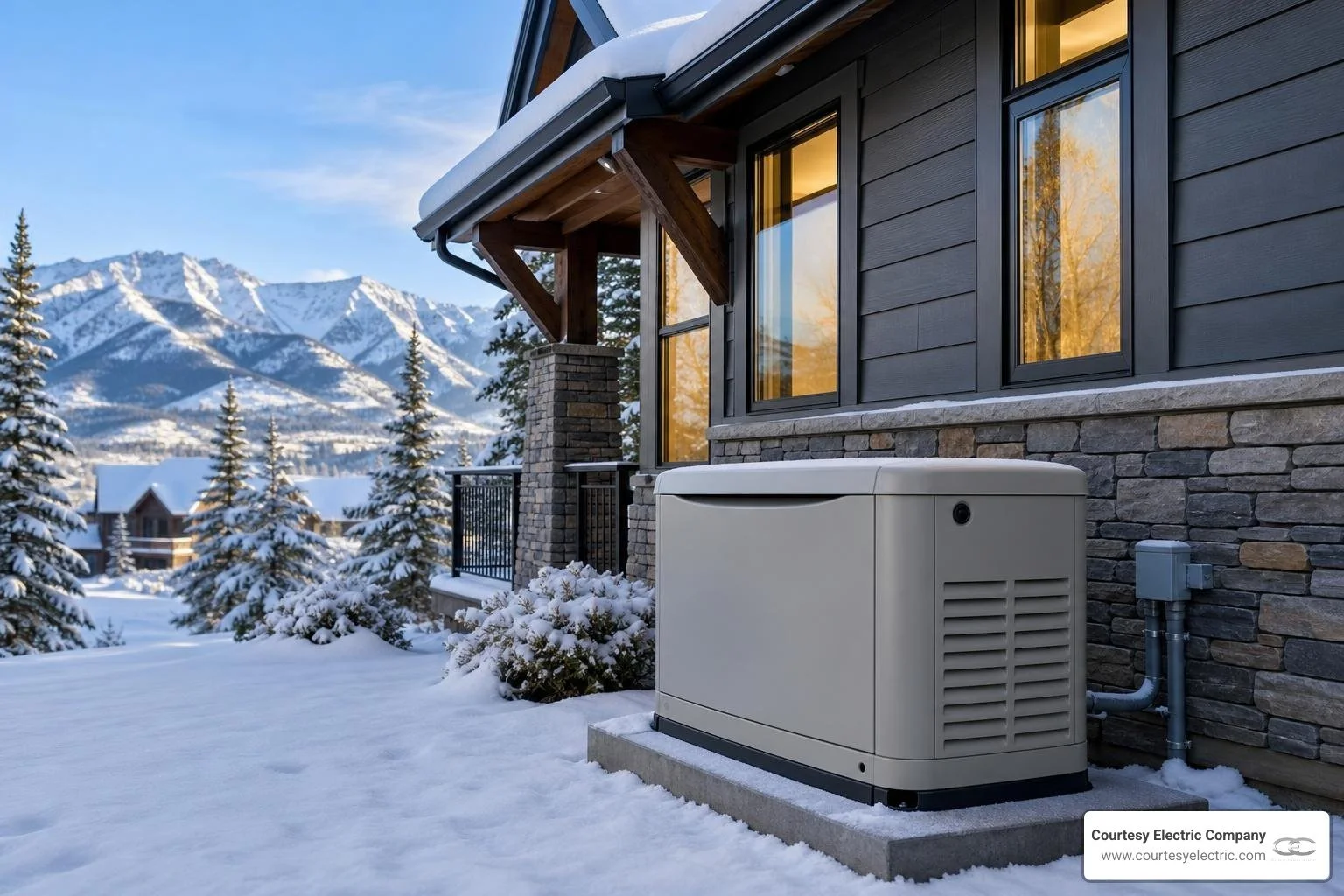
Generator Sizing Guide for Colorado Homeowners: What You Need to Know Before You Buy
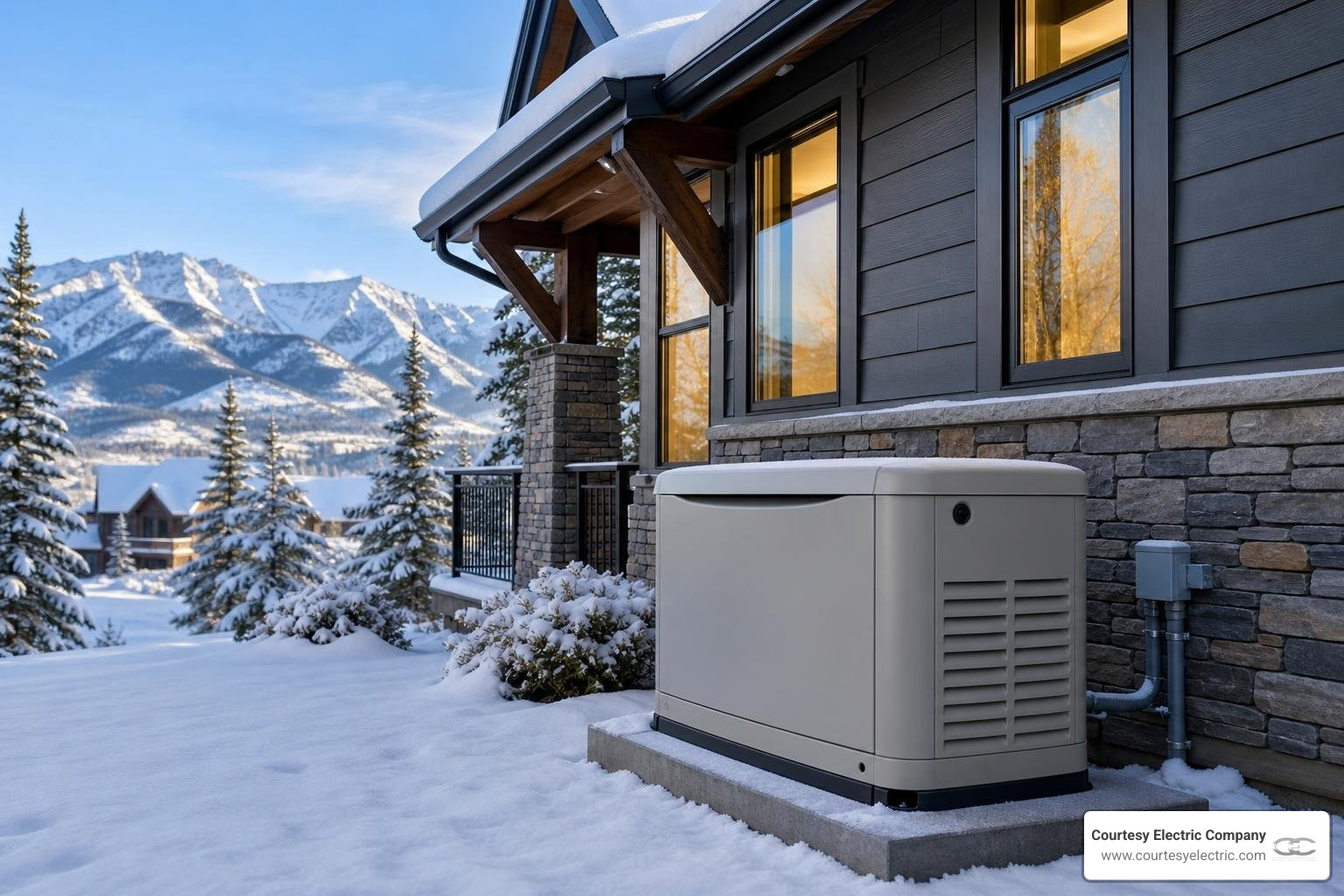
If you're looking for a generator sizing guide for Colorado homeowners, here's a quick-reference summary to get you started:
Quick Generator Sizing Guide for Colorado Homes
| Home Size | Base Generator Size | Recommended Size at 5,280 ft (Denver) | Recommended Size at 7,000+ ft |
|---|---|---|---|
| Tiny / Small (under 1,500 sq ft) | 2–7 kW | 8–9 kW | 9–11 kW |
| Medium (1,500–3,000 sq ft) | 7–15 kW | 12–18 kW | 15–22 kW |
| Large (3,000+ sq ft) | 15–22 kW | 20–26 kW | 22–28 kW+ |
The core steps to size a generator in Colorado:
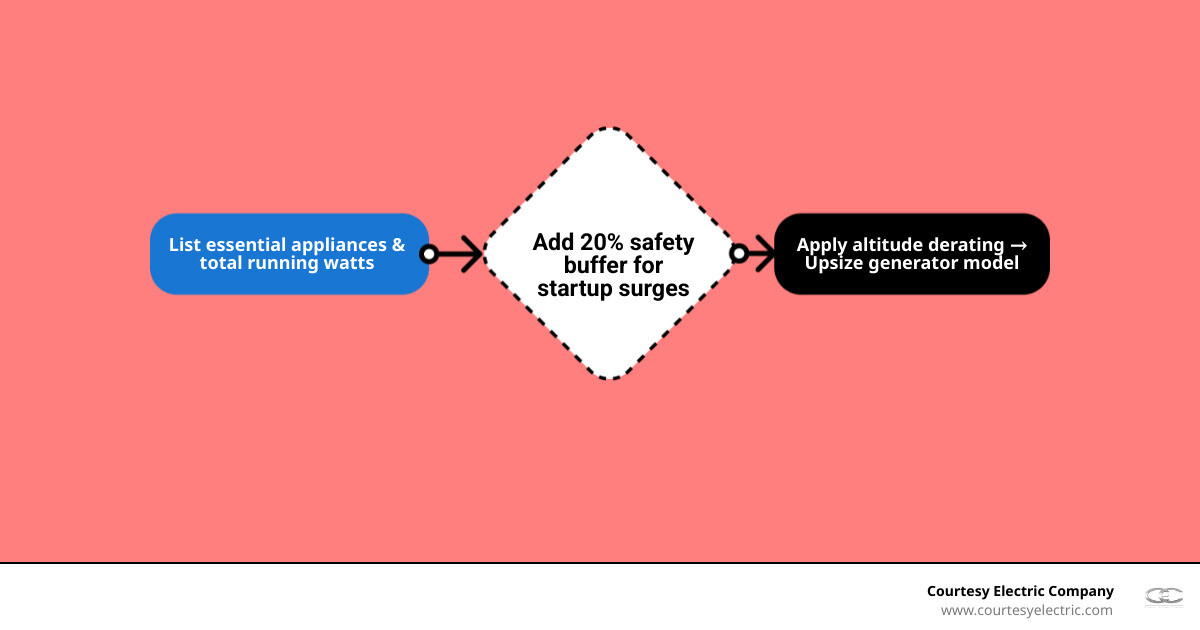
- List the appliances you need to run during an outage and total their running watts
- Add 20% to that total to cover motor startup surges
- Convert to kilowatts (divide by 1,000)
- Apply the altitude derating factor — subtract approximately 3.5% of rated output for every 1,000 feet of elevation
- Upsize your generator to match the derated output your home actually needs
Colorado is not a one-size-fits-all state when it comes to backup power. At Denver's elevation of 5,280 feet, a generator loses roughly 18% of its rated power output just from the thinner air. Climb to Breckenridge or Leadville — above 9,000 to 10,000 feet — and that loss climbs past 30 to 35%. A generator that looks perfectly sized on a spec sheet can leave you seriously underpowered when it matters most.
Layer on top of that the real grid reliability risks Colorado homeowners face — from Xcel Energy intentionally cutting power to tens of thousands of Front Range customers during high-wind wildfire events, to heavy spring snowstorms and bomb cyclones that knock out power for days in rural and mountain communities — and it becomes clear that getting your generator size right is one of the most important decisions you can make for your home.
I'm David Meyer, Vice President of Courtesy Electric Company, and I've spent my career working hands-on with Colorado homeowners on exactly these kinds of backup power challenges — making our team well-versed in every variable that shapes a proper generator sizing guide for Colorado homeowners. In the sections ahead, we'll walk you through the full calculation process, altitude adjustments, fuel choices, permitting requirements, and everything else you need to make a confident, informed decision.
Why Colorado’s Grid Risks and High Altitude Demand a Custom Sizing Strategy
When you live along the Front Range, in the pine-dense acreage of Black Forest, or the master-planned communities of Highlands Ranch and Parker, backup power is no longer a luxury. The local electrical grid faces unprecedented stress. In 2024, Xcel Energy took the historic step of intentionally cutting power to more than 55,000 customers across the Front Range during high-wind advisory events to mitigate wildfire risks.
When you combine these Public Safety Power Shutoffs (PSPS) with heavy, wet spring snowstorms and winter bomb cyclones, a reliable backup power strategy becomes essential. To keep your home safe, understanding Generator Benefits During Colorado Winter Power Outages is step number one.
However, you cannot simply buy a generator off the shelf based on its standard factory label. Colorado’s geography introduces physical constraints that will quickly choke an improperly planned system. The unique local climate also dictates how we protect these machines. Reading up on How Colorado Weather Affects Generator Lifespan shows that bitter cold, dry air, and high winds demand a tailored mechanical approach.
The Altitude Power Thief: How Elevation Affects Output
Internal combustion engines need oxygen to burn fuel. Because Colorado’s air is significantly thinner than at sea level, generators literally gasp for air. This physical reality is known as altitude derating.
A generator loses approximately 3.5% to 4% of its rated power for every 1,000 feet of elevation above sea level. This power loss applies directly to gas-fired and liquid propane equipment. Let's look at how this plays out across the Front Range:
- Fort Collins / Denver (approx. 5,000–5,280 feet): A generator delivers roughly 18% to 20% less than its nameplate rating.
- Parker / Foothills (approx. 6,000–7,000 feet): Generator derating climbs to 21% to 28%.
- Black Forest / Higher Elevations (approx. 7,500+ feet): Derating climbs to 30% or more.
If you purchase a standard 22 kW generator to run your home at sea level, that same machine will only produce about 15.8 kW to 18 kW in Denver. If you live in a higher-elevation community, that 22 kW unit drops to an effective output of 14 kW to 15 kW. This is why learning Which Home Generator Brand Is Better For Colorado is so critical; some brands and engines handle high-elevation air mixtures far better than others.
Using a Generator Sizing Guide for Colorado Homeowners to Combat Grid Instability
Grid instability in Colorado is highly seasonal. In the spring, heavy, wet snow snaps tree branches onto power lines. In the summer, dry lightning and extreme winds trigger precautionary grid shutdowns. In the winter, sub-zero blizzards freeze grid infrastructure.
For homeowners in Parker, Highlands Ranch, and Black Forest, being self-reliant for 24 to 72 hours is standard procedure. Properly sizing your backup power ensures you aren't left in the dark during these critical windows. When evaluating your home's needs, Choosing The Right Backup Power For Colorado means designing a system that accounts for these specific environmental threats, ensuring your heating systems, well pumps, and refrigeration never skip a beat.
The Step-by-Step Generator Sizing Guide for Colorado Homeowners
Sizing a generator is a game of math, not guesswork. If you undersize your generator, the system will overload and shut down when heavy appliances try to kick on. If you oversize it, you waste fuel and risk "wet-stacking" (unburnt fuel accumulating in the exhaust system of diesel units, or general engine inefficiency in gas units).
To find the sweet spot, you must understand How Does A Standby Generator Work under load. Generators handle two types of electrical loads:
- Running Watts (Continuous Watts): The continuous power required to keep an appliance operating.
- Starting Watts (Surge Watts): The brief, intense burst of power required to start electric motors (like those in your air conditioner, refrigerator, or well pump). These motor startup surges can demand 6 to 8 times the running current for a fraction of a second.
Step 1: Calculate Your Total Running and Starting Wattage
To calculate your baseline power needs, list the essential appliances you want to run during an outage. Here is a list of common household appliances and their typical wattages:
- Refrigerator / Freezer: 700 running watts | 2,200 starting watts
- Natural Gas Furnace Blower: 800 running watts | 2,350 starting watts
- Sump Pump (1/3 HP): 800 running watts | 1,300 starting watts
- Well Pump (1/2 HP): 1,000 running watts | 3,000 starting watts
- 3-Ton Central Air Conditioner: 3,500 running watts | 7,000 starting watts
- Electric Water Heater: 4,500 running watts | 4,500 starting watts
- Microwave: 1,000 running watts | 1,000 starting watts
- LED Light Bulbs (10 bulbs): 100 running watts | 100 starting watts
- Wi-Fi Router and Modem: 50 running watts | 50 starting watts
To simplify the math without having to map out every single starting watt, industry experts use a 20% safety buffer multiplier (1.2).
First, add up the running watts of all the appliances you want to run simultaneously. Let's say your essential list includes your refrigerator, furnace blower, lights, router, and microwave:
$$\text{Total Running Watts} = 700 + 800 + 100 + 50 + 1,000 = 2,650\text{ W}$$
Next, apply the 20% safety buffer to account for starting surges and future load additions:
$$2,650\text{ W} \times 1.2 = 3,180\text{ W (or } 3.18\text{ kW)}$$
This means your minimum generator size at sea level would be roughly 3.2 kW.
Step 2: Adjusting for Elevation with a Generator Sizing Guide for Colorado Homeowners
Now, we must apply the Colorado altitude adjustment. If you live in Parker at an elevation of 6,000 feet, your generator will suffer an approximate 24% loss in power output (using a standard 4% derating factor per 1,000 feet).
To find the actual nameplate generator size you need to purchase, use this formula:
$$\text{Required Generator Nameplate Capacity} = \frac{\text{Calculated Wattage Need}}{1 - \text{Derating Percentage}}$$
Using our 3.18 kW baseline need in Parker:
$$\text{Nameplate Capacity} = \frac{3.18\text{ kW}}{1 - 0.24} = \frac{3.18\text{ kW}}{0.76} = 4.18\text{ kW}$$
In this scenario, a standard 3.2 kW generator would fail under load at altitude. You would need to upsize to at least a 4.5 kW or 5 kW unit to safely deliver the power your home requires. If you are sizing a whole-home system that requires 22 kW of actual power, a low-elevation 22 kW unit must be upsized to a 28 kW unit or larger to deliver that same effective output at altitude.

Recommended Generator Sizes by Colorado Home Size
To help you visualize what this math looks like in the real world, we have compiled a quick reference table comparing standard home sizes, baseline power needs, and the adjusted generator sizes required at different Colorado altitudes.
Before committing to a system, many homeowners ask: Is A Whole Home Generator Worth The Investment? When you look at the cost of frozen pipes, ruined food, and displaced families, the math usually speaks for itself.
| Home Size (Sq Ft) | Typical Essential Appliances | Baseline Sea-Level Size | Denver Area (5,280 ft) | Parker / Black Forest (7,000+ ft) |
|---|---|---|---|---|
| Tiny / Small (<1,500) | Lights, fridge, Wi-Fi, furnace blower, sump pump | 5 kW to 7 kW | 8 kW to 10 kW | 10 kW to 12 kW |
| Medium (1,500–3,000) | Above + well pump, microwave, select outlets, 1 AC unit | 10 kW to 15 kW | 13 kW to 18 kW | 15 kW to 22 kW |
| Large (3,000+) | Above + dual HVAC, electric water heater, double ovens | 15 kW to 22 kW | 20 kW to 26 kW | 22 kW to 28 kW+ |
Sizing for Tiny and Small Colorado Homes
For smaller homes or cabins, a generator in the 2 kW to 7 kW range can comfortably power essential loads like refrigeration, heating blowers, and communications. If you are looking for specific regional advice, our Generators Fraser Co Complete Guide or similar mountain-specific resources can help you navigate extreme cold and high-altitude planning for smaller properties. For these smaller footprints, portable units or compact standby systems are often highly efficient.
Sizing for Medium and Large Colorado Homes
Medium and large homes in neighborhoods like Highlands Ranch or Parker typically feature larger square footage, central air conditioning, multiple heating zones, and sometimes well pumps. Sizing for these homes usually lands in the 12 kW to 22 kW range (which translates to 15 kW to 28 kW at altitude).
To understand how these larger units operate seamlessly, exploring Whole Home Generator Benefits For Colorado Homeowners will show you how automatic power management keeps your entire household comfortable without manual intervention.
Backup Power Options: Standby Generators, Batteries, and High-Performance Homes
While standby generators remain the gold standard for long-term power outages, modern technology has expanded the toolkit for Colorado homeowners. Today, you can choose between standby generators, battery storage systems, or a hybrid combination of both.
If you are weighing these technologies, it is helpful to read Generator Or Battery For Power Outages Is A Generator Or Battery Better For Power Outages to compare runtime, fuel dependence, and performance.
For the ultimate in resilient home energy, you can actually combine these systems. Understanding How Generators And Batteries Can Work Together allows you to use battery storage for quick, silent backup during short outages, while a standby generator kicks in to recharge the batteries and handle heavy loads during extended multi-day grid failures.
At Courtesy Electric Company, we specialize in high-performance integrations, including:
- Standby Generators: High-capacity units from Generac and Cummins that run on natural gas or liquid propane.
- Battery Storage: Premium systems like Franklin Battery Storage that store clean energy from the grid or solar panels.
- Smart Electrical Panels: SPAN smart panels that allow you to dynamically manage your home's electrical loads from an app, instantly turning off non-essential circuits to extend your battery or generator life.
Whole-Home Backup vs. Critical Circuits Backup
When designing your backup system, you must make a fundamental choice: do you want to back up your entire home, or only your critical circuits?
- Whole-Home Backup: An automatic transfer switch (ATS) monitors grid power. When the grid goes down, the ATS disconnects your home from the utility lines and energizes your entire main electrical panel. You can run any appliance in your house, provided the generator is sized to handle the cumulative load. To see how this seamless protection changes daily life, read about How A Whole Home Generator Protects Your Family.
- Critical Circuits Backup: Instead of powering the whole panel, the generator or battery connects to a dedicated subpanel containing only essential circuits (fridge, furnace blower, well pump, internet, and select lights). This approach allows you to install a significantly smaller, more cost-effective generator.
How High-Performance Homes Change the Sizing Math
If you own a high-performance home, such as one built to Passive House standards, the backup power math changes completely. High-performance homes use advanced insulation, airtight building envelopes, and energy recovery ventilators (ERVs) to reduce total energy consumption by 60% to 80% compared to conventional code-built homes.
In a Passive House, you do not need a massive generator to keep the home warm during a winter blizzard. The home retains its heat for days with minimal input. A tiny generator or a modest battery storage system paired with solar panels can keep a high-performance home fully functional indefinitely, bypassing the need for large, high-altitude-adjusted standby units.
Colorado Regulatory, Permitting, and Safety Requirements
Installing a standby generator is not a DIY weekend project. Because these systems interface directly with your home's electrical infrastructure and local gas lines, they are heavily regulated to ensure safety.
Under National Electrical Code (NEC) Article 702, standby systems must feature a certified transfer switch to prevent back-feeding power into the utility grid, which poses a fatal risk to utility line workers. The Colorado Department of Regulatory Agencies (DORA) and local municipal building departments require electrical and mechanical permits before installation begins. To understand what this process looks like from start to finish, check out our guide on Generator Installation What To Expect.
Fuel Types and Cold-Weather Considerations
The fuel you choose impacts both generator sizing and winter reliability:
- Natural Gas (NG): Convenient because it is piped directly to your home. However, natural gas has slightly lower energy density than liquid propane, meaning your generator's output will be slightly lower on NG than on LP.
- Liquid Propane (LP): Highly reliable and burns incredibly clean. It is the preferred choice for rural properties in Black Forest or the foothills where natural gas lines are unavailable.
Because Colorado winters routinely drop below freezing, standby generators require cold weather kits. These kits include thermostatically controlled battery warmers and oil heaters. Without them, the engine oil thickens, and the battery loses its cranking power, preventing the generator from starting when a winter blizzard knocks out the grid.
Critical Safety Protocols for Colorado Winters
Carbon monoxide (CO) poisoning is a major hazard during winter power outages, often caused by improper portable generator placement. Standby generators must be permanently installed on a concrete pad at least 5 feet away from home openings (windows, doors, vents) and ideally 20 feet away from the home for portable units.
During heavy snowfalls, you must keep the generator's intake and exhaust vents clear of snow drifts to prevent engine choking and CO backup. To prepare your system for these harsh conditions, review Generator Maintenance Before Colorado Storm Season to ensure your unit is ready to perform safely when the weather turns.
Frequently Asked Questions About Colorado Generator Sizing
Will a 5,000-watt generator run a whole house in Colorado?
No, a 5,000-watt (5 kW) generator will not run a typical whole house, especially at Colorado altitudes. In Denver or Parker, a 5 kW generator only delivers about 3.8 kW to 4.1 kW of actual power due to altitude derating. While it cannot power a whole house, a 5,000-watt generator is excellent for critical circuits backup — easily running your refrigerator, natural gas furnace blower, internet router, and a few LED lights simultaneously.
Can I run my whole house on a 12,000-watt generator at high altitude?
Yes, a 12,000-watt (12 kW) generator is typically adequate to run most small to medium homes (up to three bedrooms) depending on their specific energy usage. However, at high altitudes, its effective output drops to around 9 kW to 9.6 kW. While it can run your essential appliances, you will need to practice active load management — meaning you should avoid running heavy-draw appliances like your electric clothes dryer, double ovens, or central AC at the same time.
What is the difference between kW and kVA for home generators?
- kW (Kilowatts): This represents "real power" — the actual electricity used to perform work on resistive loads, like light bulbs and heating elements.
- kVA (Kilo-Volt-Amperes): This represents "apparent power" — the total amount of power in the system, including reactive power used by inductive loads (motors in ACs, pumps, and refrigerators).
Most residential standby generators are rated at a 0.8 Power Factor (PF). This means a generator rated at 12.5 kVA only delivers 10 kW of real power ($12.5 \times 0.8 = 10$). When sizing your backup system, always base your calculations on the generator's continuous kW rating, not its kVA rating.
Conclusion
Getting your generator size right along the Colorado Front Range requires balancing electrical loads, altitude power losses, and local environmental demands. By calculating your continuous and surge wattages, applying the altitude derating factor, and choosing the right fuel and cold-weather protections, you can ensure your family remains safe, warm, and connected through any storm or grid shutdown.
At Courtesy Electric Company, we have been serving Denver and the Front Range since 1976. Our team of licensed master electricians specializes in the professional layout, sizing, and installation of premium home standby generators from Generac and Cummins, as well as Franklin battery storage systems and SPAN smart panels. We handle the entire process — from load calculations and local permitting to final utility coordination — ensuring your system is perfectly optimized for our unique Colorado climate.
Don't leave your home's resilience to guesswork. Get a free estimate on your backup power installation from Courtesy Electric Company today, and let our local experts design the perfect system for your home.


