
Why Colorado's Climate Is One of the Hardest Tests a Generator Can Face

How Colorado weather affects generator lifespan is something every Front Range homeowner with a standby generator needs to understand — because Colorado's climate puts backup power systems under stress that most other states simply don't match.
Here is a quick summary of the key ways Colorado's climate shortens generator lifespan:
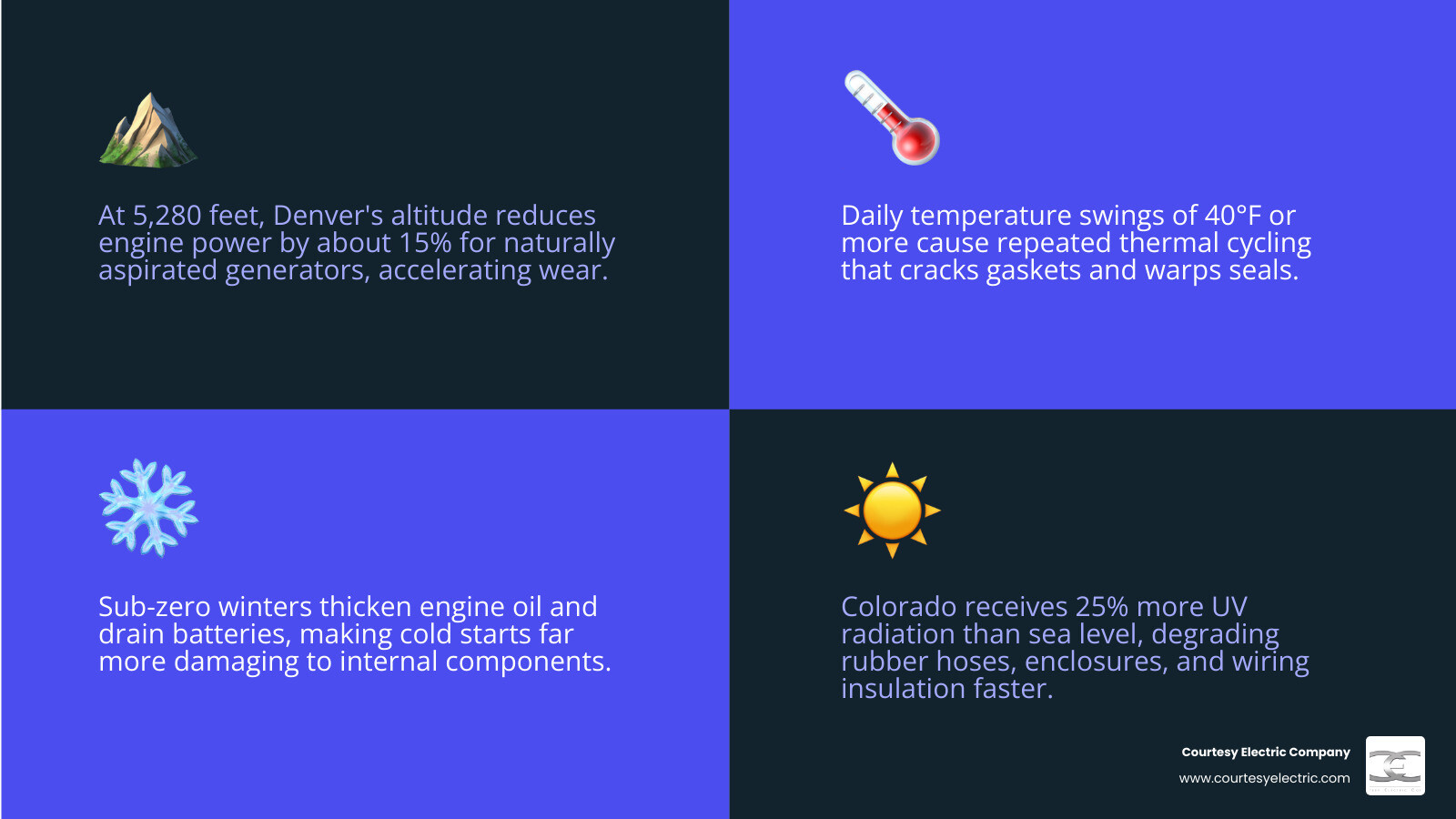
- High altitude — Denver sits at 5,280 feet, and naturally aspirated engines lose roughly 3% power per 1,000 feet of elevation gain, forcing generators to work harder and wear faster
- Extreme temperature swings — Daily shifts of 40°F or more cause repeated thermal cycling that cracks gaskets, warps seals, and accelerates component wear
- Sub-zero winters — Freezing temperatures thicken engine oil, drain batteries, and make cold starts far more damaging to internal engine parts
- Snow and ice — Blocked intake and exhaust vents restrict airflow, trap moisture, and create dangerous conditions
- Intense UV radiation — Colorado receives about 25% more UV than sea level, degrading rubber hoses, enclosures, and wiring insulation faster
- Dry air and low humidity — Winter humidity can drop below 20%, drying out seals and gaskets that need moisture to stay flexible
- Wildfire smoke and dust — Fine particulates clog air filters quickly, increasing engine wear and reducing combustion efficiency
Taken together, these conditions can meaningfully reduce a generator's expected 20- to 30-year lifespan if the unit is not properly maintained and installed for Colorado's specific environment.
I'm David Meyer, Vice President of Courtesy Electric Company, and after decades of installing and servicing backup power systems across Denver and the Colorado Front Range, I've seen how Colorado weather affects generator lifespan — from altitude-related power loss to cold-weather starting failures that could have been prevented. In the sections below, I'll walk you through exactly what's happening to your generator and what you can do about it.
How Colorado Weather Affects Generator Lifespan: The Altitude and Temperature Factor
To understand why a generator in Parker or Highlands Ranch might age faster than one at sea level, we have to look at the physics of internal combustion. Standby generators are essentially stationary cars; they rely on an engine to burn fuel, turn an alternator, and produce electricity. Because of this, they are highly sensitive to the air they breathe and the temperatures they operate in.
When we talk about Choosing the Right Backup Power for Colorado, we must design the system around two invisible but powerful forces: thin mountain air and rapid thermal cycling.
High Altitude and Air Density Challenges
At sea level, atmospheric pressure is roughly 14.7 PSI. By the time you get to Denver, that pressure drops to about 11.5 PSI—representing an approximate 20% reduction in air density. For a naturally aspirated engine (one that relies on atmospheric pressure to pull air into the combustion chamber), this is a major hurdle.
With 20% fewer oxygen molecules in every cubic foot of air, the fuel-to-air ratio is thrown out of balance. The engine cannot burn as much fuel as efficiently as it would at sea level. This leads to a physical phenomenon known as altitude "derating."
Naturally aspirated generator engines lose roughly 3% of their rated power output for every 1,000 feet of elevation gain. In Denver, Parker, and Highlands Ranch, a generator operates at a permanent 15% to 18% capacity loss. Up in higher communities like Black Forest, that loss can easily exceed 20%.
Because the engine has less oxygen to work with, it must run longer and work significantly harder to support the same electrical load. This constant extra strain accelerates internal engine wear, increases operating temperatures, and ultimately shortens the overall lifespan of the system. If your home requires 15 kW of power, installing a 15 kW generator will result in severe overloading at our altitude. Instead, the unit must be sized 15% to 20% larger to compensate for the thin air.
Extreme Temperature Swings and Thermal Cycling
Colorado is famous for its wild weather swings. It is not uncommon in the Front Range to experience a balmy 60°F afternoon in February, only for an Arctic cold front to crash through and drop the temperature to -5°F by midnight.
This rapid fluctuation is incredibly hard on mechanical equipment due to "thermal cycling." When metals and rubbers are subjected to sudden, extreme temperature changes, they expand and contract at different rates.
For a standby generator, this means:
- Gasket and Seal Failure: Rubber and silicone gaskets become brittle and lose their elasticity, leading to oil and coolant leaks.
- Warped Components: Mismatched expansion rates between aluminum engine heads and cast-iron blocks can warp mating surfaces over time.
- Stressed Electronics: Sensitive control panels and wiring harnesses experience micro-expansions that can loosen electrical connections and degrade solder joints.
Winter Hazards: Cold Starts, Snow, and Ice Accumulation
Winter is when you are most likely to need your standby generator, but it is also when the system is under the greatest environmental stress. The combination of sub-zero temperatures and heavy, wind-driven snow can easily cause a generator to fail right when the power grid goes dark.

To ensure your system is ready for the first freeze, we always emphasize completing Generator Maintenance Before Colorado Storm Season.
How Colorado Weather Affects Generator Lifespan in Sub-Zero Temperatures
When the temperature drops below freezing, two critical generator components are immediately compromised: the engine oil and the battery.
Standard 10W-30 engine oil, which is perfectly fine for summer operation, thickens dramatically in sub-zero cold. It turns into a heavy, molasses-like sludge. When the generator receives a signal to start, the starter motor must work twice as hard to turn the engine over against this thick oil. More importantly, once the engine does fire up, the thick oil cannot circulate quickly enough to lubricate the cylinder walls, bearings, and overhead valves. Those first few seconds of dry, unlubricated operation cause more engine wear than dozens of hours of normal running time.
At the same time, extreme cold drains the battery. Just like a car battery, a generator’s 12V starting battery can lose up to 50% of its cranking capacity when temperatures drop below freezing. If the battery is already a few years old, the combination of thick oil and a cold-weakened battery will result in a "fail to start" error, leaving you in the dark.
Snow and Ice Blockages on Intake and Exhaust Vents
Blizzards and heavy snow accumulation pose a direct physical threat to standby units. Standby generators are housed in protective enclosures, but they still require massive amounts of fresh air to cool the engine and support combustion.
If blowing snow accumulates against the side of the enclosure, it can completely block the air intake vents. This starves the engine of oxygen, causing it to run "rich" (burning too much fuel and not enough air), which leads to carbon buildup on the spark plugs and valves. If the exhaust port becomes blocked by ice or heavy snow drifts, dangerous carbon monoxide fumes can back up into the enclosure, and the unit will quickly shut down due to high backpressure or overheating.
Additionally, melting snow that refreezes into ice can lock the enclosure's access doors shut or freeze the automatic transfer switch (ATS) mechanism. Understanding How Blizzards Hail and Lightning Stress Your Wiring is essential for keeping your entire electrical system safe during major winter weather events.
Summer Stressors: Intense UV Radiation, Dry Air, and Wildfire Smoke
While winter gets most of the attention, Colorado’s summers present their own unique set of challenges. Between our high-altitude sun, low humidity, and seasonal wildfires, summer can be just as damaging to a generator's lifespan as winter.
Transitioning your system between these extreme seasons requires targeted care, which is why we recommend scheduling Spring Generator Maintenance After Winter to clean out winter debris and prepare for the summer heat.
How Colorado Weather Affects Generator Lifespan During Wildfire Season
In recent years, wildfire season has become a regular part of summer in the Front Range. The smoke carried by these fires is not just an air quality issue for humans; it is highly destructive to mechanical engines.
Wildfire smoke is packed with extremely fine particulate matter, ash, and corrosive chemical compounds. When your generator runs its weekly self-test or operates during a summer outage, it pulls this ash-laden air directly into its intake system.
- Rapid Filter Clogging: Standard air filters can plug up in a matter of hours during heavy smoke events, starving the engine of air.
- Engine Abrasion: If fine ash particles bypass a cheap or damaged filter, they act as an abrasive sandpaper inside the combustion chamber, quickly wearing down piston rings and scoring cylinder walls.
- Corrosive Ash: When ash combines with the trace moisture in the air, it can form mild acids that corrode copper electrical terminals and aluminum engine components.
Dry Air and Intense UV Degradation
Because Denver and the Front Range sit closer to the sun with less atmospheric protection, our UV radiation is roughly 25% stronger than at sea level. This intense solar radiation beats down on the generator's enclosure all day, raising internal temperatures and degrading materials.
At the same time, Colorado's dry air—frequently dropping below 20% humidity—accelerates the drying out of rubber and plastic. Over time, this combination of high UV and low humidity causes:
- Brittle Hoses and Belts: Fuel lines, coolant hoses, and drive belts dry out, crack, and eventually split, leading to catastrophic fuel leaks or engine overheating.
- Degraded Wiring Insulation: Exposed wiring harnesses inside and outside the enclosure can become brittle, leading to short circuits.
- Faded and Cracked Seals: The weatherproofing seals around the enclosure doors degrade, allowing rain, snow, and pests to enter the sensitive electrical compartment.
Essential Maintenance and Fuel Considerations for the Front Range
Operating a generator successfully in Colorado means adjusting your maintenance routine and component choices to match our unique climate. Standard, out-of-the-box setups designed for midwestern or coastal states often fall short here.
To keep your system running reliably for decades, you must understand How Proper Maintenance Extends Generator Life under local conditions.
Cold Weather Kits and Battery Warmers
If you live in Denver, Parker, Highlands Ranch, or Black Forest, a Cold Weather Kit is not an optional accessory—it is a necessity.
A standard cold weather kit typically consists of two main components:
- An Oil Warm-up Pad (Oil Pan Heater): A thermostatically controlled heating pad that wraps around or sticks to the bottom of the engine oil pan. It keeps the oil warm and fluid, ensuring immediate lubrication upon startup.
- A Battery Warmer: A heated blanket that wraps around the starting battery, keeping it at an optimal temperature so it retains its full cranking power even on the coldest January nights.
These heaters plug directly into your home’s utility power and only turn on when ambient temperatures drop below a certain threshold (usually around 35°F to 40°F). They ensure that when a winter storm knocks out your power, your generator fires up effortlessly on the first try, saving your engine from damaging dry starts.
Proactive Maintenance Schedules for Colorado Homeowners
Because of the environmental stressors we've discussed, standard manufacturer maintenance intervals are often too long for Colorado. We recommend a proactive, climate-adjusted maintenance schedule.
| Component | Standard Interval | Recommended Colorado Front Range Interval | Why It Matters in Colorado |
|---|---|---|---|
| Engine Oil & Filter | Every 100-200 hours / Annually | Every 100 hours / Bi-annually (Spring & Fall) | Combats thermal breakdown from temperature swings and prevents winter sludge. |
| Air Filter | Annually | Check quarterly; replace after any major wildfire or dust event | Prevents engine starvation and internal abrasion from ash and dust. |
| Starting Battery | Replace every 3-5 years | Replace every 3 years | Cold winter temperatures rapidly degrade battery chemistry and starting reliability. |
| Spark Plugs | Every 200 hours / Annually | Annually | High-altitude combustion can lead to carbon buildup and hard starting. |
| Rubber Hoses & Belts | Inspect annually | Inspect bi-annually; replace at first sign of micro-cracking | Dry air and high UV accelerate dry rot and cracking. |
Keeping up with this schedule is much easier when you know How Often Should You Service Your Standby Generator. For a complete breakdown of what you can do yourself, check out our Generator Maintenance Tips for Homeowners.
Frequently Asked Questions about Colorado Generator Lifespan
What is the average lifespan of a standby generator in Colorado?
With regular maintenance, proper high-altitude sizing, and a cold weather kit installed, a quality standby generator in Colorado can last between 20 to 30 years, or roughly 3,000 to 5,000 run-time hours. However, without proper winterization and high-altitude adjustments, that lifespan can easily be cut in half due to premature engine wear, battery failures, and gasket degradation.
How does altitude derating affect generator sizing?
Because the air is thinner at higher elevations, naturally aspirated generator engines lose about 3% of their power output for every 1,000 feet of elevation gain. In the Denver area (approx. 5,000–6,000 feet), this results in a 15% to 18% loss of capacity. When sizing a generator, we must calculate this "derate factor" and install a unit that is physically larger than your electrical load requires to ensure it doesn't overload and shut down during an outage.
What are the signs that my generator is failing from weather stress?
Some of the most common warning signs include:
- Hard starting or taking multiple attempts to fire up in cold weather.
- Visible oil or coolant puddles under the unit, indicating cracked or shrunk gaskets from thermal cycling.
- A drop in voltage output or flickering lights in the home when the generator is running.
- Excessive black smoke from the exhaust, indicating air starvation from a clogged filter or altitude issues.
If you notice any of these issues, it is critical to seek professional help. Read our guide on Signs Your Generator Needs Professional Attention to learn more.
Conclusion: Partner with Front Range Standby Power Experts
Understanding how Colorado weather affects generator lifespan is the first step in protecting your investment. Our wild temperature swings, high altitude, and heavy snows mean that your backup power system requires specialized installation, precise sizing, and proactive, local maintenance.
At Courtesy Electric Company, we have been serving Denver, Parker, Highlands Ranch, Black Forest, and the wider Colorado Front Range for decades. We specialize in the professional installation and servicing of top-tier standby generators, ensuring they are perfectly calibrated for high-altitude performance and fully equipped to survive our harshest winters.
Investing in a standby system brings incredible peace of mind. To learn more about how a properly configured system can protect your family, read about the Whole Home Generator Benefits for Colorado Homeowners.
Don't wait for the next blizzard or summer wildfire to find out if your generator is up to the task. Schedule professional backup power services today with Courtesy Electric Company for a free estimate on installations or to get your system ready for whatever the Colorado skies throw our way.


