

How Much Does Battery Storage Save During Outages — And Is It Worth It in Colorado?

How much does battery storage save during outages depends on several factors — but here's a quick answer for most Colorado Front Range homeowners:
Quick Answer: Battery Storage Savings During Outages
| Savings Category | Estimated Value |
|---|---|
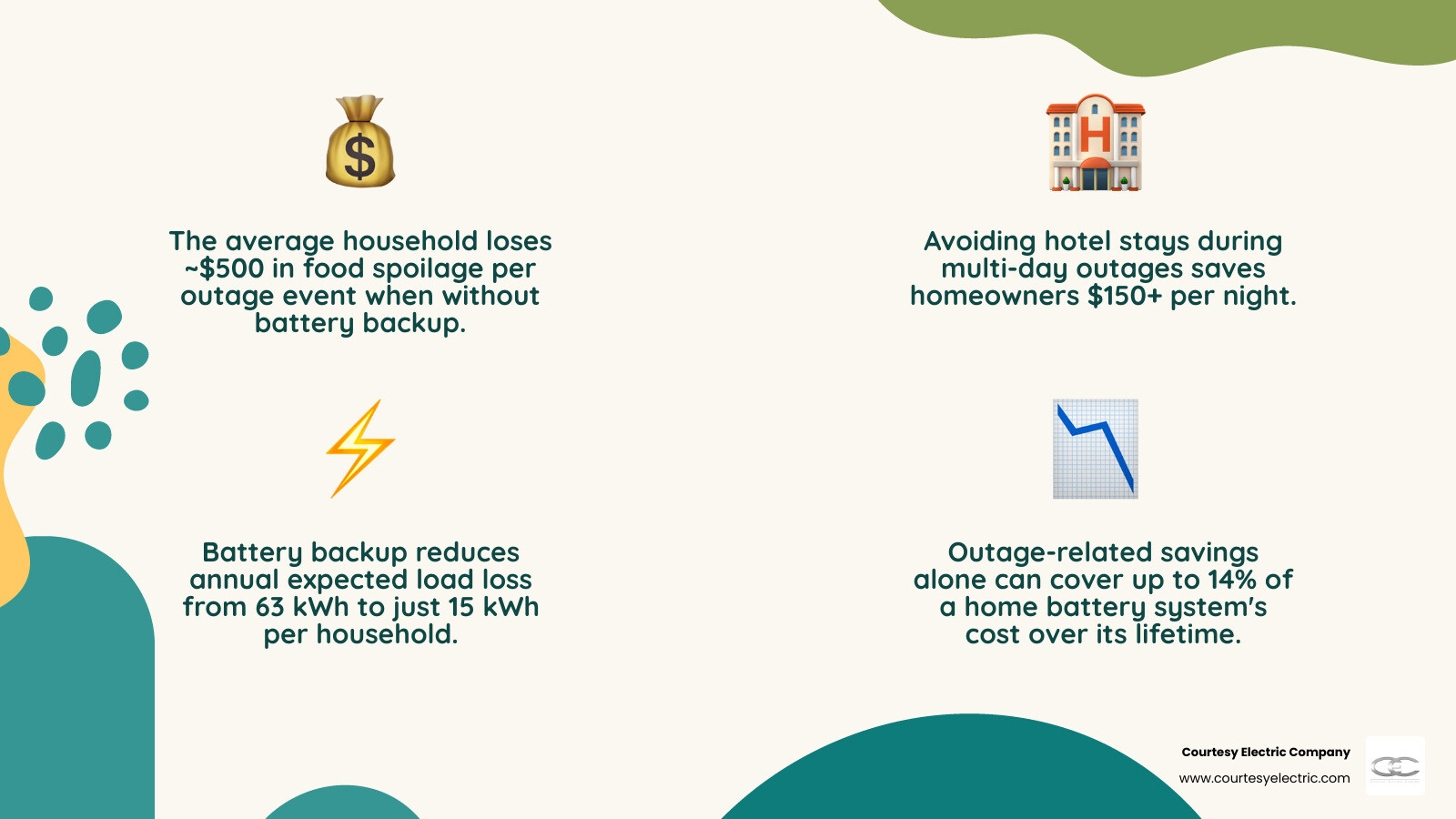
| Food spoilage prevention | ~$500 per outage event |
| Avoided hotel stays | ~$150+ per night |
| Load loss reduction | Up to 95.8% of expected energy loss |
| Annual expected load loss (without battery) | 0–63 kWh per household |
| Annual expected load loss (with battery) | 0–15 kWh per household |
| Resilience value vs. battery cost (base case) | ~14% of battery cost covered by outage savings alone |
The bottom line: a home battery system significantly reduces the energy and financial losses caused by grid failures, though outage savings alone rarely cover the full cost. The strongest case for battery storage comes when you stack outage protection with daily energy management benefits.
Power outages in the United States hit their highest level in a decade in 2024, with 27 separate billion-dollar weather disasters recorded by NOAA that year. For homeowners across Denver and the Colorado Front Range, that trend is hard to ignore. A summer storm or a winter ice event can knock out the grid for hours — or days — leaving families scrambling to protect their food, their pipes, their medical equipment, and their peace of mind.
The U.S. economy loses between $28 billion and $169 billion every year because of power outages. At the household level, that translates into spoiled groceries, damaged property, lost productivity, and in some cases, serious safety risks. A home battery backup system is increasingly the answer homeowners are turning to — but the real question is whether the savings justify the investment.
I'm David Meyer, Vice President of Courtesy Electric, and over my career installing and designing battery backup systems across Colorado, I've helped dozens of homeowners work through the exact math of how much does battery storage save during outages before they commit to a system. In this guide, I'll break down the numbers honestly — from food spoilage and load loss to payback periods and smart energy strategies — so you can make a confident, informed decision.
The Financial Impact of Grid Failures and How Much Does Battery Storage Save During Outages
When the power goes out, the clock starts ticking on your wallet. While we often think of blackouts as a minor inconvenience, the financial reality of prolonged grid failures is steep. For a typical family in Parker, Highlands Ranch, or Black Forest, a sudden blackout can quickly lead to hundreds or thousands of dollars in unrecoverable losses.
By installing a modern energy storage system, you create a personal safety net. We often look at the return on investment of home energy upgrades through the lens of monthly utility bill reductions. However, a major part of the equation is "avoided costs"—the money you don’t have to spend because your power stayed on.
To determine if a backup system makes sense for your home, it helps to look at the regional factors. Our local grid faces unique challenges, from heavy spring snows that snap power lines to intense summer thunderstorms and high-wind events. Understanding these regional risks is the first step in evaluating whether Is Home Battery Storage Worth It In Colorado for your specific household needs.
Calculating the Value of Lost Load (VOLL)
Economists and grid planners use a metric called the Value of Lost Load (VOLL) to quantify the economic impact of power interruptions. VOLL is essentially the monetary value that consumers place on a kilowatt-hour of uninterrupted electricity. While a standard kWh of electricity from the grid might cost you a fraction of a dollar, the value of that same kWh during a critical outage is exponentially higher.
Without battery storage, the average annual expected loss of load for a single-family home ranges from 0 to 63 kWh, depending on local grid reliability and weather patterns. When you integrate a home battery system, this annual expected loss of load drops dramatically to between 0 and 15 kWh.
In fact, academic research shows that solar battery storage can mitigate up to 95.8% of expected load loss during long-duration power interruptions (those lasting over 24 hours) for a typical single-family home. To understand how your home handles this transition seamlessly during a blackout, it helps to understand How Does A Home Battery Backup System Work to isolate your home from the utility grid and establish a self-sustaining microgrid.

How Much Does Battery Storage Save During Outages by Preventing Food Spoilage and Property Damage
Let's look at the direct, tangible household savings. When the grid fails, the most immediate casualty is usually the contents of your refrigerator and freezer. The USDA notes that a refrigerator will keep food safely cold for only about 4 hours during a power outage, while a full freezer can hold its temperature for up to 48 hours if the doors remain closed.
For a family with a fully stocked fridge and a chest freezer, losing all that food can easily cost $500 or more in a single event. A home battery backup keeps your appliances running continuously, completely eliminating this risk.
Beyond food, there are even more severe property damage risks:
- Frozen Pipes: During Colorado winters, a prolonged outage can cause indoor temperatures to plummet. Without a furnace blower or boiler pump running, pipes can freeze and burst, leading to thousands of dollars in water damage.
- Basement Flooding: If a heavy summer storm knocks out power, your sump pump stops working. A battery backup ensures your sump pump keeps running, preventing a flooded basement.
- Medical Equipment: For households relying on CPAP machines, oxygen concentrators, or home dialysis, keeping the power on is a matter of physical safety, not just comfort.
By protecting these critical systems, a battery system acts as an insurance policy. You can read more about selecting and sizing a system to cover these exact household risks in our Home Battery Storage Complete Guide.
Battery Storage vs. Standby Generators: A Backup Power Comparison
When Front Range homeowners realize they need reliable backup power, they usually find themselves choosing between two primary technologies: a battery storage system or a traditional standby generator. Both systems are designed to keep your lights on, but they go about it in very different ways, with distinct financial and operational profiles.
To help you visualize how these two options stack up over time, let's look at a direct comparison:
| Feature | Battery Storage System | Standby Generator (Gas/Propane) |
|---|---|---|
| Fuel Source | Solar energy or stored grid power | Natural gas, liquid propane, or diesel |
| Fuel Costs | $0 (when paired with solar) | Variable (subject to utility gas/propane rates) |
| Maintenance | Virtually none (solid-state electronics) | Annual oil changes, spark plugs, and engine runs |
| Noise Level | Silent (0 dB) | Loud (60–70+ dB) |
| Emissions | Zero local emissions | Carbon monoxide and greenhouse gases |
| Daily Value | High (can perform time-of-use shifting) | None (only operates during grid outages) |
| Lifespan | 10 to 15 years | 15 to 20+ years (with proper maintenance) |
For a deeper dive into which technology aligns with your home's layout and goals, check out our comparison on Battery Storage Vs Generator Which Is Better For Backup.
Operational Differences and Fuel Independence
Standby generators rely on internal combustion engines. This means they require regular mechanical maintenance, generate significant noise, and emit exhaust fumes that must be carefully vented away from your home. Furthermore, standby generators require a continuous supply of fuel—either natural gas piped from your utility or liquid propane stored in a large tank on your property.
A battery storage system, on the other hand, is completely silent and produces zero emissions. Because it is a solid-state electronic system, there are no moving parts to wear out, meaning it requires virtually no ongoing maintenance.
The biggest operational advantage of a battery system comes when it is paired with solar panels. This combination allows you to achieve true energy independence. When evaluating Generator Or Battery For Power Outages Is A Generator Or Battery Better For Power Outages, the ability to generate your own fuel from the sun is a massive differentiator.
How Much Does Battery Storage Save During Outages Compared to Generator Fuel Costs
During an extended, multi-day outage, a standby generator can consume a significant amount of fuel. If you are running a 20 kW generator on liquid propane, you could easily burn through 2 to 3 gallons of fuel per hour under moderate load. Over a three-day outage, that can add up to hundreds of dollars in fuel costs alone—assuming fuel delivery trucks can even access your property during a major winter storm or natural disaster.
A solar-plus-storage system bypasses this fuel constraint entirely. During the day, your solar panels power your home's immediate loads and send any excess electricity to recharge your batteries. At night, your home runs off the stored battery power.
This continuous cycle allows you to ride out multi-day outages without spending a single penny on fuel or worrying about utility gas lines being shut down for safety. For homeowners who want the ultimate level of resilience, we also design custom hybrid systems where How Generators And Batteries Can Work Together to provide a multi-layered backup strategy.
Maximizing Your Return on Investment with Smart Energy Management
While the peace of mind during a blackout is invaluable, a home battery system shouldn't just sit idle waiting for the grid to fail. In fact, if you only look at the "resilience value" of a battery—the money saved purely during outages—it typically covers about 14% of the system's total cost over its lifetime. To make the investment truly cost-effective, you need to put your battery to work every single day.
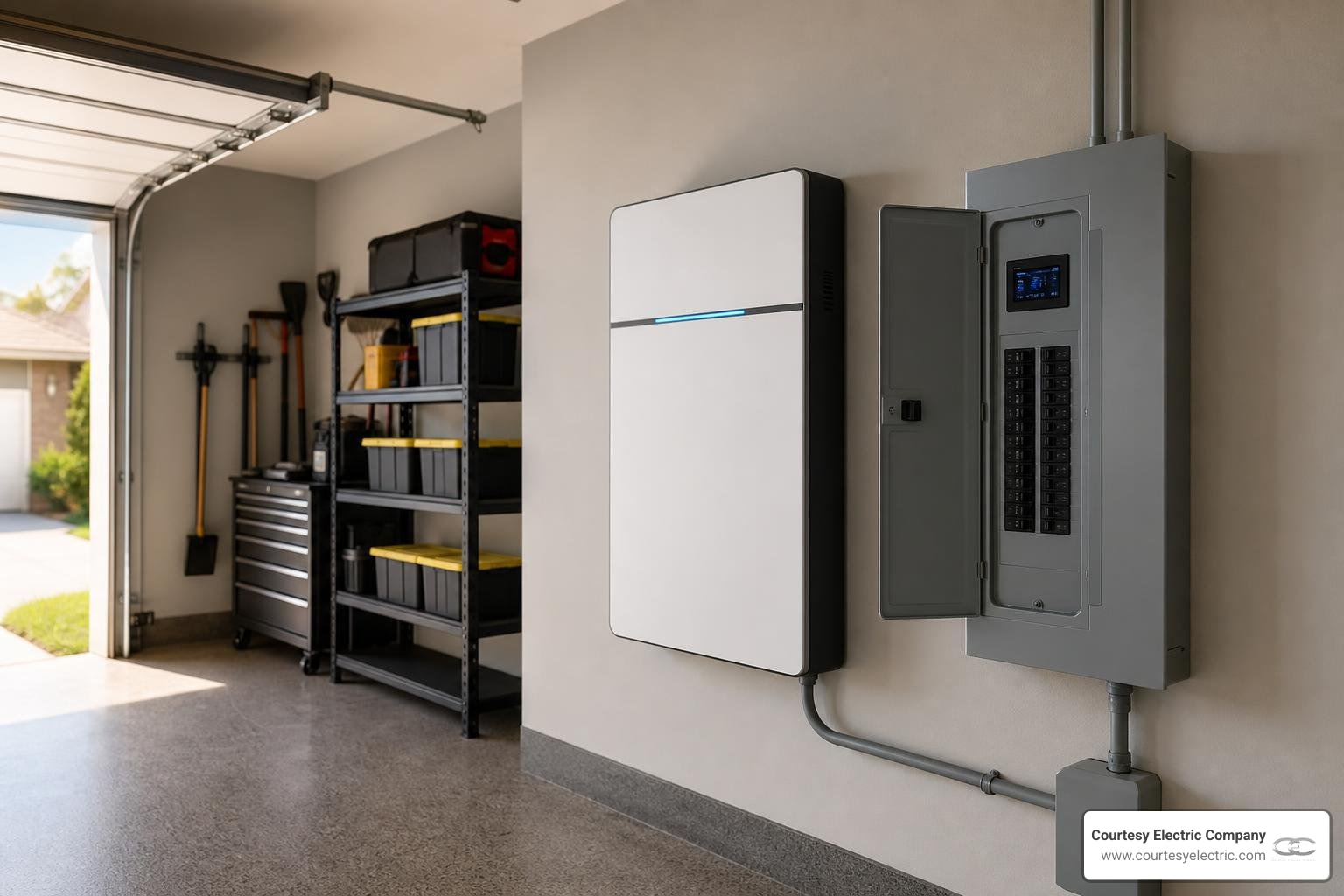
This daily value is unlocked through smart energy management. By utilizing your battery to manage how and when you draw power from the utility grid, you can generate ongoing savings that dramatically shorten your payback period.
This is where upgrading to a modern smart electrical panel makes a world of difference. When comparing a Smart Energy Management Vs Traditional Panel, a smart panel gives you the digital controls needed to automatically optimize your battery usage based on real-time utility rates.
Integrating Smart Panels for Load Shedding
One of the challenges of backup power is sizing. If you want to back up your entire home—including high-load appliances like your air conditioner, electric range, and EV charger—you would need a very large, expensive battery array.
A smarter, more cost-effective approach is to pair your battery with a smart electrical panel, such as a SPAN panel. Instead of physical critical load panels that permanently wire only a few circuits for backup, a smart panel allows you to dynamically manage your loads through a mobile app.
During an outage, a smart panel can automatically shed non-essential loads—like your guest bedroom outlets or your hot tub—to ensure your battery power is reserved for your refrigerator, internet, and furnace blower. This intelligent load shedding can easily double or triple your battery's effective runtime during an outage. To see how this works in real-time, you can explore How To Track And Control Energy Use Room By Room.
Leveraging Incentives and Tax Credits
To maximize your return on investment, it is essential to take advantage of all available financial incentives. The federal government offers a substantial 30% Residential Clean Energy Credit (under Section 25D) for qualified battery storage installations, which directly reduces your federal tax liability.
In addition to federal incentives, Colorado homeowners can often stack state-level incentives, utility rebates, and demand-response programs. Many local utilities offer programs that pay you to allow them to occasionally draw a small amount of power from your battery during periods of extreme grid strain, turning your battery into an active income generator.
Navigating these programs can be complex, but we make it simple. You can read our complete guide on Federal Tax Credits For Battery Storage And Span Panels to learn how to maximize your savings.
Frequently Asked Questions about Battery Storage Savings
How long can a home battery run during an outage?
The runtime of a home battery system depends on three main factors: the total usable capacity of your battery, the electrical load of the appliances you choose to run, and whether you have solar panels to recharge the system during the day.
If you are only powering critical loads—such as your refrigerator, LED lighting, Wi-Fi router, and a few device chargers—a standard 13.5 kWh battery can easily keep your home running for 24 hours or more on a single charge. When paired with solar panels, this backup duration can extend indefinitely, as the system recharges every day the sun shines. To learn more about high-performance options, read about the Franklin Battery Storage Benefits Explained.
Does a solar battery completely eliminate outage losses?
While a solar battery system can mitigate up to 95.8% of expected load loss during a major outage, it is important to have realistic expectations. A battery system will eliminate losses like food spoilage, frozen pipes, and lost internet connectivity, but it is not designed to run your entire home at full capacity indefinitely unless you have sized a very large system.
To get the most out of your system, we recommend working with an experienced professional to design a customized backup plan. This ensures your system is sized correctly to keep your household safe and comfortable. For a detailed look at planning your backup strategy, check out our guide on Choosing The Right Backup Power For Colorado.
Can I charge my battery with solar panels when the grid is down?
Yes, but only if your system is designed with "islanding" capabilities. Standard grid-tied solar systems without batteries are legally required to shut down during a power outage. This safety feature prevents your solar panels from sending electricity back into the utility lines, which could severely injure utility workers who are trying to repair the grid.
When you install a battery backup system, the system's inverter is designed to automatically isolate your home from the utility grid during a blackout. This creates a localized microgrid, allowing your solar panels to safely continue operating, powering your home, and recharging your batteries even when the rest of the neighborhood is completely dark. You can learn more about this process in our article on How Does A Home Battery Backup System Work.
Conclusion
At the end of the day, answering how much does battery storage save during outages requires looking at both direct financial protection and daily energy management. While avoiding spoiled food, frozen pipes, and hotel stays provides immediate, tangible savings during a blackout, the true financial victory comes from stacking those resilience benefits with daily time-of-use savings and smart energy controls.
At Courtesy Electric Company, we have been serving homeowners across Denver and the Colorado Front Range since 1976. We specialize in designing and installing high-quality backup power solutions, including Franklin battery storage systems and SPAN smart electrical panels, tailored specifically to our local climate and grid conditions.
If you are ready to protect your home from future grid failures while taking control of your daily energy bills, we are here to help. Schedule a free estimate with Courtesy Electric Company today, and our team of local experts will design the perfect backup system for your home and budget.


