
What Every Colorado Homeowner Should Know About Home Battery Backup Systems

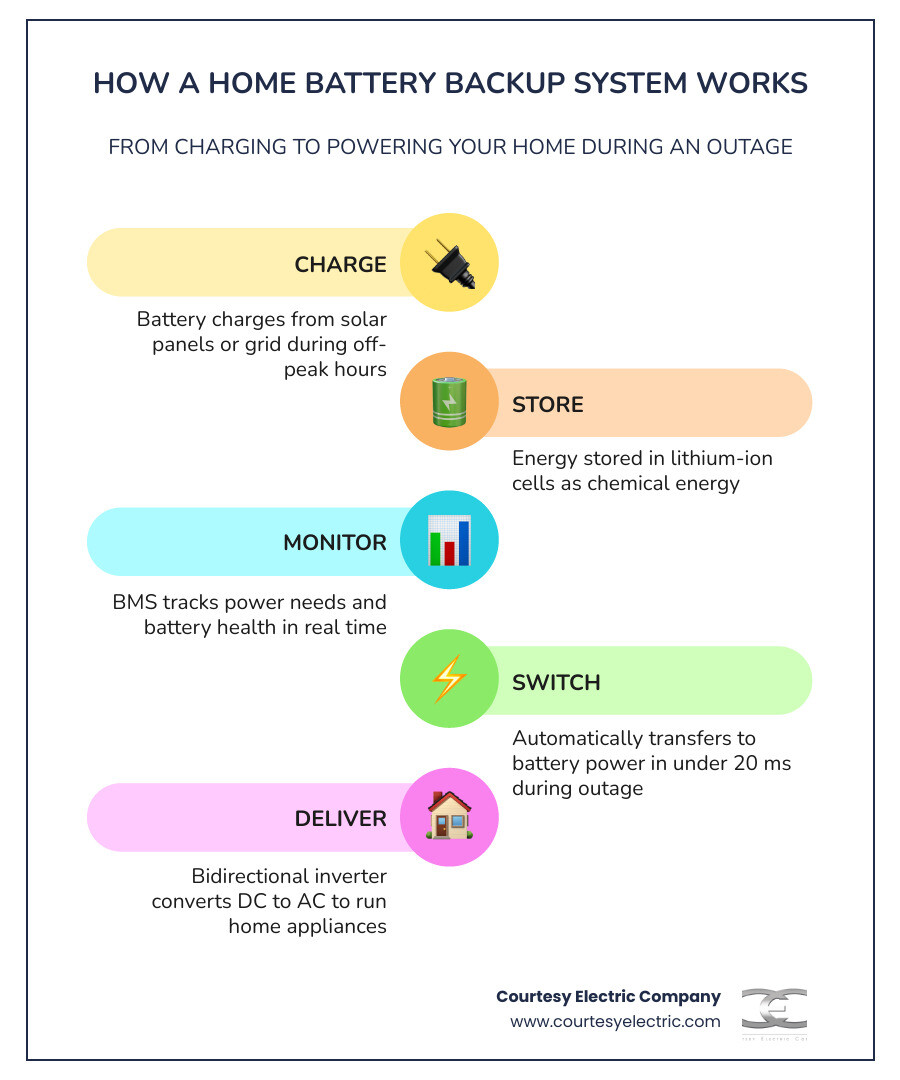
How a home battery backup system works comes down to one core idea: it stores electricity when you don't need it, then delivers it when you do — whether that's during a grid outage, after sunset, or when utility rates spike.
Here's a quick breakdown of how it works:
- Charges from your solar panels or the grid during off-peak hours
- Stores that energy in a bank of lithium-ion battery cells
- Monitors your home's power needs through a built-in Battery Management System (BMS)
- Switches automatically to battery power the moment the grid goes down — in less than 20 milliseconds
- Delivers AC power to your home through a bidirectional inverter, keeping your lights, refrigerator, and other essentials running
Power outages on the Colorado Front Range aren't rare. Severe winter storms, summer thunderstorms, and an aging grid can leave your home dark for hours — or days. At the same time, rising electricity costs and changing utility rate structures are pushing more homeowners to take control of when and how they use energy. A home battery backup system sits at the center of that shift, quietly doing its job until the moment you need it most.
In 2023, 13% of residential solar installations included battery storage — a figure that has tripled since 2018 and is expected to keep climbing. Over half of homeowners who install a battery do so primarily for one reason: backup power.
I'm David Meyer, Vice President of Courtesy Electric, and after decades of hands-on electrical work across Colorado — including installations of battery wall systems and advanced backup energy infrastructure — I've seen how a home battery backup system works in real homes under real conditions. In the sections ahead, I'll walk you through everything you need to know to make a confident decision for your home.
How Does a Home Battery Backup System Work?
To understand how a home battery backup system works, it helps to look at it as a highly sophisticated, stationary energy reservoir. At its core, the system relies on electrochemical storage. Inside the battery pack are hundreds or thousands of individual battery cells that store electrical energy in chemical form.
When we look at the daily operation of a home battery, it goes through three primary cycles:
- The Charging Cycle: When excess electricity is available—either from your rooftop solar panels during a sunny Colorado afternoon or from the utility grid when rates are low—the battery system draws this power. Because batteries store electricity as Direct Current (DC), but your home and the grid run on Alternating Current (AC), the system’s inverter converts the AC electricity into DC. This DC power is then directed into the battery cells, causing lithium ions to move from the cathode to the anode, storing the energy.
- The Discharging Cycle: When your home requires power—such as during the evening or during a blackout—the process reverses. The lithium ions flow back from the anode to the cathode inside the cells, releasing free electrons. This chemical reaction generates DC electricity. The inverter instantly converts this DC electricity back into AC electricity, which is routed directly to your home’s main electrical panel or a dedicated critical-loads subpanel.
- Load Shifting and Peak Shifting: You do not have to wait for a power outage to benefit from your battery. Many homeowners use their systems for "load shifting." Under time-of-use (TOU) rate plans, utilities charge significantly more for electricity during peak hours (usually late afternoon and early evening). A smart battery system can be programmed to charge during the day when electricity is cheap (or free from solar) and discharge to power your home during peak evening hours, shielding you from high utility rates.
To explore the deeper financial and operational benefits of residential energy storage, check out our Home Battery Storage Complete Guide.
Step-by-Step: How Does a Home Battery Backup System Work During an Outage?
When a severe blizzard sweeps across the Front Range and knocks down local power lines, your battery backup system transitions from an energy-saving tool into an emergency lifesaver. Here is the step-by-step sequence of how the system handles a sudden grid failure:
- Grid Failure Detection: The system’s internal gateway and smart monitoring software constantly analyze the incoming voltage from the utility grid. If the grid voltage drops or disappears entirely, the system detects this failure in less than 20 milliseconds. This transition is so rapid that sensitive electronics, desktop computers, and clocks typically won't even flicker.
- Automatic Transfer and Disconnection: Before the battery can safely discharge power to your home, it must isolate your electrical system from the utility grid. An Automatic Transfer Switch (ATS) or internal gateway instantly disconnects your home from the grid. This step is critical for safety; if your system backfed electricity onto the down lines, it could severely injure or electrocute utility technicians working to restore power.
- Entering "Island Mode": Once safely disconnected, your system establishes what is known as "island mode." It creates a self-sustaining local microgrid. The battery’s bidirectional inverter starts up, generating its own clean AC signal to mimic the grid.
- Powering Critical Loads: Stored DC electricity is pulled from the battery cells, converted to AC by the inverter, and sent directly to your electrical panels. Depending on how your home is wired, the system will immediately begin powering either your entire home or a designated critical-loads subpanel containing your most vital appliances.
- Grid Restoration and Reconnection: Once the utility company repairs the lines and the grid comes back online, the battery system does not immediately reconnect. It monitors the grid for a stabilization period (usually between 30 seconds and 5 minutes) to ensure the power is steady. Once confirmed, the system seamlessly synchronizes its AC signal with the grid, closes the transfer switch, exits island mode, and begins recharging the battery cells so they are ready for the next outage.
To see what a completed, professional installation looks like in a real residential setting, take a look at our project spotlight on a Home Battery Backup System Installed in Garage Colorado Home.
Grid Integration: How Does a Home Battery Backup System Work with Solar Panels?
While you can install a home battery as a standalone system that charges strictly from grid power, pairing it with rooftop solar panels creates a highly resilient energy ecosystem.
Many homeowners are surprised to learn that a standard grid-tied solar system without a battery will automatically shut down during a power outage. This safety shutdown is required by electrical codes to protect utility workers. However, when you integrate a battery backup system, your solar panels can keep producing clean electricity even during a multi-day blackout.
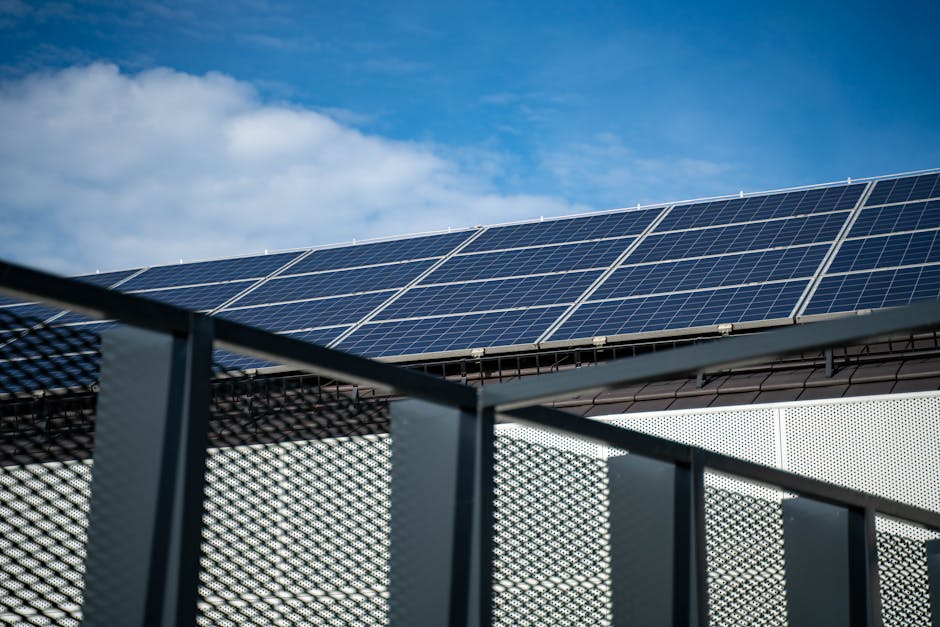
During a daytime outage, your solar panels generate DC electricity. The system's intelligent controller directs this power to meet your home's immediate electrical needs. Any excess solar power that your home isn’t actively using is routed to charge the battery. Once the battery is fully charged, the system can throttle the solar production to match your home’s exact real-time demand.
Once the sun sets, the solar panels stop producing, and your home seamlessly transitions to drawing power from the battery. When the sun rises the next morning, the cycle repeats. This continuous loop allows you to survive extended, multi-day outages indefinitely, provided you have sufficient sunlight.
Furthermore, integrating solar with battery storage is becoming essential due to shifts in utility rate structures. Across the country, utilities are transitioning from traditional net metering (where you get a 1-to-1 credit for sending excess solar to the grid) to net billing structures. Under net billing, the utility buys your excess solar power for a fraction of what they charge you to buy it back. By storing your own excess solar energy in a battery and using it yourself, you maximize your self-consumption and protect your wallet.
For a closer look at selecting the ideal power setup for our unique regional climate, read our guide on Choosing the Right Backup Power for Colorado.
Key Components and Sizing of a Home Battery
A home battery backup system is not just a single box; it is an integrated suite of hardware and software working in unison. Understanding these components is essential to understanding how the system as a whole operates.
The primary components of a modern home battery backup system include:
- The Battery Cells (Chemistry): Modern residential batteries have almost completely transitioned to Lithium Iron Phosphate (LiFePO4 or LFP) chemistry, phasing out older Nickel Manganese Cobalt (NMC) formulations. LFP chemistry offers superior thermal stability, making it highly resistant to thermal runaway (fire risks). It also boasts a much longer lifespan, typically lasting between 4,000 and 10,000 charge-discharge cycles (equivalent to 10 to 25+ years of daily use) before degrading to 70% of its original capacity.
- The Bidirectional Inverter: This is the brain of the power conversion process. It converts incoming AC grid or solar power into DC power to charge the battery, and converts stored DC power back into clean AC power for your home.
- The Battery Management System (BMS): The BMS is an internal computer that monitors the health of the battery. It balances the voltage across individual cells, prevents overcharging or deep discharging, tracks the temperature, and shuts down the system automatically if it detects any electrical faults.
- The Smart Gateway / Automatic Transfer Switch: This device sits between your main electrical panel, your battery, your solar system, and the utility grid. It acts as the traffic cop, routing power where it needs to go and managing the physical disconnection from the grid during an outage.
- Smart Electrical Panels: Upgrading to a smart electrical panel (such as a SPAN panel) allows you to monitor and control every single circuit in your home from a smartphone app. When paired with a battery, a smart panel can dynamically shed non-essential loads (like your electric vehicle charger or clothes dryer) during an outage to stretch your battery life.
To learn more about a leading-edge battery system designed for maximum reliability and seamless integration, read our detailed article where the Franklin Battery Storage Benefits Explained are laid out in detail.
Understanding Capacity vs. Power Output
When sizing a home battery backup system, you must understand the critical difference between capacity and power output. Confusing these two terms is the most common mistake homeowners make, often leading to a system that cannot run their desired appliances.
We like to use a simple plumbing analogy:
- Capacity (measured in kilowatt-hours, or kWh) is the size of your water tank. It dictates how much total energy your battery can store. A 13.5 kWh battery holds a specific volume of electricity.
- Power Output (measured in kilowatts, or kW) is the diameter of the pipe leaving the tank. It dictates how fast you can pull energy out of the battery at any single moment.
There are two types of power output ratings to look for:
- Continuous Power: The maximum electrical load the battery can support indefinitely under normal conditions (typically ranging from 5 kW to 11.5 kW per battery).
- Peak/Surge Power: The maximum power the battery can deliver for a very short period (usually 2 to 10 seconds) to handle the initial startup spike of motorized appliances, such as well pumps, refrigerators, or air conditioning compressors.
If you have a battery with a massive capacity (e.g., 20 kWh) but a low continuous power output (e.g., 5 kW), you cannot run your central air conditioner and an electric stove at the same time, because their combined instantaneous draw exceeds 5 kW—even though you have plenty of total energy stored in the tank.
For a deeper dive into sizing calculations and selecting the right specifications for your household, read our Battery Storage Guide Centennial CO.
Whole-Home vs. Partial Backup Configurations
When designing your system, you must choose between a partial backup and a whole-home backup configuration. This decision fundamentally changes how your home is wired.
- Partial (Critical-Loads) Backup: In this setup, we install a secondary electrical panel called a critical-loads subpanel. We physically move the breakers for your most essential appliances from your main panel into this subpanel. During an outage, the battery only energizes this subpanel. Your non-essential loads—like hot tubs, double ovens, and guest bedroom outlets—will remain dark. This configuration is highly efficient and allows a single 10-15 kWh battery to last for a long time.
- Whole-Home Backup: In a whole-home configuration, the battery system is wired directly to your main electrical panel, meaning every single outlet and appliance in your home remains active when the grid fails. However, because heavy loads like HVAC systems can drain a standard battery in a matter of two to three hours, whole-home backup typically requires stacking multiple batteries together (20 kWh to 40+ kWh of capacity) and utilizing smart load-management devices or smart panels to dynamically turn off heavy appliances when they aren't absolutely necessary.
To understand the financial incentives available for these configurations, including how smart panels integrate into your tax planning, check out our guide on Federal Tax Credits for Battery Storage and Span Panels.
Battery Storage vs. Standby Generators
If you are looking for backup power, you are likely comparing battery storage to a traditional standby generator. Both are excellent options, but they function in completely different ways and suit different household needs.
| Feature | Lithium-Ion Battery Storage | Standby Generator (Natural Gas / Propane) |
|---|---|---|
| Fuel Source | Solar panels or utility grid electricity | Natural gas line or liquid propane tank |
| Maintenance Needs | Virtually zero (no oil changes or moving parts) | Annual engine service, oil changes, spark plugs |
| Transfer Speed | Instantaneous (<20 milliseconds) | 10 to 30 seconds (requires engine startup) |
| Noise Levels | Completely silent | 60 to 80 decibels (similar to a lawnmower) |
| Emissions | Zero local emissions | Produces exhaust gases (CO2, carbon monoxide) |
| Runtime | Limited by battery capacity & solar recharge | Indefinite, as long as fuel supply is active |
| Installation Location | Indoors (garage/utility room) or outdoor wall | Outdoors only (requires proper clearance) |
While generators excel at providing indefinite runtime during long, multi-day winter outages where solar panels might be covered in heavy snow, batteries provide silent, instantaneous, emission-free power that can also save you money on your daily utility bills through peak shaving.
For a comprehensive head-to-head analysis of these two technologies, read our full article on Battery Storage vs Generator Which is Better for Backup.
How Generators and Batteries Can Work Together
You don't necessarily have to choose between a generator and a battery. For the ultimate in home energy resilience, you can combine them into a hybrid backup system.
In a hybrid configuration, the battery serves as your first line of defense. When a power outage occurs, the battery takes over instantly, keeping your lights on without a single second of interruption. If the outage is short, the battery handles it quietly.
However, if the outage stretches into multiple days during a heavy winter storm, and your solar panels are covered in snow, your battery charge will eventually deplete. In a hybrid system, once the battery hits a pre-programmed low threshold (such as 15% capacity), the system sends a signal to automatically start your standby generator.
The generator then runs at its peak operating efficiency to quickly recharge the battery and power your home's heavy loads. Once the battery is full, the generator shuts off, and your home returns to running silently on battery power. This setup drastically reduces generator noise, slashes fuel consumption, and extends the life of your generator engine while ensuring you never run out of power.
To learn more about how to design this level of system redundancy, check out our guide on How Generators and Batteries Can Work Together.
Frequently Asked Questions about Home Battery Backup
Can a home battery backup system run an air conditioner?
Yes, a home battery system can run an air conditioner, but it requires careful design and sizing. Central air conditioners have high HVAC loads, demanding a large amount of continuous power and an even higher surge of power to start the compressor motor.
To run a central AC, your battery system must have a peak power rating that exceeds the air conditioner's Locked Rotor Amps (LRA)—though we can often install a "soft starter" on your AC unit to reduce this startup spike by up to 70%. Additionally, because central AC units consume a lot of electricity, running one continuously will quickly deplete a standard battery. You will typically need multiple stacked batteries or a smart panel to manage how long the AC runs during an outage.
How long will a home battery power my house during an outage?
Your runtime depends on three factors: the capacity of your battery, the electrical load of the appliances you are running, and whether you have solar panels recharging the system.
- Essentials-only backup: If you are only powering a refrigerator, Wi-Fi router, LED lights, and charging devices (drawing roughly 500 watts continuously), a single 13.5 kWh battery can easily last for 20 to 24 hours.
- With Solar Recharging: If you have solar panels and it is a sunny day, your battery can recharge during the day while powering your home, allowing you to run your essentials indefinitely.
- Whole-home heavy usage: If you run heavy appliances like central AC, electric clothes dryers, or electric heaters, a single battery can be fully depleted in 2 to 4 hours.
What maintenance does a home battery backup system require?
Unlike generators, which have engines requiring oil changes, filters, and spark plugs, modern lithium-ion home batteries require virtually zero physical maintenance. They have no moving parts to wear out.
The system’s internal Battery Management System handles all cell balancing and thermal management automatically. The manufacturer will also push automatic software updates over your home Wi-Fi network to optimize performance and safety. To ensure your system continues to operate at peak efficiency for its entire 10-to-15-year lifespan, you simply need to keep the area around the battery enclosure clean, well-ventilated, and free of clutter.
For detailed maintenance tips specific to our Colorado mountain and plains climates, read our Battery Storage Maintenance Guide Granby CO.
Conclusion
Understanding how a home battery backup system works is the first step toward taking complete control of your home’s energy future. By storing clean electricity and delivering it precisely when you need it, a home battery provides unmatched peace of mind, reliable protection against severe weather outages, and daily savings on your utility bills.
At Courtesy Electric Company, we have been serving homeowners across Denver and the Colorado Front Range since 1976. Our team of highly trained, local electricians specializes in designing and installing state-of-the-art energy storage systems—including premium Franklin Battery Storage and SPAN smart panels—tailored to the unique needs of Colorado homes. We handle the entire process, from initial load calculations and permitting to final utility interconnection, ensuring your system is built for maximum safety, performance, and long-term durability.
Are you ready to secure your home’s power and build true energy resilience? Schedule a consultation for residential electrical services with Courtesy Electric today, and let us help you design the perfect backup solution for your home.


