What Is the Difference Between a Level 1 vs Level 2 EV Charger for Home Use?
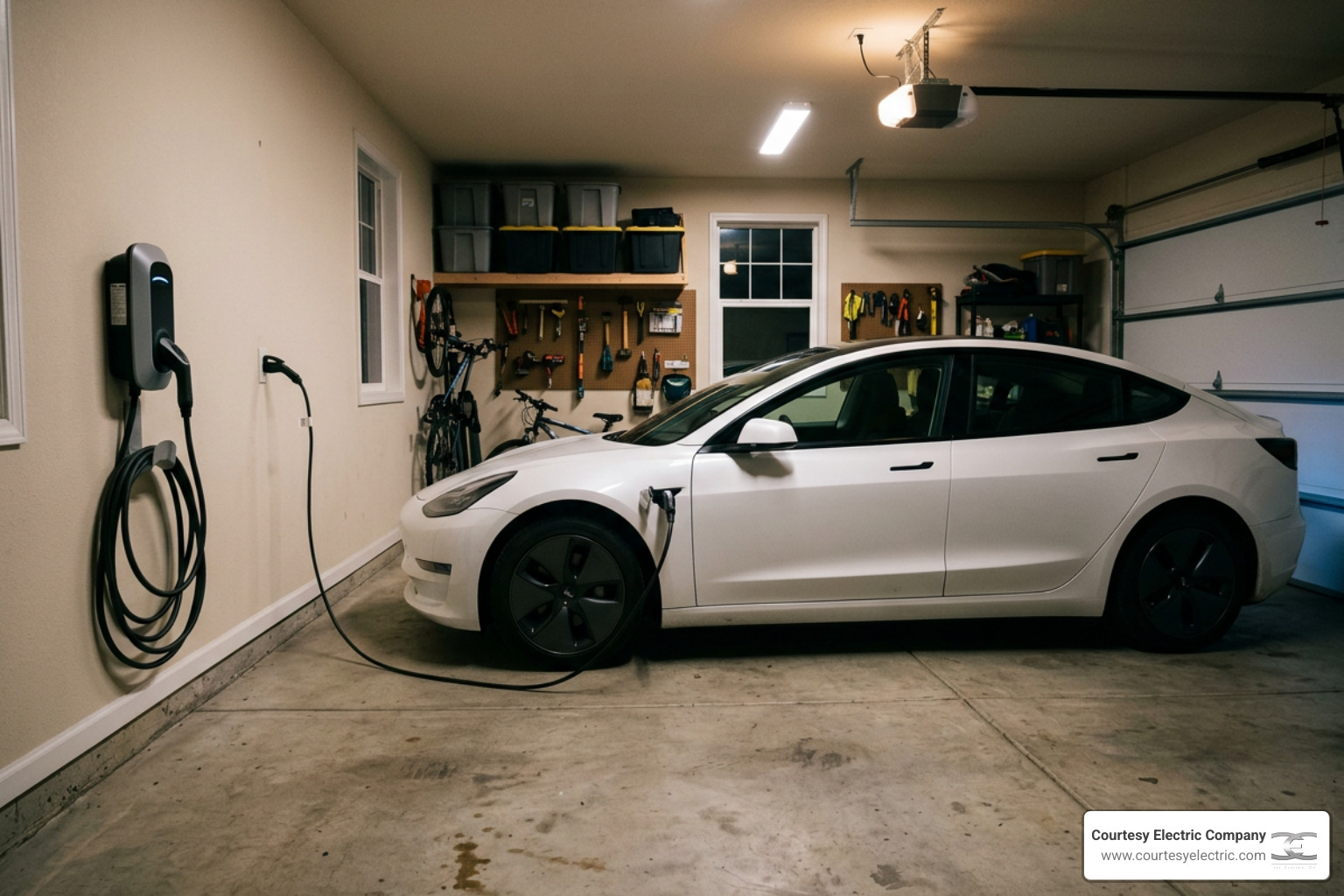
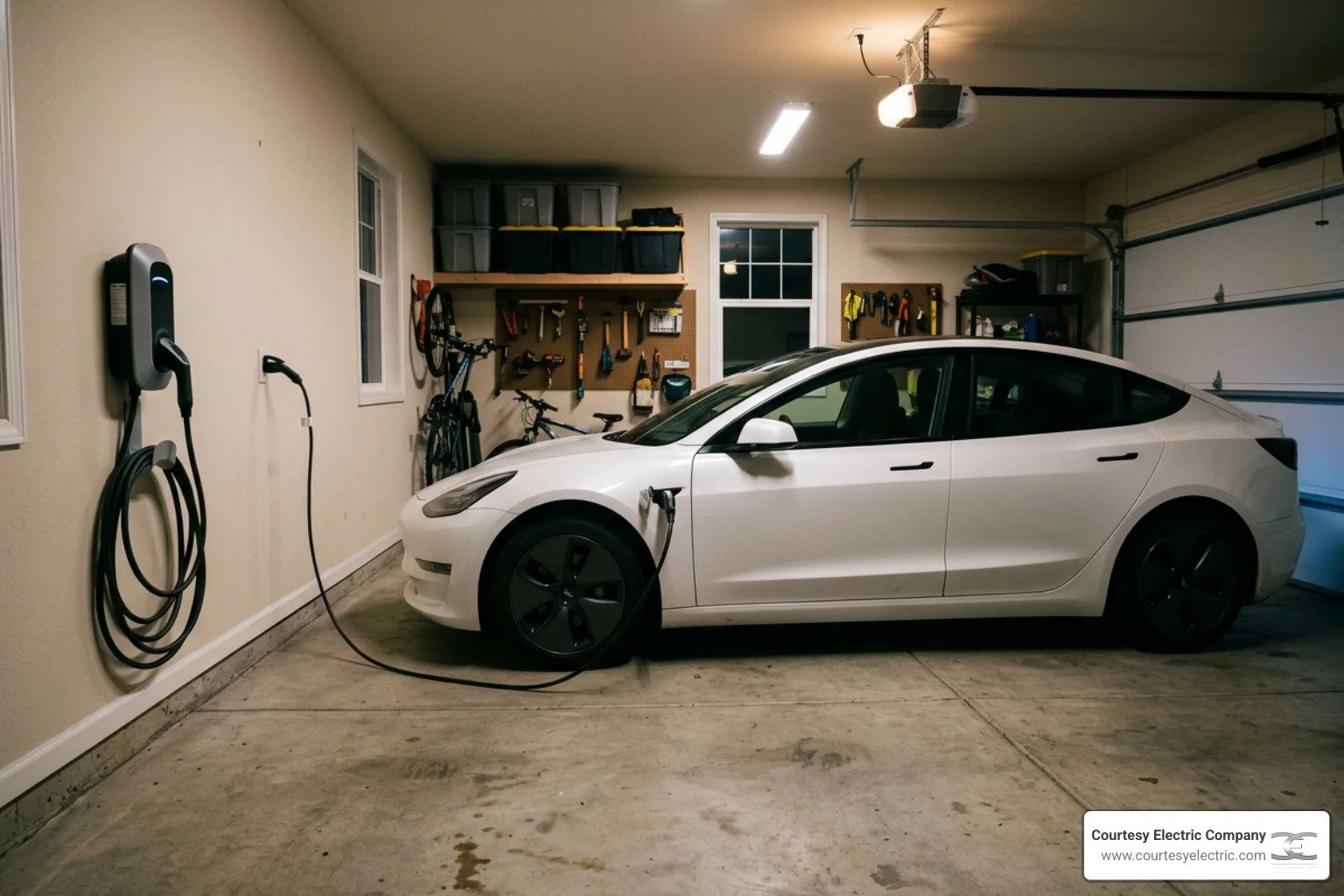
When it comes to level 1 vs level 2 EV charger for home use, here is the short answer:
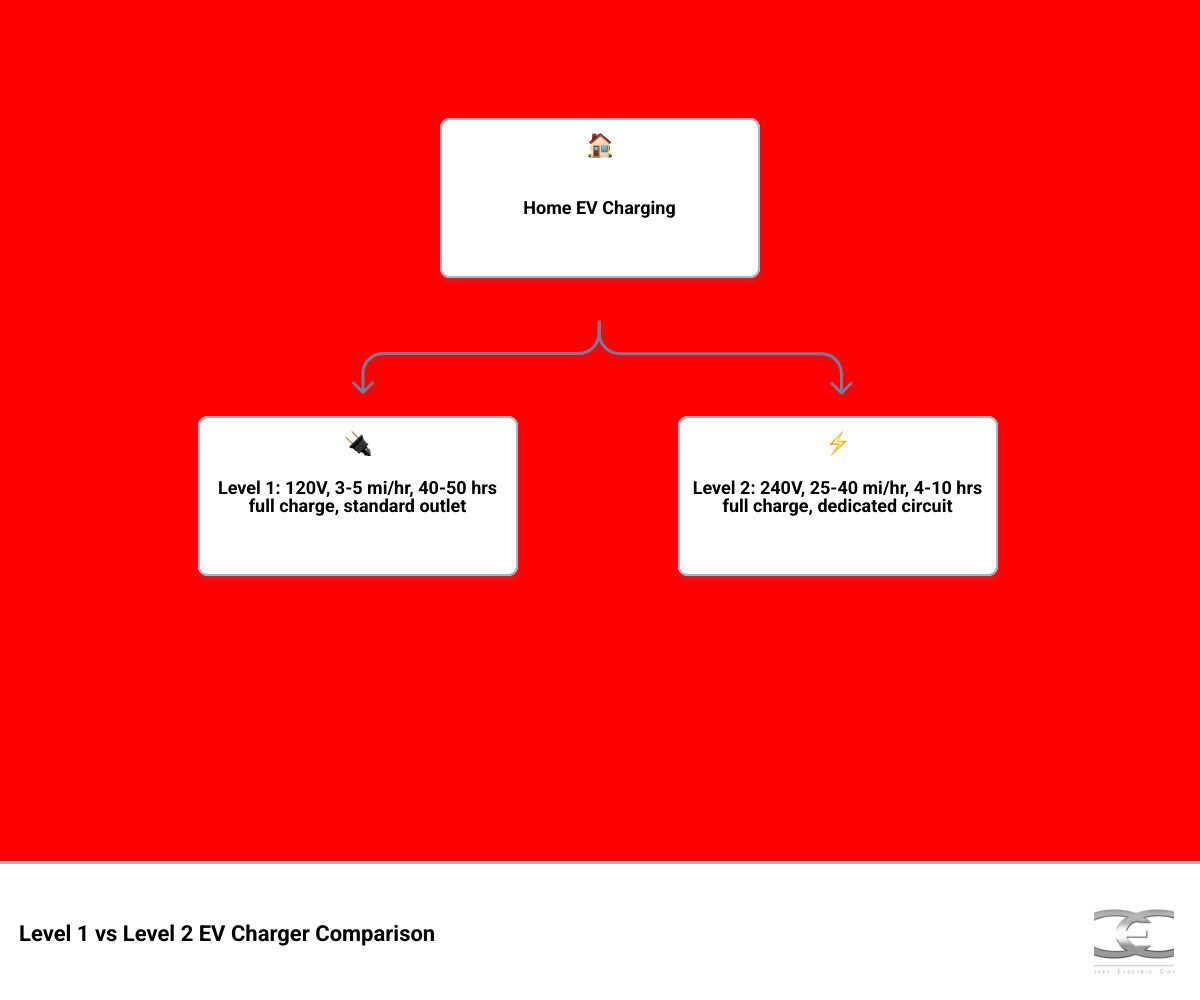
| Feature | Level 1 | Level 2 |
|---|---|---|
| Voltage | 120V (standard outlet) | 240V (dedicated circuit) |
| Power Output | ~1.2–1.4 kW | 7.6–11.5 kW |
| Range Added Per Hour | 3–5 miles | 25–40 miles |
| Full Charge Time | 40–50+ hours | 4–10 hours |
| Installation Required | No | Yes (licensed electrician) |
| Best For | PHEVs, low-mileage drivers | Daily EV drivers, large batteries |
For most homeowners who drive more than 40 miles a day, Level 2 is the practical choice. Level 1 works fine for plug-in hybrids or light driving, but it simply cannot keep up with a full battery EV on a daily commute.
Over 80% of all EV charging happens overnight at home. That means the charger sitting in your garage — or the outlet you are plugging into — has a direct impact on whether you wake up to a full battery or an anxious range calculation. Get that decision right, and EV ownership feels seamless. Get it wrong, and it is a daily frustration.
The good news is the choice between Level 1 and Level 2 comes down to a few clear factors: how far you drive each day, what your electrical panel can support, and how much you want to invest upfront to save time and money long-term.
I'm David Meyer, Vice President of Courtesy Electric, a Colorado electrical contracting company with nearly 50 years of experience helping Front Range homeowners navigate exactly these kinds of decisions — including dozens of level 1 vs level 2 EV charger for home use installations across Denver and beyond. In this guide, I'll walk you through everything you need to know to make the right call for your home and your vehicle.
Technical Differences: Level 1 vs Level 2 EV Charger for Home Use
The core difference between a Level 1 and a Level 2 charger boils down to electrical pressure and volume. Think of your home’s electrical system like a plumbing system: voltage is the water pressure, and amperage is the width of the pipe.
A Level 1 charger operates on a standard 120-volt alternating current (AC) household circuit. This is the exact same outlet you use to plug in a toaster, a vacuum cleaner, or a phone charger. Because these circuits are designed for general household use, they are strictly limited in terms of power delivery. A standard Level 1 charger typically draws 12 to 16 amps, resulting in a continuous power output of roughly 1.2 to 1.4 kilowatts (kW).
A Level 2 charger, on the other hand, operates on a 240-volt AC circuit — the same heavy-duty voltage used by electric clothes dryers, central air conditioners, and electric ranges. Because the voltage is doubled, and the circuit can handle significantly higher amperage (typically 32 to 48 amps on a residential dedicated line), the power output jumps dramatically. A home Level 2 charger can deliver anywhere from 7.6 kW to 11.5 kW of continuous power.
When we look at the physical connectors, there is a major shift happening as of June 2026. For years, the standard plug for Level 1 and Level 2 AC charging in North America has been the SAE J1772 connector (often called the J-plug). However, the industry has rapidly transitioned to the North American Charging Standard (NACS), originally developed by Tesla. Most modern EVs now ship with native NACS ports, though simple adapters make J1772 and NACS chargers highly interchangeable for home use.
| Technical Specification | Level 1 Charger | Level 2 Charger |
|---|---|---|
| Electrical Voltage | 120V AC | 208V–240V AC |
| Standard Amperage | 12A–16A | 32A–48A (up to 80A) |
| Average Power Output | 1.2 kW–1.4 kW | 7.6 kW–11.5 kW (up to 19.2 kW) |
| Connector Standard | J1772 or NACS (with adapter) | J1772 or NACS |
| Circuit Type | Shared or Dedicated 15A/20A | Dedicated 40A–60A |
Charging Speed and Range Delivery for Level 1 vs Level 2 EV Charger for Home Use
When comparing the performance of a level 1 vs level 2 EV charger for home use, the charging speed differences are massive. Because Level 1 charging operates at such low power, it is often referred to as "trickle charging." It adds a modest 3 to 5 miles of range per hour of charging.
If you drive a standard Battery Electric Vehicle (BEV) with a modern 60 kWh to 75 kWh battery pack, trying to charge it from empty to full using a Level 1 charger is an exercise in extreme patience. It can easily take 40 to 50+ hours to complete a full charge.
By upgrading to a Level 2 home charger, you increase your charging speed by 6 to 10 times. A standard 40-amp Level 2 charger can deliver 25 to 40 miles of range per hour of charging. This completely changes the ownership experience. Instead of waiting days, a Level 2 charger can fully replenish a depleted EV battery overnight — typically in about 4 to 10 hours.
For daily drivers, you rarely need to charge from absolute empty to 100%. Most drivers simply need to top off the daily range they used. If your daily commute is 40 miles, a Level 1 charger will require 8 to 10 hours of continuous plugging in to recover that range. A Level 2 charger can recover those same 40 miles in about an hour, leaving your car ready for unexpected trips or emergencies.
Efficiency and Energy Consumption of a Level 1 vs Level 2 EV Charger for Home Use
Many homeowners assume that because a Level 2 charger delivers more power, it must use more electricity and increase their utility bills. In reality, Level 2 charging is actually more energy-efficient than Level 1 charging.
All electric vehicles have an onboard charger that converts the incoming AC power from your wall into the DC power stored in the car's battery. This conversion process is not perfectly efficient; some energy is always lost as heat. Level 2 chargers operate at roughly 90% efficiency, whereas Level 1 chargers are less efficient, hovering around 80%.
The reason for this efficiency gap comes down to overhead energy. When an EV is actively charging, the vehicle's onboard computers, battery cooling systems, and thermal management pumps must run. Because a Level 1 charger takes 40 hours to do the job of a Level 2 charger, those vehicle systems have to run for much longer, wasting a significant amount of standby power.
Additionally, Level 2 charging allows you to take full advantage of utility Time-of-Use (TOU) rates. Many utility companies throughout Denver and the Front Range offer significantly cheaper electricity rates during off-peak hours (usually overnight). Because a Level 2 charger can fully charge your car in a tight 4-to-6-hour window, you can schedule all of your charging to occur during the cheapest hours of the night. With a Level 1 charger, you are forced to keep the vehicle plugged in around the clock, meaning you will inevitably draw power during expensive peak hours.
Home Electrical Requirements and Panel Considerations
Before you purchase a Level 2 charger, we must look at your home’s electrical infrastructure. A Level 1 charger requires no special electrical preparation; you simply plug it into an existing wall outlet (though we highly recommend ensuring it is on a dedicated branch line to avoid tripping breakers when other appliances run).
A Level 2 charger requires a dedicated 240-volt circuit. This means the circuit breaker, the wiring, and the outlet (or hardwired connection) must be solely dedicated to the EV charger.
Under the National Electrical Code (NEC), EV charging is classified as a "continuous load." This means the charger can draw maximum power for hours at a time. Because of this, we must apply the 125% rule for safety. The circuit breaker and wiring must be rated for 125% of the charger’s maximum continuous output.
- To run a 32-amp charger (7.6 kW), you need a 40-amp breaker.
- To run a 40-amp charger (9.6 kW), you need a 50-amp breaker.
- To run a 48-amp charger (11.5 kW), you need a 60-amp breaker.
This brings us to the capacity of your main electrical panel. Many older homes in Denver, Highlands Ranch, or Parker have 100-amp or 125-amp electrical panels. If your panel is already supporting an electric range, central air conditioning, and a clothes dryer, there may not be enough physical or electrical capacity left to add a 50-amp EV circuit.
To determine if your system can handle the load, we perform a professional load calculation. If your panel is maxed out, you may need an electrical panel upgrade to a 200-amp service. Alternatively, we often install smart energy management systems, such as a SPAN smart panel, which can dynamically manage your home’s electrical loads to prevent overloading your panel without requiring a costly utility service upgrade.
To learn more about assessing your home's current electrical capacity, read our guide on Does Your Electrical Panel Support an EV Charger.
Hardwired vs. Plug-In Level 2 Chargers
If you decide to move forward with a Level 2 charger, you will have to choose between a plug-in unit or a hardwired installation.
A plug-in charger connects to a heavy-duty 240V outlet installed on your garage wall. The most common outlet types are the NEMA 14-50 (which features a neutral wire and is highly versatile) and the NEMA 6-50 (which does not have a neutral wire and uses slightly cheaper wiring).
The primary benefit of a plug-in Level 2 charger is portability. If you move to a new home, or if you want to take your charger with you to a vacation property, you can simply unplug the unit from the wall and take it with you. However, plug-in units are limited by electrical code to a maximum of 40 amps of continuous output (requiring a 50-amp circuit).
A hardwired charger is connected directly to your home's electrical wiring via a dedicated conduit. This is our preferred installation method for several reasons:
- Higher Power Output: Hardwired connections can support up to a 48-amp continuous draw (on a 60-amp breaker) or higher, delivering maximum charging speeds.
- Superior Weatherproofing: If you must install your charger outdoors — such as on a driveway or carport in the snowy Front Range climate — a hardwired connection provides a completely sealed, watertight barrier that easily handles Colorado winters.
- Increased Safety: Eliminating the plug-and-outlet connection point removes a common point of electrical resistance and potential failure.
For a deeper dive into selecting the perfect unit configuration for your home, check out our resource on How to Choose the Right Home EV Charger.
Colorado Incentives and Utility Rebates
Installing a Level 2 charger is a significant home upgrade, but there are numerous programs designed to offset the cost of equipment and installation for Colorado residents.
First, the federal government offers the Section 30C tax credit, which can cover up to 30% of the cost of installing a home EV charger (including hardware and electrical labor) for properties located in eligible non-urban or low-income census tracts.
Locally, major utility companies across the Front Range offer excellent incentive programs:
- Xcel Energy: Offers substantial rebates for customers who install qualifying smart Level 2 chargers and enroll in their off-peak charging programs.
- Local Cooperatives & Municipal Utilities: Utilities serving communities like Parker, Black Forest, and suburban Denver frequently offer specialized rebates for home charging equipment and the electrical panel upgrades required to support them.
To make sure you don't leave any money on the table, review our comprehensive local breakdowns:
- Colorado EV Charger Rebates and Incentives
- Colorado EV Charger Incentive Programs
- Colorado Energy Rebates for Electrical Upgrades
Choosing the Right Charger for Your Lifestyle and Vehicle

Choosing between a Level 1 and a Level 2 charger ultimately comes down to your daily driving habits and the type of vehicle you own.
The primary decider is the "40-mile threshold" suggested by ENERGY STAR. If your daily commute and running of errands total less than 30 to 40 miles per day, a Level 1 charger is entirely capable of keeping your car topped off overnight.
Vehicle type also plays a massive role. If you drive a Plug-In Hybrid Electric Vehicle (PHEV) — such as a Toyota RAV4 Prime or a Chrysler Pacifica Hybrid — your battery pack is relatively small (typically between 10 kWh and 20 kWh). A Level 1 charger can easily fully recharge a PHEV battery overnight in 5 to 8 hours.
However, if you own a full Battery Electric Vehicle (BEV) with a large battery pack, relying on a Level 1 charger can quickly become a bottleneck. If you have a longer daily commute, drive frequently on weekends, or have a multi-EV household, upgrading to a Level 2 charger is almost always the right path forward. It transforms the EV ownership experience from an exercise in range planning to a seamless, "plug in and forget" routine.
If you are planning out your home setup, our EV Charger Installation Guide for Homeowners covers the step-by-step process of preparing your garage for a professional installation.
Comparing Home Charging to DC Fast Charging (Level 3)
It is important to understand how home charging compares to public DC Fast Charging (often called Level 3 charging).
While Level 1 and Level 2 chargers deliver alternating current (AC) to the vehicle, DC Fast Chargers bypass the car's internal converter and deliver high-voltage direct current (DC) directly to the battery pack. This allows Level 3 chargers to operate at speeds of 50 kW to 350+ kW, adding 100 to 250 miles of range in as little as 15 to 30 minutes.
While DC Fast Charging is incredibly convenient for long-distance highway travel, it is not practical or healthy for daily home use:
- Grid Constraints: A Level 3 charger requires industrial-grade electrical infrastructure (typically 480-volt three-phase power) that is simply unavailable in residential neighborhoods.
- Battery Longevity: The intense heat generated by frequent DC Fast Charging can accelerate battery degradation over time.
- Operating Costs: Public fast-charging networks charge premium rates for convenience. Charging at home on a residential Level 2 charger is significantly cheaper, saving you thousands of dollars annually compared to relying on public infrastructure.
Frequently Asked Questions About Home EV Charging
Can I use a standard 120V outlet to charge my EV?
Yes. Every electric vehicle sold in North America comes with a portable Level 1 charging cable that plugs directly into a standard 120V household outlet. However, this method should only be used as a temporary solution or for very low-mileage drivers. For safety and to prevent tripping breakers, ensure the outlet is in good physical condition and is not sharing a circuit with other high-draw household appliances. Never use standard household extension cords with an EV charger, as they can overheat and present a severe fire hazard.
Do I need to upgrade my electrical panel for a Level 2 charger?
Not necessarily, but it depends on your home’s existing electrical capacity and total load. If your home has a modern 200-amp electrical panel, there is usually plenty of headroom to add a dedicated 40-amp or 50-amp circuit for an EV charger. If your home has an older 100-amp or 125-amp panel, you may need a panel upgrade or a smart load-management system to safely handle the additional demand. A licensed electrician can perform a load calculation to verify your panel's capacity.
Is Level 1 charging better for my EV's battery health?
There is no significant difference in battery degradation between Level 1 and Level 2 AC charging. Modern electric vehicles are equipped with sophisticated battery management systems (BMS) and liquid thermal management that safely regulate battery temperatures during AC charging. Both Level 1 and Level 2 are highly gentle on your battery lifespan. The only charging method that can accelerate battery degradation when overused is Level 3 DC Fast Charging, due to the extreme heat generated by high-speed power delivery.
Conclusion
Waking up every morning to a fully charged vehicle is one of the greatest perks of driving an electric vehicle. Deciding on a level 1 vs level 2 EV charger for home use is the key to unlocking that convenience. While Level 1 trickle charging is a functional starting point for plug-in hybrids and low-mileage drivers, upgrading to a dedicated Level 2 home charger provides the speed, energy efficiency, and daily peace of mind that makes EV ownership truly effortless.
At Courtesy Electric Company, we have been providing top-tier residential electrical services across Denver and the Colorado Front Range since 1976. Whether you are in Parker, Highlands Ranch, Black Forest, or Denver, our team of experienced, licensed residential electricians is here to help you evaluate your home's electrical panel, navigate local utility rebates, and install a safe, code-compliant charging setup.
Ready to upgrade your home charging setup? Contact us today to schedule a free estimate for our professional residential electrical services and take the first step toward a faster, smarter home charge.


