
What Colorado Homeowners Need to Know About Power Outage Protection

Understanding how battery storage protects your home during outages starts with one simple fact: when the grid goes down, a properly installed battery system keeps your lights on — automatically, silently, and without you lifting a finger.
Here's a quick look at how it works:
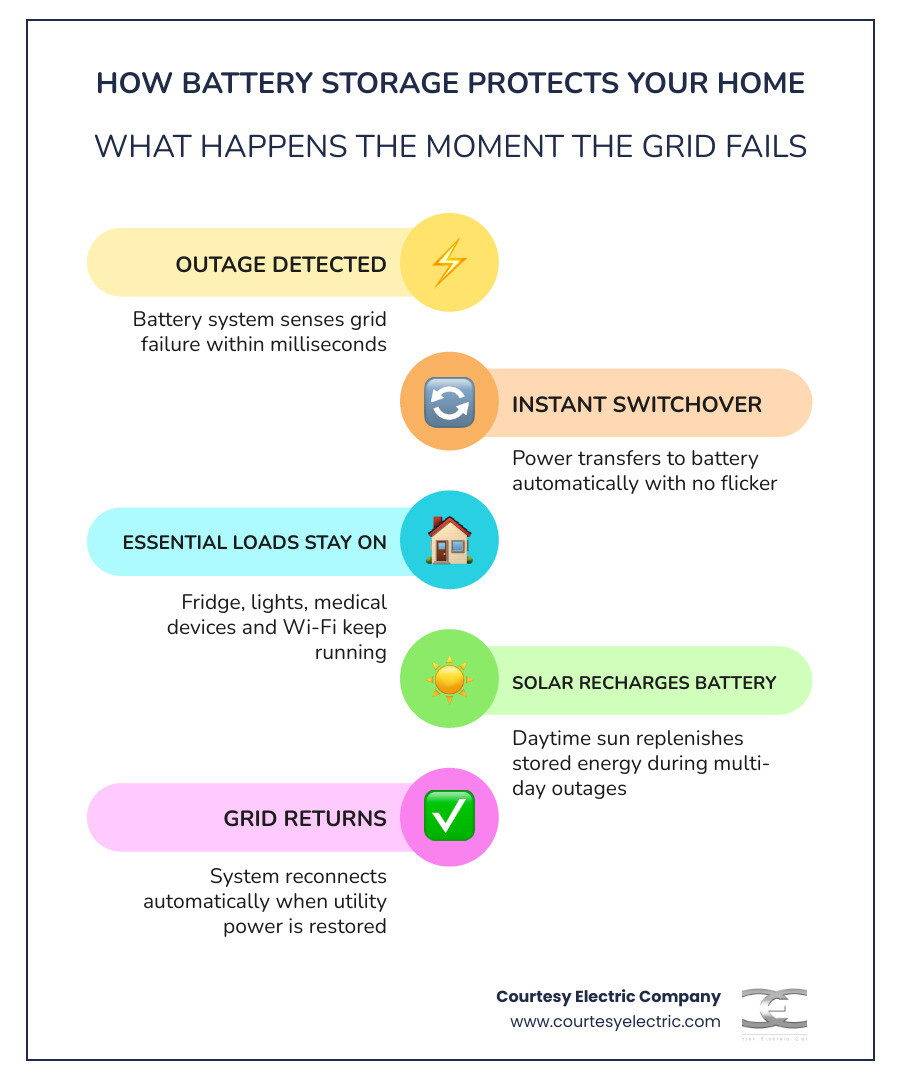
- Outage detected: Your battery system senses grid failure within milliseconds
- Automatic switchover: Power transfers to your battery instantly — no flicker, no clock resets
- Essential loads stay on: Refrigerator, lights, medical devices, Wi-Fi, and more keep running
- Solar recharges the battery: If you have solar panels, daytime sun replenishes stored energy during multi-day outages
- Grid returns: The system reconnects automatically when utility power is restored
Right here in Colorado, this matters more than ever. In recent years, Front Range homeowners have lived through outages lasting up to four days — triggered by high winds, wildfires, and severe winter storms that pushed the grid to its limits. According to local data, hundreds of thousands of Colorado households lost power during these events. For families with young children, elderly residents, or anyone depending on medical equipment, that's not just an inconvenience — it's a serious risk.
The good news? Battery storage has moved well beyond an off-grid novelty. Today's systems are compact, quiet, and designed to fit right into a modern home — giving you real energy independence when the grid can't deliver.
I'm David Meyer, Vice President of Courtesy Electric Company, and I've spent years working hands-on with battery wall installations and backup energy systems across the Colorado Front Range — giving me a front-row seat to exactly how battery storage protects your home during outages in real-world conditions. In this guide, I'll walk you through everything you need to know to make a confident decision for your home.
How Battery Storage Protects Your Home During Outages Automatically
When a winter storm hits Parker or high winds sweep through Highlands Ranch, the utility grid can drop offline in the blink of an eye. In a standard home, this means instant darkness, a silent refrigerator, and disconnected Wi-Fi. However, when your home is equipped with a modern energy storage system, the transition is so fast you might not even realize the neighborhood has lost power.
Modern home battery systems utilize an automatic transfer switch (ATS) and advanced gateway technology to monitor the incoming utility line. The moment the grid voltage drops or fluctuates outside of safe operating parameters, the system initiates what is known as "islanding." This process completely disconnects your home's electrical system from the utility grid, turning your property into a self-sustaining microgrid.

This entire detection and switchover process takes place in a mere 15 to 30 milliseconds. To put that in perspective, a human blink takes about 100 to 400 milliseconds. Because the backup power kicks in so quickly, sensitive electronics like desktop computers, home servers, and smart home hubs won't lose power or reboot.
To learn more about how these components tie into your home's electrical panel, check out our Home Battery Storage Complete Guide.
Understanding How Battery Storage Protects Your Home During Outages
To truly appreciate this technology, it helps to understand the components working behind the scenes. A home battery backup system is not just a stack of cells; it is a highly sophisticated energy appliance consisting of three primary elements:
- The Battery Cells: Most modern residential systems utilize Lithium Iron Phosphate (LiFePO4) chemistry. This is the gold standard for home use because of its exceptional thermal stability, safety profile, and long cycle life.
- The Battery Management System (BMS): This internal computer constantly monitors the temperature, voltage, and state of charge of individual cells, ensuring the system operates safely and efficiently.
- The Backup Gateway: This serves as the brain of the entire installation. It acts as the gatekeeper between your home, the solar array, the battery, and the utility grid.
When the gateway detects a grid failure, it immediately opens its internal switch to disconnect from the utility. This is a critical safety feature required by electrical codes. If the system did not isolate your home, stored power could backfeed into the downed power lines, posing a fatal hazard to utility crews working to restore service. Once isolated, the gateway signals the battery's bidirectional inverter to convert stored Direct Current (DC) power into the Alternating Current (AC) power your appliances need.
For a deeper dive into how these gateways manage local power distribution along the Front Range, read our Battery Storage Guide Centennial Co.
Whole-Home Backup vs. Essential-Loads Backup
One of the most important decisions you will make when designing your backup power system is choosing between a whole-home backup configuration and an essential-loads (or critical-loads) backup setup.
- Whole-Home Backup: In this configuration, the battery system is wired to back up your entire main electrical panel. If the power goes out, every outlet, light switch, and appliance in your home remains functional. While this offers the ultimate convenience, it requires a significantly larger battery capacity (often multiple stacked units) to handle heavy start-up loads from large appliances like central air conditioners, electric clothes dryers, and electric vehicle chargers.
- Essential-Loads Backup: This approach involves installing a dedicated critical loads subpanel during the installation process. We isolate the circuits that you absolutely cannot live without during an emergency and wire them directly to this subpanel. During an outage, only these selected circuits receive battery power, while non-essential loads (like guest bedroom outlets, pool pumps, or hot tubs) remain off.
For homeowners looking to maximize their runtime without over-investing in storage capacity, the essential-loads approach is often the most practical and cost-effective choice. It allows a single battery to stretch its stored energy over days rather than hours.
By integrating smart panel technology like SPAN panels, you can even manage these loads dynamically. Instead of physically hardwiring circuits to a subpanel, a smart panel allows you to prioritize and toggle circuits on or off directly from a smartphone app. This gives you the flexibility to transition from whole-home convenience to strict energy conservation with a simple tap.
To explore how our team designs these customized subpanels and manages load priorities, see our Battery Storage Fraser Co Complete Guide.
Why Homeowners Choose How Battery Storage Protects Your Home During Outages
When the grid goes dark, the priority shifts from luxury to basic survival and comfort. Approximately 80% of people who invest in home battery systems do so primarily for emergency backup power.
By focusing on a critical-loads setup, a residential battery system can easily keep your most vital devices running for 8 to 60 hours. These essentials typically include:
- Refrigerators and Freezers: Preventing hundreds of dollars in food spoilage.
- Medical Equipment: Ensuring continuous power for CPAP machines, oxygen concentrators, and temperature-sensitive medications.
- Wi-Fi Routers and Modems: Keeping you connected to emergency alerts, remote work, and loved ones.
- Well Pumps and Sump Pumps: Crucial for rural properties in the Front Range to maintain running water and prevent basement flooding.
- Device Charging: Keeping phones, tablets, and emergency radios fully charged.
For homeowners living in areas prone to sudden weather shifts, planning your essential circuits ahead of time is key. Get practical layout advice by reading our Battery Storage Installation Fraser Co Tips.
Solar Integration: Recharging Your Battery During Multi-Day Outages
A standalone battery system is a fantastic shield against short-term blackouts, but without a local generation source, it is ultimately a finite resource. Once the stored energy is depleted, the battery cannot recharge until the utility grid comes back online.
This is where pairing your battery with rooftop solar panels changes everything.
During a multi-day outage, your solar panels and battery storage system work hand-in-hand to create a continuous cycle of clean energy:
- Daylight Generation: When the sun rises, your solar panels begin producing electricity.
- Direct Powering: The solar energy first goes to power any active loads running in your home (like your refrigerator or home office).
- Battery Recharging: Any excess solar electricity not immediately consumed by your home is routed by the gateway to recharge the battery.
- Nighttime Support: Once the sun goes down, the solar panels stop producing, and your home seamlessly transitions to drawing electricity from the fully charged battery.
- Repeat: The next morning, the cycle begins again, allowing you to sustain your home indefinitely without grid power.
Several real-world factors will affect how quickly your solar panels can fully recharge your battery during an outage. These include local weather conditions (such as Colorado's sudden snowstorms or cloud cover), the angle of your roof, and how much electricity your family is actively consuming during the day.
If you live in mountainous or heavily forested areas, understanding local solar-plus-storage dynamics is essential. Learn more about regional performance factors in our guide on Battery Storage in Granby Co.
Battery Storage vs. Traditional Standby Generators
When evaluating emergency backup power, homeowners often compare battery storage to traditional combustion engine generators. While both systems keep your lights on, they do so in fundamentally different ways.
| Feature | Lithium Battery Storage | Standby Generator |
|---|---|---|
| Fuel Requirements | None (charges via solar or grid) | Natural gas, liquid propane, or diesel |
| Noise Levels | Completely silent | Loud engine noise (similar to a lawnmower) |
| Maintenance Needs | Virtually zero (automatic software updates) | Annual oil changes, filter swaps, and spark plug replacements |
| Emissions | Zero local emissions | Carbon monoxide and greenhouse gases |
| Activation Time | Instantaneous (15 to 30 milliseconds) | Delayed (typically 10 to 30 seconds to start engine) |
| Lifespan | 10 to 15+ years (warrantied for thousands of cycles) | Dependent on engine wear and run-hours |
Traditional gas generators require ongoing fuel delivery or a dedicated line connected to a large propane tank. Additionally, they require regular mechanical upkeep; standby generators can easily cost hundreds of dollars each year in maintenance to ensure they start reliably when needed.
Batteries, on the other hand, operate silently and require no hazardous fuel storage on your property. They also offer a "blinkless" transition, whereas a generator requires your home to lose power completely for up to half a minute while the engine cranks and stabilizes.
To read a detailed breakdown of how these two options compare for Front Range properties, check out our articles on Battery Storage vs Generator Which is Better for Backup and Standby Generator vs Battery Backup Cost Comparison. For a direct comparison of their reliability during severe storms, see our guide Generator or Battery for Power Outages is a Generator or Battery Better for Power Outages.
Frequently Asked Questions About Home Battery Backup
Investing in home energy storage is a significant decision. Here are answers to some of the most common questions Colorado homeowners ask us about battery performance, longevity, and cold-weather operation. For a detailed look at keeping your system running smoothly through our rugged winters, see our Battery Storage Maintenance Guide Granby Co.
How long will a home battery power my house during an outage?
The runtime of your battery backup system depends entirely on two variables: the usable capacity of your battery (measured in kilowatt-hours, or kWh) and the total electrical load you are running.
A typical residential home uses between 20 and 30 kWh of electricity per day. If you attempt to run your entire home — including high-draw appliances like central air conditioning, space heaters, or hot tubs — a standard 10 kWh to 13.5 kWh battery will likely drain in just a few hours.
However, if you practice smart load management and restrict your power use to essentials, your battery will last significantly longer:
- 5 kWh Battery: Can power a small home's absolute essentials (lights, internet router, phone chargers) for 10 to 12 hours.
- 10 kWh Battery: Can run a modern, energy-efficient refrigerator for up to 66 hours, or power a single LED light bulb for roughly 1,000 hours.
- High-Demand Loads: Running a large central air conditioner can draw enough power to deplete a 10 kWh battery in less than 3 hours.
By working with an experienced installer to design a dedicated critical-loads panel, you can comfortably stretch a single battery's capacity to provide 24 to 48 hours of reliable backup power. For advanced tips on sizing your system to match your home's square footage and daily energy consumption, read our Battery Storage Installation Guide Centennial Co.
Why do grid-tied solar systems shut down during outages?
Many homeowners are surprised to learn that a standard grid-tied solar array will go completely dark during a utility power outage. Even if the sun is shining brightly, your panels will stop producing electricity the moment the grid fails.
This is due to a strict safety feature required by national electrical regulations known as anti-islanding. When utility power goes down, line workers must physically handle the electrical wires to locate and repair the damage. If your solar panels continued to push electricity back onto the grid, it could send high-voltage power down the lines, putting the utility workers' lives at risk.
When you add a battery storage system with an automatic backup gateway, the gateway solves this problem. It acts as an isolation switch, instantly disconnecting your home's electrical panel from the utility grid. Once your home is safely "islanded," the gateway creates a localized microgrid. This tricks your solar inverter into thinking the grid is still active, allowing your panels to keep generating power to run your home and recharge your battery safely.
What maintenance does a home battery backup system require?
Unlike internal combustion engines, solid-state battery systems have no moving parts, belts, filters, or spark plugs. This makes them incredibly low-maintenance.
To ensure your system remains reliable for its 10- to 15-year lifespan, we recommend a few simple best practices:
- Keep Software Updated: Most modern batteries connect to your home Wi-Fi to receive automatic firmware and software updates from the manufacturer, which optimize charging algorithms and system efficiency.
- Maintain Temperature Control: Batteries operate most efficiently when kept within a moderate temperature range. While many units have high-quality outdoor NEMA ratings, installing them in a garage or utility room helps protect them from extreme Colorado winter temperatures.
- Schedule Professional Inspections: We recommend having a certified electrician perform a quick annual inspection. This includes checking electrical connections, confirming proper thermal management, and verifying that the gateway's automatic switchover functions correctly.
For homeowners living in the high country where winter temperatures regularly drop below freezing, specific care is required. Learn more about keeping your system in peak condition by reading about Battery Storage Maintenance in Winter Park Co.
Conclusion
As grid instability, extreme weather events, and wildfire-related safety shutoffs become more common across the Denver metro area and the Colorado Front Range, relying solely on the utility grid is a growing risk. Investing in home energy storage is one of the most effective ways to take control of your home's resilience, safety, and comfort.
By pairing a premium system like Franklin battery storage with a smart energy management system like SPAN panels, you can build a customized backup solution that adapts to your family's needs in real-time. Whether you are looking to protect a mountain home in Black Forest or secure a property in Highlands Ranch, this technology offers clean, silent, and instantaneous protection against blackouts.
Even better, there has never been a more financially advantageous time to make the switch. Thanks to federal incentives, homeowners can claim a substantial 30% credit on their federal income taxes for qualifying storage installations. To learn more about how to maximize these savings, read our guide on Federal Tax Credits for Battery Storage and Span Panels and explore local opportunities with Colorado Energy Rebates for Electrical Upgrades.
At Courtesy Electric Company, we have been serving Colorado families and businesses since 1976. Our team handles every step of the process, from initial system design and load calculations to professional installation and final commissioning.
Ready to secure your home's energy independence? Learn more about our residential electrical services and contact us today to schedule your free, no-obligation estimate.


