Is Your Electrical Panel Trying to Tell You Something?
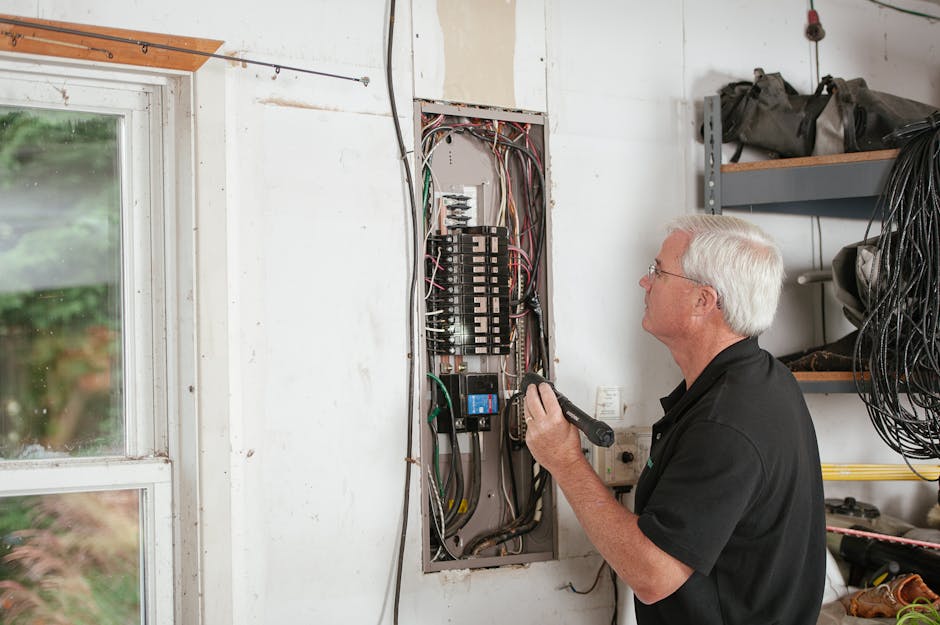
The signs your home needs an electrical panel upgrade are easy to miss — until they become a real problem. Here's a quick look at the most common warning signs:
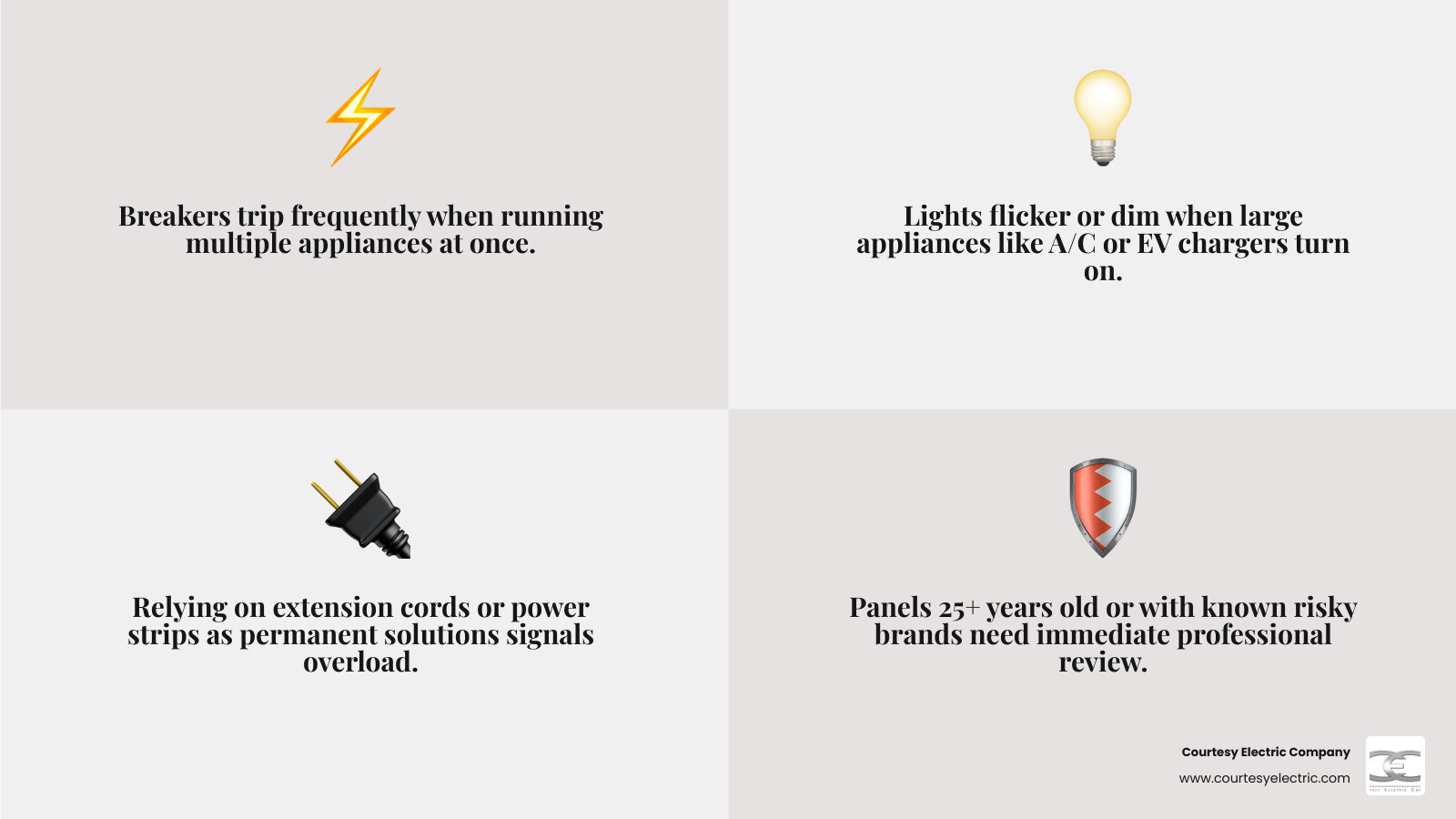
- Breakers trip frequently — especially when running multiple appliances
- Lights flicker or dim when large appliances kick on
- You rely on extension cords and power strips as permanent solutions
- Your panel is 25+ years old or still uses fuses instead of breakers
- You smell burning or notice scorch marks near the panel
- The panel buzzes, hums, or feels warm to the touch
- You're adding high-demand devices like an EV charger, hot tub, or central A/C
- You have a known problem brand like Federal Pacific Electric or Zinsco
- Rust, corrosion, or water damage is visible on the panel
- Your home has two-prong outlets throughout
If any of these sound familiar, your panel may be struggling to keep up with your home's electrical demands — and that's worth taking seriously.
Most homeowners don't think much about their electrical panel until something goes wrong. But your panel is the central hub that controls power distribution to every outlet, appliance, and light in your home. As the average U.S. household's annual electricity use has more than doubled since 1970 — now exceeding 10,700 kWh per year — older panels are increasingly being pushed beyond what they were designed to handle. And for Colorado Front Range homeowners adding EV chargers, smart home systems, or backup power solutions, an underpowered panel isn't just inconvenient — it can be a genuine safety hazard.
I'm David Meyer, Vice President of Courtesy Electric, and with nearly 50 years of hands-on electrical contracting experience behind our team, I've seen how signs your home needs an electrical panel upgrade often go unnoticed until the risks become serious. In this guide, I'll walk you through exactly what to watch for and what to do about it.
Understanding Your Home’s Electrical "Brain"

If you think of your home’s electrical wiring as the central nervous system, the electrical panel is undoubtedly the brain. It is the central hub where the main power line from the utility company enters your home and is divided into individual circuits. Each circuit is protected by a breaker (or a fuse in older systems) that acts as a safety gate.
The primary job of this "brain" is to ensure that no single circuit carries more electricity than its wires can safely handle. When a circuit is overloaded, the breaker "trips," cutting off the flow of electricity to prevent the wires from overheating and starting a fire. This makes the panel your home's most important safety device.
In May 2026, we are seeing more demand on these systems than ever before. Modern homes in the Denver area aren't just powering light bulbs and refrigerators; they are charging vehicles, running high-efficiency heat pumps, and managing complex smart home integrations. If your panel was installed in the 1980s or 90s, it was designed for a world before smartphones, streaming devices, and home offices.
For many homeowners, the first step in an upgrade is moving from an outdated fuse box to a modern circuit breaker system. While both serve the same basic purpose, the technology is vastly different.
Comparing Fuse Boxes and Modern Circuit Breaker Panels
| Feature | Fuse Box (Pre-1960s) | Modern Circuit Breaker Panel |
|---|---|---|
| Safety Mechanism | A filament melts to break the circuit. | A mechanical switch flips to break the circuit. |
| Resetting | Must replace the entire fuse with a new one. | Simply flip the switch back to the "on" position. |
| Capacity | Usually 30–60 amps; limited circuits. | 100–400 amps; supports many circuits. |
| Insurance | Often leads to higher premiums or denial. | Standard for modern safety compliance. |
| Risk Factor | High risk of "over-fusing" (using wrong size). | Built-in protection against manual overrides. |
If you are currently relying on a fuse box, it is one of the most definitive signs your home needs an electrical panel upgrade. You can learn more about our comprehensive Electrical Service options to see how we transition older homes into the modern era.
10 Critical Signs Your Home Needs an Electrical Panel Upgrade
Identifying signs your home needs an electrical panel upgrade early can save you from a middle-of-the-night emergency or, worse, a house fire. Electrical issues are often like a "check engine" light in your car; they might seem like a minor nuisance, but they usually indicate a larger underlying problem.
It is vital to know how to spot electrical problems before they become dangerous. In many cases, the panel won't just stop working; it will give you subtle clues that it is struggling to keep up with your daily energy usage.
Frequent Breaker Trips and Signs Your Home Needs an Electrical Panel Upgrade
We’ve all been there: you turn on the microwave while the toaster is running, and suddenly the kitchen goes dark. While an occasional trip is the breaker doing its job, frequent tripping is a major red flag.
Breakers trip because the circuit is drawing more current than it can handle. Over time, constant overloading causes "breaker fatigue," where the mechanical components inside the breaker wear down and become unreliable. If you find yourself walking to the garage or basement once a week to flip a switch, your panel is telling you that your home’s electrical load exceeds its current capacity. These electrical safety tips every homeowner should know can help you manage loads in the short term, but a panel upgrade is the only permanent fix.
Outdated Fuse Boxes and Obsolete Brands
If your home was built before 1960, there is a high probability it originally utilized a fuse box. Fuses aren't inherently "broken," but they were never meant to handle the 10,700+ kWh that modern households consume. Furthermore, certain brands of panels installed between the 1950s and 1980s are now known to be defective.
Federal Pacific Electric (FPE) and Zinsco panels are two of the most notorious. These panels have a high failure rate where the breakers fail to trip even during a massive surge, leading to melted wires and fires. Many insurance companies in Colorado will actually refuse to cover a home or will significantly increase premiums if these brands are present. Checking your panel for these names is a critical part of any electrical safety checklist for older homes.
Physical Damage and Signs Your Home Needs an Electrical Panel Upgrade
Physical deterioration is a clear indicator that it's time for a replacement. Rust or corrosion on the panel box usually means moisture has found its way in, which is a recipe for disaster when combined with electricity.
You should also use your other senses. Do you hear a buzzing or hissing sound coming from the panel? That's often the sound of electrical arcing. Does the panel cover feel warm to the touch? A warm panel suggests that the connections inside are loose or that the system is severely overloaded. These are immediate how to prevent electrical fires in your home warning signs that require professional attention.
Reliance on Extension Cords and Power Strips
Are extension cords running under your rugs or along your baseboards? While they are fine for temporary use (like holiday lights), they are not meant to be permanent fixtures.
Heavy reliance on power strips and extension cords usually means your home doesn't have enough outlets or circuits to support your lifestyle. This forces too much power through a single outlet, which can overheat the wires behind the wall. Upgrading your panel allows an electrician to add dedicated circuits for your high-demand areas, which is a key item on the ultimate electrical fire safety checklist home.
The Dangers of Ignoring an Outdated System
Ignoring the signs your home needs an electrical panel upgrade isn't just a matter of convenience; it’s a matter of safety. According to industry statistics, electrical panels and their associated wiring cause approximately 5-7% of home fires annually. Panels that are over 25 years old account for a disproportionate share of these incidents.
When a panel fails to regulate the flow of electricity, several dangerous things can happen:
- Electrical Fires: Overloaded wires generate heat. If the breaker doesn't trip to stop the flow, that heat can ignite the insulation or surrounding wood framing.
- Appliance Damage: Modern electronics (like your $2,000 smart fridge or OLED TV) are sensitive to voltage fluctuations. An outdated panel can "leak" electricity or cause surges that fry delicate circuit boards.
- Electrical Shock: Outdated systems often lack proper grounding. Without a safe path for excess electricity to travel to the ground, that electricity might find a path through you.
Understanding how outdated wiring increases fire risk is essential for any homeowner in an older Denver neighborhood. A panel upgrade is essentially an insurance policy for your home's most expensive assets.
Modern Power Demands in 2026: Why 100 Amps Isn't Enough
In the past, a 60-amp or 100-amp panel was the gold standard. In 2026, those numbers are quickly becoming obsolete. The "standard" modern home now requires at least a 200-amp service to function efficiently.
Why the sudden jump? Consider what we are adding to our homes:
- Electric Vehicles (EVs): A Level 2 EV charger can draw 30–50 amps on its own. If you have a 100-amp panel, your car could be taking up half of your home's total capacity while it charges.
- Electrification: As more homeowners move away from gas and toward electric heat pumps and induction cooktops, the demand on the panel skyrockets.
- Smart Home Tech: While individual smart bulbs don't use much power, the cumulative effect of dozens of connected devices, security systems, and high-powered mesh Wi-Fi routers adds up.
- Home Additions: Adding a hot tub, a finished basement, or an ADU (Accessory Dwelling Unit) almost always necessitates a panel upgrade.
At Courtesy Electric, we specialize in modern Services that address these 2026 demands. We often recommend SPAN smart panels, which allow you to monitor and control your energy usage circuit-by-circuit from your phone. This is the future of home energy management, allowing you to prioritize power to essential appliances during an outage or manage your EV charging based on utility rates.
What to Expect During a Professional Panel Replacement
Many homeowners put off an upgrade because they fear the process will be long, messy, and leave them without power for days. In reality, a standard residential panel upgrade is a highly coordinated event that usually takes between 4 and 8 hours.
Here is the general roadmap for a professional upgrade:
- The Assessment: We perform a load calculation to determine exactly what size panel you need (usually 200-amp, but sometimes 400-amp for larger estates).
- Permitting: In Denver and the Front Range, a panel upgrade requires a permit. We handle all the paperwork to ensure your upgrade is legal and code-compliant.
- Utility Coordination: We coordinate with Xcel Energy or your local utility to disconnect the power from the street.
- The Swap: Our licensed electricians remove the old equipment, install the new panel, and reconnect all your existing circuits.
- Inspection: Once the work is done, a city or county inspector will visit to verify that everything meets the National Electrical Code (NEC).
It is crucial to understand when to call an electrician vs DIY. While you might be comfortable changing a light fixture, a panel upgrade involves handling the main service lines that carry enough current to be fatal. This is strictly a job for licensed professionals.
Frequently Asked Questions about Electrical Panels
How long does an electrical panel typically last?
Most electrical panels have a functional lifespan of 25 to 40 years. However, "functional" doesn't always mean "safe" or "adequate." Even if a 35-year-old panel isn't sparking, it likely lacks modern safety features like Arc Fault Circuit Interrupter (AFCI) protection, which is designed to detect dangerous electrical arcs before they start a fire. We recommend a professional visual inspection every 3 to 5 years for homes over two decades old.
Do I need a permit for a panel upgrade in Colorado?
Yes. All jurisdictions across the Colorado Front Range require permits and inspections for electrical panel replacements. This isn't just a "red tape" issue; it’s for your protection. The inspection ensures the work was done safely, which is vital for your homeowner's insurance and for when you eventually decide to sell your home.
Can I upgrade my panel to support a whole-house generator?
Absolutely. In fact, many homeowners choose to upgrade their panel specifically because they want to install a Generac or Cummins standby generator. During the panel upgrade, we can install a transfer switch that allows your home to automatically switch from grid power to generator power during an outage. This is a great time to also consider battery storage solutions like Franklin Battery Storage for a truly resilient home.
Conclusion
Recognizing the signs your home needs an electrical panel upgrade is the first step toward a safer, more efficient home. Whether you are dealing with flickering lights, an aging fuse box, or you are simply ready to prepare your home for an electric vehicle, the team at Courtesy Electric is here to help.
Since 1976, we have served the Denver and Colorado Front Range communities with quality, integrity, and dependability. From Parker to Highlands Ranch and up through the Black Forest, we specialize in everything from basic panel retrofits to advanced SPAN smart panel installations and backup power systems.
Don't wait for a total system failure to address your home's electrical "brain." Contact us today to schedule your free estimate. Our experts will evaluate your current system and provide a clear, professional plan to bring your home into the modern age of energy. Explore our full range of Electrical Service options and let us give you the peace of mind you deserve.


