

Why Every Colorado Homeowner Needs an Electrical Fire Safety Checklist for Your Home

An electrical fire safety checklist for your home is one of the simplest tools you can use to protect your family and property from one of the most preventable disasters out there. According to data from the National Fire Protection Association, electrical distribution and lighting equipment sparked an average of over 31,000 home structure fires per year between 2019 and 2023 — causing hundreds of deaths, thousands of injuries, and over $1.6 billion in property damage annually.
Here is a quick checklist to get you started:
- Outlets and switches: No warmth, discoloration, buzzing, or loose plug fit
- Cords: No fraying, cracking, pinching, or permanent extension cord use
- Electrical panel: AFCIs and GFCIs installed and tested monthly
- Appliances: Major appliances plugged directly into wall outlets
- Smoke alarms: Installed on every level, tested monthly, replaced every 10 years
- Carbon monoxide detectors: Installed on every level, replaced every 7 years
- Space heaters: Kept 3 feet from flammables, never left unattended
- Lighting: Bulbs match the wattage rating of each fixture
- Professional inspection: Schedule one if your home is over 30 years old
The scary part? Many electrical hazards hide inside walls, behind panels, and under furniture — completely out of sight until something goes wrong. A single arc fault, a frayed cord under a rug, or an overloaded outlet can start a fire faster than most people expect. In fact, if a fire breaks out in your home, you may have less than three minutes to get out safely.
I'm David Meyer, Vice President of Courtesy Electric — a Colorado electrical contracting company with roots going back to 1976 — and electrical fire prevention is something our team takes seriously on every residential job we touch. From decades of field experience across Denver and the Front Range, this electrical fire safety checklist for your home is designed to help you spot real hazards before they become emergencies.
Common Causes of Electrical Fires in 2026
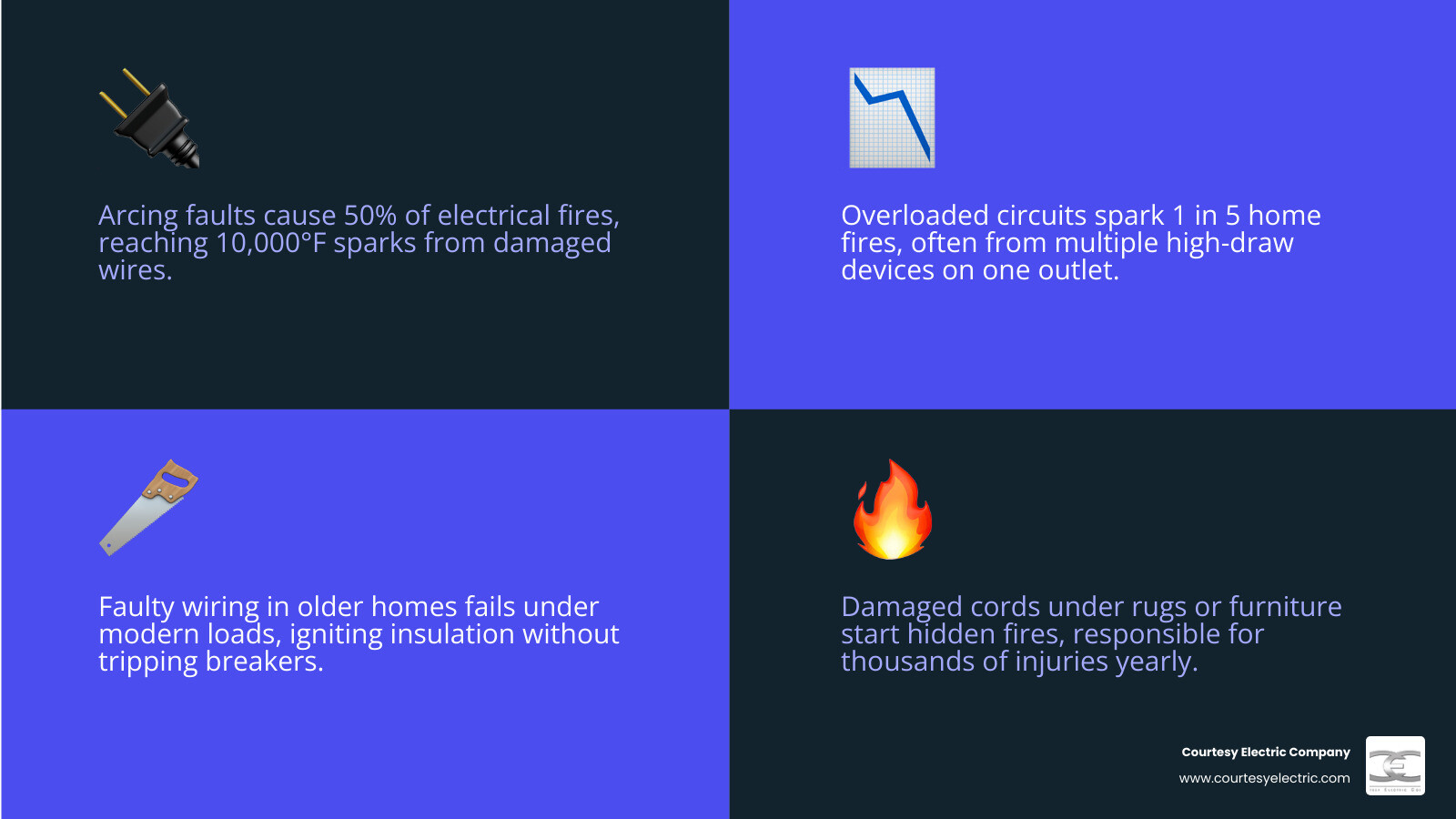
As we move through 2026, the way we use energy in our Denver homes has changed significantly. While the physics of electricity remains the same, our reliance on high-tech devices has introduced new stressors to older infrastructure. The most common culprit remains the arcing fault. This occurs when electricity "jumps" or arcs between damaged wires, often caused by a nail driven into a wall or a cord pinched by heavy furniture. These invisible sparks can reach temperatures high enough to ignite wooden studs or insulation long before a standard breaker ever trips.
Aging wiring systems are another major concern, particularly in established neighborhoods throughout the Colorado Front Range. Homes built several decades ago weren't designed to handle the simultaneous load of modern life. When you combine an aging system with overloaded circuits—think of a single outlet powering a computer, a printer, and a portable heater—you have a recipe for disaster. High-wattage appliances, like air conditioners and space heaters, draw massive amounts of current. If the wiring isn't up to the task, it generates heat, which eventually breaks down the protective insulation.
Furthermore, the rise of lithium-ion battery charging has added a new layer of risk. From smartphones to high-powered laptops, these batteries can undergo "thermal runaway" if they are damaged or charged with uncertified, counterfeit cables. To keep your home protected, ensuring your Electrical Service is modern and robust is no longer a luxury; it’s a necessity.
Emerging Risks in Modern Homes
The 2026 home looks a lot different than it did even ten years ago. We are seeing a massive influx of EV charging stations in residential garages. While these are fantastic for the environment, they require a dedicated, high-amperage circuit. Attempting to "DIY" a charger installation or using an inadequate circuit can lead to catastrophic overheating.
Similarly, the popularity of e-bikes has brought large lithium-ion batteries into our mudrooms and garages. These should never be left charging overnight unattended. We also see "smart home hub overloads," where homeowners plug dozens of smart plugs, bridges, and cameras into a single power strip. While each individual device draws little power, the cumulative heat in a confined space can be dangerous. Exploring our Services 1 can help you understand how to integrate these modern technologies safely into your home's infrastructure.
Your Essential Electrical Fire Safety Checklist for Your Home
Walking through your home with a critical eye is the best way to prevent a tragedy. We recommend performing a full walkthrough every six months. Start with the basics: look at your wall outlets. Are the plates discolored or charred? This is a sign of dangerous heat buildup.

When you plug something in, the fit should be snug. If a plug slides out easily or hangs loosely, the connection is poor, which creates resistance and heat. Listen closely as well. Do your switches make a crackling, buzzing, or sizzling sound when you flip them? Does an outlet feel warm to the touch? These are immediate red flags that require professional attention. For more information on what we look for during an inspection, visit our home page.
Using an Electrical Fire Safety Checklist for Your Home to Inspect Outlets
Modern safety standards have introduced several "silent heroes" into our homes. Tamper-resistant (TR) receptacles are now required in new construction. They feature internal shutters that prevent children from sticking foreign objects into the slots. Even if you don't have kids, these are a smart upgrade for when grandchildren or guests visit.
You should also be testing your GFCI (Ground Fault Circuit Interrupter) outlets monthly. These are the ones with "Test" and "Reset" buttons found in kitchens, bathrooms, and garages. Simply plug in a small lamp, hit "Test" (the light should go out), and then "Reset." If it doesn't trip, the protection has failed, and you are at risk of a lethal shock. Just as important is AFCI (Arc-Fault Circuit Interrupter) protection. While GFCIs protect you from shocks, AFCIs protect your home from fires by detecting those dangerous "arcs" we mentioned earlier. Learn more about our commitment to installing these life-saving technologies.
Managing Cords and Power Strips for Your Electrical Fire Safety Checklist for Your Home
Cords and plugs are involved in a disproportionately high number of fire-related deaths. A common mistake is using extension cords as permanent wiring. They are designed for temporary use only. Over time, they can degrade, get stepped on, or overheat under rugs.
Check every cord in your house for fraying, cracking, or exposed copper. If you find a damaged cord, don't wrap it in electrical tape—replace the appliance or the cord entirely. Also, ensure there is plenty of airflow around electronics. Piling blankets or papers around a gaming console or a charging laptop traps heat, which can lead to a fire. If you have questions about safe cord management, contact our team.
Identifying Faulty Wiring and Overloaded Circuits
How do you know if the wiring behind your drywall is failing? Your home usually tries to tell you. Flickering lights are more than just an annoyance; they often indicate a loose connection in your circuit or a problem with the service entrance. Similarly, if you find yourself running to the garage to flip a breaker back on multiple times a week, your system is crying for help.
For homeowners in older parts of Denver or the Front Range, aluminum wiring is a specific concern. Popular in the late 60s and early 70s, aluminum expands and contracts more than copper, which can lead to loose connections and fires at outlets.
| Feature | Standard Circuit Breaker | Arc-Fault Circuit Interrupter (AFCI) |
|---|---|---|
| Primary Goal | Prevents circuit overloads/shorts | Prevents electrical fires from arcing |
| Detection | Detects high current flow | Detects dangerous "sparking" patterns |
| Protection | Protects the wiring from melting | Protects the home structure from ignition |
| Requirement | Standard in all homes | Required for most living areas in modern code |
Signs of a Strained Electrical System
A strained system often shows "voltage drops." If your lights dim the moment your refrigerator kicks on or when you start the vacuum, your circuits are likely at capacity. Another major warning sign is a tingling sensation when you touch a metal appliance or faucet. This indicates a "ground fault" where electricity is looking for a path to the earth through you. If this happens, stop using the appliance immediately and schedule an inspection.
Best Practices for High-Wattage Appliances and Space Heaters
Space heaters are a leading cause of home fires during Colorado winters. The golden rule is the three-foot clearance: keep anything that can burn—curtains, blankets, furniture, or paper—at least three feet away from the heater.
Always plug space heaters and other high-wattage appliances (like window A/C units or microwaves) directly into a wall outlet. Power strips and extension cords are not rated to handle the sustained high current these devices draw and can easily melt or ignite. Look for the NRTL safety seal (like UL or ETL) on any heating device you buy, which ensures it has been tested for safety. Our Services 1 page offers more tips on managing high-load appliances.
Kitchen and Laundry Room Safety
The kitchen and laundry room are high-risk zones. In the kitchen, keep your exhaust fan clean. Grease buildup can ignite if a stovetop fire occurs. Also, get into the habit of unplugging small appliances like toasters and coffee makers when they aren't in use. Even when "off," they can have internal faults.
In the laundry room, dryer lint is a major fuel source. Clean the lint trap after every single load, and have your dryer vent duct professionally cleaned at least once a year. A clogged vent causes the dryer to overheat, which can ignite the highly flammable lint trapped inside the machine. Proper Electrical Service maintenance includes checking these high-use areas.
Maintaining Smoke Alarms and Carbon Monoxide Detectors
You might have the best electrical fire safety checklist for your home, but if a fire starts while you’re asleep, your smoke alarms are your only line of defense. You need an alarm on every level of your home, inside every bedroom, and outside every sleeping area.
Test the buttons monthly. If you have older units that use 9-volt batteries, change them every six months (a good rule is to do it when the clocks change). However, modern alarms often come with 10-year sealed batteries. Regardless of the battery type, the entire unit must be replaced every 10 years. Carbon monoxide detectors have an even shorter lifespan—usually around 7 years. Check the date on the back of your devices today! Find more safety resources on our home page.
Creating a 2026 Emergency Response Plan
If the worst happens, you won't have time to think. You need a practiced plan. Ensure everyone in the family knows two ways out of every room. If the hallway is full of smoke, is there a window that can be used?
Designate a meeting place outside, like a specific tree or the mailbox. For electrical fires, specifically, you should have a Class C fire extinguisher (or a multi-purpose A-B-C extinguisher) available. Never use water on an electrical fire, as water conducts electricity and could result in a fatal shock. Learn more about our commitment to community safety and preparedness.
Frequently Asked Questions about Electrical Fire Safety
What should I do if I smell burning but see no fire?
If you smell an "acrid" or "fishy" odor—which is often the smell of melting plastic or wire insulation—turn off your main breaker immediately. This stops the flow of electricity to the potential fault. Do not turn it back on until a licensed electrician has inspected the home.
How often should a professional inspect my home's wiring?
If your home is over 30 years old, or if you have recently moved into a new-to-you older home, you should have a professional inspection immediately. For newer homes, a comprehensive check every 3 to 5 years is a good standard to ensure no pests have chewed wires and no connections have loosened.
Can I use a power strip for my portable heater?
No. Most power strips are not designed to handle the high, continuous current required by a space heater. This can cause the power strip to overheat and catch fire before its internal breaker even trips. Always plug heaters directly into the wall.
Conclusion
At Courtesy Electric Company, we’ve spent the last 50 years helping Denver and Front Range families stay safe. Whether we are installing a high-tech SPAN smart panel or simply helping a homeowner work through an electrical fire safety checklist for your home, our goal is the same: quality, integrity, and dependability.
Don't wait for a flickering light to become a fire. Take the time today to walk through your home and check your outlets, cords, and alarms. If you find anything that makes you uneasy, our team of experts is here to help with everything from infrastructure design to smart home integrations. Stay safe, Colorado!
Ready to ensure your home is up to code? Explore our Electrical Service options today.


