
Why Getting Generator Size Right Is the Most Important Decision You'll Make Before the Next Outage
Knowing how to calculate generator size for your house is the difference between a generator that works when you need it most and one that shuts down the moment your AC kicks on.
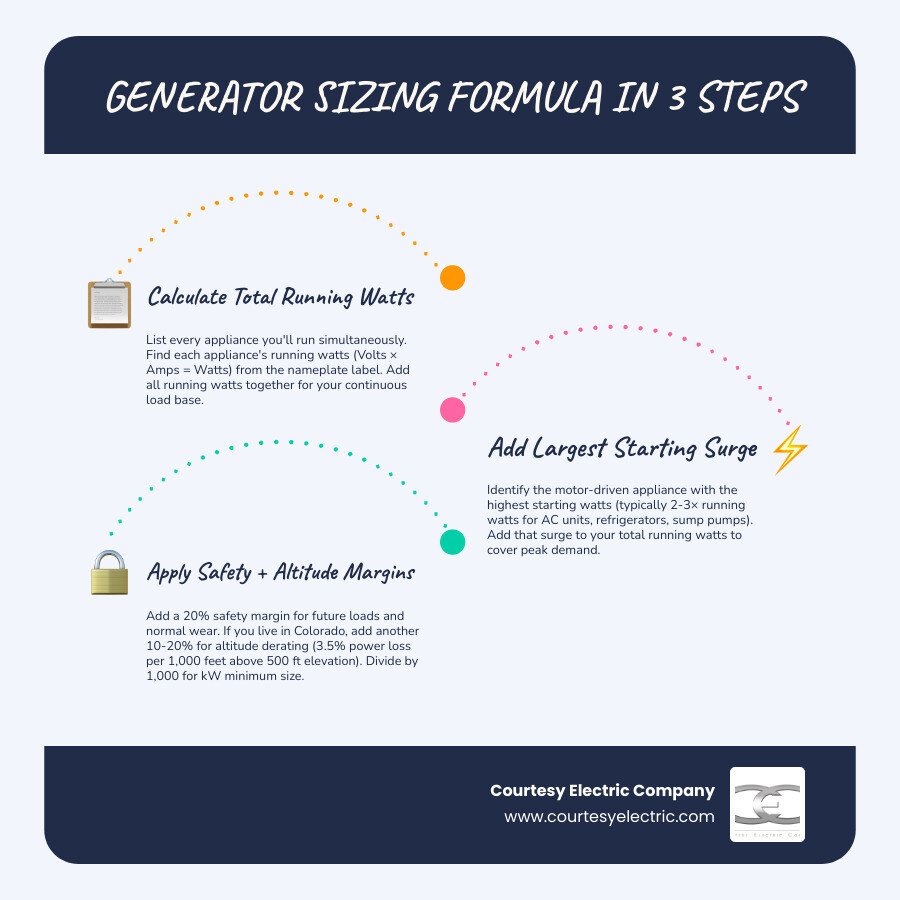
Here's the quick answer:
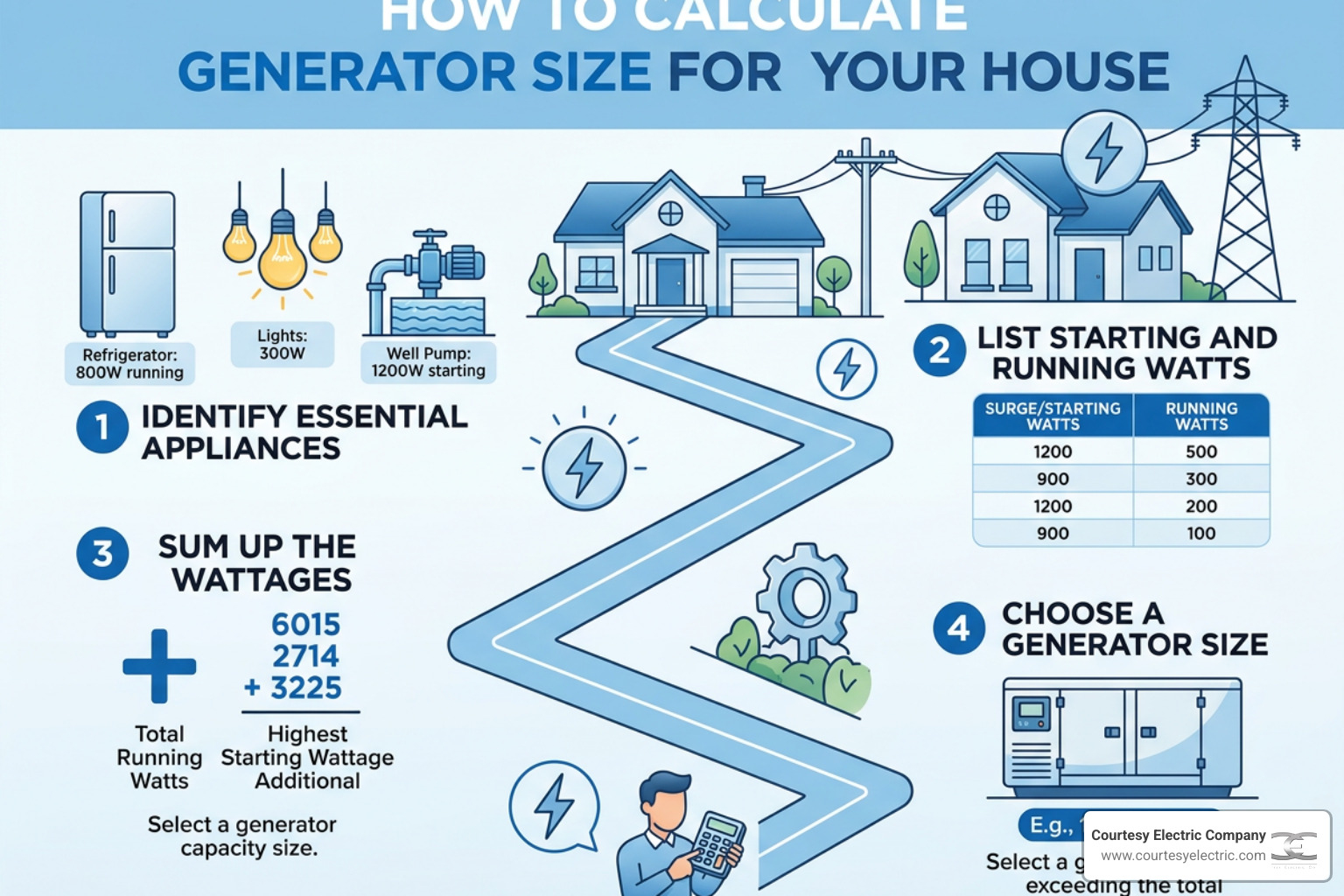
- List every appliance you need to run at the same time during an outage.
- Find the running watts for each appliance (check the nameplate label, or multiply Volts × Amps = Watts).
- Add all running watts together to get your total continuous load.
- Find the highest starting watts among your appliances (typically 2-3× the running watts for motor-driven appliances like AC units, refrigerators, and sump pumps) and add that surge to your total running watts.
- Add a 20% safety margin to the result to account for future loads and normal wear.
- Divide the final number by 1,000 to convert watts to kilowatts (kW) — that's your minimum generator size.
- If you're in Colorado, add an extra 10-20% on top for altitude derating, since generators lose roughly 3.5% of their rated power for every 1,000 feet above 500 feet elevation.
That formula works for most homes. But the size you need also depends on whether you want to power just the essentials or run your whole house — including central air conditioning — without thinking twice about it.
Here's why this matters so much: a generator that's too small will overload and shut down at exactly the wrong moment. One that's too large wastes fuel and money, and can actually cause engine problems over time from running at too low a load. Getting it right is about more than math — it's about understanding what you need to keep running and making sure the equipment can handle it.
Power outages on the Colorado Front Range aren't rare. Between summer thunderstorms, winter blizzards, and an aging grid, the question isn't really if the power goes out — it's whether you're ready when it does.
I'm David Meyer, Vice President of Courtesy Electric, a Colorado electrical contractor with roots going back to 1976. I've spent my career working on generator installations, panel upgrades, and backup power systems across Denver and the Front Range, and helping homeowners understand how to calculate generator size for your house is one of the most common — and most important — conversations we have. In the sections below, I'll walk you through three methods to get this right, from a hands-on manual calculation to professional load analysis using NEC standards.
How to Calculate Generator Size for Your House: The Step-by-Step Manual Method
The most reliable way to understand your home’s electrical appetite is to build a manual inventory. This hands-on approach helps you see exactly where your power goes, making it easier to prioritize your electrical loads during a grid failure.
When you calculate your load manually, you cannot simply add up every single lightbulb and outlet in your home. If you did, you would end up with an enormous, industrial-sized generator that would run highly inefficiently. Instead, manual calculation is about identifying your simultaneous usage — what actually needs to run at the exact same moment.
For instance, your microwave, refrigerator, and sump pump might all be on the same backup system, but they will rarely pull peak power at the exact same second. To size the generator properly, we calculate the total running watts of all your target appliances and add only the largest single starting surge to that total.
In places like Parker, Highlands Ranch, and Black Forest, our unique climate and geography play a massive role in how we apply this math. High-altitude environments feature thinner air, which directly impacts internal combustion engines. This means your generator will experience altitude derating, losing a portion of its rated capacity simply by sitting in your yard. Understanding how these factors interact ensures your system handles the load when the weather turns. For more on this, you can read about How Colorado Weather Affects Generator Lifespan.
Why You Need to Know How to Calculate Generator Size for Your House
Choosing a backup power system based on a guess is a recipe for system failure. If you undersize your generator, the system will experience overloading risks. The moment a heavy motor like your refrigerator compressor or well pump tries to cycle on while you are running lights and a microwave, the generator’s circuit breaker will trip, plunging your home back into darkness. Over time, these sudden shutdowns damage the generator's alternator and strain your appliances' motors.
Conversely, buying an oversized generator is a major mistake. Aside from the unnecessary upfront equipment costs, an oversized generator runs highly inefficiently and consumes far too much fuel. Even worse, if a diesel or gas generator runs continuously at less than 30% to 50% of its rated capacity, it can suffer from a condition known as wet stacking. This occurs when unburned fuel accumulates in the exhaust system, degrading engine performance, creating heavy carbon deposits, and drastically shortening system longevity.
Sizing your system correctly ensures your generator runs within its optimal efficiency sweet spot (usually between 50% and 75% load). To protect your investment over the long haul, take a look at our guide on How to Extend the Life of Your Standby Generator.
Running Watts vs. Starting Watts
To master the math of generator sizing, you must understand the difference between two critical numbers: running watts and starting watts.
- Running Watts (Continuous Load): This is the steady, ongoing electrical power an appliance requires to remain operational after its initial startup. For example, a standard refrigerator might only need 150 to 200 watts to keep its interior cold once the motor is running.
- Starting Watts (Peak Demand / Surge Watts): This is the brief, high-energy burst of electricity required for a fraction of a second to start an electric motor or compressor from a dead stop. Because motors must overcome physical inertia, their starting watts can be 2 to 3 times higher than their running watts.
If your generator cannot supply this instantaneous peak demand, the motor will stall, and the generator’s safety controls will shut the unit down. This dynamic is central to understanding How Does a Standby Generator Work to keep your home safe.
Step-by-Step Wattage Calculation and the 20% Safety Margin
If an appliance label does not explicitly list its wattage, you can easily find it using a simple conversion formula. Look at the silver nameplate data tag on the back or bottom of the device to find the listed volts and amps.
Multiply those two numbers together to find the wattage:
$$\text{Volts} \times \text{Amps} = \text{Watts}$$
For example, if your microwave lists a demand of 10 amps at 120 volts, it requires 1,200 watts of power ($10 \times 120 = 1,200$).
For larger motorized equipment, such as a central AC compressor, look for the LRA (Locked Rotor Amps) or Starting Amps on the data plate. This indicates the absolute maximum current the motor will draw when starting up.
Once you have gathered these numbers, use this step-by-step process:
- List the running watts of every device you want to power simultaneously.
- Sum those running watts to establish your continuous load baseline.
- Identify the single appliance with the highest starting surge (e.g., your air conditioner or well pump). Subtract its running watts from its starting watts to find its "surge overhead," then add that surge overhead to your continuous baseline.
- Add a 20% safety margin (multiply the sum by 1.20). This safety factor provides essential headroom so your generator does not run at maximum capacity, leaving room for future household electrical additions.
- Apply altitude derating. Because air is less dense in Denver, Parker, and Highlands Ranch, generators lose approximately 3.5% of their rated power for every 1,000 feet above an elevation of 500 feet. If you live at 5,500 feet, your generator will experience roughly a 17.5% reduction in performance. We recommend adding an extra 10% to 20% to your final calculation to compensate for this high-altitude performance loss.
Here is a quick reference list of common household appliance power requirements:
- Refrigerator / Freezer: 150W running / 1,200W starting
- Sump Pump (1/2 HP): 1,000W running / 2,150W starting
- Well Pump (3/4 HP): 1,500W running / 3,000W starting
- Furnace Blower (Gas/Propane): 600W running / 1,200W starting
- Electric Water Heater (Standard Tank): 4,500W running / 4,500W starting
- Microwave Oven: 1,200W running / 1,200W starting
- Sump Pump (1/2 HP): 900W running / 1,800W starting
- Garage Door Opener: 500W running / 1,000W starting
Calculating these loads accurately is especially vital when preparing for winter weather. Explore how a properly sized system keeps you safe in our article on Generator Benefits During Colorado Winter Power Outages.
Method 2: Sizing by Square Footage and Coverage Goals
If you want a quick, reliable estimate before diving into individual appliance labels, you can use your home's square footage as a helpful starting proxy. This method groups your backup power goals into clear tiers: powering only the essentials versus running a true whole-house backup system.

When sizing by square footage, we must carefully evaluate your HVAC loads. Heating and cooling systems are typically the largest electrical consumers in any home. If your home relies on a central AC unit, a heat pump, or electric resistance heating, your generator size requirements will increase significantly compared to a home with gas-fired heating and no central cooling.
To help you visualize these general sizing brackets, we have put together a quick-reference comparison:
| Home Square Footage | Essentials Only (No Central AC) | Whole-House Backup (With Central AC) | High-Demand Backup (Dual AC / Electric Heat) |
|---|---|---|---|
| Under 1,000 sq. ft. | 3 – 5 kW | 5 – 8 kW | 10 – 12 kW |
| 1,000 – 2,000 sq. ft. | 5 – 7 kW | 8 – 12 kW | 14 – 20 kW |
| 2,000 – 3,000 sq. ft. | 7 – 10 kW | 12 – 20 kW | 22 – 26 kW |
| Over 3,000 sq. ft. | 10 – 12 kW | 22 – 26 kW | 26 – 30+ kW |
This table provides a starting point, but your specific appliance mix will dictate the ideal system. For a deeper look at how to select the right approach for your property, read our guide on Choosing the Right Backup Power for Colorado.
Sizing for Essentials Only vs. Whole-House Backup
Deciding between an essentials-only system and a whole-house backup determines both the size of your generator and how you will use it during an outage.
- Essentials-Only Backup: This setup focuses strictly on critical circuits. It keeps your refrigerator cold, runs your gas furnace blower, powers your sump pump, and keeps your home's lights and internet active. For most homes, a generator in the 3 to 7 kW range is plenty for these essentials. This setup is highly efficient but requires you to manage your power usage, meaning you cannot run heavy convenience appliances like your electric dryer or oven while the generator is active.
- Whole-House Backup: This approach powers your entire electrical panel, allowing you to live comfortably without worrying about what appliances are running. It easily handles comfort conveniences like central air conditioning, double ovens, and electric clothes dryers. If your home features high-draw systems like dual AC units, a hot tub, or tankless electric water heaters, you will typically need a standby generator in the 22 to 30 kW range to support these loads simultaneously.
Sizing for High-Load HVAC Systems and EV Chargers
In modern homes, central air conditioning, heat pumps, and electric vehicle (EV) chargers demand special attention during the sizing process. A standard 5-ton central AC unit can require 5,500 running watts but may demand up to 11,000 starting watts to kick the compressor into motion.
Fortunately, we can install a soft starter on your AC unit. A soft starter is an electronic device that smooths out the electrical current during startup, cutting the compressor's peak starting amps (LRA) by approximately 50%. This simple addition can allow you to install a smaller, more fuel-efficient generator while still enjoying full air conditioning during an outage.
For homes with heat pumps, our calculations must also account for supplemental heat. When outdoor temperatures plunge along the Front Range, heat pumps rely on electric resistance heat strips for backup. Sizing calculations must add 65% of this supplemental heat wattage to the overall load.
Additionally, EV chargers are continuous loads that draw high current for hours at a time. If you need to charge your electric vehicle during an outage, the generator must be sized to handle this continuous load alongside your household needs. To manage these massive draws without buying an oversized generator, we often design a system with an integrated Load Management System (LMS). An LMS automatically monitors your home's power draw and temporarily pauses ("sheds") lower-priority loads—like your EV charger or water heater—whenever your AC compressor cycles on, keeping your total electrical demand safely within your generator's capacity.
Method 3: Professional Sizing and Smart Load Management
While manual calculations and square-footage estimates are excellent for initial planning, the most accurate way to size a standby generator is to have a professional perform a code-compliant load calculation. This method utilizes the strict guidelines outlined in the National Electrical Code (NEC) 220.82 (Optional Method) for residential load calculations.
Rather than guessing your electrical demand, a licensed electrician can look at your home’s actual historical energy usage. By retrieving your 12-month peak utility demand billing history from your utility provider and multiplying that peak kW demand by 1.25, we establish a highly accurate, real-world baseline. This ensures your generator is perfectly optimized for your actual living habits without violating local electrical codes.
Modern electrical upgrades also allow us to integrate smart panels, such as SPAN panels, into your backup power design. A SPAN smart panel replaces your traditional breaker box and gives you complete, digital control over every circuit in your house via a smartphone app.
Instead of hardwiring only a few select circuits to a backup generator, a smart panel allows us to connect your entire home to the generator. If the power goes out, you can use the app to dynamically turn off non-essential breakers (like the guest bedroom outlets or the hot tub) with a single tap. This smart load shedding reduces your home's peak demand, allowing a smaller, quieter, and more efficient generator to back up your entire property. To understand how these components come together on installation day, read our detailed overview of Generator Installation What to Expect.
Let a Professional Show You How to Calculate Generator Size for Your House
Enlisting a licensed electrician to handle your sizing and installation is about more than just getting the math right—it is a matter of safety and strict electrical code compliance.
A professional installation ensures that your generator is connected to your home via a properly sized transfer switch. The transfer switch is a critical safety device that physically isolates your home from the utility grid when the generator is running. This prevents "backfeeding," a dangerous situation where your generator sends electricity back into the utility lines, which can injure or kill utility lineworkers working to restore power.
Furthermore, a professional installer will evaluate local physical constraints. Standby generators must comply with strict clearance rules (such as NFPA 37, which requires specific offsets from windows, doors, and combustible walls) and local HOA guidelines. A licensed expert will also verify that your existing natural gas meter or propane regulator has the proper BTU capacity and pressure to supply the generator under full load. If you are curious about which equipment brands perform best under these local conditions, check out our analysis of Which Home Generator Brand is Better for Colorado.
Sizing Standby Generators vs. Portable Generators
When planning your backup power system, you must choose between a portable generator and a permanently installed standby generator. Sizing considerations differ significantly between the two.
- Portable Generators: These units must be wheeled out of storage, fueled manually, and started during a storm. They typically range from 3 to 10 kW. Because you must run heavy-duty extension cords or connect them to a manual transfer switch, they are best suited for backing up select, critical appliances. Portability also becomes highly impractical at larger sizes, as units over 7.5 kW often weigh more than 200 pounds and consume gasoline rapidly.
- Standby Generators: These are permanently installed on a concrete pad outside your home, housed in a weather-protective enclosure, and connected directly to your natural gas or liquid propane line. They operate automatically via an Automatic Transfer Switch (ATS). Within seconds of detecting a grid failure, the ATS starts the generator and transfers your electrical loads, providing seamless whole-house power.
Because standby systems run on continuous fuel lines, they can run indefinitely during extended outages. To compare the long-term value of these systems against alternative backup technologies, view our Standby Generator vs Battery Backup Cost Comparison.
Frequently Asked Questions About Generator Sizing
What happens if my generator is too small or too large?
If you install a generator that is too small, it will frequently overload and shut down when you need it most. The sudden voltage drops caused by an overloaded generator can damage sensitive modern electronics and overheat the electric motors in your refrigerator, AC, and pumps.
If you install a generator that is too large, you will waste fuel and money. Additionally, running a large generator under light loads (less than 30% capacity) prevents the engine from reaching its optimal operating temperature. This leads to wet stacking, where unburned fuel and carbon build up in the engine cylinders and exhaust, degrading the system's efficiency and lifespan.
How do fuel types and power factors affect generator selection?
The fuel source you choose directly impacts your generator's continuous power output. Standby generators typically run on natural gas (NG) or liquid propane (LP). Natural gas is highly convenient because it connects directly to your utility line, providing an unlimited fuel supply during a storm. However, natural gas has a slightly lower energy density than propane, meaning a generator running on natural gas will produce roughly 10% to 15% less power than the same unit running on LP.
Power factor is another technical detail to consider. Residential generators are rated using a standard power factor of 0.8. This represents the ratio of usable real power (measured in kilowatts, or kW) to apparent power (measured in kilovolt-amperes, or kVA). A generator rated at 20 kVA with a 0.8 power factor delivers 16 kW of actual, usable power to your home ($20 \times 0.8 = 16$).
Can I use a battery backup instead of a generator?
Yes. Whole-home battery storage systems, like Franklin battery storage, are increasingly popular alternatives to traditional generators. Batteries operate silently, produce zero emissions, and integrate seamlessly with home solar arrays to provide clean, renewable backup power.
For many homeowners, a hybrid system—combining a moderately sized standby generator with a battery storage system—provides the ultimate backup solution. The battery handles quick, temporary outages silently, while the generator stands ready to support the home during prolonged grid failures. To explore which technology fits your home's needs, read our detailed comparison: Generator or Battery for Power Outages.
Conclusion
Determining how to calculate generator size for your house is the essential first step in securing reliable backup power for your family. Whether you perform a manual appliance wattage calculation, estimate your needs based on square footage, or utilize advanced smart panels to manage your loads, getting the size right ensures your home remains safe, warm, and fully operational during any power outage.
At Courtesy Electric Company, we have been serving homeowners across Denver and the Colorado Front Range for decades. We specialize in designing and installing premium backup power solutions, including Generac and Cummins standby generators, Franklin battery storage systems, and SPAN smart electrical panels.
We can help you navigate altitude derating, local building codes, and complex load calculations to find the perfect backup system for your home. To learn more about how a customized standby system can keep your household running smoothly, read about How a Whole Home Generator Protects Your Family.
Ready to secure your home's power supply? Schedule a professional consultation with Courtesy Electric Company today for a free estimate on your generator or backup power installation.


