How Old Is Too Old for an Electrical Panel — and What Every Colorado Homeowner Should Know First
How old is too old for an electrical panel? Most electrical panels last between 25 and 50 years, but age alone does not automatically mean replacement is needed. Here is a quick breakdown:
| Panel Age | Recommended Action |
|---|---|
| Under 25 years | Monitor for warning signs; no action needed if functioning well |
| 25 to 40 years | Schedule a professional inspection; assess condition and capacity |
| 40 to 60 years | Strong candidate for replacement; inspect for safety hazards |
| 60+ years | Replacement is strongly recommended regardless of visible condition |
| Any age (FPE, Zinsco, Pushmatic brands) | Replace immediately — these brands have documented safety defects |
The honest answer is that a 40-year-old panel may still function, but function and safety are not the same thing. Panels that age past their design window often lack the capacity for modern electrical loads, miss decades of code improvements, and contain components — especially breakers — that may no longer trip reliably when they need to. According to the U.S. Consumer Product Safety Commission, standard circuit breakers should be replaced every 30 to 40 years, even when the metal enclosure itself looks fine.
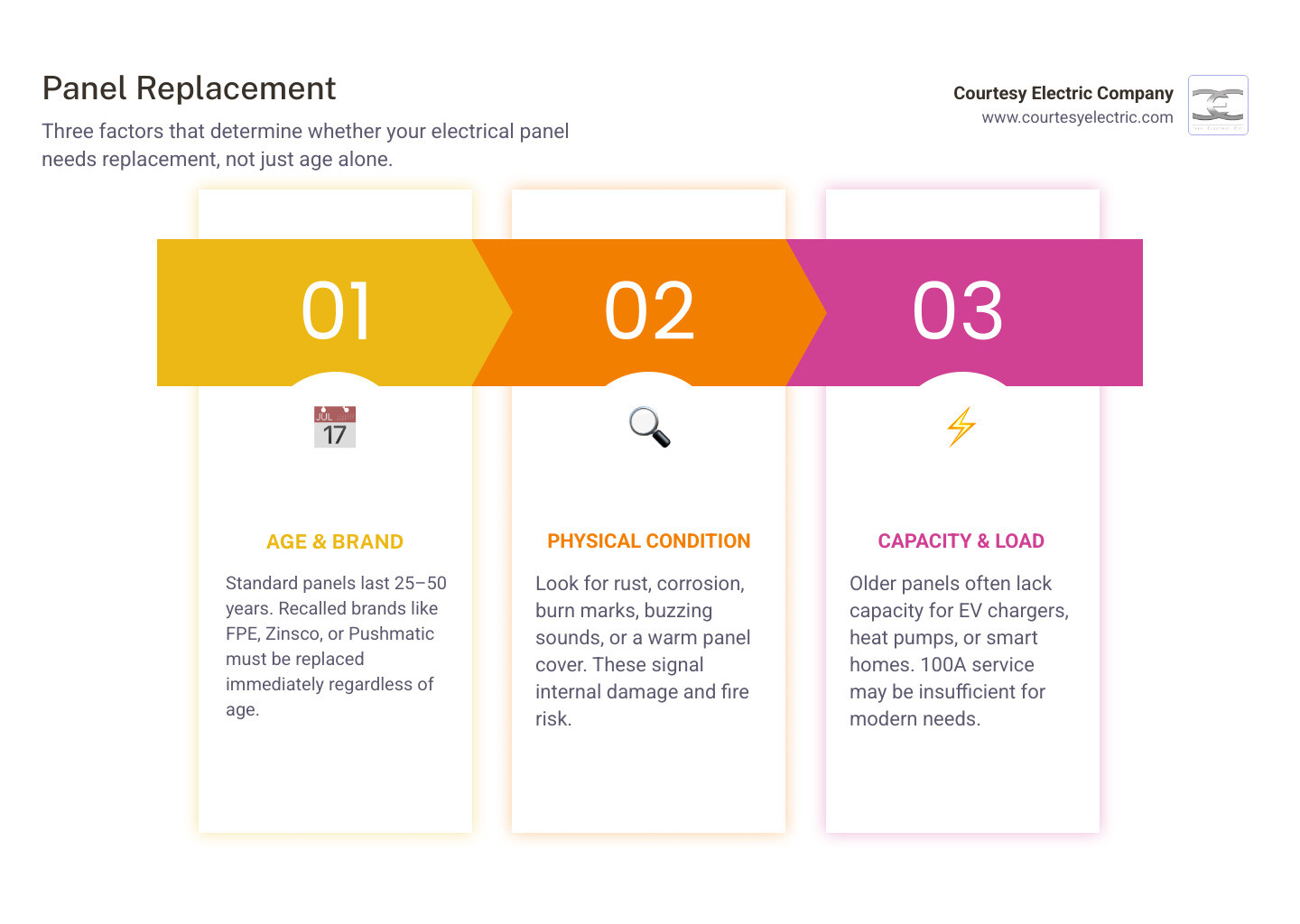
What actually triggers a replacement is usually a combination of factors: the panel's age, its brand, its physical condition, and whether it can support the way you live today. For homeowners across Denver and the Colorado Front Range, where older housing stock is common and modern electrification demands — think EV chargers, heat pumps, and smart home systems — are growing fast, getting this answer right matters more than ever.
I'm David Meyer, Vice President of Courtesy Electric, a Colorado electrical contractor with roots going back to 1976 — and questions about how old is too old for an electrical panel come up in nearly every older-home project we take on across the Front Range. In the sections below, I'll walk you through exactly what professionals look at when evaluating a panel, so you can make a confident, informed decision.
Before you decide whether to repair or replace your system, it helps to understand how we determine a panel's true condition. First, let's look at how to recognize the baseline safety of your panel and how to spot potential issues early by reading our guide on How to Spot Electrical Problems Before They Become Dangerous.
Determining Lifespan: How Old is Too Old for an Electrical Panel?
While we often use a general estimate of 25 to 50 years for the average lifespan of an electrical panel, the physical reality is more nuanced. Organizations like InterNACHI benchmark the maximum service life of an electrical service panel at roughly 60 years under ideal conditions. However, the moving parts inside that panel — the circuit breakers — have a much shorter reliable lifespan.
The U.S. Consumer Product Safety Commission (CPSC) indicates that standard circuit breakers should be replaced every 30 to 40 years. This discrepancy exists because of a physical phenomenon known as heat cycling. Every time electricity flows through a breaker, it generates a small amount of heat. As appliances turn on and off, the metal components inside the panel expand and contract. Over decades, this constant thermal shift gradually loosens terminal connections, degrades plastic housings, and fatigues the internal springs that allow a breaker to snap open during a short circuit.
Because these changes happen silently behind the metal cover, relying solely on the panel's age is a gamble. To keep your home safe, we highly recommend reading about How Often Should You Have Your Electrical System Inspected to establish a routine safety baseline.
How Old is Too Old for an Electrical Panel in Older Denver Homes?
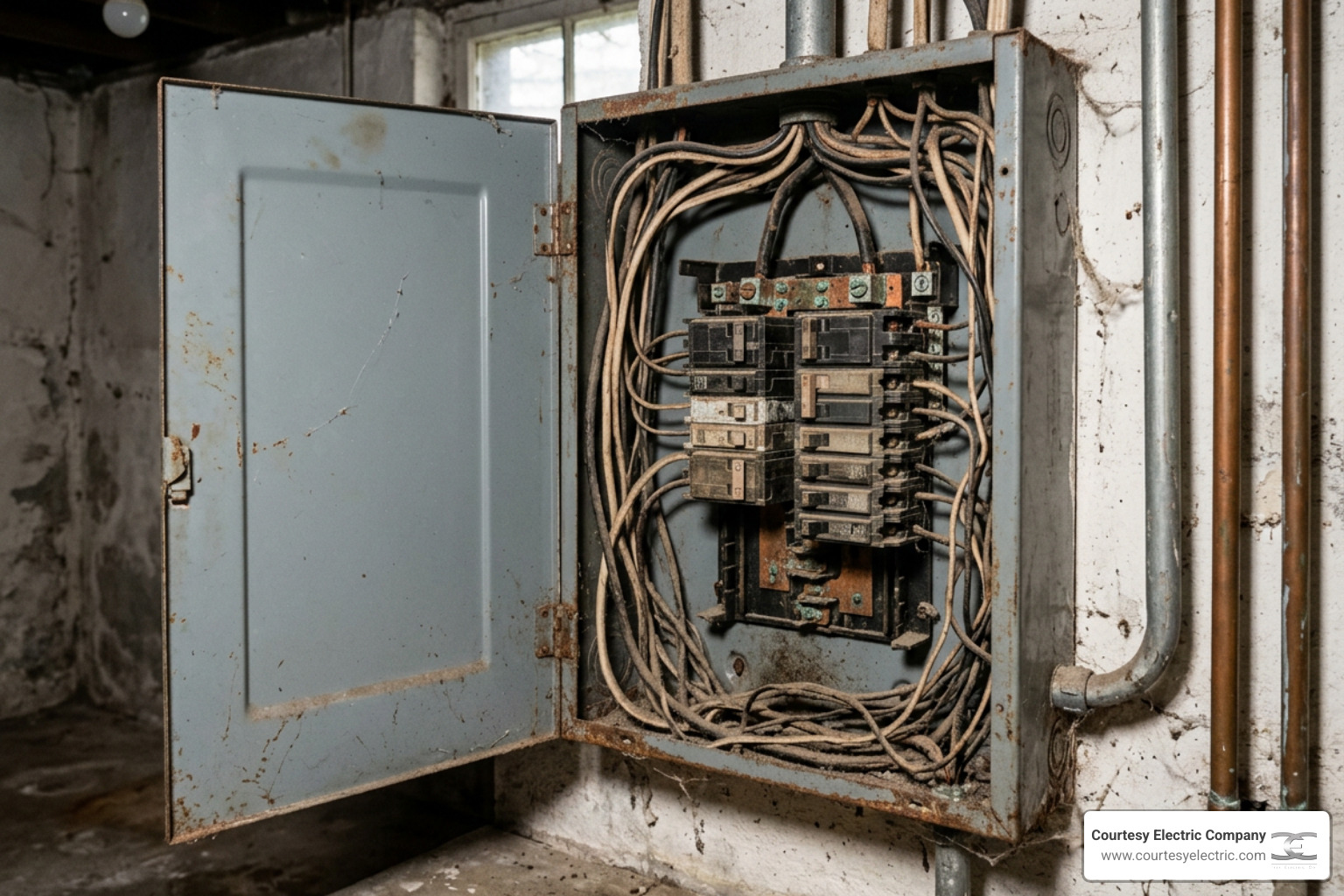
In the Denver metro area, Parker, Highlands Ranch, and the Black Forest, we have a beautiful mix of historic and mid-century homes. However, many pre-1978 properties across the Colorado Front Range still rely on their original electrical infrastructure.
When these homes were built, a 60-amp or 100-amp electrical service was considered generous. Today, a typical family runs multiple computers, smart TVs, air conditioning units, and high-draw kitchen appliances simultaneously. An older panel in a historic Front Range home is often operating at or near its maximum physical capacity daily. This chronic stress accelerates the aging process of the internal bus bars and breakers. If your home was built before the late 1970s and has not had an electrical upgrade, it is highly likely that your panel has already aged out of its safe operating window. To see how your older home measures up, consult our Electrical Safety Checklist for Older Homes.
Decoding Manufacturer Labels and Date Codes
If you are not sure when your electrical panel was installed, you can often find clues on the unit itself. To do this safely, open the outer metal door of the panel (the door that covers the breaker switches). Do not unscrew or remove the flat metal cover plate (the deadfront) that surrounds the switches — only a licensed electrician should remove that.
Look for a manufacturer’s data sticker or a stamped metal plate, typically located on the inside of the panel door. This label contains the manufacturer’s name, the model number, and a serial number or date code.
For example, many Square D panels feature a multi-digit date code. In these configurations, the first two digits often represent the year of manufacture, and the next two represent the week. A code starting with "0235" indicates the panel was manufactured in the 35th week of 2002. Other legacy brands like Cutler-Hammer, Eaton, and General Electric use distinct serial number formats that map to specific manufacturing years.
If this label is missing, painted over, or completely unreadable, a professional evaluation by a licensed electrician is the safest way to determine the approximate age and safety of your system.
Unsafe Legacy Brands and Obsolete Panel Designs
Age is not the only reason to replace a panel. Some systems were poorly designed from the start, and others have developed known safety defects over decades of real-world use. If your home has one of these obsolete brands, it represents an immediate hazard regardless of how long it has been operating without an obvious issue.
These panels also present serious insurance complications. Many insurance companies now require homeowners to replace recalled or defective panel brands before they will issue or renew a policy. In some cases, insurers may deny claims for fire damage if the blaze was traced back to a known hazardous panel that the homeowner failed to replace. To understand how these systems compromise your home's safety, read about How Outdated Wiring Increases Fire Risk.
Recalled and Defective Panel Manufacturers
There are three major legacy brands that we recommend replacing immediately for safety reasons:
- Federal Pacific Electric (FPE) Stab-Lok Panels: Manufactured from the 1950s through the 1980s, these panels are incredibly common in older Front Range homes. While the CPSC closed its investigation in 1983 due to budget limitations, a landmark 2002 New Jersey class-action lawsuit (Aronson v. Reliance) ruled that FPE had knowingly misrepresented its Underwriters Laboratories (UL) safety listings. Independent testing has shown that FPE Stab-Lok breakers fail to trip under overload or short-circuit conditions at rates as high as 51% to 60%. A peer-reviewed 2012 study in the IEEE Transactions on Industry Applications estimated that Stab-Lok breaker malfunctions cause roughly 2,800 residential fires, 13 deaths, and millions in property damage annually.
- Zinsco and GTE-Sylvania Panels: Popular throughout the 1970s, Zinsco panels (and some rebranded Sylvania units) suffer from a severe design flaw. The connection clip that attaches the breaker to the main bus bar is prone to loosening. This loose connection causes electrical arcing, which generates extreme heat. Over time, the breaker can actually melt and fuse directly to the copper or aluminum bus bar. Once fused, the breaker cannot trip, allowing massive amounts of current to flow unchecked through your home's wiring.
- Pushmatic (ITE/Bulldog) Panels: These panels are easily identified by their rectangular push-button breakers instead of traditional toggle switches. While they do not have the same catastrophic failure-to-trip rates as FPE or Zinsco, they are entirely obsolete. The internal grease inside Pushmatic breakers hardens over time, making the buttons stiff or impossible to reset. Because replacement parts are no longer manufactured, any single breaker failure typically requires a complete panel replacement.
Obsolete Designs: Split-Bus Panels and Fuse Boxes
Before modern safety standards were established, two electrical distribution designs were common in residential construction:
Split-Bus Panels: Popular before the 1980s, split-bus panels do not have a single "Main" breaker to shut off power to the entire board. Instead, they are split into two sections: an upper section containing up to six "main" breakers (which control heavy appliances like dryers or ranges, plus a sub-main breaker), and a lower section for general lighting and outlets. To completely de-energize a split-bus panel, you have to flip up to six individual switches. The National Electrical Code (NEC) no longer allows this design for new installations because it complicates emergency shut-offs.
Fuse Boxes: Standard in homes built before the 1960s, fuse boxes use single-use glass fuses that melt to interrupt an electrical overload. While a fuse is technically an effective safety device, fuse boxes are highly obsolete. Because they were designed for lower historical electrical loads, homeowners often run into "over-fusing" hazards. This occurs when a homeowner gets tired of a 15-amp fuse blowing and screws in a 30-amp fuse instead. This bypasses the safety limit of the circuit's wiring, allowing the wires to overheat inside the walls without the fuse blowing.
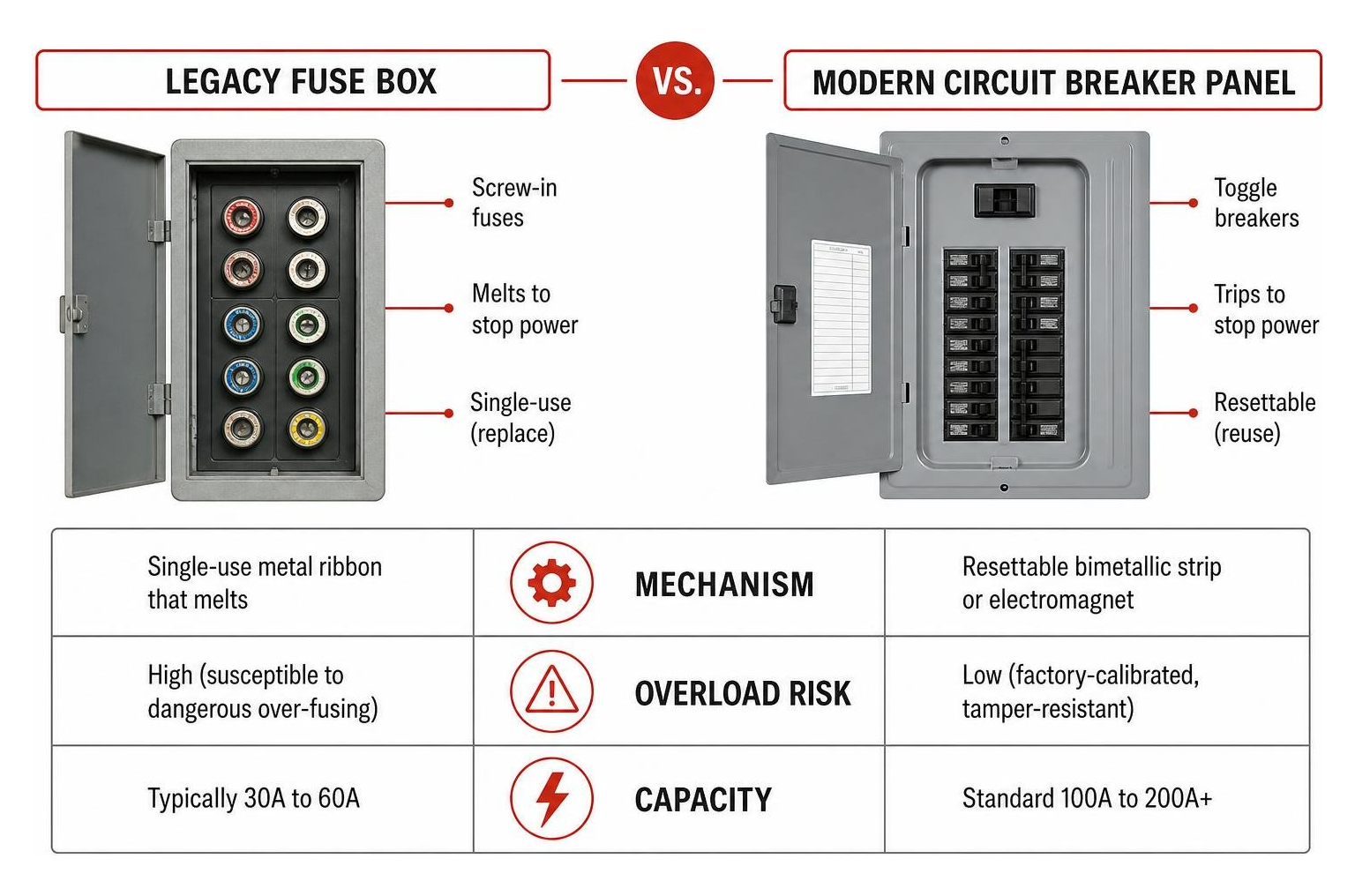
| Feature | Legacy Fuse Box | Modern Circuit Breaker Panel |
|---|---|---|
| Mechanism | Single-use metal ribbon that melts | Resettable bimetallic strip or electromagnet |
| Overload Risk | High (susceptible to dangerous over-fusing) | Low (factory-calibrated, tamper-resistant) |
| Capacity | Typically 30A to 60A | Standard 100A to 200A+ |
| Modern Safety | Lacks AFCI/GFCI integration compatibility | Native support for AFCI, GFCI, and smart tech |
Physical Warning Signs of a Failing Electrical Panel
If your panel is approaching the 25-to-50-year mark, you should monitor it closely for physical signs of wear. Catching these warning signs early can prevent a catastrophic failure. For a deeper look at protecting your household, check out these Electrical Safety Tips Every Homeowner Should Know.
Signs That Tell You How Old is Too Old for an Electrical Panel
When inspecting your panel, use your senses of sight, hearing, touch, and smell. If you notice any of the following signs, your panel requires immediate professional attention:
- Frequent Breaker Trips: If a particular breaker trips repeatedly, or if resetting a breaker does not restore power, the breaker itself may have failed or the circuit is chronically overloaded.
- Flickering or Dimming Lights: If your lights flicker or dim when a heavy appliance (like your refrigerator, microwave, or air conditioner) kicks on, your panel is struggling to distribute power.
- Buzzing, Crackling, or Humming Sounds: A healthy electrical panel should run silently. Any buzzing or sizzling sound indicates active electrical arcing, which is a severe fire hazard.
- Warm Panel Cover: If you place the back of your hand on the metal cover plate and it feels warm or hot to the touch, there is dangerous heat building up inside the enclosure.
- Burning Smells: An acrid, metallic, or fishy smell near the panel suggests that plastic wire insulation or breaker casings are melting due to extreme heat.
- Rust and Corrosion: Colorado's dry climate helps protect metal, but moisture from basement walls or leaking pipes can still cause rust. If you see white powdery corrosion or rust streaks on the breakers or bus bars, the structural integrity of the electrical connections is compromised.
Hidden Hazards: Double-Tapping and Loose Connections
Some of the most dangerous panel hazards are invisible from the outside. A common code violation in older panels is "double-tapping." This occurs when two separate electrical wires are connected to a single breaker terminal designed for only one wire. Because the terminal screw cannot apply even pressure to both wires, one or both connections will eventually loosen.
Loose connections are highly susceptible to thermal expansion. As electricity flows, the loose joint heats up, causing the metal to expand. When the power is turned off, the metal cools and contracts. This cycle eventually creates a tiny gap where electricity can jump across, creating an arc. These micro-fires can smolder inside the panel, slowly carbonizing the surrounding plastic until a major fire erupts. To learn how a professional diagnostic scan can find these hidden hot spots, read about How an Electrical Inspection Prevents Problems.
Modern Capacity Demands and Future-Proofing
Even if an older electrical panel is physically clean and free of defects, it may simply lack the capacity to support modern life. Upgrading your electrical panel is not just about safety; it is also about ensuring your home can handle your current and future electrical needs. To learn more about preparing your home for the long haul, read our guide on How to Future-Proof Your Home Electrical System.
Upgrading for Modern Electrification and Smart Tech
The electrical load of the average home has grown significantly over the last decade. As we transition away from fossil fuels, we are adding high-draw electrical equipment to our homes:
- Level 2 EV Chargers: A standard Level 2 electric vehicle charger requires a dedicated 240-volt circuit and pulls 40 to 50 amps of continuous power. On an older 100-amp service panel, adding an EV charger can easily overload the entire system during peak usage hours.
- Heat Pumps and Electric HVAC: High-efficiency heat pumps, electric water heaters, and induction cooktops are fantastic for energy efficiency, but they require robust electrical capacity.
- Smart Home Tech and Smart Panels: Modern homes benefit immensely from intelligent power management. We specialize in installing SPAN smart panels, which replace traditional panels with a digital interface. A SPAN panel allows you to monitor your energy usage in real-time, prioritize circuits during a power outage, and integrate seamlessly with home battery storage systems.
To explore how these advanced systems fit into a modern home, read about Future-Proofing Your Electrical for Smart Home Technology.
Overcoming Older Home Infrastructure Challenges
Upgrading a panel in an older home often uncovers other legacy wiring issues that must be addressed to comply with current building codes:
- Aluminum Branch Wiring: Common in homes built between 1965 and 1973, small-gauge aluminum wiring is highly prone to oxidation and loose connections at outlets and switches. While aluminum service entrance cables are still standard and safe today, older branch circuits require specialized connectors or complete rewiring.
- Knob-and-Tube Circuits: Found in pre-1950 homes, knob-and-tube wiring lacks a ground wire and uses air space for insulation. It is completely incompatible with modern three-prong outlets and high-draw appliances.
- Ungrounded Outlets: Many older homes have two-prong outlets that lack a safety ground path. When upgrading a panel, we can install Ground Fault Circuit Interrupter (GFCI) breakers to provide code-compliant shock protection on these ungrounded circuits without requiring a complete home rewire.
Because of these complex structural and safety challenges, panel upgrades are not a DIY project. If you are trying to decide whether to tackle a project yourself, take a look at our guide on When to Call an Electrician vs DIY.
Frequently Asked Questions about Electrical Panel Lifespan
Does age alone mean I must replace my electrical panel?
No. If your panel is a reputable modern brand (such as Square D, Eaton, or Siemens), is in excellent physical condition, shows no signs of corrosion or overheating, and has sufficient capacity for your household's electrical load, it does not need to be replaced simply because of its age. However, if your panel is over 25 years old, we highly recommend scheduling a professional inspection to verify its internal integrity.
Can an outdated electrical panel affect my homeowners insurance?
Yes, absolutely. Many insurance carriers in Colorado actively inspect homes or review construction records before renewing policies. If they discover a recalled brand like Federal Pacific or Zinsco, or if your home still uses an obsolete fuse box, they may demand an upgrade as a condition of coverage or apply substantial premium surcharges.
How long does a professional panel upgrade take?
A standard panel replacement typically takes between 4 and 8 hours to complete. During this time, your home's power will be safely disconnected. We coordinate closely with your local utility provider (such as Xcel Energy or CORE Electric Cooperative) and municipal inspectors to ensure the power is restored as quickly as possible, usually on the very same day.
Conclusion
Determining how old is too old for an electrical panel ultimately comes down to a balance of age, brand history, physical condition, and capacity. While a well-maintained panel can last up to 50 years, the safety of your home and the demands of modern appliances often make an earlier upgrade the smartest choice.
At Courtesy Electric Company, we have been serving homeowners across Denver, Parker, Highlands Ranch, the Black Forest, and the entire Colorado Front Range since 1976. Whether you need a standard panel upgrade, a smart SPAN panel installation, or a complete home backup power solution with Generac/Cummins generators and Franklin battery storage, our team is dedicated to providing quality installations built on integrity and dependability.
Ready to secure your home's electrical infrastructure? Contact us today to schedule an inspection or request a free estimate on your next upgrade by visiting our Electrical Service page.


