What is Home Electrification and Why is it Growing?

How electrification is changing home electrical needs is one of the most important shifts Colorado homeowners are navigating right now. As more households replace gas appliances with electric alternatives — from heat pumps and induction cooktops to EV chargers and electric water heaters — the demand placed on home electrical systems is growing faster than most panels were ever designed to handle.
Here is a quick look at the core ways electrification is reshaping what your home's electrical system needs to do:
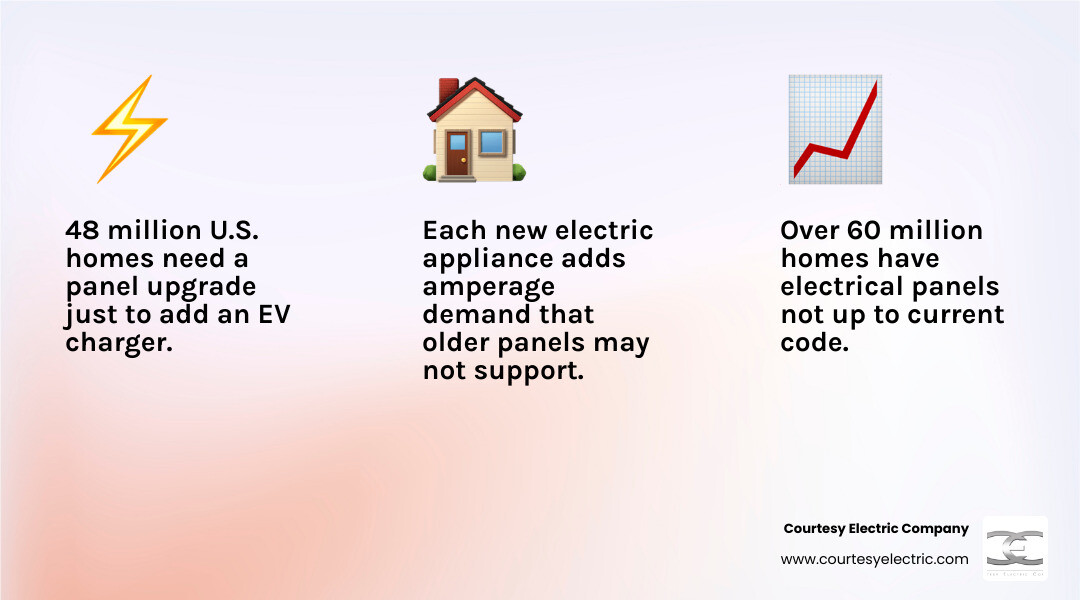
- Higher electrical load: Each new electric appliance adds amperage demand that older panels may not support
- Panel capacity limits: Many homes — especially those built before 1980 — have 100-amp panels that struggle to keep up with modern electrification loads
- Dedicated circuits required: EV chargers, heat pumps, and electric dryers each need their own dedicated circuit
- Peak demand spikes: Running multiple high-draw appliances at the same time can push a panel close to or beyond its limits
- Potential need for panel upgrades: Adding electrification loads without assessing capacity first can create safety risks and code violations
- Smart technology as a solution: Load management devices and smart panels can help existing systems handle more without a full service upgrade
The good news is that understanding your current electrical capacity — and planning upgrades strategically — can make the transition to an all-electric home smoother and more affordable than most homeowners expect.
The scale of this challenge is significant. Research shows that 48 million homes in the U.S. would need a panel upgrade just to add an EV charger, and over 60 million homes have panels that are not up to current electrical code. On the Colorado Front Range, where EV adoption and energy-efficient home upgrades are accelerating, these numbers hit close to home.
I'm David Meyer, Vice President of Courtesy Electric, a Colorado electrical contractor with roots going back to 1976. Over the decades, I've watched how electrification is changing home electrical needs — from the field to the panel box — and this guide reflects what I've seen work for homeowners across Denver and the Front Range.
Home electrification is the process of transitioning a household’s energy consumption away from fossil fuels — such as natural gas, propane, or fuel oil — and replacing those systems with highly efficient electric alternatives. Instead of burning gas for heat, hot water, and cooking, an electrified home relies entirely on the electrical grid and, in many cases, on-site renewable energy like rooftop solar.
This movement is gaining rapid momentum across Colorado for several compelling reasons:
- Unmatched Energy Efficiency: Modern electric appliances are marvels of engineering. For instance, electric heat pumps are up to three times more efficient than traditional combustion heating systems because they transfer heat rather than generate it. Additionally, electric clothes dryers use roughly 20% less energy than standard gas models, while heat pump dryers can save up to 60% more energy.
- Substantial Cost Savings: Transitioning away from fossil fuels is a smart financial move over the long term. Retrofitting an existing residential building with electric systems can save homeowners up to $10,000 over a 20-year period, while all-electric new construction projects can see savings of approximately $15,000 over that same timeframe.
- Dramatic Air Quality and Public Health Improvements: Burning fossil fuels inside our living spaces compromises the air we breathe. Gas stoves, for example, emit harmful pollutants like nitrogen dioxide and carbon monoxide. Studies show that wide-scale residential electrification across the United States could prevent 3,400 premature deaths, 1,300 hospital admissions, and 220,000 asthma attacks.
- A Greener Electrical Grid: As utilities transition to renewable energy sources, the electricity powering our homes becomes cleaner every year. In 2023, roughly 21% of total U.S. electricity generation came from renewable sources, and that percentage continues to rise.
- Policy and Municipal Support: Across the country, local jurisdictions are actively promoting or requiring building electrification. Here in Colorado, municipalities are introducing progressive energy codes and local utility programs to encourage homeowners to make the switch.
To successfully navigate this transition, it helps to take a structured approach. Learning how to future-proof your home electrical system ensures that your home is ready to handle these modern upgrades safely. Additionally, many homeowners find that pairing these efficiency upgrades with local energy storage is highly beneficial; evaluating whether is home battery storage worth it in Colorado can help you decide if a home battery is the right addition to your electrification plan.
How Electrification Is Changing Home Electrical Needs and Panel Capacity
At the center of every home's electrical system is the main service panel, often referred to as the breaker box. This panel is responsible for safely distributing electricity from the utility grid to the various circuits throughout your home. However, the rapid shift toward electrification is fundamentally changing the demands placed on this critical piece of infrastructure.

To understand how these changes impact your home, it helps to understand a few key concepts:
- Electrical Load: The total amount of electrical power consumed by all the devices, lights, and appliances running in your home at any given time.
- Panel Capacity: The maximum amount of electrical current (measured in amperes, or "amps") that your electrical panel is rated to safely handle.
- Main Breaker: The master switch located at the top of your panel that limits the total incoming electrical current to protect the system from overloading.
- Amperage Rating: The specific capacity of your home’s electrical service, typically ranging from 60 or 100 amps in older homes to 200 amps or more in modern builds.
- Continuous Load: A load where the maximum current is expected to continue for three hours or more, such as an electric vehicle charger.
- Peak Demand: The brief periods during the day when your household's electricity usage is at its absolute highest — usually in the evening when family members are cooking, running laundry, and charging vehicles simultaneously.
If you are wondering if your current system is up to the task, evaluating whether does your electrical panel support an EV charger is an excellent starting point. For a broader look at how to manage these demands, our home battery storage complete guide explains how storing power can help buffer peak demand and protect your home from grid outages.
Understanding How Electrification Is Changing Home Electrical Needs for EV Charging
Adding a Level 2 electric vehicle (EV) charger is often a homeowner’s first major step into electrification, and it is also one of the most demanding. Unlike standard household appliances that cycle on and off, an EV charger operates as a continuous load.
Under the National Electrical Code (NEC), continuous loads must be calculated at 125% of their rated capacity to prevent overheating. For example, a standard 40-amp Level 2 charger actually requires 50 amps of dedicated panel capacity.
Installing a high-draw circuit like a NEMA 14-50 outlet on an older 100-amp panel without careful planning can easily push your system past its safe operating limits during peak demand hours.
Sizing Your Service: How Electrification Is Changing Home Electrical Needs for HVAC
Space heating and water heating represent the largest energy demands in the average residential home. Transitioning these systems from natural gas to electric heat pumps has a massive impact on your service panel capacity.
While modern heat pump space heaters and heat pump water heaters are incredibly efficient, they still require dedicated 240-volt circuits. A whole-home heat pump system can add 30 to 60 amps of electrical demand to your load calculation.
If your home currently relies on a 100-amp service, adding an electric heat pump alongside your existing appliances will almost always require upgrading your electrical service or implementing smart load management.
Calculating Your Home's Electrical Load Under the NEC
Before adding any new electric appliances, a professional load calculation must be performed in accordance with National Electrical Code (NEC) Article 220. This calculation determines whether your existing service panel has the physical and electrical capacity to handle the new loads safely.
The NEC allows for two primary calculation methods:
- The Standard Method: This traditional approach uses standardized calculations based on your home's square footage (calculated at a set volt-amperes, or VA, per square foot) and adds the full nameplate ratings of all fixed appliances, heating, and cooling systems. It applies conservative demand factors to estimate peak usage.
- The Optional Method: This modern approach is highly favored by residential electricians for existing homes. It looks at the actual maximum demand of the home over the past 12 months (using utility records) or applies a more realistic diversity factor to the home's total connected loads. Because it accounts for the fact that you rarely run every appliance in your home at the exact same moment, the Optional Method often yields a lower, more accurate load requirement.
The 2026 NEC Update: Reflecting Modern Efficiency
A major update in the 2026 NEC directly helps homeowners looking to electrify. Recognizing the widespread adoption of highly efficient LED lighting, the NEC officially reduced the general lighting load calculation for dwelling units from 3 VA to 2 VA per square foot for service and feeder sizing.
For a 2,000-square-foot home, this simple code change immediately frees up 2,000 VA of calculated capacity — equivalent to over 16 amps of breathing room at 120 volts. This update makes it significantly easier for homes with 100-amp or 150-amp panels to qualify for new electrification projects without needing an immediate service upgrade.
| Calculation Element | NEC Standard Method | NEC Optional Method (Article 220 Part IV) |
|---|---|---|
| General Lighting & Receptacles | 2 VA per sq. ft. (2026 Code Update) | Included in the first 10 kVA calculation |
| Small Appliance & Laundry | 1,500 VA per dedicated circuit | Included in the first 10 kVA calculation |
| First 10,000 VA (10 kVA) of Load | Calculated at 100% demand factor | Calculated at 100% demand factor |
| Remaining Load over 10,000 VA | Calculated at 35% demand factor | Calculated at a highly favorable 40% demand factor |
| Heating vs. Cooling Load | Sized for the larger of the two systems | Sized for the larger of the two systems |
| Suitability | Best for new construction design | Ideal for retrofits and existing home electrification |
Smart Panels and Load Management: Alternatives to Panel Upgrades
Historically, if a load calculation showed that your planned EV charger or heat pump would overload your panel, your only option was to perform a traditional utility service upgrade. This process involves replacing your electrical panel and potentially coordinating with your local utility company to run new wires underground or replace neighborhood transformers — a process that can be time-consuming.
Fortunately, modern technology offers an elegant alternative: Smart Panels and Dynamic Load Management.
Instead of defaulting to a costly service upgrade, homeowners can use smart load centers and circuit-sharing devices to optimize their existing panel capacity:
- Smart Panels (like SPAN): These advanced digital panels replace traditional breaker boxes and allow you to monitor and control every circuit in your home via a smartphone app. If your home approaches its capacity limit, the smart panel can automatically and temporarily pause power to non-essential loads (like an EV charger or hot tub) to ensure your stove, lights, and medical equipment keep running smoothly.
- Smart Energy Management: By utilizing dynamic load shedding, these systems prevent your home from ever exceeding its main breaker capacity, allowing you to fully electrify a home on a 100-amp or 150-amp panel.
- Circuit-Sharing Devices: These smart switches allow two high-draw appliances (such as an electric clothes dryer and an EV charger) to share a single circuit, automatically routing power to the charger only when the dryer is not in use.
To compare your options, take a look at our breakdown of smart energy management vs traditional panel installations. You can also explore the wide-ranging energy management system benefits for homeowners, learn how energy management reduces your electric bill, and discover how simple it is to track and control energy use room by room using modern smart home technology.
Incentives, Rebates, and Preparing Your Home for the Future
Making your home electric-ready is a smart long-term investment, and there are more financial incentives available today than ever before to help offset the costs.
Under the federal Inflation Reduction Act (IRA), homeowners can take advantage of significant tax credits and rebates:
- Energy Efficient Home Improvement Credit (Section 25C): Provides a federal tax credit covering 30% of the cost of qualifying electrical panel upgrades up to $600, provided the upgrade is installed in conjunction with an eligible heat pump or heat pump water heater.
- Clean Energy Tax Credits (Section 25D): Offers a 30% tax credit for residential solar and battery storage installations, helping you build a self-sufficient home microgrid.
- State and Utility Rebates: Colorado homeowners have access to excellent localized programs. Many local utilities offer direct rebates for installing heat pumps, smart thermostats, and Level 2 EV chargers.
To maximize your savings, check out our comprehensive guide to Colorado energy rebates for electrical upgrades. Additionally, you can learn how to combine these local programs with federal incentives by reading about federal tax credits for battery storage and Span panels.
Steps to Prepare Your Home for Electrification
If you are planning to transition to electric systems over time, you can prepare your home in phases to avoid emergency upgrade costs down the road:
- Schedule a Home Energy Audit: Identify areas where weatherization, insulation, and sealing can reduce your overall heating and cooling loads, which in turn reduces the size of the electrical equipment you will need.
- Assess Your Existing Panel: Locate your main breaker box, identify your main breaker's amperage rating, and take note of any empty expansion slots.
- Pre-Wire for Future Loads: If you are having electrical work done for a remodel or minor repair, have your electrician run the wiring and conduit for an EV charger or heat pump at the same time to save on labor costs later.
Frequently Asked Questions about Home Electrification
Can I electrify my home without upgrading my electrical panel?
Yes, in many cases you can fully electrify your home without upgrading your main electrical panel. By utilizing smart load management systems, circuit-sharing devices, and highly efficient appliances, you can maximize the capacity of a standard 100-amp or 150-amp panel. Making "power-smart" appliance choices and utilizing the NEC Optional Method for load calculations often reveals that a panel upgrade is unnecessary.
What is the difference between the NEC standard and optional calculation methods?
The Standard Method uses a conservative, rigid formula based on square footage and full appliance nameplate ratings to calculate electrical load. The Optional Method (Article 220 Part IV) applies a more realistic diversity factor to your home's connected loads or utilizes 12 months of actual utility data. Because it accounts for real-world demand patterns, the Optional Method typically yields a much lower calculated load, making it easier to add new electric appliances to existing panels.
How do smart panels help manage increased electrical loads?
Smart panels, such as SPAN panels, replace traditional breaker boxes with digital, software-controlled systems. They continuously monitor your home's total electrical draw in real time. If your household's demand approaches the panel’s safety limit, the smart panel will temporarily pause or throttle power to non-essential, high-draw circuits (like your EV charger or hot tub) to ensure your primary appliances continue running safely without tripping the main breaker.
Conclusion
Understanding how electrification is changing home electrical needs is the key to creating a home that is safer, cleaner, and prepared for the future. Whether you want to install a Level 2 EV charger, transition to an ultra-efficient heat pump, or gain total control over your energy bills with a smart panel, taking a proactive and planned approach to your electrical system is the best way to save time and money.
At Courtesy Electric Company, we have been helping homeowners across Denver and the Colorado Front Range navigate these transitions with quality, integrity, and dependability since 1976. From Parker and Highlands Ranch to the Black Forest, our team specializes in end-to-end electrical solutions, including SPAN smart panels, Franklin battery storage, and standby generator systems.
We are here to help you design an electrical system that fits your lifestyle and your budget. Schedule your electrical service with Courtesy Electric Company today to request a free estimate on your next upgrade.


