
Circuit Breaker Tripping Frequently What It Means

Circuit breaker tripping frequently what it means is something every homeowner should understand — because it's rarely just a minor annoyance. When your breaker trips, it's your electrical system sending you a clear signal that something needs attention.
Quick Answer: What Does a Frequently Tripping Circuit Breaker Mean?
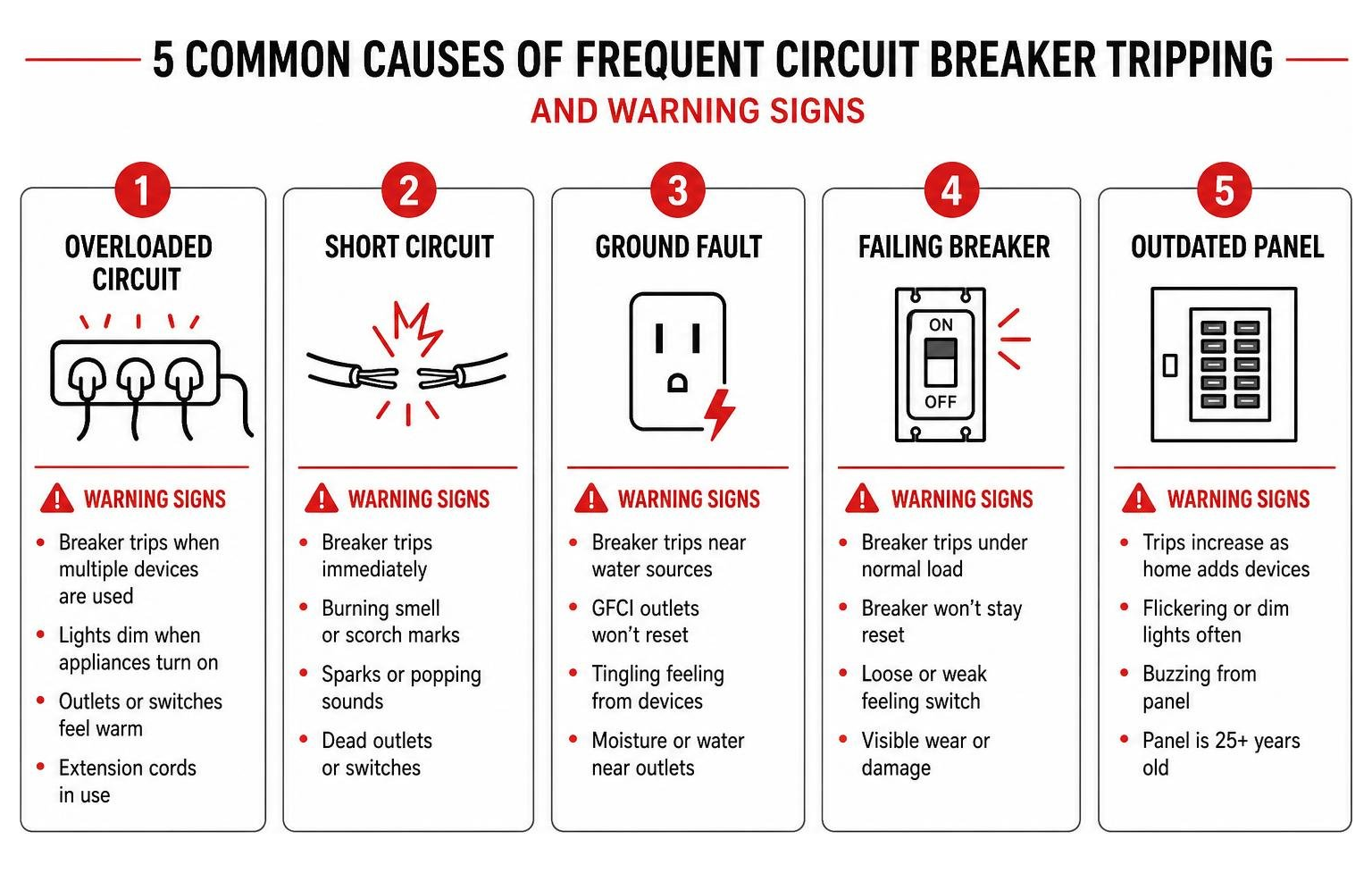
A circuit breaker that keeps tripping is telling you one of the following:
- Overloaded circuit - Too many devices are drawing power from a single circuit at the same time
- Short circuit - A hot wire and a neutral wire have made contact, causing a dangerous surge of current
- Ground fault - A hot wire is contacting a ground wire or a grounded surface, often in a damp area
- Failing breaker - The breaker itself is worn out and tripping even under normal load
- Outdated panel - Your electrical panel can't keep up with your home's modern power demands
A single trip after running too many appliances at once is usually nothing to worry about. But if it keeps happening, your electrical system is warning you — and that warning is worth taking seriously. According to the NFPA, electrical distribution and lighting equipment caused an average of 31,647 home structure fires per year between 2019 and 2023, resulting in $1.6 billion in property damage annually.
Here in Colorado, Front Range homes face unique pressures: cold winters push heating systems hard, EV chargers and smart home devices are adding new loads to older panels, and many homes were wired decades before those demands existed. That combination makes understanding your breakers more important than ever.
I'm David Meyer, Vice President of Courtesy Electric Company — a Colorado-based electrical contractor with roots going back to 1976. Over the decades, I've seen how circuit breaker tripping frequently, and what it means for a home's safety, is one of the most misunderstood issues homeowners face. In this guide, I'll walk you through exactly what's happening inside your panel, how to respond safely, and when it's time to call in a professional.
When we think about our home’s electrical system, we often treat it like plumbing: power flows through the wires, out of the outlets, and into our devices. But unlike plumbing, where a leak is easily visible, electrical issues can hide behind drywall for years. That is why your breaker panel exists. It is the brain and the safety shield of your home’s electrical infrastructure.
A single, isolated trip is often just a sign that you asked too much of a single room’s outlets. Perhaps you tried to run a high-wattage space heater while vacuuming the carpet. But when you experience repeated tripping, the situation changes from a simple user error to a structural warning.
A breaker that keeps tripping means your electrical system is repeatedly operating outside of its safe design limits. It is a protective response, not a failure of the breaker itself. When a breaker trips, it physically opens the circuit, stopping the flow of electricity before the copper wiring inside your walls can heat up to the point of melting its insulation or igniting nearby wooden framing. To help you protect your family, we have compiled a guide on How to Spot Electrical Problems Before They Become Dangerous to show you what else to look out for.
Is it safe to keep resetting a breaker that trips repeatedly?
The short answer is absolutely not. We understand the temptation. You are in the middle of working in your home office in Highlands Ranch, or cooking dinner in Parker, and the power cuts out. You walk down to the basement, flip the plastic switch back to "ON," and go back to your day.
However, resetting a breaker that trips repeatedly is incredibly risky. Each time a breaker trips, it is responding to an active hazard. By forcing it to reset without resolving the root cause, you are subjecting your wiring, connections, and appliances to cumulative thermal and mechanical stress.
Think of it this way: every time electricity surges through a short circuit or an overloaded wire, it generates intense, localized heat. If you reset the breaker over and over, that heat builds up. Eventually, the insulation on your wires will degrade, leading to a permanent failure or, worse, an electrical fire. For more essential tips on keeping your household out of harm's way, read our Electrical Safety Tips Every Homeowner Should Know.
Why does my breaker trip when nothing seems to be running?
It can be incredibly baffling when a breaker trips in the middle of the night or in a room where absolutely nothing is turned on. When this happens, homeowners often assume the breaker itself must be broken. While a bad breaker is possible, there are other hidden factors at play:
- Phantom Loads: Many modern electronics draw power even when turned "off." Things like chargers, smart TVs, game consoles, and microwave clocks continuously pull small amounts of electricity. If a circuit is already sitting near its maximum capacity, these background loads can push it over the edge.
- Background Appliances: You might not think anything is running, but hidden appliances like sump pumps, water heaters, refrigerator compressors, or outdoor security lighting might share that same circuit and cycle on automatically.
- Hidden Short Circuits: If a wire inside your wall has been damaged by pests, or if a connection inside an outlet box has come loose, a short circuit can occur completely independent of whether you have appliances plugged in.
Over time, older home wiring degrades, making these mystery trips more common. Understanding How Outdated Wiring Increases Fire Risk can shed light on why older homes in historic areas of Denver experience these frustrating issues.
The Three Main Causes of a Tripping Breaker
To solve the mystery of why your electricity keeps cutting out, we must look at the three primary electrical phenomena that trigger a breaker's safety mechanisms.

| Electrical Issue | What Causes It? | Danger Level | Primary Warning Signs |
|---|---|---|---|
| Overloaded Circuit | Too many high-draw appliances running simultaneously on one line. | Moderate | Warm outlets, flickering lights, breaker trips after several minutes of use. |
| Short Circuit | A hot wire makes direct contact with a neutral wire, dropping resistance to zero. | High | Burning smell, black soot around outlets, breaker trips instantly upon resetting. |
| Ground Fault | A hot wire touches a ground wire or a metal box, often due to moisture. | High | Tripped GFCI outlets, shock sensations when touching appliances, frequent trips in kitchens/baths. |
Overloaded Circuits: The Most Common Culprit
An overloaded circuit is the most common reason why your circuit breaker keeps tripping. It is a simple matter of math. Every circuit in your home is rated for a specific maximum amperage—usually 15 amps or 20 amps.
A 15-amp circuit can safely handle about 1,800 watts of continuous electrical load, while a 20-amp circuit can handle around 2,400 watts. If you plug in a hair dryer (1,500 watts) and a space heater (1,500 watts) on the same 15-amp circuit, you are asking for 3,000 watts of power. The bimetallic strip inside your thermal-magnetic breaker will slowly heat up from this excess current, eventually bending and tripping the breaker to save your wires from melting.
To prevent this, you need to distribute your high-wattage appliances across different circuits. We recommend reviewing the Ultimate Electrical Fire Safety Checklist Home to evaluate how your home's appliances are distributed.
Short Circuits: A Direct Path of Low Resistance
While an overload is a slow, thermal process, a short circuit is a sudden, violent event. In a healthy circuit, electricity travels along the hot wire, passes through the resistance of an appliance (like a lightbulb or toaster), and returns safely along the neutral wire.
A short circuit occurs when the hot wire makes direct contact with the neutral wire before reaching the appliance. Because there is no longer any resistance to slow down the electrical current, the flow of electricity spikes instantly to dangerous levels.
The electromagnetic coil inside your breaker detects this sudden spike and trips the breaker in a fraction of a second. Short circuits are often caused by loose wire connections, damaged appliance cords, or insulation chewed away by pests. If you suspect a short, check out our guide on Electrical Fire Prevention Tips for Homeowners to protect your property.
Ground Faults: When Current Escapes the Circuit
A ground fault is a specific type of short circuit. It happens when the hot wire comes into contact with the ground wire, a grounded metal junction box, or a grounded portion of an appliance.
Ground faults are particularly common in areas where moisture is present, such as kitchens, bathrooms, basements, and outdoor patios. Water is an excellent conductor of electricity, and if it seeps into an outlet or outdoor fixture, it can easily bridge the gap between a hot wire and the ground.
Because ground faults present a severe shock hazard, the National Electrical Code requires Ground Fault Circuit Interrupter (GFCI) protection in these areas. If you live in an older home that lacks these modern safety upgrades, our Electrical Safety Checklist for Older Homes is an invaluable resource for identifying where your home might be vulnerable.
How to Safely Reset a Tripped Breaker and Spot Warning Signs
If a breaker trips in your home, you should always follow a safe, structured process to restore power. Do not simply rush to the panel and flip switches blindly.
- Unplug Devices: Before you touch the panel, walk through the area that lost power. Unplug any high-draw appliances that were running when the power went out. This prevents an immediate re-overload when you turn the power back on.
- Locate the Panel: Open your electrical panel door. Look for a breaker toggle switch that is not aligned with the rest. Tripped breakers usually sit in a middle position between "ON" and "OFF," often showing a small red or orange indicator window.
- Stand to the Side: For safety, stand slightly to the side of the panel rather than directly in front of it, and look away as you flip the switch. Wearing safety glasses is a great precaution.
- The Full Off Trick: You cannot simply flip a tripped breaker back to "ON." You must first push the switch firmly to the "OFF" position until you hear a distinct click. This resets the internal spring mechanism. Once it is fully off, flip it back to "ON."
- Restore Power Gradually: Walk back to the room and plug your devices back in one by one, waiting a minute between each to ensure the circuit remains stable.
If you are hesitant about handling your electrical panel, it is always best to defer to the experts. Read our guide on When to Call an Electrician vs DIY to understand where to draw the line.
Circuit Breaker Tripping Frequently What It Means When It Trips Instantly
If you reset a breaker and it trips instantly—with a loud click or even a visible spark—stop touching it.
An immediate trip upon reset is a classic diagnostic signal that a severe short circuit or ground fault is active on the line. The breaker is doing its job perfectly by refusing to allow electricity to flow into a dangerous path. Continuously trying to force the breaker to stay on during an active short circuit can cause catastrophic damage to your panel and poses an immediate fire risk. Leave the breaker off and call a licensed professional. To learn how to read these silent warnings, consult our article on How to Spot Electrical Problems Before They Become Dangerous.
Warning Signs of a Failing or Bad Circuit Breaker
Like any mechanical device, circuit breakers do not last forever. While high-quality breakers can perform reliably for decades, they eventually wear out, weaken, or suffer internal damage. Here are the clear warning signs that a breaker itself has gone bad:
- The panel or breaker feels hot to the touch.
- You notice a persistent burning plastic or metallic odor near the electrical panel.
- The breaker toggle feels loose, wobbly, or refuses to click into the "OFF" or "ON" position.
- You see visible scorch marks, soot, or corrosion on the breaker casing or the metal bus bars behind it.
- The breaker trips even when absolutely nothing is plugged into the circuit.
If you notice any of these warning signs, especially in an older home, it is a clear indicator of structural wear. Refer to our Electrical Safety Checklist for Older Homes to evaluate your system's components.
When to Upgrade Your Electrical Panel or Add Dedicated Circuits
Sometimes, the issue isn't a short circuit, a ground fault, or even a bad breaker. Sometimes, your home's electrical panel simply cannot keep up with the demands of modern life.
Circuit Breaker Tripping Frequently What It Means for Your Panel Capacity
Many homes across the Colorado Front Range—especially those built in the 1970s, 80s, or early 90s—were built with 100-amp electrical panels. At the time, 100 amps was plenty of power for a family's needs.
But today, our homes are packed with high-draw electronics. Between central air conditioning, hot tubs, electric vehicle (EV) charging stations, induction cooktops, and smart home systems, a 100-amp panel can easily become overloaded. In fact, approximately 31% of single-family homes in the United States still operate on panels rated at 100 amps or less.
If your breakers are tripping frequently because you are running standard household appliances, it is a sign that your panel is operating at its maximum capacity. Upgrading to a 200-amp service, or installing a modern SPAN smart panel, allows you to monitor your energy usage in real-time and distribute loads intelligently. Discover how to prepare your home for the next generation of technology by reading How to Future-Proof Your Home Electrical System.
The Importance of Routine Electrical Inspections
The best way to deal with a frequently tripping breaker is to prevent it from happening in the first place. Regular preventative maintenance is key to keeping your home safe and functional.
Loose connections, minor corrosion, and outdated components can all be caught during a routine electrical inspection before they escalate into costly repairs or safety hazards. If you are wondering how often you should have a professional look over your panel and wiring, we have broken down the recommended schedules in our guide on How Often Should You Have Your Electrical System Inspected.
Conclusion
A circuit breaker that trips frequently is not a nuisance to be ignored or bypassed with tape—it is a vital safety system working exactly as designed to protect your home and family. Whether you are dealing with a simple overloaded circuit, a hidden ground fault in a damp basement, or an outdated panel that is struggling to keep up with your modern lifestyle, identifying the root cause is the only way to ensure lasting peace of mind.
At Courtesy Electric Company, we have been serving homeowners across Denver, Parker, Highlands Ranch, Black Forest, and the entire Colorado Front Range since 1976. Our mission is built on quality, integrity, and dependability. Whether you need a simple breaker replacement, a full 200-amp panel upgrade, a SPAN smart panel installation, or a home standby generator to protect against unpredictable Colorado weather, our team of experienced professionals is here to help.
Don't guess when it comes to your family's safety. Schedule professional electrical service today and let our experts restore safety, balance, and reliability to your home’s electrical system.


