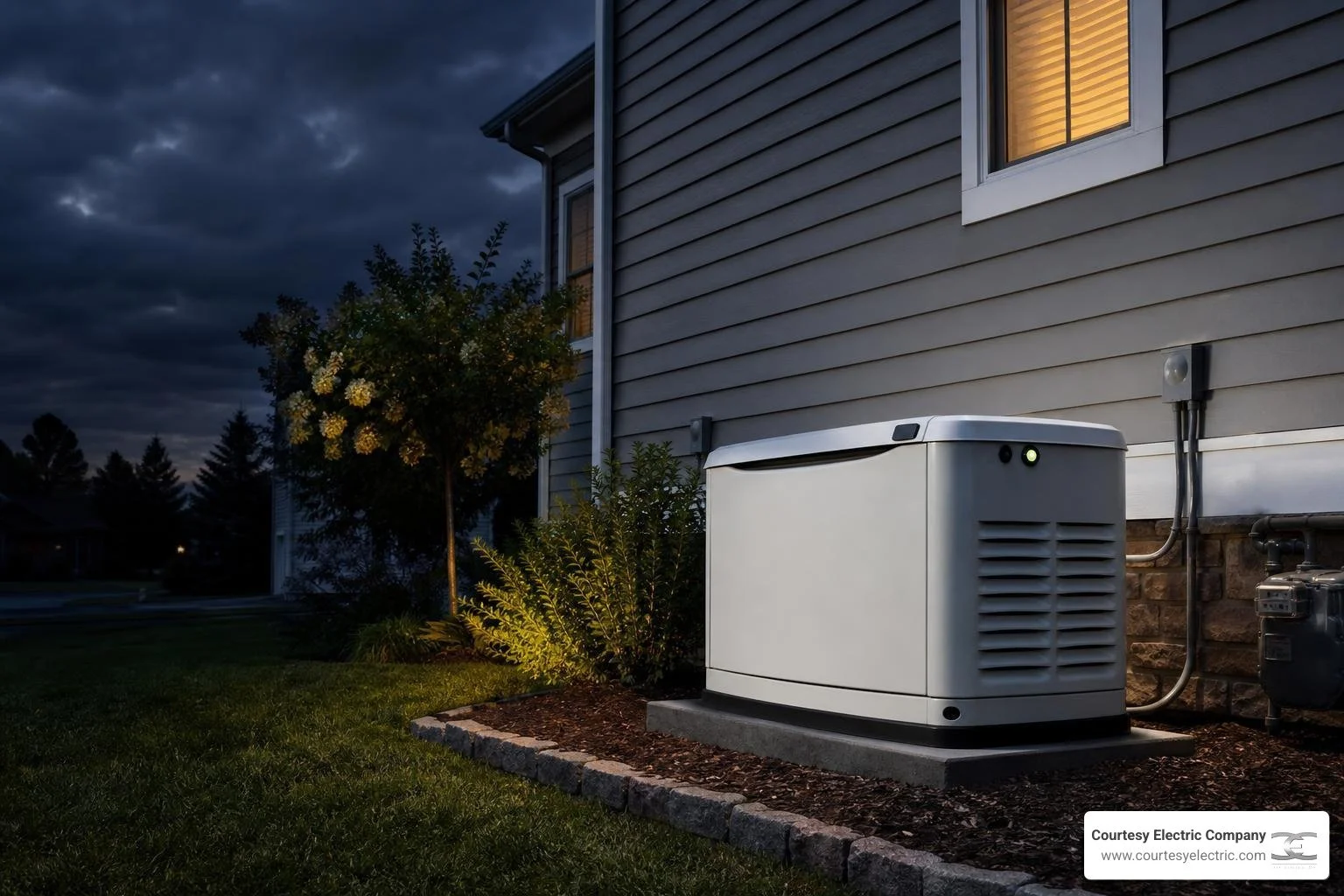
Why Getting the Right Generator Size Is the Most Important Decision You'll Make for Home Backup Power
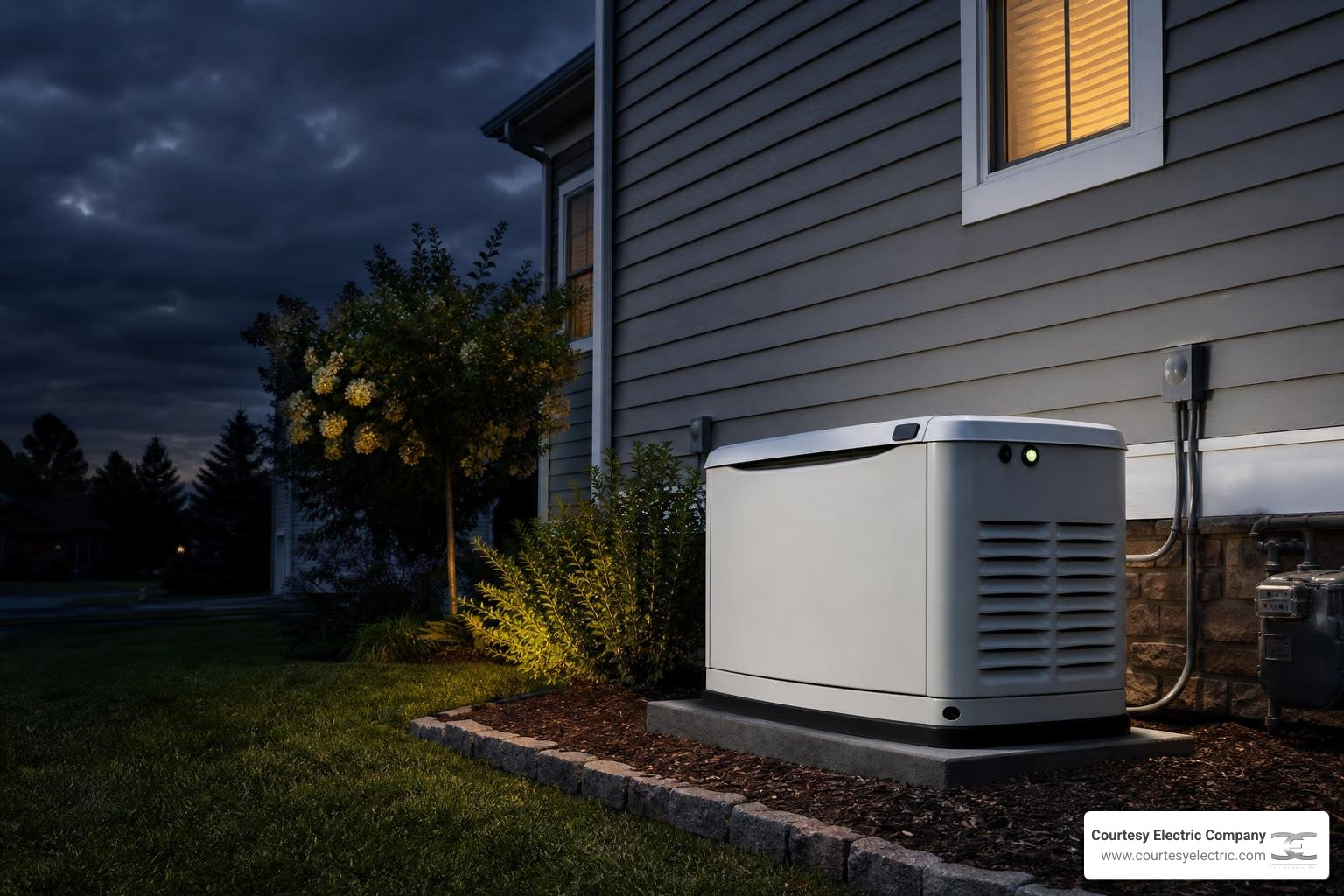
If you're wondering what size generator do I need for my home, here's the short answer:
| Home Type | Home Size | Recommended Generator Size |
|---|---|---|
| Gas appliances | Up to 2,000 sq ft | 14–16 kW |
| Gas appliances | 2,000–3,000 sq ft | 16–18 kW |
| Mixed fuel (gas heat, electric AC) | Up to 2,500 sq ft | 18–22 kW |
| All-electric (heat pump, electric water heater) | Any size | 22–24 kW + load management |
| Essentials only (any home) | Any size | 7,500–10,000 W portable |
These are starting points. Your actual number depends on your appliances, your fuel type, and your peak electrical load — all of which we'll walk through below.
Power outages in Colorado are no longer rare events. Snowstorms, high winds, and increasing grid demand across the Front Range mean many homeowners lose power multiple times a year — sometimes for days at a stretch. A generator can keep your heat running, protect your pipes from freezing, and keep your refrigerator and medical devices online when the grid goes down.
But here's the problem most homeowners run into: they pick a generator based on square footage or a vague sense of "bigger is better," and end up with a unit that either stalls the moment the air conditioner kicks on, or costs far more than necessary to buy and fuel. Getting the sizing right from the start is the single most important step in the whole process.
I'm David Meyer, Vice President of Courtesy Electric, a Colorado electrical contracting company with roots going back to 1976. Over the years, our team has helped hundreds of Front Range homeowners answer the question of what size generator do I need for my home — from small mountain cabins to large all-electric residences in the Denver metro. In the steps below, I'll walk you through exactly how we approach that calculation so you can go into the process informed.
What Size Generator Do I Need for My Home?
When starting your research, it is easy to get overwhelmed by the numbers. You will see terms like "running watts," "starting watts," "surge capacity," and "kilowatts (kW)." To make an informed decision, you first need to understand how these metrics translate to the physical equipment sitting outside your home.
At its core, determining what size generator do I need for my home is a balancing act. You want a system with enough capacity to handle your peak electrical load during an outage without paying for excess capacity you will never use.
To understand the mechanics of how these backup systems operate once they are installed, it helps to read up on How Does a Standby Generator Work. For local homeowners, there are specific advantages to choosing a permanently installed system, which we cover in our guide on Whole Home Generator Benefits for Colorado Homeowners.
Determining What Size Generator Do I Need for My Home Based on Appliance Load
Many online guides attempt to size generators purely by the square footage of a home. This is a highly flawed approach. Two identical 2,500-square-foot homes in the Denver metro area can have vastly different power requirements:
- Home A (Gas-Appliance Profile): Uses natural gas for heating, water heating, and cooking. Its primary electrical loads are a refrigerator, some lights, home electronics, and a furnace blower motor. This home might have a peak running load of only 8,000 to 13,000 watts, meaning a 14 kW to 18 kW generator is more than enough for a full-home backup.
- Home B (All-Electric Profile): Uses an electric heat pump, an electric water heater, an electric range, and perhaps an EV charger. This home's simultaneous peak load can easily exceed 28,000 watts, requiring a much larger 22 kW to 24 kW generator equipped with smart load management.
To find your true requirement, you must calculate your actual appliance load. This means listing every device you want to power, finding its running wattage, and accounting for the high startup surge of motor-driven appliances (like your refrigerator, sump pump, and central air conditioner).
Why Sizing Matters: What Size Generator Do I Need for My Home to Avoid Stalling?
What happens if you get this calculation wrong?
If your generator is too small, the consequences are immediate and frustrating. The most common failure mode reported by homeowners during a summer outage is a generator stalling the moment the central AC compressor tries to start. When a motor-driven appliance starts up, it demands a massive, instantaneous burst of electrical current. If the generator cannot supply this surge, its voltage drops, the engine bogs down, and the unit's circuit breaker trips to protect the system. In worse-case scenarios, chronic under-sizing can cause damage to sensitive home electronics due to voltage fluctuations.
On the flip side, over-sizing your generator by too much is also a mistake. While a larger generator will easily handle any load you throw at it, it will cost more upfront and consume significantly more fuel. Standby generators run most efficiently when loaded to 50% to 75% of their rated capacity. Running a massive generator under a very light load (a condition known as "wet stacking" in diesel units, or simple fuel wastage in natural gas and propane systems) is inefficient and can lead to premature engine wear.
How to Calculate Your Home's Peak Electrical Load in 5 Steps
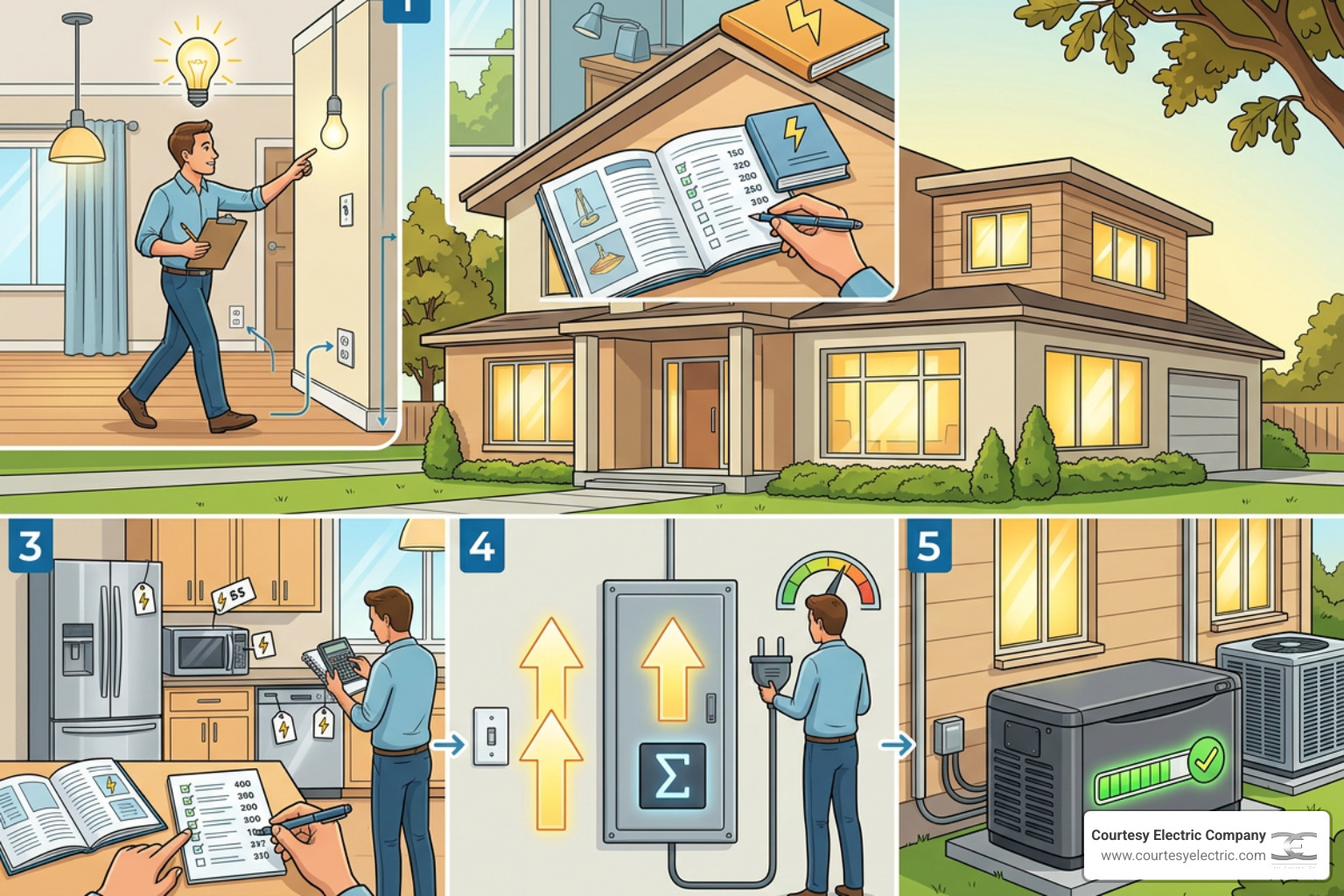
Calculating your home’s peak electrical load does not require an engineering degree. By following this structured, five-step process, you can build a highly accurate wattage worksheet that matches your family's actual lifestyle.
Before diving into the steps, it is worth noting that proper system design pays off during installation. You can learn more about this phase in our overview of Generator Installation What to Expect. Additionally, once your system is up and running, keeping it in top shape is essential. Be sure to review Spring Generator Maintenance After Winter to ensure your system is ready for summer storm season.
Here is the step-by-step method we use to calculate your home's peak load:
Step 1: List Essential Appliances
Start by dividing your home's electrical loads into two categories: "Must-Haves" and "Nice-to-Haves."
During a winter blizzard in Parker or Highlands Ranch, your must-haves will likely include:
- Heating system (furnace blower or heat pump)
- Water heater (especially if electric)
- Sump pump and well pump (if your home relies on a well)
- Refrigerator and freezer
- Key lighting circuits
- Home network (modem and Wi-Fi router)
- Medical equipment (if applicable)
Your "Nice-to-Haves" might include your central air conditioner, clothes dryer, dishwasher, and double ovens. Write these down on a simple spreadsheet or piece of paper.
Step 2: Identify Running Watts
Every electrical appliance has a manufacturer's nameplate (usually a silver or black sticker) that lists its electrical specifications. Look for the "Running Watts" (sometimes listed as "Continuous Watts").
If the nameplate only lists Volts and Amps, you can easily calculate the wattage using this simple formula:
$$\text{Watts} = \text{Volts} \times \text{Amps}$$
For example, if a refrigerator nameplate reads 120V and 6.5 Amps:
$$120 \times 6.5 = 780 \text{ Watts}$$
Note: A typical home refrigerator runs at approximately 300 to 800 running watts once its compressor is stabilized.
Step 3: Account for Starting Watts and Motor Surge
Appliances with electric motors require an extra burst of electricity to break the motor's inertia and get it spinning. This is known as "Starting Watts," "Surge Watts," or "Locked Rotor Amps" (LRA). Starting watts are typically 2 to 3 times higher than running watts and last for only a fraction of a second.
To calculate your peak starting demand, you do not need to add up the starting watts for every appliance in your home. It is highly unlikely that your refrigerator, sump pump, and air conditioner will all start at the exact same millisecond. Instead, use this industry-standard rule of thumb:
- Sum the running watts of all the appliances you want to run simultaneously.
- Identify the single appliance with the highest starting surge (usually your central AC compressor or well pump).
- Add that single highest starting surge value to your total running watts.
This gives you a realistic target for your generator's maximum surge capacity.
Step 4: Apply the Safety Buffer
Never design an electrical system to run at 100% capacity. To prevent unexpected overloads and allow headroom for future appliance purchases (such as adding a hot tub, finishing a basement, or installing an EV charger), you should always add a safety factor.
We recommend adding a 20% to 25% safety margin to your calculated total.
$$\text{Minimum Generator Size} = \text{Calculated Peak Load} \times 1.20$$
This safety margin ensures your generator runs comfortably within its optimal operating sweet spot and won't trip its main breaker if someone accidentally runs the microwave while the vacuum cleaner is plugged in.
Step 5: Convert Units and Select Your Generator
Generator manufacturers rate their standby units in Kilowatts (kW). To convert your final wattage calculation into kilowatts, simply divide by 1,000:
$$\text{Kilowatts (kW)} = \frac{\text{Total Watts}}{1,000}$$
For example, if your calculated load (including the safety buffer) is 15,500 watts:
$$\frac{15,500}{1,000} = 15.5 \text{ kW}$$
In this scenario, you would round up to the next standard generator size, which would be an 18 kW unit.
Altitude Derating: A Critical Factor for Colorado Homeowners
If you live along the Front Range or up in the foothills, there is one more crucial calculation you must make: altitude derating.
Internal combustion engines need oxygen to burn fuel. Because the air is thinner at high elevations, generators lose power as altitude increases. The industry-standard rule is that a generator loses approximately 3.5% of its rated power for every 1,000 feet of elevation above 500 feet.
If you live in Denver (approx. 5,280 feet) or Black Forest (approx. 7,300 feet), your generator will produce significantly less power than its faceplate rating.
- At 5,000 feet: A generator loses roughly 15% of its capacity. A "20 kW" generator will only deliver about 17 kW of usable power.
- At 7,500 feet: A generator loses roughly 24% of its capacity. That same "20 kW" generator will only deliver about 15.2 kW.
Our team always factors in altitude derating when designing systems for Front Range homeowners to ensure your generator performs flawlessly when a mountain blizzard hits.
Sizing by Home Profile: 2,000 Sq Ft Homes and Central Air Conditioning
To give you a clearer picture of how these calculations work in the real world, let's look at some common home configurations we encounter throughout Denver, Parker, and the wider Front Range.
If you are located in the high country, you can read our specialized Generators Installation in Fraser Co page or check out the Generators Fraser Co Complete Guide for localized high-altitude advice.
Sizing for a 2,000 Square Foot House
A 2,000-square-foot home is the sweet spot for many Colorado families. However, the fuel configuration of the home dictates the generator size:
| Appliance Profile | Key High-Draw Appliances | Typical Peak Load | Recommended Standby Generator |
|---|---|---|---|
| Gas-Appliance Profile | Gas furnace, gas water heater, gas range, standard refrigerator, lights, electronics. | 8,000 – 11,000 W | 14 kW – 16 kW |
| Mixed-Fuel Profile | Gas furnace, electric water heater, electric oven, 3-ton central AC unit. | 14,000 – 18,000 W | 18 kW – 20 kW |
| All-Electric Profile | Electric heat pump, electric water heater, electric cooktop, clothes dryer. | 22,000 – 26,000 W | 22 kW – 24 kW (with Load Management) |
As you can see, transitioning from gas to electric appliances dramatically increases your backup power requirements. This is why we perform a comprehensive, on-site load evaluation before recommending a specific model.
Sizing for Central Air Conditioning
Central air conditioning is often the single largest electrical load in a modern home. Sizing a generator to run an AC unit requires looking closely at the compressor's startup demand.
A standard 4-ton central AC unit typically requires about 4,000 to 5,000 running watts, but its startup surge can easily reach 12,000 to 16,000 watts.
- Without a Soft Start Kit: Running a 4-ton AC unit along with your home's basic essentials on a standard 14 kW air-cooled generator is highly risky. The massive startup surge will often stall the generator engine.
- With a Soft Start Kit: A soft starter is an inexpensive accessory that can be installed on your AC compressor. It electronically smooths out the startup current, reducing the initial surge by up to 60%. This simple upgrade allows a smaller, more fuel-efficient generator (like a 14 kW or 18 kW unit) to easily power your central air conditioning without stalling.
For very large homes with multiple AC zones or exceptionally heavy electrical loads, we sometimes recommend upgrading to a larger, liquid-cooled generator. These units feature automotive-style engines that handle heavy motor starting surges with ease.
Frequently Asked Questions about Generator Sizing
When choosing a backup power system, homeowners often ask similar questions. Here are clear answers to help you navigate the process.
If you already own a system and are noticing performance issues during testing, you should read about Signs Your Generator Needs Professional Attention. To keep your investment running smoothly for decades, consult our guide on How Often Should You Service Your Standby Generator.
What is the difference between running watts and starting watts?
Running watts (also known as rated or continuous watts) are the constant, steady-state power an appliance needs to keep operating. Starting watts (also known as surge or peak watts) represent the brief, intense burst of power an electric motor needs for the first few seconds when starting from a dead stop. Always size your generator's surge capacity to match your highest starting watt load.
Can a 14 kW generator run a 4-ton central AC unit?
In a typical gas-appliance home, a 14 kW generator can comfortably run your lighting, refrigerator, home electronics, and basic appliances. However, a standard 4-ton AC unit has a startup surge of up to 16,000 watts, which exceeds the continuous rating of a 14 kW generator.
To run a 4-ton AC on a 14 kW generator, you must either:
- Install a Soft Start Kit on your AC compressor to lower the starting surge.
- Use a Load Management Module to temporarily shed other high-draw appliances when the AC kicks on.
- Size up to a 16 kW or 18 kW generator to provide native headroom for the surge.
Do I need a load management module for my home generator?
A load management module (sometimes called a smart switch or circuit-shedding controller) is an incredibly useful piece of technology. It monitors your generator's total load in real-time. If your generator is running close to its capacity and a high-draw appliance (like an electric water heater or AC unit) turns on, the module will temporarily "shed" (turn off) non-essential circuits for a few minutes to prevent the generator from overloading.
Using load management allows you to install a smaller, more affordable, and more fuel-efficient generator while still protecting your home from unexpected blackouts. It is highly recommended for all-electric homes.
Conclusion
Determining what size generator do I need for my home is not a decision you have to make based on guesswork. By listing your essential appliances, calculating running and starting wattages, applying a safety margin, and factoring in Colorado's unique altitude derating, you can select a backup power system that provides total peace of mind without breaking your budget.
At Courtesy Electric Company, we have been serving homeowners across Denver, Parker, Highlands Ranch, Black Forest, and the entire Front Range since 1976. As certified installers of industry-leading backup systems, including Generac and Cummins generators, Franklin battery storage, and SPAN smart panels, we handle the entire process from initial load calculation to final inspection.
If you are ready to protect your home and family from the next major grid outage, we are here to help. Contact us today for a free, professional electrical load assessment and estimate on our electrical-service.


