How to Know When an Electrical Problem Is an Emergency
Knowing when an electrical problem is an emergency could be the difference between a quick fix and a house fire. Here is a fast reference to help you decide right now:
An electrical problem is an emergency if you notice any of the following:
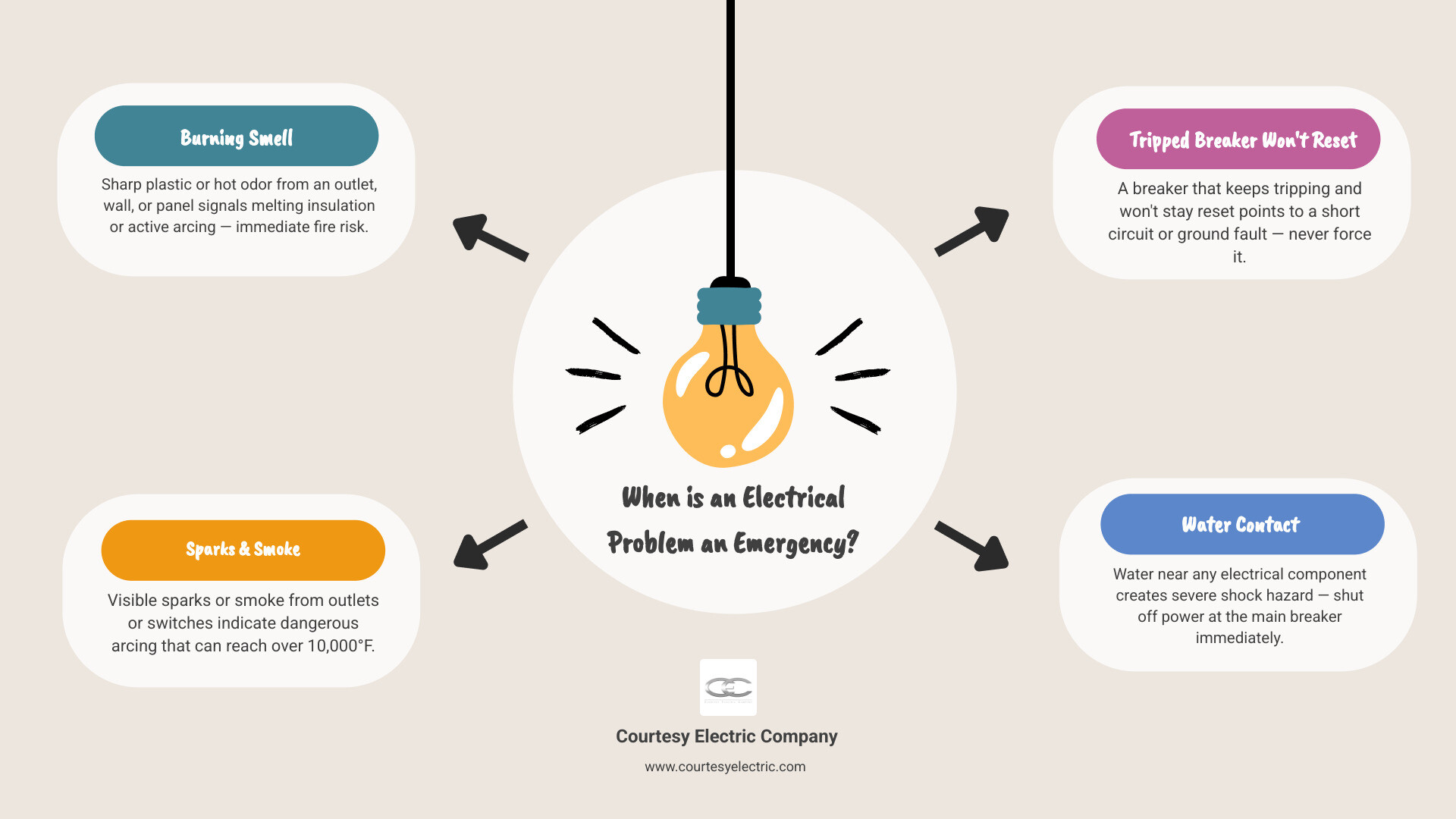
- A burning smell from an outlet, wall, or panel
- Sparks or smoke coming from an outlet or switch
- Your electrical panel feels hot to the touch
- A breaker keeps tripping and won't stay reset
- Buzzing or crackling sounds inside a wall or ceiling
- Water has contacted any electrical component
- Half your home has lost power while neighbors still have theirs
- Exposed or damaged wiring anywhere in the home
Issues that can usually wait for standard service:
- A single dead outlet with no heat, smell, or sparks
- One flickering light with no other symptoms
- Planned upgrades like EV chargers or smart home devices
If you are unsure, treat it as an emergency. Electricity does not leave much room for hesitation.
Electrical failures and malfunctions are a leading cause of residential fires in the United States, according to the Electrical Safety Foundation International (ESFI). And on the Colorado Front Range, where high-altitude lightning storms, heavy winter snow loads, and aging neighborhood infrastructure all push electrical systems to their limits, the stakes are even higher.
Most homeowners face the same moment of doubt: something feels off — maybe a sharp plastic smell near the panel or half the house going dark — and you're not sure whether to call someone immediately or wait until morning. That hesitation is understandable. But with electricity, what looks like a minor inconvenience can be active arcing hidden behind your drywall, generating heat that exceeds 10,000 degrees Fahrenheit at the arc point.
This guide will walk you through exactly what separates a true electrical emergency from a routine repair, what to do in the critical minutes before help arrives, and how to protect your home before problems start.
I'm David Meyer, Vice President of Courtesy Electric, and after decades of hands-on electrical work across Denver and the Front Range, I know how quickly when an electrical problem is an emergency goes from a question to an urgent reality. Growing up in this trade and working in the field taught me to recognize the warning signs that demand immediate action — and that's exactly what I'll share with you here.
How to Determine When an Electrical Problem Is an Emergency
To make the right call under stress, you need a simple framework. When we evaluate whether a service call requires immediate, after-hours dispatch or a scheduled appointment, we look at three core risk factors: fire risk, shock hazard, and loss of critical power.
If an issue presents a direct path to a fire or physical injury, it is a priority hazard. If it threatens your family's basic safety or makes your home uninhabitable during extreme weather, it is a critical power emergency. Understanding the line between these scenarios helps you decide When to Call an Electrician vs DIY without putting your property at risk.
| Symptom | Risk Level | Recommended Action |
|---|---|---|
| Burning plastic or fishy smell | Emergency | Shut off main breaker; evacuate; call us immediately |
| Continuous popping or buzzing in wall | Emergency | Shut off affected breaker; call emergency service |
| Breaker trips repeatedly after one reset | Emergency | Leave the breaker off; call for troubleshooting |
| Water leaking into panel or outlets | Emergency | Do not touch! Call us to coordinate utility disconnect |
| Single dead wall outlet (no heat/smell) | Non-Urgent | Stop using the outlet; schedule standard service |
| Single light bulb flickering | Non-Urgent | Tighten or replace bulb; schedule inspection if it persists |
Warning Signs: When an Electrical Problem Is an Emergency
Active hazards are rarely quiet. They communicate through heat, odor, and sound. A burning smell near a wall switch, a breaker panel that feels warm to the touch, or an ominous buzzing noise inside a wall cavity are all clear indicators that electricity is escaping its intended path.
When current flows through high-resistance connections or jumps across gaps, it produces extreme thermal energy. Learning How to Spot Electrical Problems Before They Become Dangerous allows you to catch these subtle sensory warnings before they escalate into open flames.
Minor Issues That Can Wait for Standard Service
Not every electrical hiccup is a crisis. A single wall outlet that suddenly stops working — provided it isn't warm, emitting a smell, or sizzling — is typically a localized failure, such as a back-stabbed wire connection that has finally pulled loose.
Similarly, a single flickering bulb is often just a failing LED driver or a loose bulb socket. While these issues are inconvenient and require professional attention, they are stable. You do not need to pay emergency rates for them. Instead, take note of these Signs Your Home Is Due for an Electrical Inspection and schedule a visit during standard business hours.
Critical Warning Signs You Should Never Ignore

When electrical current escapes its proper path, it creates a phenomenon known as arcing. Arcing generates extreme heat, with temperatures exceeding 10,000 degrees Fahrenheit at the arc point. To put that in perspective, the surface of the sun is about 10,000 degrees Fahrenheit. This intense localized heat can ignite surrounding wood framing, drywall paper, and attic insulation in fractions of a second.
This is why understanding How to Prevent Electrical Fires in Your Home is so critical for homeowners in dry, high-altitude climates like Denver, where fire can spread rapidly.
Burning Smells and Overheating Panels
If you smell burning plastic, vinyl, or a strange "fishy" odor near your outlets or electrical panel, do not ignore it. This odor is the smell of wire insulation, plastic outlet bodies, or terminal blocks overheating and melting.
If your electrical panel's metal enclosure feels hot to the touch, the internal bus bars or main breakers are likely overloaded or loose, creating high resistance. Reviewing Electrical Fire Prevention Tips for Homeowners will remind you that a hot panel is a final warning sign before a catastrophic failure occurs.
Sparking Outlets and Buzzing Walls
A tiny, brief blue spark when you plug in a high-draw appliance (like a vacuum cleaner that is switched on) is normal contact arcing. However, large, yellow, or continuous sparking accompanied by popping sounds is highly dangerous.
Similarly, a buzzing or crackling sound inside a wall or ceiling indicates that current is actively jumping across loose connections or damaged wire runs. In older Colorado homes, this is often exacerbated by aging infrastructure. Understanding How Outdated Wiring Increases Fire Risk is essential if you live in historic neighborhoods throughout the Denver metro area, where original wiring may still be in use.
Tripped Breakers That Won't Reset
A circuit breaker's sole job is to shut off power when it detects an overload, a short circuit, or a ground fault. If a breaker trips, you should unplug the appliances on that circuit and reset it exactly once.
If it trips again immediately, do not force it or hold it down. The breaker is doing its job to prevent a fire. Repeatedly resetting a faulted breaker can cause severe damage to the panel bus bar and ignite a fire behind your walls. Keep this at the top of your Ultimate Electrical Fire Safety Checklist Home to keep your family safe.
Environmental Hazards and Power Fluctuations
Living along the Colorado Front Range means dealing with extreme weather. From heavy spring blizzards in Parker and Highlands Ranch to intense lightning storms over the Black Forest, our local environment poses unique challenges to residential electrical systems.
Storm and Water Damage: When an Electrical Problem Is an Emergency
Water and electricity are a deadly combination. If a heavy downpour floods your basement, or if a roof leak channels water directly into your electrical panel or light fixtures, you have an immediate emergency.
Water inside outlet boxes and junction boxes causes rapid corrosion on wiring connections, which can create severe fire hazards long after the water has dried. Additionally, if a falling tree branch or heavy snow bends your exterior service mast — which carries 240 volts of unprotected utility power directly to your meter base — stay far away and call us immediately.
Partial Power Loss vs. Total Outage
If your entire neighborhood goes dark, it is almost certainly a utility grid issue. You should report it to your local utility provider (such as Xcel Energy or CORE Electric Cooperative) and wait for updates.
However, if half your home is dark while your neighbors have full power, you are likely experiencing a partial power loss. This is often caused by an "open neutral" or a dropped hot leg on your service entrance. A partial power outage can cause dangerous voltage imbalances, sending up to 240 volts through 120-volt circuits, which can destroy your appliances and create fire hazards.
In these situations, modern smart energy systems like SPAN panels or a Franklin battery storage system can help isolate circuits and protect your home's electronics from damaging voltage spikes.
What to Do While Waiting for an Emergency Electrician
Once you have identified a true emergency and called for dispatch, the steps you take while waiting for our technician to arrive can protect your property and ensure a fast, safe repair.
How to Safely Isolate the Hazard
- Shut off the main power: If you can safely access your electrical panel without walking through standing water, smoke, or a dangerous area, open the panel door and flip the large main breaker (usually labeled "100A" to "200A" at the top of the panel) to the "OFF" position.
- Evacuate if necessary: If you see active smoke, smell heavy burning odors, or hear loud crackling inside a wall, do not wait inside. Evacuate your family and pets immediately, call 911, and then call us.
- Do not touch wet components: If water is leaking onto outlets or your panel, do not touch any switches or cords. Wait for professional isolation.
Information to Prepare for Your Call
To help us dispatch the right team and prepare our diagnostic tools, please gather the following information if it is safe to do so:
- What are the exact symptoms? (e.g., burning smell, buzzing sound, partial power loss)
- Where is the problem located? (e.g., kitchen outlet, main panel in the garage, basement ceiling)
- Is there clear access to your panel? Please clear boxes, tools, or storage away from the panel area so our technician can work safely and quickly.
- Has anything changed recently? Did you just plug in a new high-draw appliance, or did a severe storm just pass through?
Preventing Electrical Emergencies with Proactive Maintenance
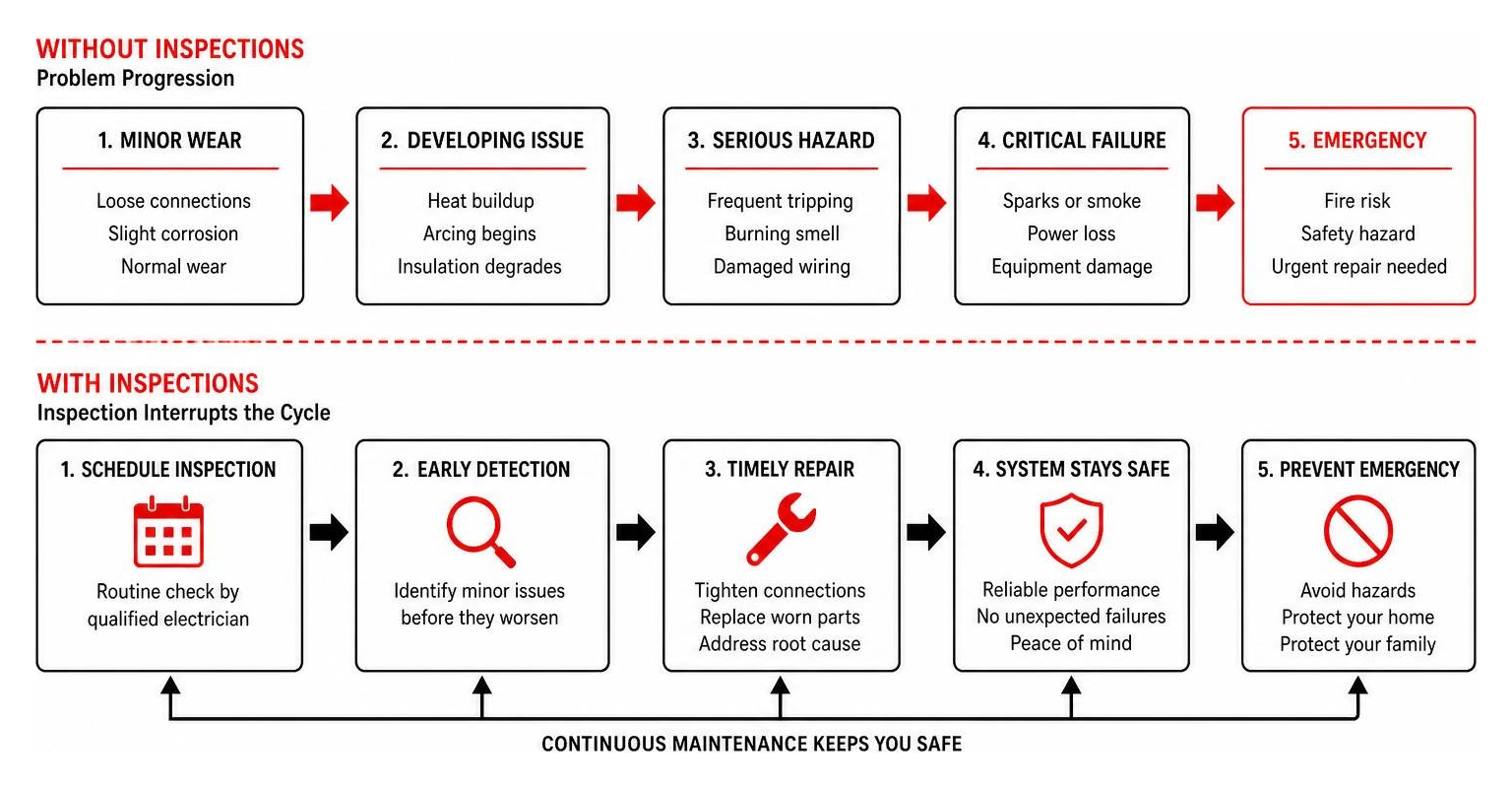
The best way to handle an electrical emergency is to prevent it from happening in the first place. Your home's electrical system is largely hidden behind drywall, making it easy to forget until something goes wrong.
Proactive care is key. By understanding How an Electrical Inspection Prevents Problems, you can catch loose connections, corroded terminals, and overloaded circuits before they turn into late-night hazards. We recommend reviewing How Often Should You Have Your Electrical System Inspected to establish a safe maintenance schedule based on your home's age and power demands.
Upgrading to Modern Safety Standards
Older homes along the Front Range were not built to handle the electrical loads of modern life. Between electric vehicles, hot tubs, and multi-zone HVAC systems, older panels can easily become overloaded.
Upgrading your home with modern Arc Fault Circuit Interrupter (AFCI) breakers — which detect dangerous arcing faults and shut off power instantly — and Ground Fault Circuit Interrupter (GFCI) protection in wet areas is a critical step. These systems are designed to meet current National Electrical Code (NEC) standards and keep your family safe. For more details, explore these Electrical Safety Tips Every Homeowner Should Know.
Smart Energy Management and Backup Solutions
Modern technology offers incredible ways to monitor and protect your home's electrical system. By upgrading to a SPAN smart panel, you gain real-time, circuit-level monitoring on your smartphone, allowing you to see exactly how much power each appliance is drawing and receive alerts if a circuit behaves abnormally.
Additionally, pairing a SPAN panel with a Franklin battery storage system or a Generac/Cummins home standby generator ensures that if the Denver grid goes down during a heavy winter storm, your critical safety systems, medical equipment, and heating remain fully powered.
Frequently Asked Questions About Electrical Emergencies
Is a burning smell from an outlet always an emergency?
Yes, with one minor exception: if you are using a brand-new space heater, toaster, or appliance for the very first time, a brief, faint burning smell can be caused by manufacturing oils heating up. However, if the burning smell comes directly from the outlet itself, a wall cavity, or your electrical panel, it is an active emergency indicating melting insulation or arcing wiring. Shut off the breaker immediately and call us.
Should I keep resetting a breaker that keeps tripping?
No. If a breaker trips again immediately after you reset it once, do not attempt to reset it a second time. The breaker is detecting a short circuit, a ground fault, or a severe overload. Forcing it to reset can damage your panel, ruin your appliances, and ignite a fire inside your walls. Leave it off until a licensed professional can diagnose the issue.
What should I do if water comes in contact with electrical components?
Do not touch any wet electrical devices, outlets, or appliances. If it is safe to access your main panel without stepping through standing water, shut off the main breaker. If the water is coming into the panel itself, do not touch the panel; call us immediately so we can coordinate with your utility provider to safely disconnect power at the outdoor meter.
Conclusion
Determining when an electrical problem is an emergency doesn't have to be a guessing game. By paying attention to critical warning signs like burning smells, buzzing walls, hot panels, and storm damage, you can protect your home and family from serious hazards.
At Courtesy Electric Company, we have been serving homeowners across Denver, Parker, Highlands Ranch, Black Forest, and the entire Colorado Front Range since 1976. We are dedicated to providing high-quality installations, panel upgrades, smart home integrations, and reliable backup power solutions with integrity and dependability.
If you suspect an active hazard in your home, or if you want to schedule a preventative safety inspection to ensure your system is up to code, we are here to help. Schedule emergency electrical service or a safety inspection with Courtesy Electric Company today to keep your home safe, modern, and resilient.


