Why the Generac vs Cummins Sizing Comparison Matters for Colorado Homeowners
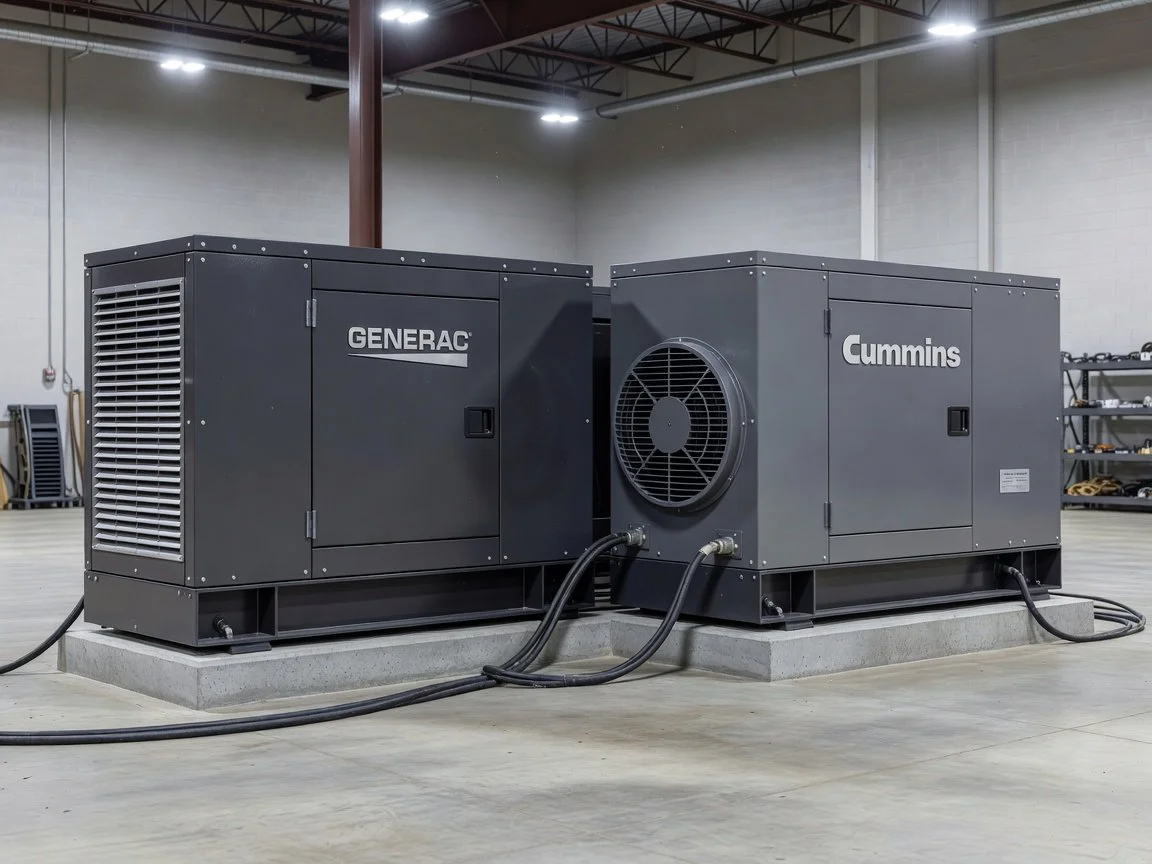
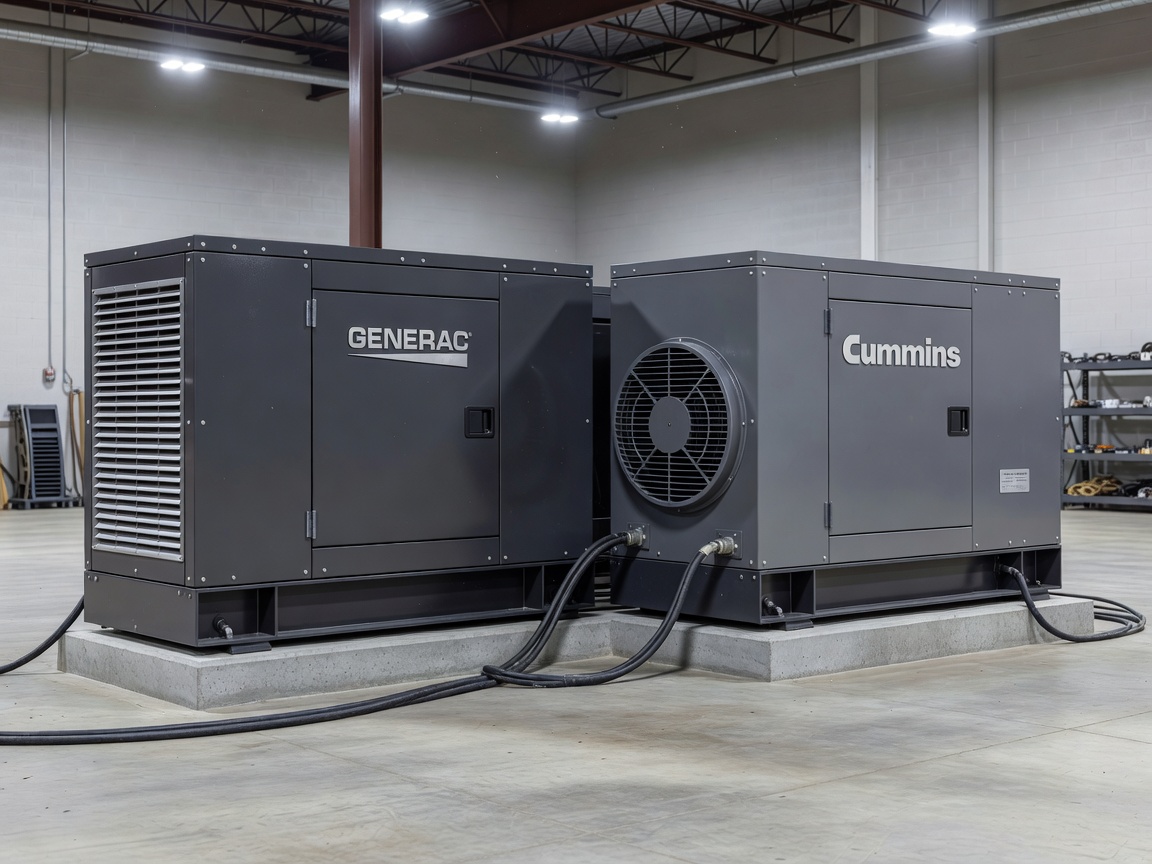
When it comes to the generac vs cummins sizing comparison, the right choice depends on your home's power needs, local climate, and how much load you need to cover during an outage. Here's a quick breakdown to help you decide:
| Factor | Generac | Cummins |
|---|---|---|
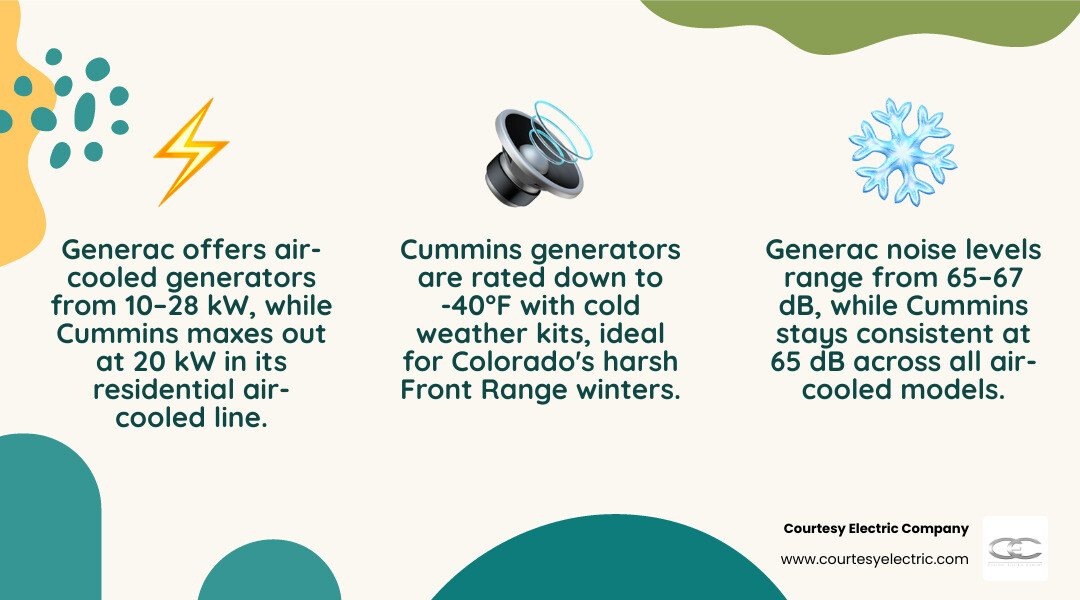
| Residential air-cooled sizes | 10–28 kW (7 options) | 13, 17, 20 kW (3 options) |
| Max residential air-cooled output | 28 kW | 20 kW |
| Natural gas output (22/20 kW models) | 19.5 kW | 18 kW |
| Propane output (22/20 kW models) | 22 kW | 20 kW |
| Noise level | 65 dB (14–18 kW), 67 dB (22 kW+) | 65 dB across all models |
| Built-in load management | Add-on required | Included (up to 4 loads) |
| Cold weather rating (with kit) | Varies by model | Down to -40°F |
| Best for | Larger homes, wide service network | Noise-sensitive installs, durability |
The short answer: if your home needs more than 20 kW, Generac is your only air-cooled option. If noise and built-in load management are priorities and 20 kW covers your needs, Cummins is hard to beat.
Power outages in Colorado are not a rare inconvenience — they're a regular reality, especially along the Front Range where spring storms, high winds, and winter cold snaps can knock out grid power for hours or days at a time. Choosing the wrong generator size means either running out of capacity when you need it most or paying to run an oversized unit that burns more fuel than necessary. Neither outcome is good, and sizing is where most homeowners get tripped up.
The two most common names in residential standby power are Generac and Cummins. Generac dominates the U.S. residential market with roughly 70–75% market share and a dealer network of over 9,200 locations. Cummins brings a decades-long industrial heritage — building engines for hospitals, data centers, and semi-trucks — and applies that same engineering rigor to its residential Quiet Connect RS series. Both are solid. But they are not interchangeable, and the sizing differences between them matter more than most homeowners realize before they buy.
I'm David Meyer, Vice President of Courtesy Electric, a Colorado electrical contractor with roots going back to 1976, and I've helped countless Front Range homeowners work through exactly this generac vs cummins sizing comparison to find the right fit for their home, load profile, and local climate. We'll walk through everything you need to know to make a confident decision.
Key Differences in Generac vs Cummins Sizing Comparison
When comparing these two powerhouses, the physical limits of their residential air-cooled product lines are often the first major fork in the road. Air-cooled generators are the most popular standby options because they are compact, easier to install, and highly cost-effective. However, the two brands approach this space with very different philosophies.
Generac believes in offering a highly granular range of choices. They provide seven distinct sizes in their residential air-cooled Guardian lineup, spanning from 10 kW all the way up to 28 kW. This broad spread allows us to target your home’s exact electrical footprint, ensuring you do not pay for more generator than you actually need.
Cummins, on the other hand, keeps its residential air-cooled lineup streamlined. They offer exactly three sizes: 13 kW, 17 kW, and 20 kW. If your home requires a capacity beyond 20 kW, Cummins does not offer an air-cooled option. To get more power from Cummins, you must step up to their liquid-cooled commercial-grade models. While liquid-cooled units are incredibly durable and built for heavy-duty, multi-day runtimes, they also require a larger installation footprint and a more complex setup.
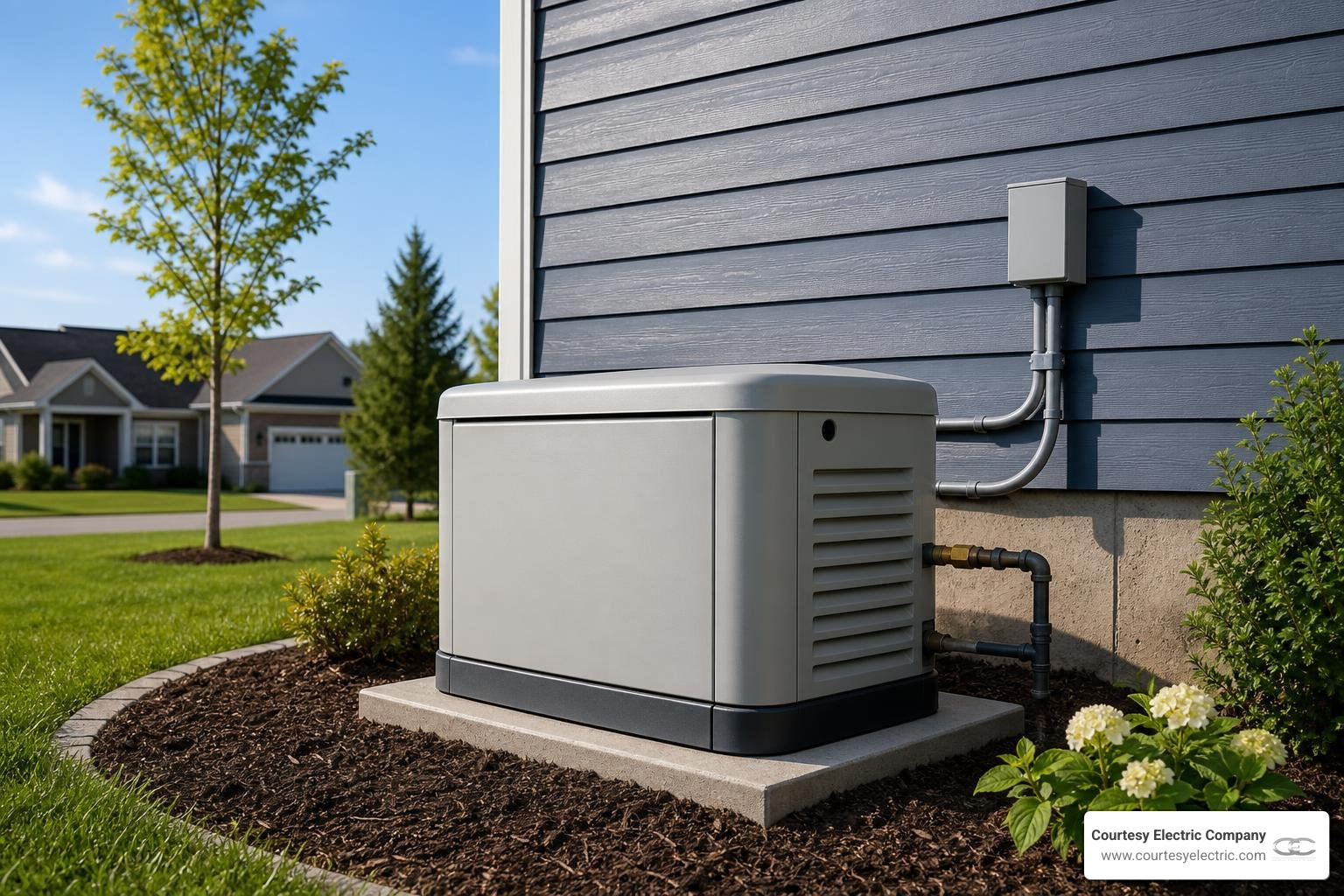
This structural difference makes your load calculation the ultimate deciding factor. For instance, if we calculate your home's peak demand and find that you need a 22 kW system, Generac offers a perfect air-cooled fit with their popular 22 kW or 24 kW models. With Cummins, you would have to make the leap to a larger, liquid-cooled commercial unit, which might be overkill for a standard residential property.
To help visualize how these two brands match up across their most popular residential capacities, review our Generator Brand Comparison for Homeowners to see how engineering philosophies translate into real-world home performance.
Sizing for Starting vs. Running Loads and Load Management
Sizing a standby generator is not as simple as adding up the numbers on the back of your appliances. If you look at your microwave, refrigerator, and television, you will see their "running watts" — the continuous power they need to stay on. But appliances with electric motors, such as your central air conditioner, well pump, or sump pump, require a massive, temporary surge of electricity just to start up. This is known as the "starting load" or surge wattage.
To measure a generator's ability to handle these sudden, heavy demands, we look at motor-starting kVA. Think of motor-starting kVA as the generator's athletic sprint capacity. When your 5-ton air conditioner compressor kicks on, it demands a massive gulp of power for a fraction of a second. If your generator lacks the surge capacity to handle that gulp, the engine will bog down, voltage will drop, and the system may shut down entirely to protect itself.
To understand the mechanics behind how standby systems handle these sudden surges, you can read more about How Does a Standby Generator Work.
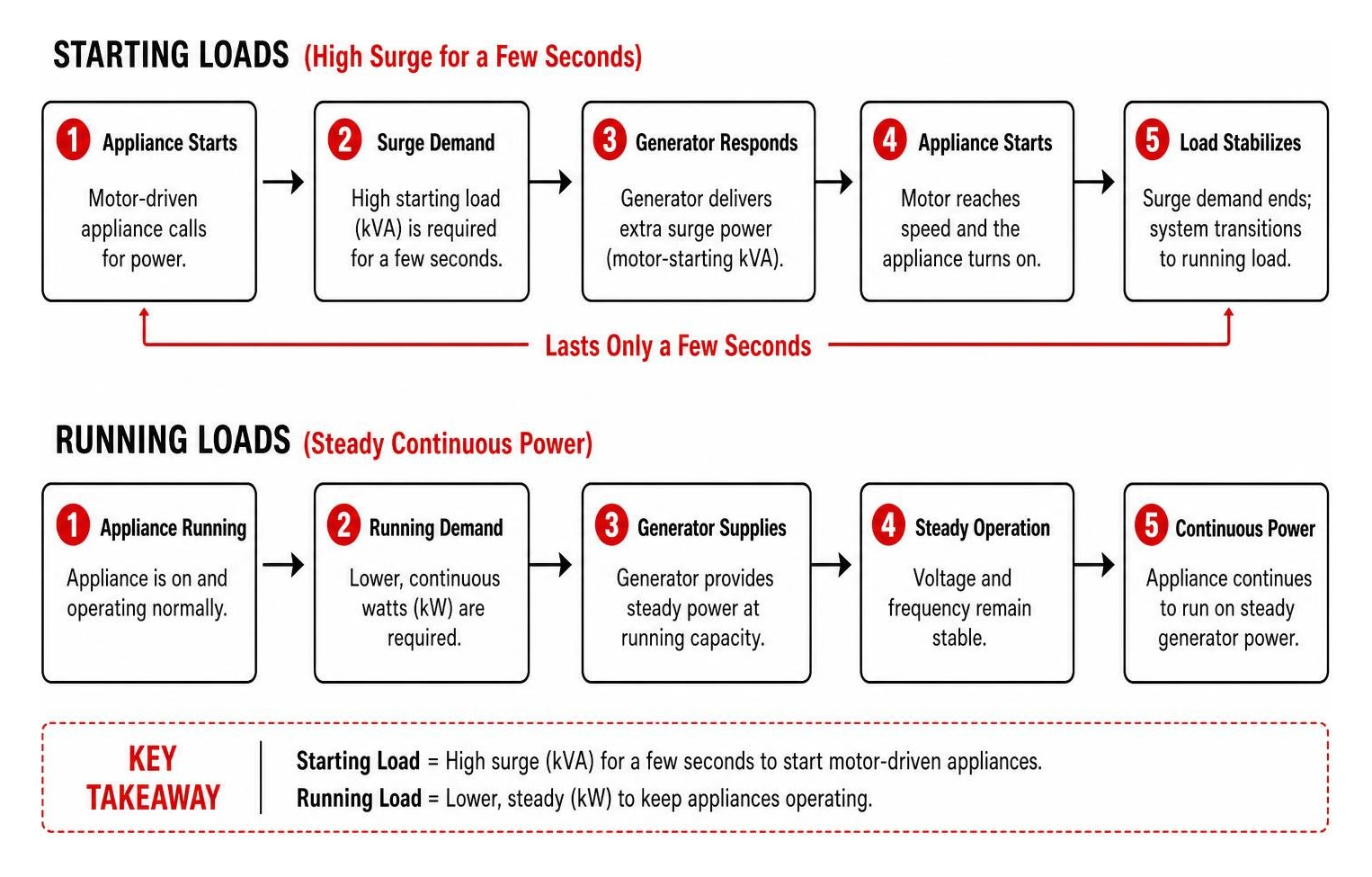
A typical 3-ton central air conditioner needs about 24 kVA to start up, while a larger 5-ton unit can require up to 42 kVA. Cummins generators leverage their heavy-duty industrial heritage to deliver exceptional motor-starting kVA. Their Quiet Connect systems are specifically engineered to handle high-torque starting loads, allowing their 20 kW model to successfully start a 5-ton air conditioner even while supporting other household operational loads. Generac units also offer robust surge capabilities through their G-Force engine design, but because their air-cooled line extends up to 28 kW, they often rely on sheer size to handle those massive starting spikes.
Sizing Considerations for a Generac vs Cummins Sizing Comparison in Colorado
Sizing a generator in Colorado requires an extra layer of engineering math because of our beautiful, high-altitude geography. Both Generac and Cummins rate their generator capacities based on sea-level conditions. However, as you climb in elevation, the air becomes thinner and contains less oxygen. Because internal combustion engines rely on oxygen to burn fuel, thinner air means less power.
This loss of capacity is called altitude derating. As a general rule of thumb, a standby generator loses approximately 3.5% of its rated power for every 1,000 feet of elevation above sea level.
Let's look at how this impacts a generac vs cummins sizing comparison along the Colorado Front Range:
- Denver (approx. 5,280 feet): At over a mile high, a generator will experience an automatic derating of roughly 18%. A 20 kW generator operating in Denver is effectively reduced to a 16.4 kW generator.
- Parker and Highlands Ranch (approx. 5,900 to 6,200 feet): Homeowners here will see a derating of around 20% to 21%, meaning a 22 kW unit will only deliver about 17.5 kW of usable power.
- Black Forest (approx. 7,200 to 7,500 feet): In these higher-elevation timbered areas, the derating penalty approaches 25% to 26%. A 20 kW model will only provide around 15 kW of actual capacity.
Because of these steep environmental penalties, you cannot simply buy a generator that matches your sea-level electrical load. If your home requires 16 kW of continuous power during an outage, installing a 17 kW generator in Parker will result in an overloaded system that constantly trips. We must intentionally "oversize" the physical unit so that its derated, high-altitude output still comfortably covers your home's peak demands. To see how these local atmospheric conditions influence brand selection, take a look at our guide on Which Home Generator Brand is Better for Colorado.
Managing Electrical Loads in a Generac vs Cummins Sizing Comparison
If you want to keep your physical generator size—and your fuel consumption—to a minimum, the secret lies in smart load management. Rather than buying a massive generator designed to run every single appliance in your home simultaneously, load management systems act as a digital traffic cop, prioritizing your electrical circuits so they do not all run at once.
This is an area where the two brands diverge significantly in their standard configurations. You can read a deep dive into these mechanical differences in our Generac vs Cummins Home Generator Comparison.
Cummins includes intelligent, built-in 4-load management in their Quiet Connect RS series at no additional cost. The generator's control board can monitor and manage up to four high-demand loads (like your A/C, electric dryer, or hot tub). If the generator senses that starting the air conditioner will push the system past its safety limit, it temporarily pauses other managed loads, starts the A/C, and then reintroduces the other loads once the starting surge has passed.
Generac approaches load management through external hardware. Their systems utilize Smart Management Modules (SMMs). These are individual, wire-in boxes that are installed next to your electrical panel. While this requires purchasing external modules, it offers incredible flexibility. Generac's SMMs operate autonomously, monitoring frequency to protect the generator without needing a dedicated control wire running back to the unit.
For homeowners weighing these options, it is also worth considering how a traditional standby generator matches up against modern battery storage solutions. If you want to compare these technologies, check out our Standby Generator vs Battery Backup Cost Comparison.
Physical Footprint, Noise, and Installation Sizing
Once we determine the electrical size of your generator, we have to look at where it will actually live on your property. Physical dimensions, local HOA rules, and municipal noise ordinances play a massive role in the installation process.
Noise is often a primary concern, especially in dense residential neighborhoods in Highlands Ranch or Parker. If your generator runs for three days straight during a blizzard, you—and your neighbors—will care deeply about how loud it is.
- Cummins Quiet Connect: Cummins has made quiet operation a hallmark of their residential engineering. They maintain a consistent, low noise profile of 65 decibels (dB) across their entire air-cooled lineup (13, 17, and 20 kW).
- Generac Guardian: Generac units are also highly quiet, matching the 65 dB mark on their mid-size 14 kW and 18 kW models. However, as you move up to their larger 22 kW, 24 kW, and 28 kW models, the sound level increases to 67 dB or higher.
While a 2 dB difference might sound negligible on paper, the decibel scale is logarithmic. A 2 dB increase represents a noticeable difference in real-world sound pressure, which can be the difference between a peaceful night's sleep and an annoyed knock on the door from a neighbor.
When it comes to physical footprint and placement, both brands are designed to meet strict National Fire Protection Association (NFPA 37) standards, which allow for installation as close as 18 inches to a home's exterior wall, provided they are kept clear of windows, doors, and fresh air intakes. Cummins units feature an exceptionally compact, curved enclosure design that blends beautifully into residential landscaping, while Generac’s classic rectangular steel or aluminum enclosures are built for easy component access during routine maintenance.
To learn more about the physical installation process, including gas line connections, concrete pads, and electrical permitting, review our overview of Generator Installation What to Expect.
Frequently Asked Questions about Generator Sizing
What size generator do I need for a typical home?
There is no single "standard" size because every family's electrical usage is unique. However, we generally look at home backup in two ways:
- Essential Circuits Backup (13 kW to 17 kW): This is ideal for homes under 2,500 square feet. It is sized to run your critical infrastructure: heating system (furnace blower), refrigerator, freezer, sump pump, Wi-Fi router, select lights, and kitchen outlets.
- Whole-House Backup (20 kW to 26 kW+): This is designed for larger homes (3,000+ square feet) or homes with high-demand electric appliances like double ovens, well pumps, hot tubs, and multiple central A/C units.
To help identify which tier fits your lifestyle, you can read our guide on Choosing the Right Backup Power for Colorado.
How does altitude affect generator sizing in Colorado?
As elevation increases, the thinner air reduces the amount of oxygen available for combustion inside the generator's engine. This causes a loss of engine horsepower, which directly translates to a lower electrical kilowatt output. Along the Colorado Front Range, you must factor in a derating penalty of 18% to 25% depending on your exact elevation. This means we must always size your generator larger than your actual calculated electrical load to ensure you have adequate power when the system is running at high altitude.
Can a 20 kW generator run a 5-ton air conditioner?
Yes, but it requires careful planning. A standard 5-ton air conditioner has a massive starting surge that can easily stall a standard 20 kW generator if other appliances are running. To make this work safely, we either utilize the built-in load management capabilities of a system like the Cummins RS20A to temporarily shed other household loads during startup, or we install a "soft-start" kit on your air conditioner compressor. A soft-start kit reduces the initial starting current of your A/C by up to 60%, allowing it to start smoothly on a smaller generator.
Conclusion
Sizing a standby generator is a precise science, especially when you factor in the high-altitude demands of Denver, Parker, Highlands Ranch, and Black Forest. Whether you choose the highly customizable, market-leading versatility of a Generac Guardian or the quiet, robust, industrial-grade engineering of a Cummins Quiet Connect, getting the size right is the single most important step in protecting your home.
At Courtesy Electric Company, we have been serving the Colorado Front Range since 1976. Our team of highly trained, factory-certified electricians specializes in complete, end-to-end backup power solutions. We do not believe in guessing games or one-size-fits-all recommendations. We perform comprehensive, engineered load calculations that account for your home's unique layout, your starting and running appliance loads, and your exact local elevation.
If you are ready to protect your family from Colorado's unpredictable weather with a professionally installed standby generator, we are here to help. Contact us today to schedule your free estimate on our wide range of professional electrical installations.
Explore Our Electrical Services to learn more about how we can keep your home safe, powered, and comfortable all year round.


