

Why the Advantages of a Company Built for Scale and Precision Matter for Your Infrastructure

The advantages of a company built for scale and precision are clear and measurable — and they matter especially when you're trusting someone with your home's electrical infrastructure:
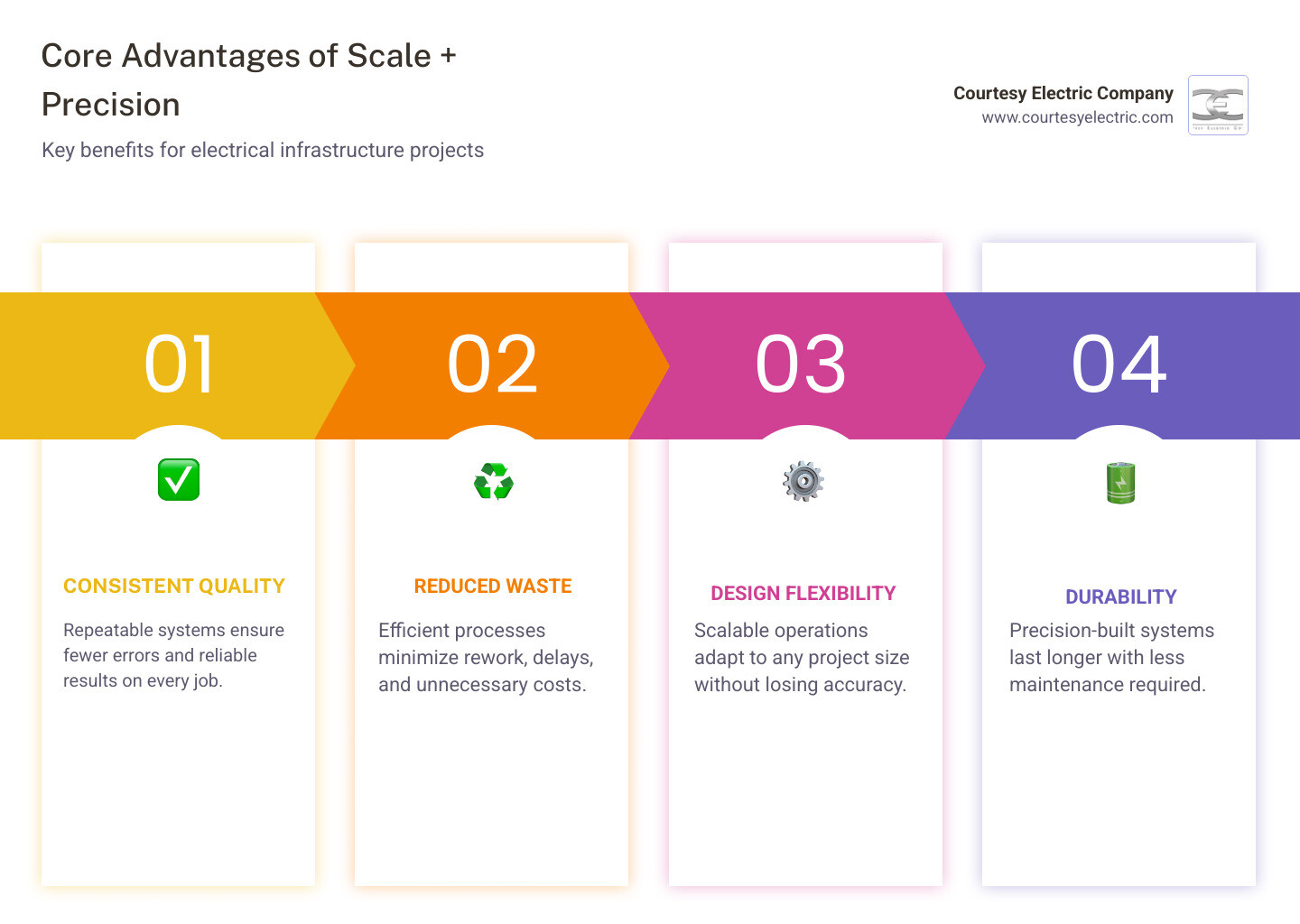
- Consistent quality — Repeatable systems mean fewer errors and more reliable results on every job
- Reduced waste — Efficient processes cut down on rework, delays, and unnecessary cost
- Design flexibility — Scalable operations adapt to your project without sacrificing accuracy
- Faster delivery — Streamlined workflows get the job done right and on schedule
- Durability — Precision-built systems last longer and require less ongoing maintenance
- Operational agility — A company built for scale can handle one home or an entire development without skipping a beat
- Access to better technology — Scale enables investment in smarter tools, from AI-assisted planning to advanced diagnostics
Here's why that matters to you as a homeowner or developer in Colorado: most electrical problems — outages, panel failures, integration breakdowns — don't come from bad intentions. They come from contractors who aren't set up to deliver consistent, high-accuracy work at any volume. A company built for scale and precision closes that gap.
Precision manufacturing dominates roughly 70% of the growing industrial market, and that same principle is reshaping how modern electrical contractors operate. The old model — show up, improvise, repeat — is giving way to something more rigorous: companies that build systems, use data, and scale their expertise without losing accuracy.
I'm David Meyer, Vice President of Courtesy Electric, a Colorado electrical contractor with over 50 years of experience where I've seen how the advantages of a company built for scale and precision separate contractors who deliver from those who disappoint. That foundation shapes everything we do, from single-family panel upgrades to large multi-family infrastructure builds.
Defining the Modern Model: Scale Meets Precision
In the business world of April 2026, the definition of a successful company has shifted. We no longer measure "scale" simply by how many employees are on the payroll. Instead, modern leaders look at leverage. A company built for scale today is a "Leverage-First Organization." This means we prioritize systems, automation, and smart alliances to achieve outsized impact without the bloat of traditional, labor-heavy models.
In the electrical industry, this looks like moving away from "random acts of contracting" toward a structured, precision-based approach. While traditional models often struggle with "diseconomies of scale"—where getting bigger just makes things more expensive and disorganized—a precision-scaled model does the opposite. It uses "thin-slicing" to break down complex projects into repeatable, high-accuracy tasks.
By focusing on "economic truth"—the reality that growth must be earned through efficiency rather than just financial theater—we ensure that every project, whether it's a backup generator install in Highlands Ranch or a large-scale development in Denver, benefits from the same rigorous standards. This momentum compounds. When a company builds a machine to "stack the bricks" rather than just stacking them by hand, the results are more durable and the growth is more sustainable.
At Courtesy Electric, we’ve spent decades refining this balance. You can learn more about our mission and history to see how we’ve evolved from a local shop in 1976 to a precision-driven leader in the Front Range.
The Core Advantages of a Company Built for Scale and Precision
When a company is engineered for both size and accuracy, the customer wins in several specific ways. In high-accuracy industries like aerospace or medical manufacturing, precision is a requirement for safety. We believe residential and multi-family electrical infrastructure should be held to that same standard.
1. Superior Product Quality and Consistency
Precision is the ability of a system to repeatedly produce identical, high-quality results. In manufacturing, this might mean a CNC machine hitting a tolerance of ±0.05 mm. In electrical work, it means every wire pull, every panel termination, and every smart-home integration is performed to a documented, high-standard specification. This reduces defects and ensures that your system functions exactly as designed, every time.
2. Design Flexibility and Customization
One of the greatest myths is that "scale" means "cookie-cutter." In reality, precision technologies like 3D modeling and advanced CAD software allow for incredible customization. We can adapt a power backup solution specifically for a unique home in Black Forest while maintaining the same structural integrity we use for a hundred-unit complex.
3. Reduced Waste and Cost Efficiency
Precision manufacturing is inherently cost-efficient because it minimizes material waste and rework. When you get it right the first time, you don't spend money fixing mistakes. This efficiency allows scaled companies to invest in better materials and higher-tier equipment—like SPAN smart panels or Franklin battery storage—without passing on the costs of inefficiency to the client.
4. Increased Durability
Systems built with precision simply last longer. Whether it's a high-capacity scale measuring displacement with SAW technology or a home electrical grid, tight tolerances and exact specifications mean less wear and tear on components over time.
To see these benefits in action, browse our completed projects across the Front Range, which showcase everything from residential upgrades to complex infrastructure.
How Precision Drives High-Accuracy Results
The "how" behind these advantages often involves Industry 4.0 solutions. Technologies like AI-driven diagnostics, automation, and specialized machinery (like CNC machining in the parts we source) ensure that components meet rigorous standards like ISO 9001:2015.
In the electrical field, we use these principles to manage "tight tolerances" in energy distribution. As homes become more complex—incorporating EV charging, solar, and battery backups—the margin for error shrinks. A precision-scaled company uses specialized expertise and advanced tools to ensure these systems play nicely together.
Why Precision is One of the Advantages of a Company Built for Scale and Precision
The primary reason precision is such a heavy-hitter is repeatability. In the past, a great electrical job depended entirely on which technician showed up that day. In a precision-built company, the system ensures the quality. By using standardized playbooks and high-accuracy tools, we reduce the "human error" factor. This leads to a massive reduction in defects, which is why precision manufacturing now holds 70% of the market share over conventional methods.
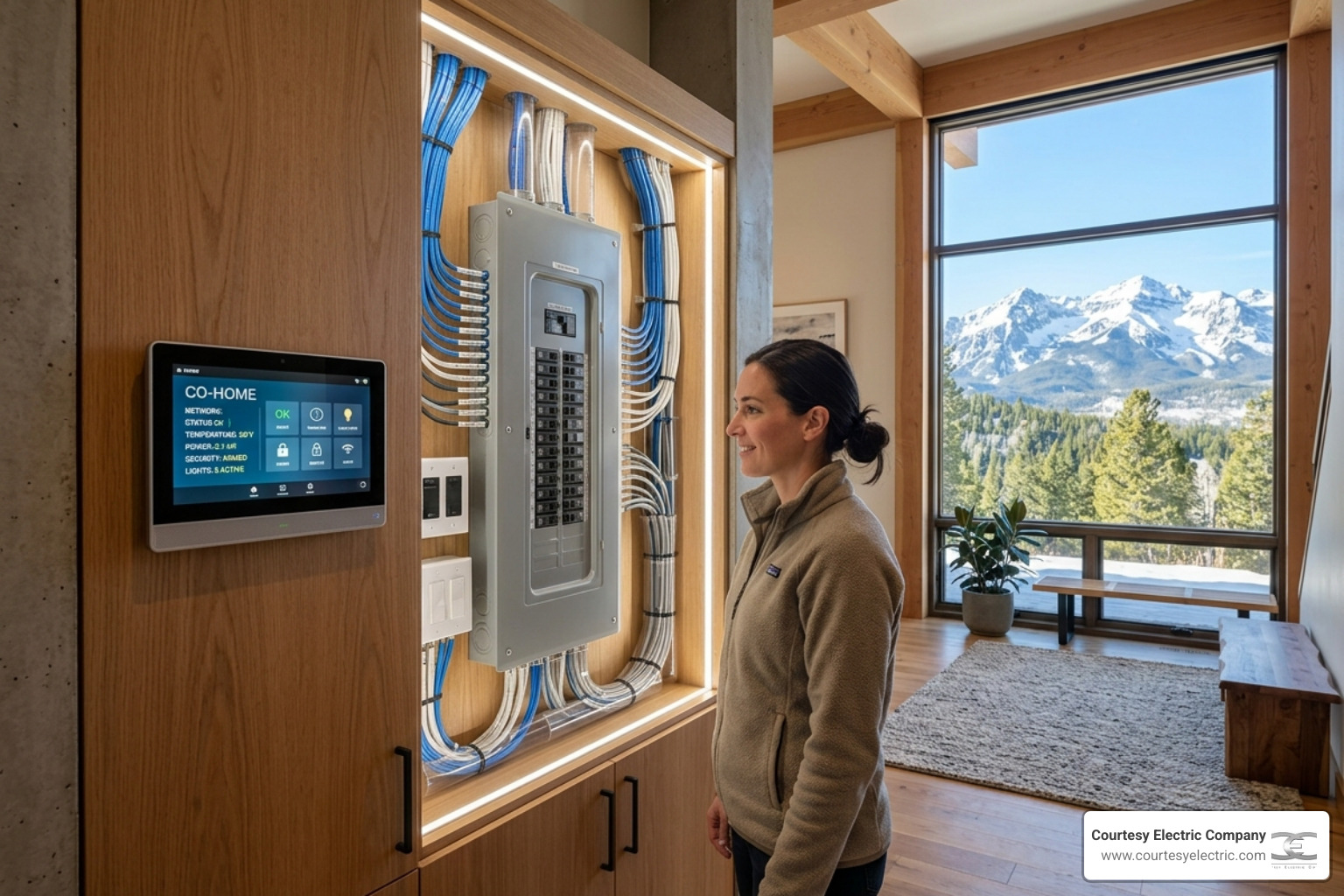
For homeowners, this means peace of mind. Our residential services are built on these repeatable frameworks, ensuring that your home’s "heart"—the electrical panel—is installed with the same accuracy as a medical device or an automotive component. Check out some of our featured projects to see the level of detail we bring to every job.
Scaling Without the Overhead: The Leverage-First Approach
Traditional growth often leads to "bloat"—more managers, more meetings, and more mistakes. Modern "20x companies" (those that produce 20 times the output of their peers) avoid this by using a "leverage-first" approach. They use technology to handle the "table-stakes" activities, allowing their best talent to focus on high-impact work.
This means using smart infrastructure to scale. For example, when building for builders and developers, we don't just add more labor; we add better systems. We use an "audit-to-agent" mindset, where repetitive tasks are automated or streamlined, ensuring that our skilled electricians are spending their time on complex problem-solving rather than administrative friction.
Maximizing the Advantages of a Company Built for Scale and Precision Through Technology
We are currently seeing a revolution in "Sovereign Internal Automation." For a company like ours, this involves:
- Smart Panels: Using SPAN panels to give homeowners digital control over every circuit.
- Predictive Analytics: Monitoring system health to catch a failure before it happens.
- Digital Twins: Creating digital maps of electrical infrastructure for large-scale communities to streamline future maintenance.
Real-World Impact Across High-Stakes Industries
The success of the scale-and-precision model isn't theoretical. It’s the reason why companies like Google and Uber reached the S&P 500 in just six years, compared to the 36 years it took legacy giants.
| Feature | Labor-Heavy Model (Traditional) | Leverage-First Model (Modern) |
|---|---|---|
| Growth Method | Linear hiring (more people = more work) | Exponential leverage (systems = more work) |
| Error Rate | High (dependent on individual skill) | Low (dependent on system precision) |
| Response Time | Slow (bureaucratic layers) | Rapid (agile frameworks) |
| Cost Control | Difficult (overhead grows with size) | High (fixed costs spread over volume) |
| Quality | Variable | Consistent and Repeatable |
This model is vital in industries like:
- Automotive: Where precision parts are essential for assembly line speed.
- Medical: Where a 0.01 lb difference in medication measurement can be life-altering.
- Residential Infrastructure: Where we apply these same high-stakes standards to your home.
Our multifamily residential portfolio illustrates this perfectly. Managing the electrical needs of hundreds of families in a single complex requires a level of precision and scale that traditional "man-with-a-truck" operations simply cannot match.
Frequently Asked Questions about Scale and Precision
What is a company built for scale and precision?
It is an organization designed to grow its output and impact through systems, technology, and leverage rather than just adding headcount. It maintains "tight tolerances" in its operations, ensuring that as it grows, the quality of its service remains consistently high.
How does precision manufacturing improve product quality?
By using advanced machinery (like CNC) and software (like CAD), precision manufacturing eliminates the variances found in manual work. This results in fewer defects, better fitment of components, and a more reliable end product.
Why is scalability essential for modern growth?
In a dynamic market like the Colorado Front Range, demand can shift rapidly. Scalability allows a company to adjust its production volumes or service capacity quickly without losing the accuracy or quality that customers expect.
Conclusion
In the end, the advantages of a company built for scale and precision come down to sustainability and trust. Whether you are a homeowner in Parker looking for a reliable backup generator or a developer in Denver planning a new community, you need a partner who won't buckle under the weight of a complex project.
By choosing a partner that prioritizes leverage over labor and precision over guesswork, you ensure that your infrastructure is built to last. At Courtesy Electric, we’ve spent half a century proving that you don't have to choose between a company that is "big enough to handle it" and "accurate enough to do it right." We are built for both.
Ready to see what a precision-scaled electrical partner can do for your next project? Learn more about us and let’s build something durable together.


