How to Choose the Best Low-Voltage Integration Services in Winter Park

How to Find the Best Low-Voltage Integration Services in Winter Park, CO
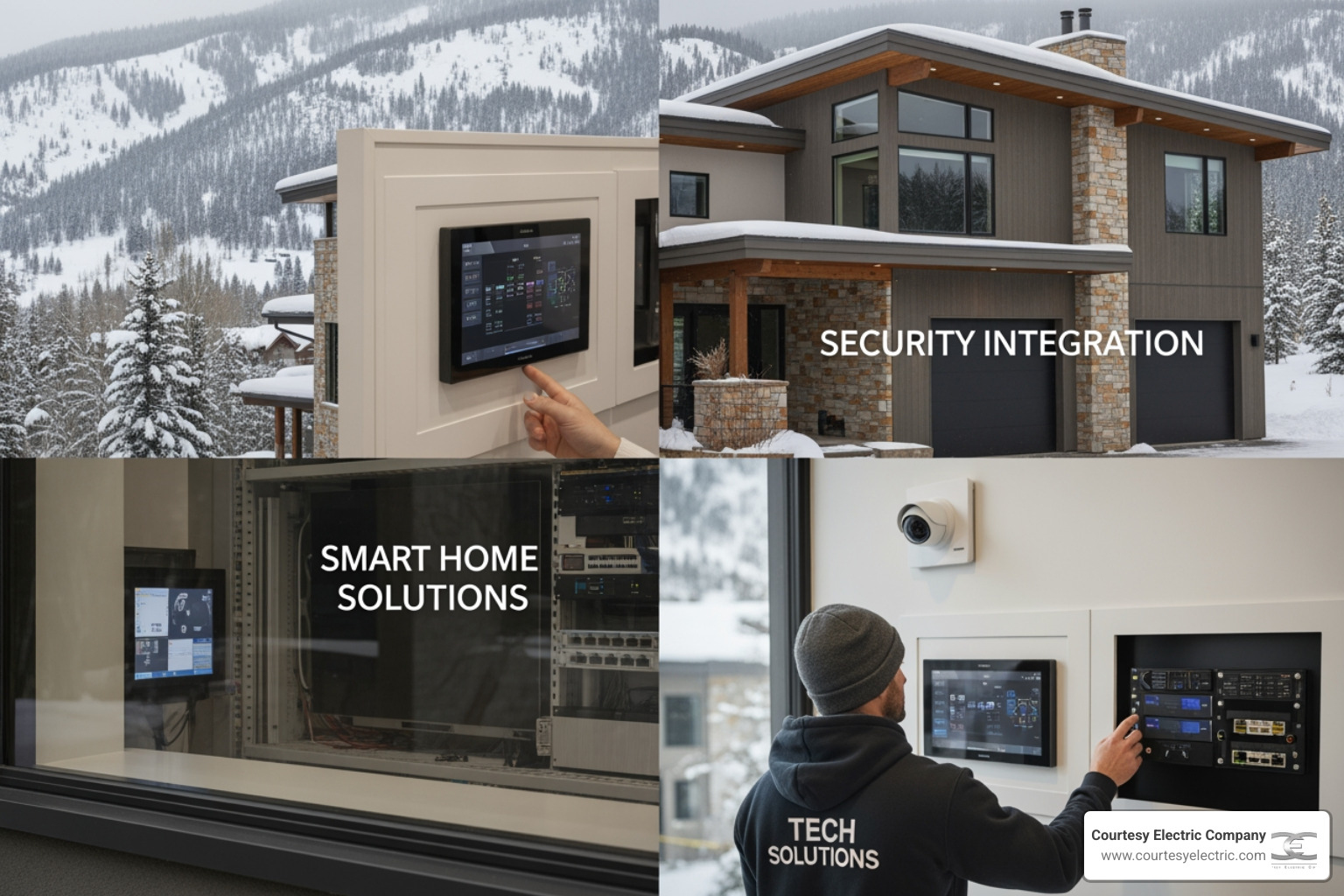
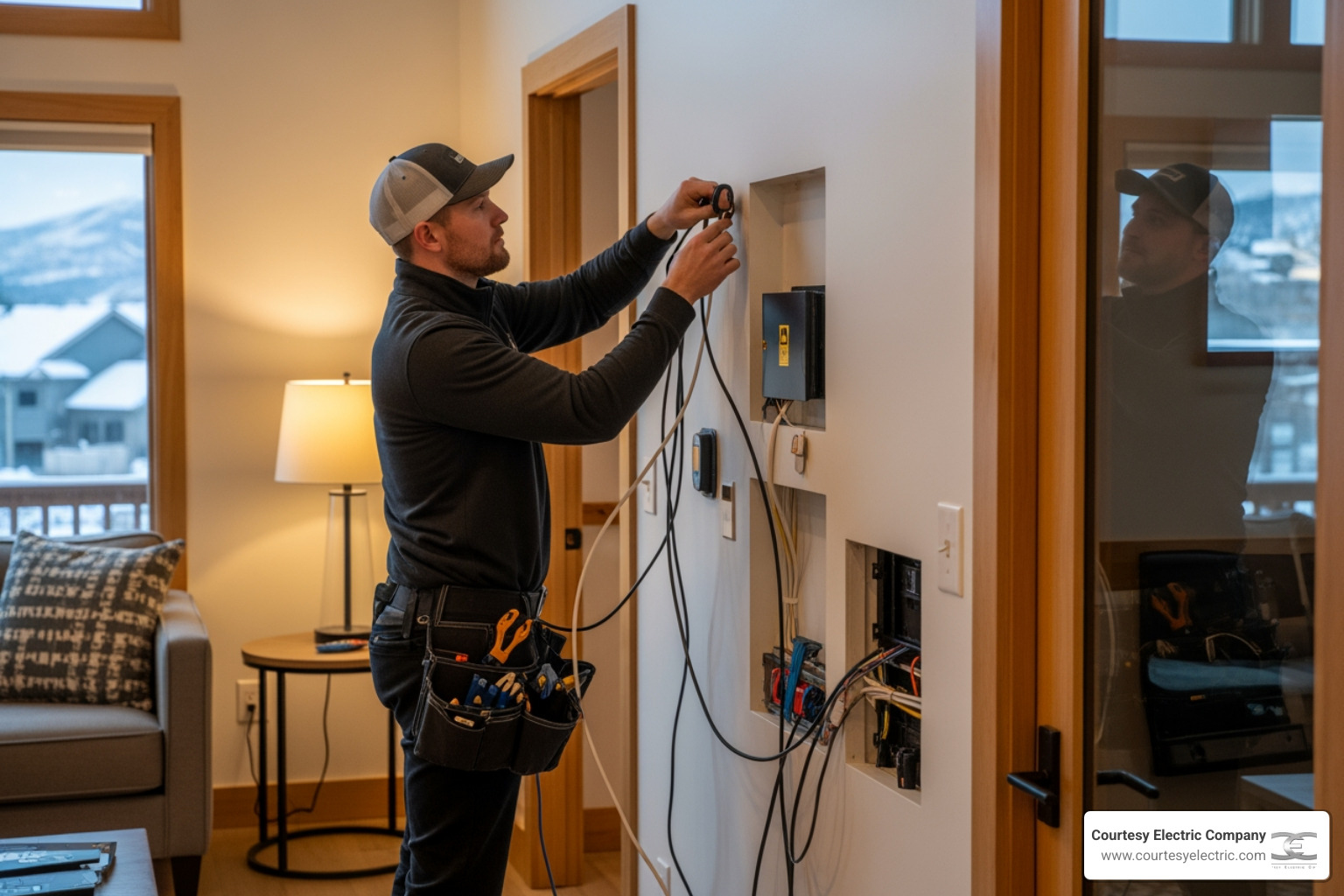
low-voltage integration services Winter Park CO smart home interior - best low-voltage integration services in winter park

The best low-voltage integration services in winter park, co cover a range of systems that make your home smarter, safer, and more energy-efficient. Here's a quick look at what top providers should offer:

  • Smart home automation - Control lighting, climate, audio, and security from one interface
  • Structured wiring and networking - High-bandwidth infrastructure for reliable whole-home connectivity
  • Lighting control - Automated scenes, dimmers, and occupancy sensors
  • Surveillance and security - 4K cameras, video doorbells, motion detection, and remote monitoring
  • Motorized shades - Seasonal energy optimization and UV protection
  • Home theater and multi-room audio - Distributed audio/video throughout your property
  • Climate control integration - Intelligent thermostats and eco-mode automation
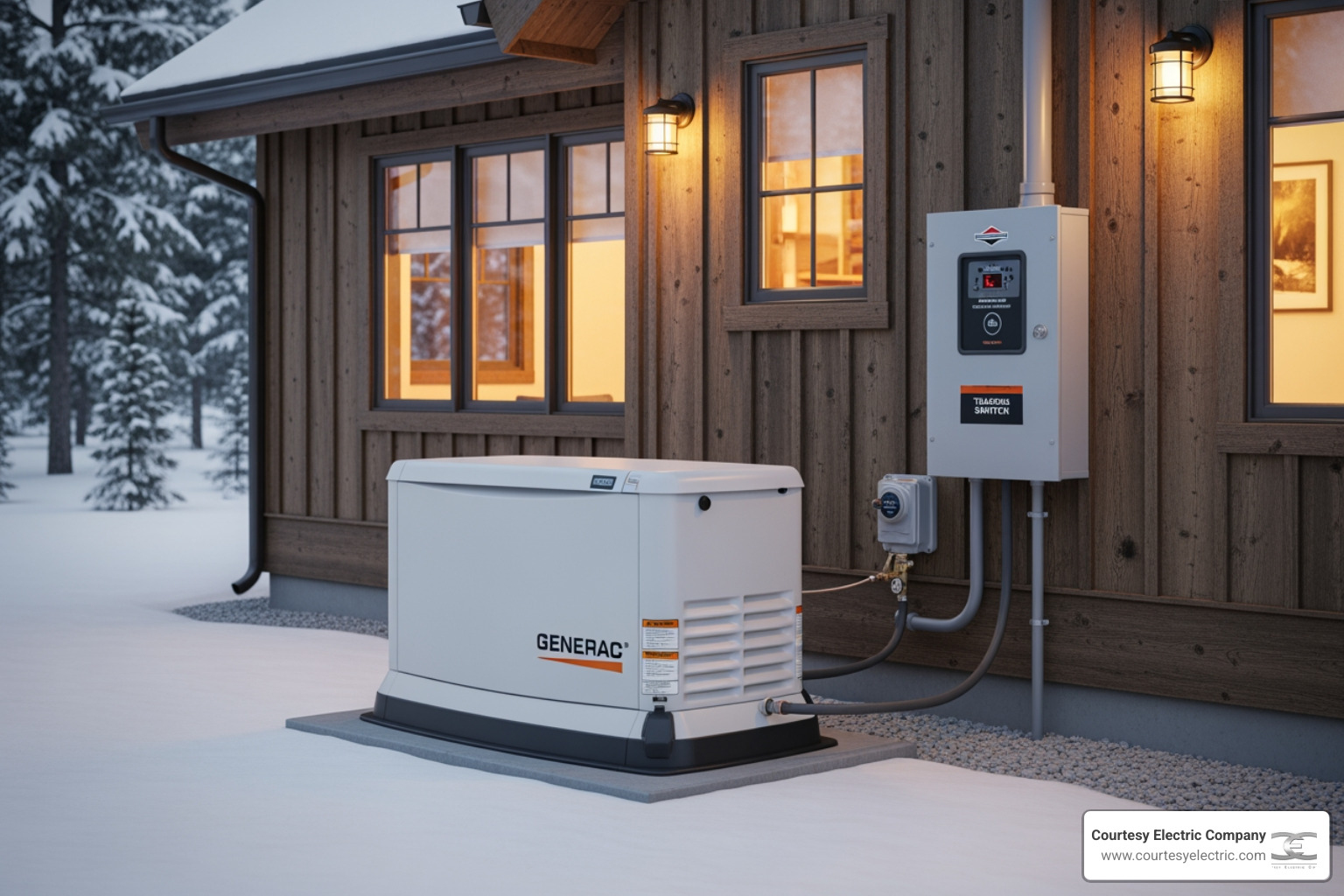
  • EV charger and generator integration - Future-ready power solutions for mountain living

Winter Park homeowners know the challenges that come with mountain living. Power outages are real. Winters are long and unpredictable. And older homes weren't built with today's connected technology in mind. That gap between what your home does and what it could do is exactly where low-voltage integration steps in.

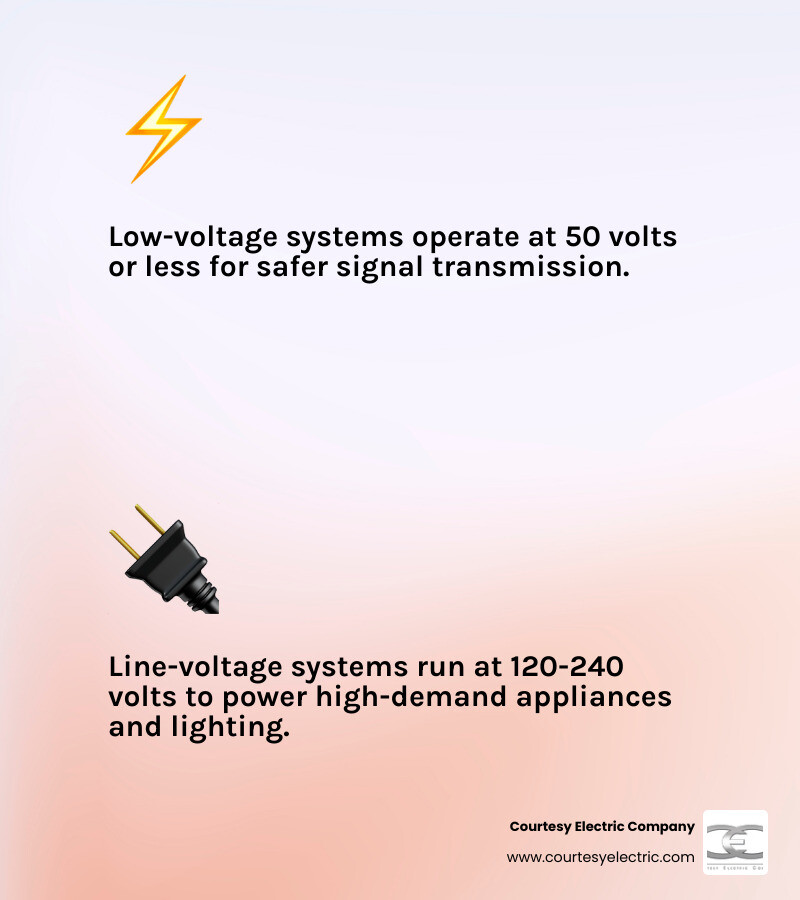
Low-voltage systems run on 50 volts or less. That includes your data cables, security cameras, audio wiring, smart lighting, and more. Unlike standard electrical work, these systems need to talk to each other — and that requires a different kind of planning, design, and installation expertise.

Getting it wrong means dropped signals, unreliable automation, and a system that frustrates instead of simplifies. Getting it right means a home that works for you — quietly, efficiently, and reliably — even in the middle of a Colorado snowstorm.

I'm David Meyer, Vice President of Courtesy Electric, a Colorado electrical contracting company with 50 years of experience powering homes across the Front Range — and I've seen how the right best low-voltage integration services in winter park, co can transform a property. In this guide, I'll walk you through everything you need to know to make a smart, confident choice.
Infographic showing the low-voltage ecosystem: networking, lighting, security, audio, climate, and automation layers - best

Key Features of the Best Low-Voltage Integration Services in Winter Park, CO

When you are hunting for Low Voltage Services in a mountain town like Winter Park, you aren't just looking for someone who can pull a wire through a wall. You are looking for a partner who understands the "ecosystem" of a modern home. Low-voltage integration is the nervous system of your property; it carries the data, signals, and commands that allow your devices to "talk" to one another.

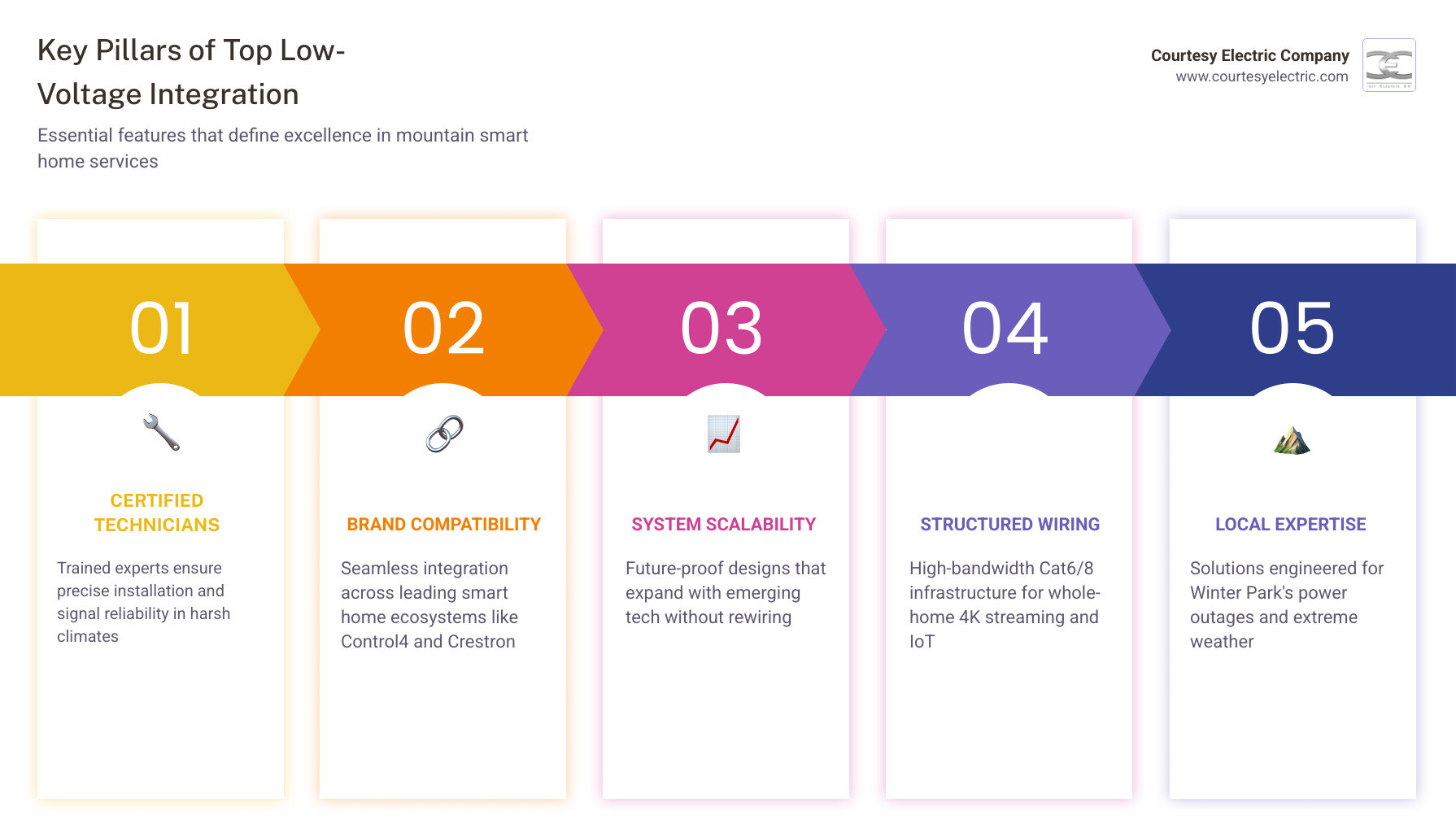
The best providers in the Colorado Front Range distinguish themselves through a few critical pillars:

  • Certified Technicians: The industry moves fast. Top-tier integrators invest in ongoing training for brands like Control4, Lutron, and Crestron. This ensures that the person inside your walls understands the specific nuances of high-end hardware.
  • Brand Compatibility: A great integrator won't force you into a "one-size-fits-all" box. They should be fluent in various ecosystems, ensuring your Nest thermostat plays nice with your Lutron lighting and your Ring cameras.
  • System Scalability: You might only want a media room today, but what about whole-home audio next year? The best services design with the future in mind, installing Structured Wiring that allows for easy expansion without tearing out drywall later.
  • Local Climate Expertise: Winter Park isn't Denver. We deal with extreme cold, heavy snow loads, and frequent power fluctuations. Your low-voltage provider needs to understand how to protect outdoor cameras from ice buildup and how to integrate systems with backup power sources.

Comparison: Wired vs. Wireless Integration

Feature Wired Integration (Structured Wiring) Wireless Integration (Wi-Fi/Zigbee/Z-Wave)
Reliability Extremely high; no signal interference. Subject to dead zones and interference.
Speed Maximum bandwidth for 4K/8K streaming. Dependent on router distance and traffic.
Security Hard to hack; requires physical access. Easier to intercept without strong encryption.
Installation Best for new builds or major renos. Great for retrofitting existing finished rooms.
Scalability Limited by physical ports/cables. Highly flexible; easy to add devices.

Why Professional Expertise Matters for the Best Low-Voltage Integration Services in Winter Park, CO

It is tempting to think that because low-voltage wires won't give you a lethal shock, they are a DIY project. However, professional expertise is about signal integrity. In a large mountain home, a poorly terminated Cat6 cable or a misplaced wireless access point can lead to "buffering" circles that ruin your movie night.

Professional integrators use custom engineering to map out your home's RF (radio frequency) environment. They ensure that your 4K surveillance cameras aren't hogging all the bandwidth your kids need for gaming or that you need for a Zoom call. Furthermore, choosing a certified pro means you get technical support long after the installation is done. If a software update breaks a connection, you have a "one-call" solution instead of spending your weekend on a support forum.

Maximizing Property Value with the Best Low-Voltage Integration Services in Winter Park, CO

In the Winter Park real estate market, buyers aren't just looking for square footage; they are looking for lifestyle. A home with integrated Lighting Control and a robust security system commands a premium.

  • Modern Amenities: Features like motorized shades that adjust with the sun or a "vacation mode" that mimics occupancy are high-demand "wow" factors.
  • Seamless Aesthetics: Professional integration hides the "spaghetti" of wires. All your gear lives in a centralized, ventilated rack, leaving your living spaces clean and focused on those mountain views.
  • Energy Efficiency: Automated systems can reduce utility bills by ensuring lights and heat aren't running in empty rooms—a major selling point for eco-conscious buyers.

Essential Low-Voltage Systems for Modern Mountain Homes

Living in the Rockies requires a specific set of tools. When we talk about the best low-voltage integration services in winter park, co, we are looking at a suite of systems designed to handle the "mountain lifestyle."

Lighting Control and Motorized Shades

Lighting Control is about more than just dimming the bulbs. It’s about "scenes." Imagine pressing a "Goodnight" button by your bed that turns off every light in the house, locks the doors, and lowers the temperature. In Winter Park, motorized shades are equally vital. During our bright winters, automated shades can lower to protect your furniture from UV damage and provide an extra layer of insulation against the glass, keeping the heat in.

Entertainment: Surround Sound and Multi-Room Audio

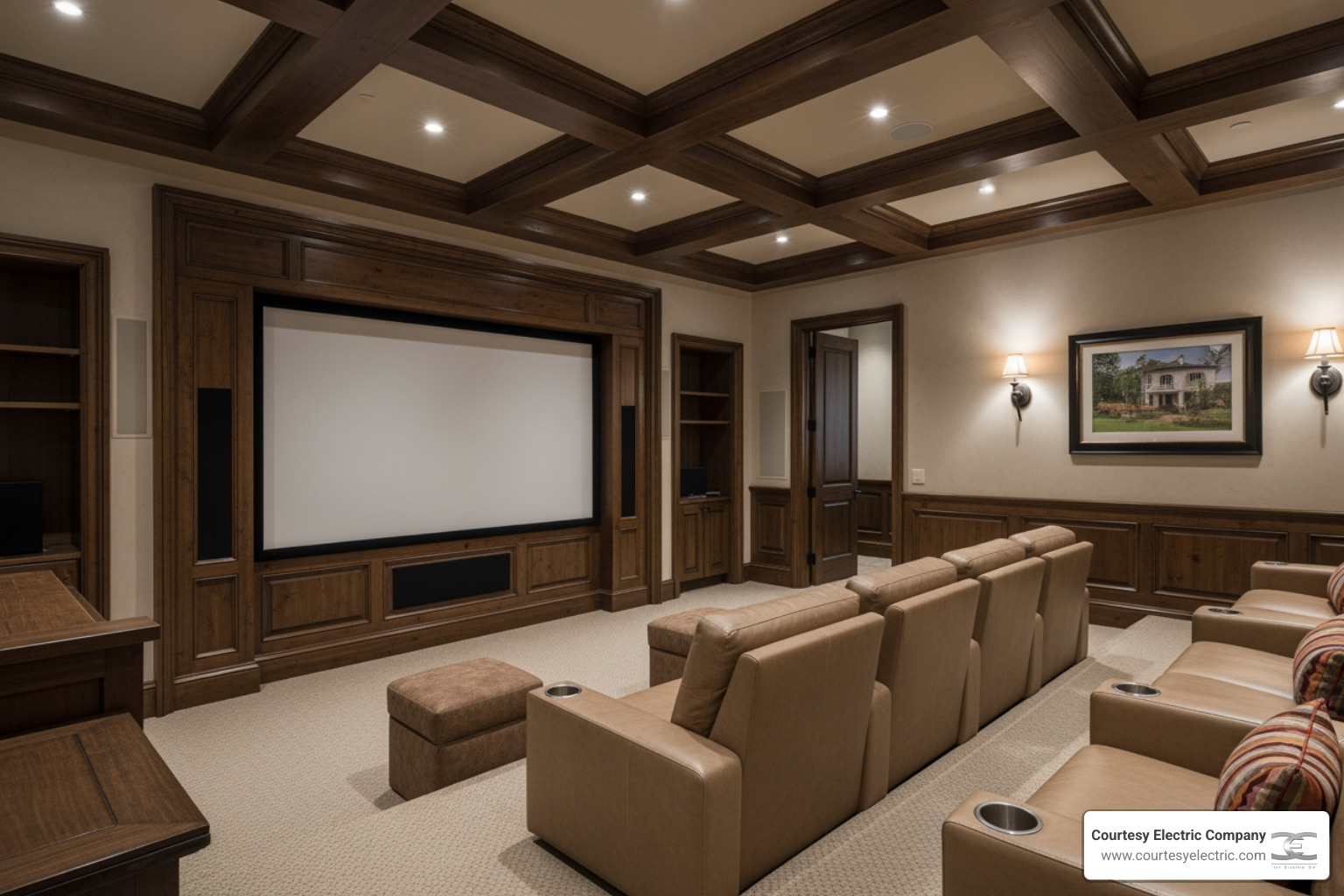
Whether you are hosting a post-ski party or settling in for a blizzard-day marathon, Surround Sound Systems provide the immersive experience that standard TV speakers lack. A professional integrator can set up "zones," allowing you to play jazz in the kitchen while the kids watch a movie in the basement—all controlled from a single app.

Security and Surveillance

Safety is paramount, especially for seasonal residents. Home Security systems today include 4K Ultra HD cameras with "human detection" to distinguish between a prowler and a wandering elk. Integration allows you to view your front door from your phone while you're away in Denver or traveling abroad.

Convenience: Central Vac Systems

One often-overlooked low-voltage hero is the Central Vac System. Instead of lugging a heavy upright vacuum up and down three flights of stairs, you simply plug a lightweight hose into wall inlets. The powerful motor is usually located in the garage or basement, venting dust and allergens completely out of the living space—a huge benefit for those sensitive to high-altitude dryness and indoor air quality.

Common Low-Voltage Components:

  • WAPs (Wireless Access Points): Strategically placed for 100% Wi-Fi coverage.
  • Smart Thermostats: Learning your schedule to save energy.
  • Video Doorbells: Two-way audio for package deliveries.
  • Rack Systems: The "brain" where all networking and A/V equipment is housed.

The Professional Installation and Design Process

The difference between a "guy with a drill" and the best low-voltage integration services in winter park, co is the process. A professional installation follows a structured path to ensure the final result is exactly what you envisioned.

  1. Consultation and Needs Analysis: We start by asking how you live. Do you entertain often? Do you work from home? We walk through every room to determine where you'll need data ports, speakers, and sensors.
  2. CAD Design and Engineering: For new builds or major renovations, we use CAD (Computer-Aided Design) technology to create precise schematics. This includes "rack elevations"—blueprints for how the equipment will be stacked to ensure proper cooling and cable management.
  3. Project Management: We coordinate with your general contractor and interior designer. Low-voltage wiring needs to go in after the plumbing and HVAC but before the insulation and drywall.
  4. System Documentation: You should never be "locked out" of your own home's tech. We provide extensive documentation, including wiring maps and IP address lists, so any future technician (or the next homeowner) knows exactly how the system is built.
  5. User Training: A smart home isn't smart if you can't use it. We spend time with you, setting up your "scenes," teaching you how to use the app, and ensuring you feel confident controlling your environment.
  6. Ongoing Maintenance: Technology needs updates. The best providers offer post-installation support to troubleshoot glitches or upgrade hardware as new standards emerge.

Future-Proofing Your Property with Advanced Integration

Technology doesn't stand still, and neither should your home. One of the biggest trends in the Colorado Front Range is the merging of low-voltage data with high-voltage power management.

Renewable Energy and Battery Storage

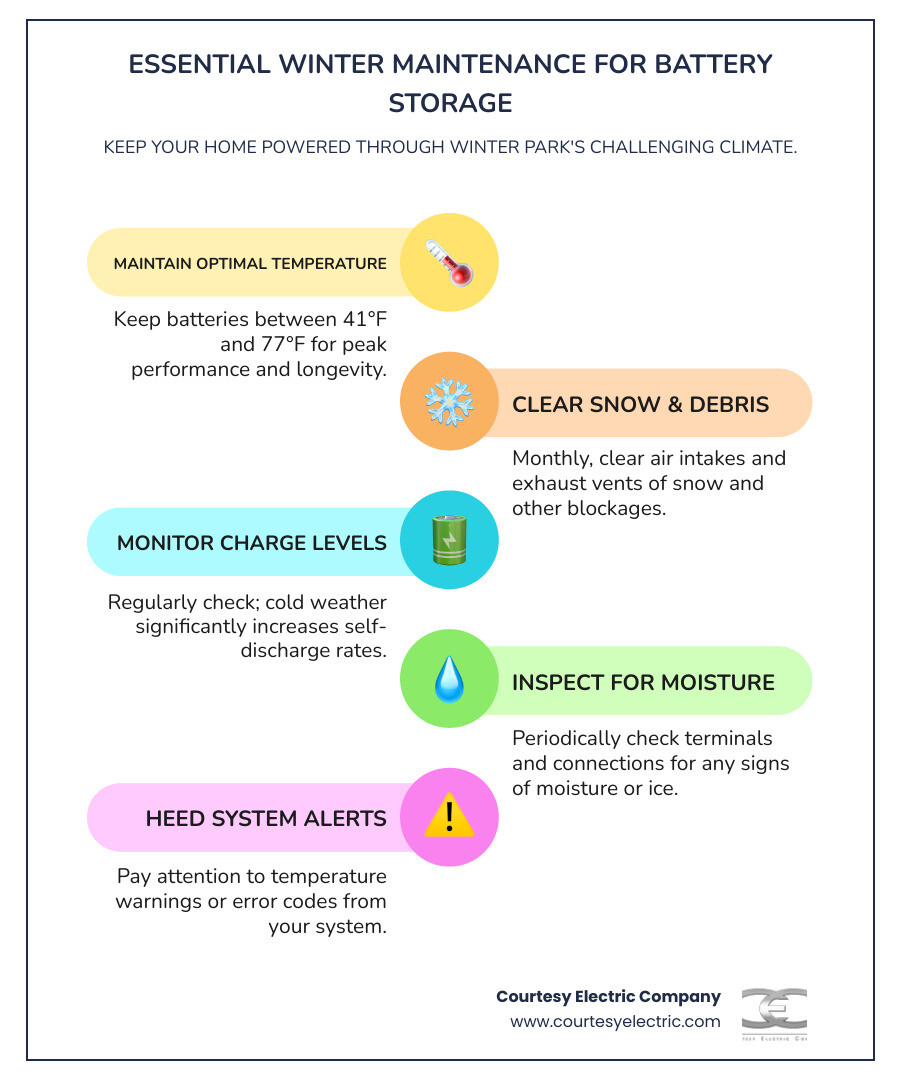
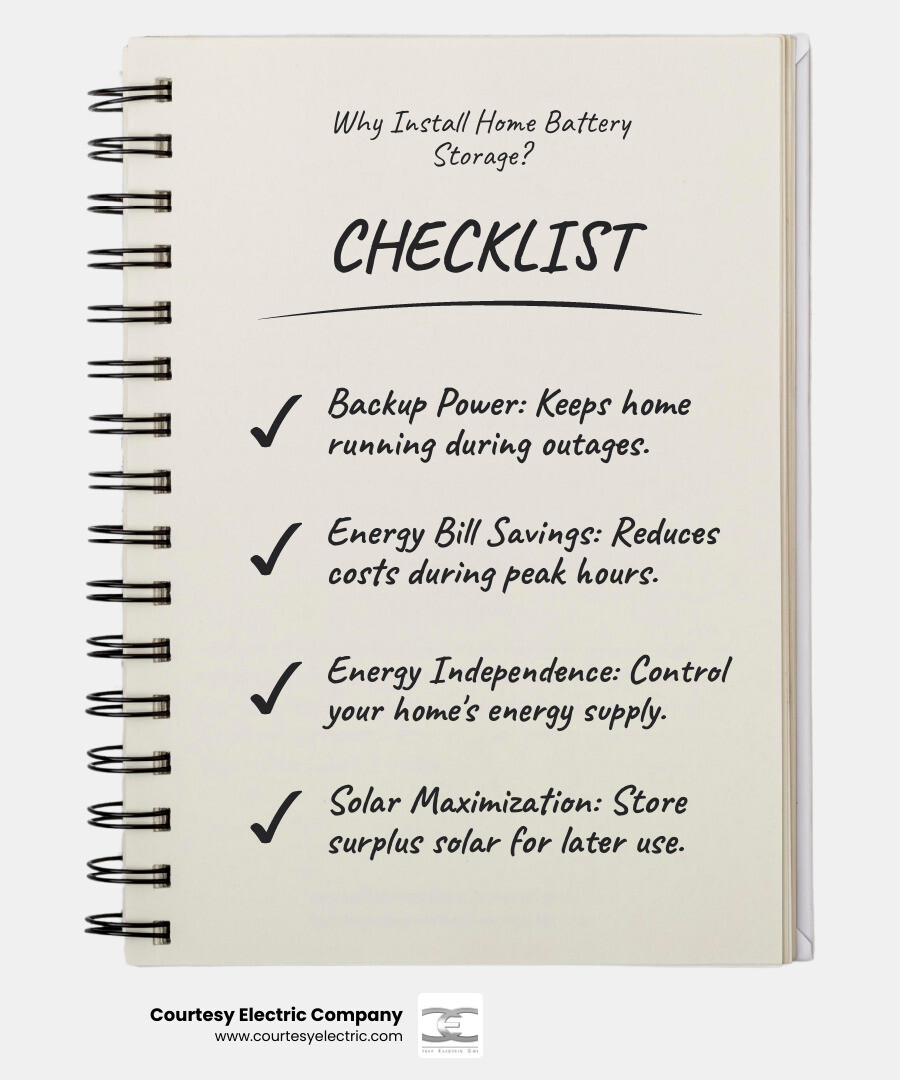
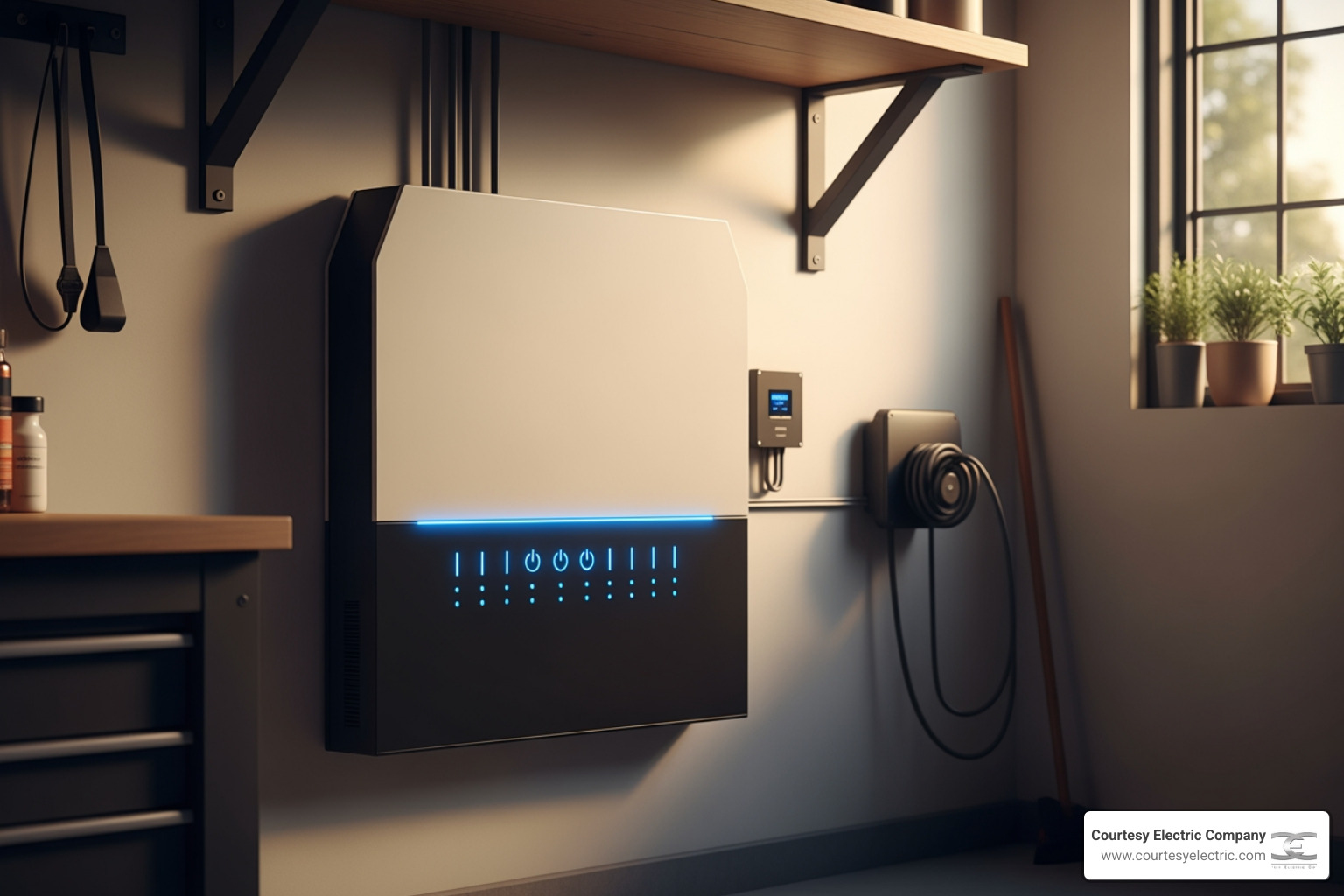
As we move toward a greener grid, integration with systems like Franklin battery storage or Generac generators is becoming standard. By using smart panels like SPAN, you can prioritize which "low-voltage" circuits stay on during a power outage. For example, you might choose to keep your Wi-Fi and security cameras running while shedding the power to the dishwasher. For more on this, check out our Winter Park CO Battery Storage Guide.

EV Charging and Smart Grids

Installing an EV charger is no longer just about the plug; it's about the data. Smart chargers can communicate with your home's energy management system to charge only when rates are lowest or when your solar panels are producing excess power.

AI and Voice Assistants

The next frontier is AI-driven automation. Instead of you telling the house what to do, the house learns your patterns. It notices that when you wake up at 6:00 AM, you like the kitchen lights at 20% and the news playing in the bathroom. A robust, high-speed data infrastructure is the foundation that allows these AI voice assistants (like Josh.ai or Alexa) to function without lag.

Frequently Asked Questions about Low-Voltage Services

Can I upgrade my existing home with low-voltage systems?

Absolutely. While "new construction" is the easiest time to run wires, we have specialized tools and techniques for retrofitting existing Winter Park homes. We can often use a hybrid approach—hardwiring the "backbone" (like your main TV and office) and using high-end wireless solutions for the rest.

How does mountain weather affect outdoor low-voltage installations?

Winter Park's climate is harsh. Outdoor cameras, speakers, and access points must be "weather-rated" (IP65 or higher). We also take care to use UV-resistant cabling for any exposed runs to prevent the intense high-altitude sun from cracking the wire jackets over time.

What is the difference between a standard electrician and a low-voltage integrator?

A standard electrician focuses on high-voltage (120V/240V) to power your appliances and lights. A low-voltage integrator focuses on the control and communication between those devices. While Courtesy Electric handles both, it’s important to ensure your provider has specific expertise in data networking and system programming, as these require a different set of certifications.

Conclusion

Choosing the best low-voltage integration services in winter park, co is an investment in your home’s future and your daily peace of mind. Whether it's the security of knowing your mountain retreat is safe while you're away, the comfort of automated lighting, or the sheer joy of a high-end surround sound system, the right integration makes all the difference.

At Courtesy Electric Company, we bring decades of residential expertise to the Colorado Front Range. We pride ourselves on quality craftsmanship, from the initial CAD design to the final user training. We don't just "install gadgets"—we build reliable systems that stand up to the rigors of mountain living.

If you're ready to transform your property with Low-Volt Integration Services, reach out to us for a consultation. Let’s build a home that’s as smart as it is beautiful.

Finding the Best Low-Voltage Integration Services in Fraser CO

Essential Low-Voltage Systems for Mountain Properties

Smart thermostat interface in a mountain home showing freeze prevention settings - best low-voltage integration services in

When we talk about the best low-voltage integration services in Fraser, CO, we are looking at systems that operate on 50 volts or less. While high-voltage wiring powers your heavy appliances and outlets, low-voltage (LV) systems act as the "nervous system" of your home. In a climate where the average low in January can plummet well below zero, these systems are your first line of defense. They provide the intelligence and communication pathways that allow a modern mountain home to respond dynamically to its environment.

Low Voltage Services in mountain environments prioritize resilience and reliability. One of the most critical integrations for Fraser homeowners is climate control. A smart thermostat isn't just about comfort; it’s about disaster prevention. We integrate systems that provide real-time alerts if your home’s temperature drops below a certain threshold, preventing the catastrophic pipe bursts that plague unmonitored mountain cabins. This is especially vital for part-time residents who may not be on-site to notice a furnace failure during a blizzard.

Furthermore, Lighting Control plays a dual role in energy efficiency and security. By automating your lights, you can simulate occupancy while you are away in Denver or traveling, which is a proven deterrent for intruders. For those dealing with heavy snowfall, low-voltage sensors can even trigger snow-melt systems for driveways and gutters, ensuring your property remains accessible and preventing ice dams from forming on your roof. These automated responses reduce the physical burden of mountain homeownership and protect the structural integrity of the building.

To truly future-proof a mountain property, many residents are looking toward energy independence. Our Battery Storage Fraser CO Complete Guide highlights how integrating low-voltage monitoring with battery systems allows you to manage your power usage during peak times or outages, ensuring your critical systems—like your Wi-Fi and security—never go dark. This level of integration ensures that even when the grid fails, your home's "nervous system" remains fully operational.

Best Low-Voltage Integration Services in Fraser, CO for Security

For many in Grand County, their Fraser home is a cherished second property. This makes Home Security and remote monitoring the cornerstone of any low-voltage project. Modern security is no longer just a loud siren; it is a fully integrated ecosystem of CCTV, access control, and smart sensors that can be managed from anywhere in the world.

When choosing between wired and wireless security, we often recommend a hybrid approach for mountain homes to account for the unique topography and construction materials used in the region.

Feature Wired Integration Wireless Integration
Reliability Extremely high; no signal interference Dependent on Wi-Fi strength
Maintenance Low; no batteries to change High; batteries drain faster in cold
Installation Best for new builds or renovations Best for quick retrofits
Security Cannot be "jammed" easily Vulnerable to signal interference

High-definition CCTV allows you to check snow loads on your deck or verify a delivery from your smartphone. Access control—such as smart locks and video doorbells—allows you to grant temporary entry to maintenance crews or guests without ever needing to hide a key under a rock (which, let's be honest, everyone knows about). This digital gatekeeping provides peace of mind, knowing exactly who is entering your property and when.

Advanced Entertainment and Utility Integration

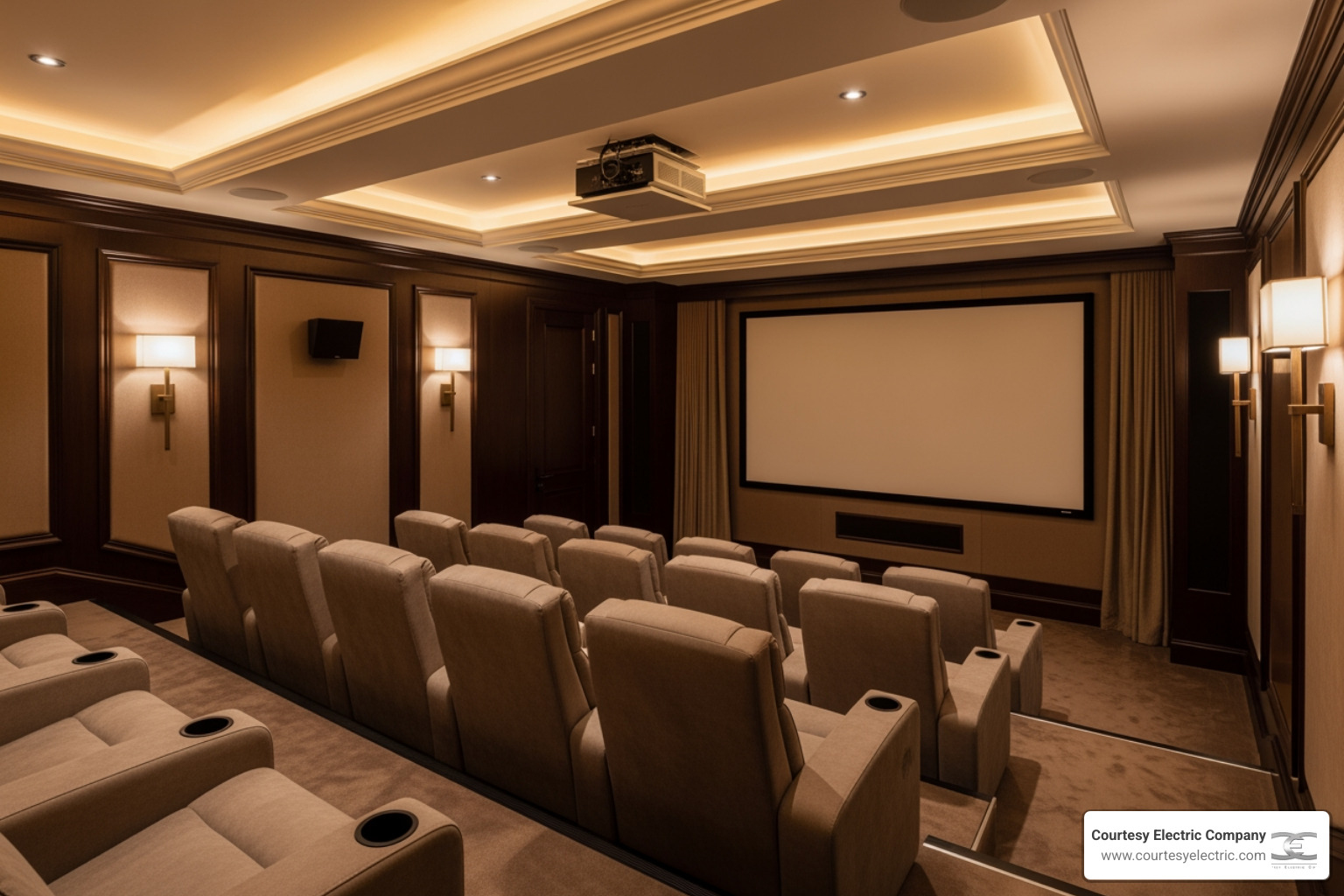
Custom home theater setup in a luxury Fraser mountain home - best low-voltage integration services in fraser, co

Beyond safety, the best low-voltage integration services in Fraser, CO are about enhancing your lifestyle and the overall enjoyment of your mountain retreat. After a day at Winter Park Resort, there is nothing like retreating to a home with professional Surround Sound Systems. We design these systems to be "invisible," with in-wall speakers and hidden cabling that doesn't distract from your mountain views or the natural aesthetic of your interior design. Whether you are hosting a gathering or enjoying a quiet movie night, the audio quality should be immersive without being intrusive.

Utility integration also includes often-overlooked systems like Central Vac Systems. These are particularly popular in the mountains because they vent dust and allergens outside the living space—a major plus for those sensitive to the dry, high-altitude air. By removing fine particles from the home rather than recirculating them, these systems contribute to a much healthier indoor environment, which is essential when homes are sealed tight against the winter cold.

Proper integration starts with structured cabling. This is the "backbone" of your home's tech. By installing high-quality data cabling and fiber optics during a renovation or build, you ensure that every room has a stable connection. This infrastructure is what allows your smart home to grow and evolve as new technologies emerge. If you are planning a large-scale project, following Battery Storage Installation Fraser CO Tips will help you coordinate your entertainment and utility loads so your backup power isn't drained by non-essential electronics during a storm, keeping your most important devices running longer.

Optimizing Best Low-Voltage Integration Services in Fraser, CO for Connectivity

Fraser’s topography can be a challenge for cellular and internet signals. Part of finding the best low-voltage integration services in Fraser, CO involves optimizing your connectivity. We often install signal boosters and wireless enhancements to ensure that "dead zones" don't exist in your home, regardless of how thick your log walls or stone fireplaces may be.

In today's market, a smart home ecosystem is only as good as its internet infrastructure. We recommend a robust networking setup that can handle the high bandwidth required for 4K streaming, remote work video calls, and dozens of smart home devices running simultaneously. This infrastructure also supports your backup systems. As detailed in our Generators Fraser CO Complete Guide, a connected generator can send status updates directly to your phone, letting you know the moment your home has switched to backup power during a blizzard. This connectivity ensures you are never left in the dark about your home's status, even if you are hundreds of miles away.

Choosing the Best Low-Voltage Integration Services in Fraser, CO

When selecting an integrator, technical standards matter. In low-voltage AC (LVAC) and protection systems, precision is key. For example, professional installations should consider lighting levels—aiming for a maintained illuminance of 400 lux in utility or control rooms to ensure safe maintenance. This level of brightness is critical when technicians need to identify color-coded wiring or read small labels on a control board during a service call.

We also pay close attention to the "unseen" details that ensure long-term safety and performance:

  • Earthing Systems: Using earthing conductors with a cross-section of no less than 70mm² for metalwork to ensure safety and code compliance. This is a vital step in protecting your sensitive electronics from power surges.
  • Cable Containment: Ensuring minimum 600mm wide apertures for high-level cable containment in utility areas to allow for future expansion. This prevents the "spaghetti" of wires often found in poorly planned homes.
  • Environmental Control: Maintaining internal temperatures between 15°C and 30°C and relative humidity (RH) between 20% and 75% to protect sensitive electronics from the static-prone mountain air. Dry air can lead to static discharge, which can fry delicate circuit boards if not managed correctly.

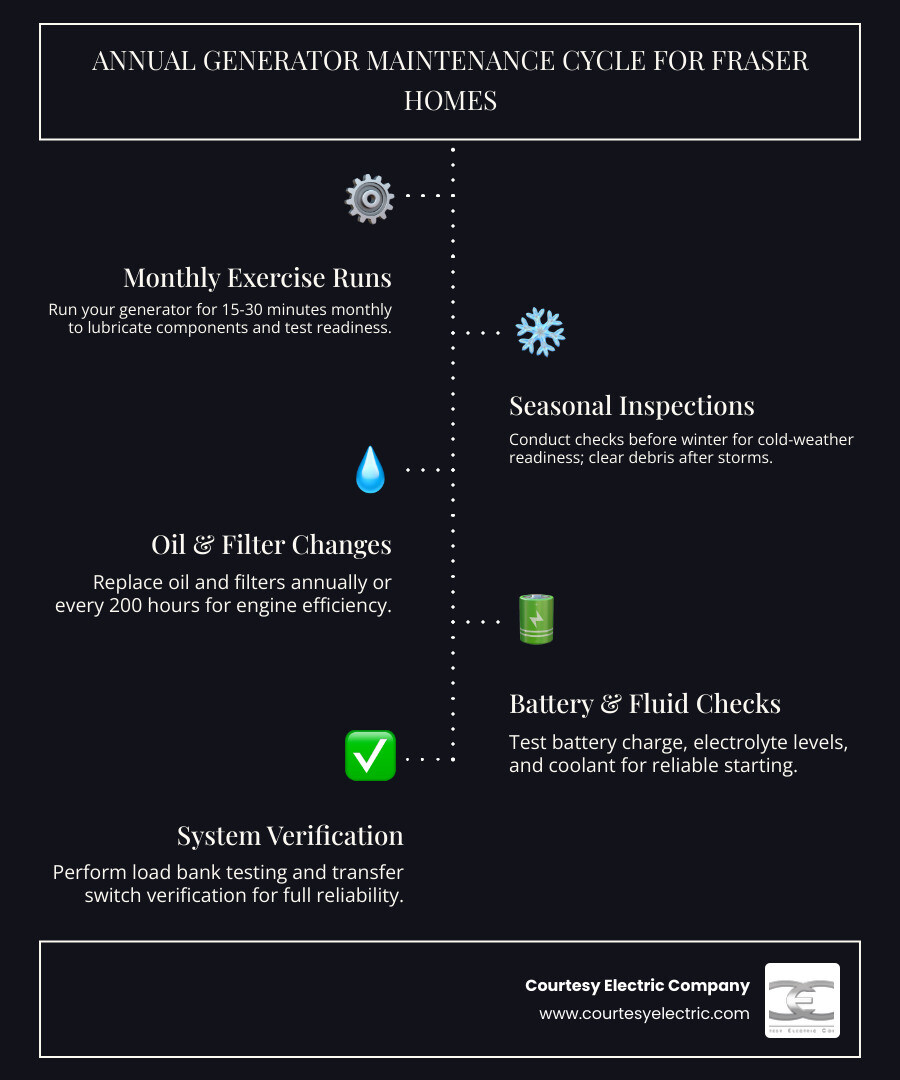
Regular upkeep is also essential. Our Generators Maintenance Guide Fraser CO emphasizes that low-voltage control boards on generators need just as much attention as the engine itself. Whether it’s a new Generators Installation in Fraser CO or a retrofit of an existing system, the integration must be seamless to be effective and reliable.

The future of the best low-voltage integration services in Fraser, CO is increasingly driven by Artificial Intelligence and advanced software. We are seeing a rise in "Embedded iPaaS" (Integration Platform as a Service), which allows different smart devices to talk to each other more fluently. Imagine a home that checks the weather forecast and automatically adjusts your heating, lowers your smart shades to retain heat, and tops off your battery storage because a winter storm warning was issued. This proactive approach to home management is becoming the new standard for luxury mountain living.

Smart panels, like the SPAN panel, are also revolutionizing how we handle low-voltage integration. These panels allow you to control every circuit in your home from an app, making it easy to prioritize essential loads (like your well pump and fridge) over non-essential ones during an outage. Paired with EV charging integration, your home becomes a sophisticated energy management hub that can adapt to your needs in real-time, providing both efficiency and security.

Frequently Asked Questions about Low-Voltage Integration

What are the best low-voltage integration services in Fraser, CO for second homeowners?

For second homeowners, the "Big Three" are remote access, security, and freeze prevention. You want a system that allows you to monitor your Home Security from anywhere in the world and adjust your lighting and temperature to ensure the home looks occupied and stays warm enough to protect the plumbing. Having a single interface to manage these systems is key for ease of use.

How does the mountain climate affect low-voltage wiring?

Fraser’s extreme temperature swings and dry air can be tough on electronics. Proper insulation standards and moisture protection for outdoor sensors and cameras are vital. Our Low Voltage Services are designed specifically to withstand these conditions, using weather-rated enclosures and high-quality cabling that won't become brittle in the cold. We also account for the high UV index at 8,500 feet, which can degrade standard plastic casings over time.

Can low-voltage systems integrate with backup power?

Absolutely. In fact, they should. By working with the Best Generators Services in Fraser CO, you can set up smart load management. This ensures that when your generator kicks on, your low-voltage systems—like your Wi-Fi and security cameras—are prioritized so you never lose visibility of your property during a power failure. This integration is what separates a basic backup plan from a truly smart home.

Is it possible to retrofit low-voltage systems into an older mountain cabin?

Yes, while it is easiest to install these systems during construction, there are many advanced wireless and hybrid solutions available for retrofitting. We can often use existing pathways or discreetly run new cabling to bring modern security, networking, and climate control to older properties without compromising their rustic charm.

Conclusion

Finding the best low-voltage integration services in Fraser, CO means finding a partner who understands both the technology and the unique challenges of Grand County living. At Courtesy Electric Company, we bring decades of experience to every project, ensuring that your residential electrical systems—from the infrastructure in your walls to the smart tech on your phone—are installed with the highest quality and care. Our deep understanding of the local climate and terrain allows us to build systems that last.

Whether you are building a new custom home or modernizing a classic mountain cabin, we are here to help you navigate the complexities of low-voltage integration. From SPAN panels and EV chargers to whole-home audio and advanced security, our team provides the reliable solutions you need for peace of mind at 8,500 feet. Ready to upgrade your mountain home? Contact us today for a consultation on our Low Voltage Services and see how we can make your Fraser property smarter, safer, and more efficient.

Granby Low-Voltage Systems: From Installation to Maintenance

Why Low-Voltage Integration Installation in Granby, CO Is Essential for Modern Mountain Homes

low-voltage integration installation in granby, co

Low-voltage integration installation in Granby, CO covers a broad range of home and business technology systems — all running on 50 volts or less. Here's a quick look at what that includes:

  • Audio-video systems – home theaters, distributed speakers, 4K video
  • Data and network cabling – structured wiring, fiber optics, Wi-Fi mesh
  • Security systems – cameras, smart locks, motion sensors, access control
  • Smart home automation – lighting control, climate management, and centralized hubs
  • Intercoms and gate controls – whole-property communication

These systems work together behind the scenes — wired quietly through walls and ceilings — to make your home safer, smarter, and more connected. For homeowners near ski areas like Winter Park and Breckenridge, or anyone managing a seasonal property in Grand County, that kind of reliable integration isn't a luxury. It's becoming a practical necessity.

Granby presents some real challenges that don't exist in lower-elevation cities. Harsh winters, remote terrain, signal interference from mountain geography, and aging property infrastructure all make low-voltage installation more complex here than in metro areas. Add in local utility requirements and Grand County building codes, and it's clear that getting this right takes more than just plugging things in.

I'm David Meyer, Vice President of Courtesy Electric, a Colorado electrical contracting company with 50 years of experience powering homes and infrastructure across the state — including the kind of low-voltage integration installation in Granby, CO that modern mountain homeowners depend on. In this guide, I'll walk you through everything from the basics of these systems to what it takes to install and maintain them in Granby's unique environment.

Infographic comparing low-voltage and line-voltage systems side by side: left panel shows low-voltage systems including audio-video, security cameras, network cabling, smart home automation, and intercoms with a label of 50 volts or less; right panel shows line-voltage or standard electrical systems including outlets, appliances, HVAC, and lighting at 120 to 240 volts; center column highlights key differences in safety, installation requirements, licensing, and typical use cases in a mountain home setting - low-voltage integration installation in granby, co infographic 2_facts_emoji_light-gradient

Understanding Low-Voltage Integration Installation in Granby, CO

When we talk about "integration," we aren't just talking about running a few wires for a TV. We are talking about creating a cohesive digital ecosystem where your devices talk to one another. In a place like Granby, where homes are often tucked into valleys or perched on ridges, this infrastructure is the "nervous system" of the property.

True system synergy happens when your Low-Volt Services are planned from the ground up. Instead of having five different apps for five different gadgets, integrated technology uses smart home hubs to centralize control. This residential infrastructure ensures that your Wi-Fi doesn't drop out when you're in the basement and your security cameras don't lose their feed during a blizzard.

Core Components of Low-Voltage Integration Installation in Granby, CO

A comprehensive installation usually touches several "pillars" of home technology:

  • Audio-Video Systems: This includes everything from immersive Surround Sound Systems in the living room to hidden speakers on the deck.
  • Data Communications: The backbone of the home. We use high-grade Ethernet (Cat6 or Cat6A) to ensure high-speed internet reaches every corner.
  • Security and Safety: Modern Home Security integrates smart cameras, glass-break sensors, and smoke detectors that can alert your phone instantly.
  • Intercoms and Access: Great for large mountain estates where you need to see who is at the front gate or call the kids for dinner from the other side of the house.
  • Climate Control: Smart thermostats integrated into the low-voltage network allow you to pre-heat the house before you drive up from Denver.

Essential Connectivity for Mountain Properties

Granby’s geography is beautiful, but it can be a nightmare for wireless signals. Thick logs, stone fireplaces, and metal roofs — common in Rocky Mountain architecture — act as shields against Wi-Fi.

To combat this, a professional ISP Hookup involves more than just plugging in a provider's modem. We look at network cabling and fiber optics to create a "hardwired" foundation. Using Wi-Fi 6 mesh systems and signal boosters, we can ensure seamless roaming. This is especially vital for remote access; if you are managing a rental near Winter Park from afar, you need to know that your smart locks and cameras are always online.

Installing low-voltage systems in Grand County isn't a "wild west" scenario. There are strict building codes and National Electrical Code (NEC) standards that must be met to ensure safety and insurance compliance.

Feature Indoor Low-Voltage Wiring Outdoor Low-Voltage Wiring
Cable Rating CL2 or CL3 (General Purpose) Direct Burial (DB) or UV-Rated
Protection Within wall cavities or J-hooks Conduit (PVC or Rigid) recommended
Moisture Resistance Standard High (Gel-filled or Water-block)
Temperature Range Controlled Extreme (-30°F to 90°F+)

Following local utility guidelines is also critical. Before any trenching for outdoor lighting or gate controls, calling 811 for utility locates is a non-negotiable step to avoid hitting existing power or gas lines.

Adapting to Granby’s Mountainous Terrain and Climate

Granby’s climate is rugged. With frost lines that can reach deep into the soil and winters that see temperatures plummet well below zero, standard "big box store" wiring won't cut it.

We utilize moisture-rated cabling and specialized insulation designed to withstand extreme temperature fluctuations. For outdoor security or landscape lighting, we ensure that every connection point is sealed against snowmelt and ice. If a cable isn't rated for "cold bend" or UV exposure, the high-altitude sun and freezing nights will crack the jacket within a few seasons.

Technical Standards for Local Power Service

When integrating low-voltage systems with the main power grid, we have to be mindful of power quality. Local utility providers have specific standards to ensure stability. For instance, long secondary service runs can lead to voltage flicker — a quick dip in power that can crash sensitive electronics like servers or high-end AV receivers.

Utility guidelines suggest limiting customer-provided underground service to 300 feet to avoid these drops. We also pay close attention to grounding requirements and meter height (typically 4.5 to 5.5 feet above grade) to ensure that your low-voltage tech isn't fried by a surge during a summer lightning storm.

Enhancing Property Value with Integrated Technology

Investing in low-voltage integration installation in Granby, CO isn't just about fun gadgets; it’s about property value. Today’s buyers expect a home to be "smart-ready."

Energy efficiency is a major driver here. By using Lighting Control, you can ensure lights are never left on in empty rooms. Smart thermostats learn your schedule, lowering the heat when you're out on the slopes and raising it just before you return, significantly cutting down on those high mountain heating bills.

Custom Entertainment and Media Solutions

There is nothing quite like watching a movie in a professionally designed space after a day of hiking or skiing. Home Theaters in Granby, CO are popular because they provide a dedicated escape.

We focus on distributed audio and 4K video distribution, which allows you to start a movie in the theater and finish it in the master bedroom. Acoustic optimization is also key — mountain homes with vaulted ceilings and hard surfaces often have "echo" issues. We use low-voltage integration to balance the sound, ensuring every seat is the best seat in the house.

Advanced Security and Surveillance for Seasonal Homes

For many in Granby, their property is a second home. This makes remote monitoring essential. Integrated security systems allow you to check cameras, adjust smart locks for a guest, or receive an alert if a motion sensor is triggered — all from your phone in Denver or beyond. Given the proximity to Winter Park, these systems offer peace of mind that your investment is protected year-round, even when you aren't there to shovel the walk.

The Installation Process and Long-Term Maintenance

A successful installation follows a proven path:

  1. Consultation: We sit down to discuss how you live in your home and what technology you actually need.
  2. System Design: Mapping out every wire, speaker, and sensor.
  3. Rough-in Wiring: Installing the cables while the walls are open (in new builds) or carefully fishing them through (in remodels).
  4. Trim-out Phase: Installing the actual devices, faceplates, and hardware.
  5. Final Programming: Making sure the "brain" of the house works exactly as intended.

Maintaining Low-Voltage Integration Installation in Granby, CO

Maintenance is what keeps a "smart home" from becoming a "frustrating home." In Granby's environment, we recommend:

  • Firmware Updates: Keeping your system's software current to patch security holes and add features.
  • Hardware Cleaning: Dust and pet dander can clog up server fans and camera lenses.
  • Weatherproofing Checks: Inspecting outdoor cameras and sensors every autumn to ensure seals are still tight against the coming snow.
  • Annual Safety Inspections: Checking battery backups and surge protectors to ensure they are ready for summer storms.

Scalability and Future-Proofing Your System

Technology moves fast. That’s why we emphasize "headroom" in our structured wiring. By installing high-bandwidth cables today, we ensure your home can handle the 8K video or ultra-fast internet speeds of tomorrow. We also look at smart panel integration, like SPAN panels, which allow you to manage your home's power loads digitally, making it easy to add things like EV chargers or battery storage later on.

Frequently Asked Questions about Granby Low-Voltage Systems

How does the Granby climate affect outdoor low-voltage wiring?

The combination of deep freezes and intense high-altitude UV rays can degrade standard wire jackets. We use direct burial cables and conduit protection to shield the copper from moisture and physical damage. Cold-weather insulation is also vital so the wires don't become brittle and snap when the ground shifts during the spring thaw.

Can low-voltage integration improve my home's energy efficiency?

Absolutely. Through Lighting Control and automated HVAC scheduling, you can eliminate "phantom" energy use. Occupancy sensors can turn off lights in guest rooms that aren't being used, and energy monitoring tools can show you exactly where your power is going in real-time.

What is the difference between low-voltage and standard electrical wiring?

Standard (line-voltage) wiring is what powers your fridge and microwave, typically at 120 or 240 volts. It requires heavy-duty conduit and strict fire-stopping. Low-voltage wiring (50 volts or less) is designed for signal transmission and data. While it is safer to handle, it requires specialized connectors and a different set of skills to ensure data isn't lost or "noisy" due to interference.

Conclusion

At Courtesy Electric Company, we believe that your home should work for you, not the other way around. Whether you are building a new custom retreat or updating a classic mountain cabin, professional low-voltage integration installation in Granby, CO is the key to a modern, comfortable lifestyle.

From the first wire we pull to the final programming of your home theater, our team brings Rocky Mountain reliability and decades of local expertise to every project. If you're ready to see how Granby Low-Voltage Integration can transform your property, we’re here to help you get connected.

Who is the brightest landscape lighting system contractor in Centennial?

Why Finding the Best Landscape Lighting Services in Centennial, CO Matters for Your Home

landscape lighting centennial co - best landscape lighting services in centennial, co

The best landscape lighting services in Centennial, CO can transform your property after dark — boosting curb appeal, improving safety, and even deterring intruders. In a city known for its beautiful residential pockets and expansive parks, your home's exterior deserves to be seen even after the sun sets behind the Rockies. Professional lighting isn't just about visibility; it's about creating an emotional response and a sense of arrival when you pull into your driveway. Here's a quick look at what top-rated local providers typically offer:

  • Custom design and installation tailored to your home's unique features
  • Pathway and walkway lighting for safety and visibility
  • Architectural and feature lighting to highlight trees, water features, and stonework
  • Repair and replacement of damaged or outdated fixtures
  • Holiday and seasonal lighting with full installation and takedown
  • Energy-efficient LED upgrades and smart lighting integration

Every Centennial home is different. The right lighting service doesn't just place fixtures — it studies your property, considers your landscaping, and creates a cohesive plan that works beautifully night after night. Whether your yard is modest or expansive, professional outdoor lighting extends your usable living space well into the evening while making your home look its best from the street.

I'm David Meyer, Vice President of Courtesy Electric, a Colorado electrical contractor with 50 years of hands-on experience helping homeowners find the right outdoor lighting solutions — including the best landscape lighting services in Centennial, CO. In this guide, I'll walk you through exactly what to look for so you can make a confident, informed choice.

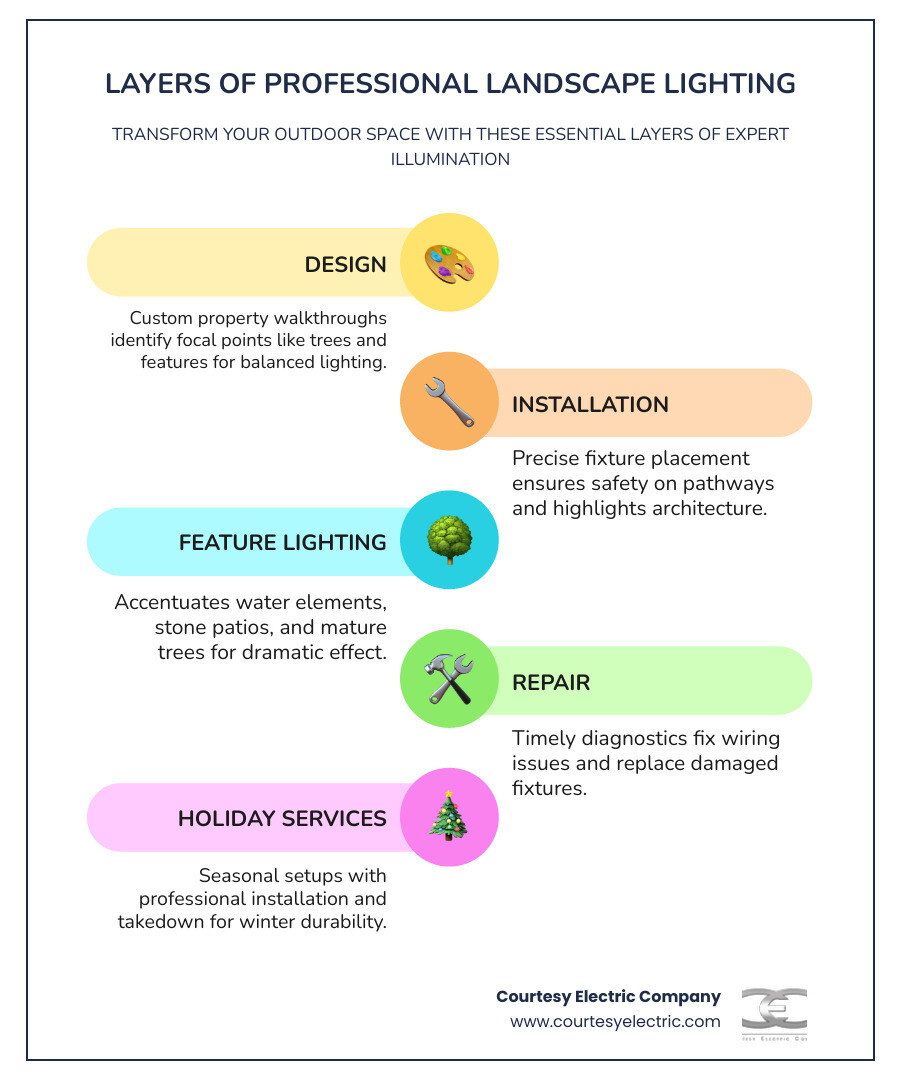
Infographic showing layers of professional landscape lighting: design, installation, feature lighting, repair, and holiday

Essential Features of the Best Landscape Lighting Services in Centennial, CO

When you look at a property that has been professionally illuminated, you don't just see "lights." You see an atmosphere. The difference between a DIY solar stake from a big-box store and professional-grade illumination is night and day. In Centennial, where our landscapes range from the manicured lawns of Willow Creek to the sprawling estates near Piney Creek, the "best" service is one that treats lighting as both a science and an art.

Professional Design and Customization for Unique Properties

The hallmark of a premier lighting contractor is the property walkthrough. We don't believe in "cookie-cutter" kits. A true expert listens to how you use your space. Do you host late-night dinners on the patio? Do your kids play in the yard at dusk? Perhaps you have a specific architectural feature, like a gabled roofline or a custom entryway, that deserves a spotlight.

By identifying focal points—perhaps a majestic Blue Spruce or a custom-built stone pillar—we can determine the exact light intensity needed. It’s all about ambient balance. Too much light and your yard looks like a parking lot; too little, and it feels eerie. We use techniques like "grazing" to highlight the texture of stone walls and "shadowing" to project the interesting shapes of branches onto flat surfaces. Our residential electrical expertise allows us to understand the load requirements of these systems, ensuring that beauty never comes at the cost of electrical safety. We focus on homeowners' lighting needs by selecting high-quality, durable fixtures that can withstand Colorado’s intense sun and heavy snow.

Integrating Lighting with Centennial Landscape Elements

A great lighting design should feel like a natural extension of your landscaping. In Centennial, many of our clients have invested heavily in water features, stone patios, and mature trees.

  • Water Features: Using underwater lights or subtle spotlights can create mesmerizing reflections in ponds or waterfalls.
  • Stone Patios: We often use "down-lighting" from nearby trees or eaves to mimic the soft, intimate glow of moonlight.
  • Walkway Definition: Instead of a "runway" look with perfectly straight lights, we prefer strategic placement that guides the eye while highlighting the texture of the path.

With modern Lighting Control systems, you can manage these zones independently, dimming the architectural lights while keeping the walkways bright for guests.

Comprehensive Outdoor Lighting Solutions: From Installation to Repair

Landscape lighting isn't a "set it and forget it" project. Because these systems live outdoors, they are subject to the whims of Colorado weather. From the hailstorms of June to the deep freezes of January, your system needs to be robust. In Centennial, the freeze-thaw cycle can be particularly brutal on outdoor electrical components. Ground shifting can occasionally pull on buried conduits, and heavy spring snows can weigh down fixtures mounted in trees or along rooflines.

The Importance of Timely Repair and Replacement

We often see systems that have "dipped" in performance. Maybe a few bulbs are out, or perhaps a lawnmower caught a wire. Timely repair is crucial for several reasons:

  1. Safety: Dark spots on stairs or walkways are a trip hazard.
  2. Security: A partially lit home suggests neglect, which can embolden intruders.
  3. Wiring Integrity: Exposed or nicked wires can lead to shorts or even damage your transformer.
  4. Energy Efficiency: Older halogen systems waste a significant amount of energy compared to modern LEDs.

When we provide Electrical Service quality, we perform meticulous inspections to decide if a fixture needs a simple repair or a full replacement. We prioritize moisture protection and precision-driven repairs to ensure your "luminous heartbeat" stays steady.

Seasonal and Holiday Lighting Services in Centennial, CO

Let’s be honest: nobody likes untangling lights in 20-degree weather. Professional holiday lighting is a growing trend in Centennial for a reason—it’s hassle-free. The best services handle everything:

  • Custom Design: Whether you want a classic "warm white" look for your Southglenn home or a colorful display in Foxridge.
  • Professional Installation: No more wobbly ladders. Pros use clips and ties that won't damage your shingles or gutters.
  • Maintenance: If a strand goes out in mid-December, the pros come back to fix it.
  • Takedown and Storage: Once the holidays are over, the lights are removed and stored properly, so they aren't a tangled mess next year. This full-service approach ensures your home remains festive without the physical strain or safety risks of DIY installation.

Why Professional Landscape Lighting is a Smart Investment

Beyond just looking pretty, professional lighting is a functional upgrade to your property. It’s one of the few home improvements that provides an immediate return in both lifestyle and home value. A well-lit home is often perceived as more valuable and better maintained by potential buyers and neighbors alike, creating a lasting impression of quality and care.

Energy Efficiency and Modern Technology

The transition to LED technology has revolutionized the industry. Modern LEDs use about 80% less energy than traditional bulbs and can last for decades. This isn't just about saving on your monthly utility bill; it's about reducing the maintenance burden on the homeowner. When integrated with smart timers and voltage regulation, your system becomes almost entirely autonomous.

For those looking toward the future, we also discuss how these systems interact with your home’s overall energy profile. If you are exploring our Battery Storage Guide Centennial CO, you’ll see that efficient lighting is a key component of a sustainable home. Proper Battery Storage Installation Guide Centennial CO ensures that even during a power dip, your essential security lighting can remain active, providing peace of mind during summer storms or winter outages.

Choosing the Best Landscape Lighting Services in Centennial, CO

How do you separate the experts from the amateurs? Look for these three pillars:

  1. Licensing and Insurance: Never hire an "unlicensed" contractor for electrical work. It puts your home at risk.
  2. Local Experience: Colorado’s soil and climate are unique. You want someone who knows how to bury conduit deep enough to avoid frost heave.
  3. Warranties: A company that stands by its work will offer industry-leading warranties on both fixtures and labor.

At Courtesy Electric, we pride ourselves on our professional standards, ensuring every installation is built to last and complies with all local Centennial electrical codes.

Frequently Asked Questions about Centennial Landscape Lighting

How does landscape lighting improve home security?

Intruders look for "soft targets"—homes with plenty of shadows to hide in. By eliminating dark spots around windows, doors, and side yards, you remove that cover. Motion sensors can be integrated to flood an area with light if movement is detected, acting as a powerful deterrent. Furthermore, a well-lit home signals to the neighborhood that the property is well-maintained and occupied, which is often enough to make a trespasser move on to an easier target.

Can outdoor lighting be integrated with smart home systems?

Absolutely. Most modern systems can be controlled via smartphone apps. You can set schedules, create "scenes" (like a "Party Mode" or "Security Mode"), and even sync your lights with your Home Theaters and tech integration for a seamless indoor-outdoor experience. Imagine your outdoor lights dimming automatically when you start a movie inside, or flashing if an alarm is triggered.

What maintenance does a professional lighting system require?

While low-maintenance, they aren't "no-maintenance." We recommend:

  • Lens Cleaning: Wiping away hard water deposits or dirt to keep the light crisp.
  • Fixture Realignment: Adjusting lights that may have been bumped by pets or landscapers.
  • Pruning: Trimming back plants that have grown over the fixtures.
  • Seasonal Inspections: Checking for any wire exposure or moisture intrusion after heavy snowfalls.

Conclusion

Finding the best landscape lighting services in Centennial, CO doesn't have to be a shot in the dark. By focusing on professional design, high-quality fixtures, and expert electrical installation, you can transform your home into a nighttime masterpiece.

At Courtesy Electric Company, we bring decades of experience to every project, ensuring your outdoor space is safe, beautiful, and energy-efficient. We understand the local codes and the specific environmental challenges of the Front Range, from soil composition to extreme weather patterns. Whether you need a brand-new installation or a repair of an existing system, our team is here to help. Contact us for a consultation today and let's see your home in a whole new light. Visit our Home page to learn more or Schedule your Centennial lighting service today.

Maintenance Tips to Keep Your Fraser Landscape Lighting Shining Bright

Why Landscape Lighting Maintenance Matters in Fraser's Mountain Climate

Fraser landscape lighting at dusk - landscape lighting maintenance in fraser, co

Landscape lighting maintenance in Fraser, CO is essential to keep your outdoor lighting system performing through extreme weather, heavy snowfall, and intense UV exposure at high altitude. Fraser's climate puts unique stress on electrical fixtures—freeze-thaw cycles can crack lenses, snow accumulation can bury or damage lights, and temperature swings can compromise wiring connections. Without regular upkeep, your investment in beautiful outdoor lighting can quickly fade, leaving you with dim, flickering, or completely failed fixtures that reduce both safety and curb appeal.

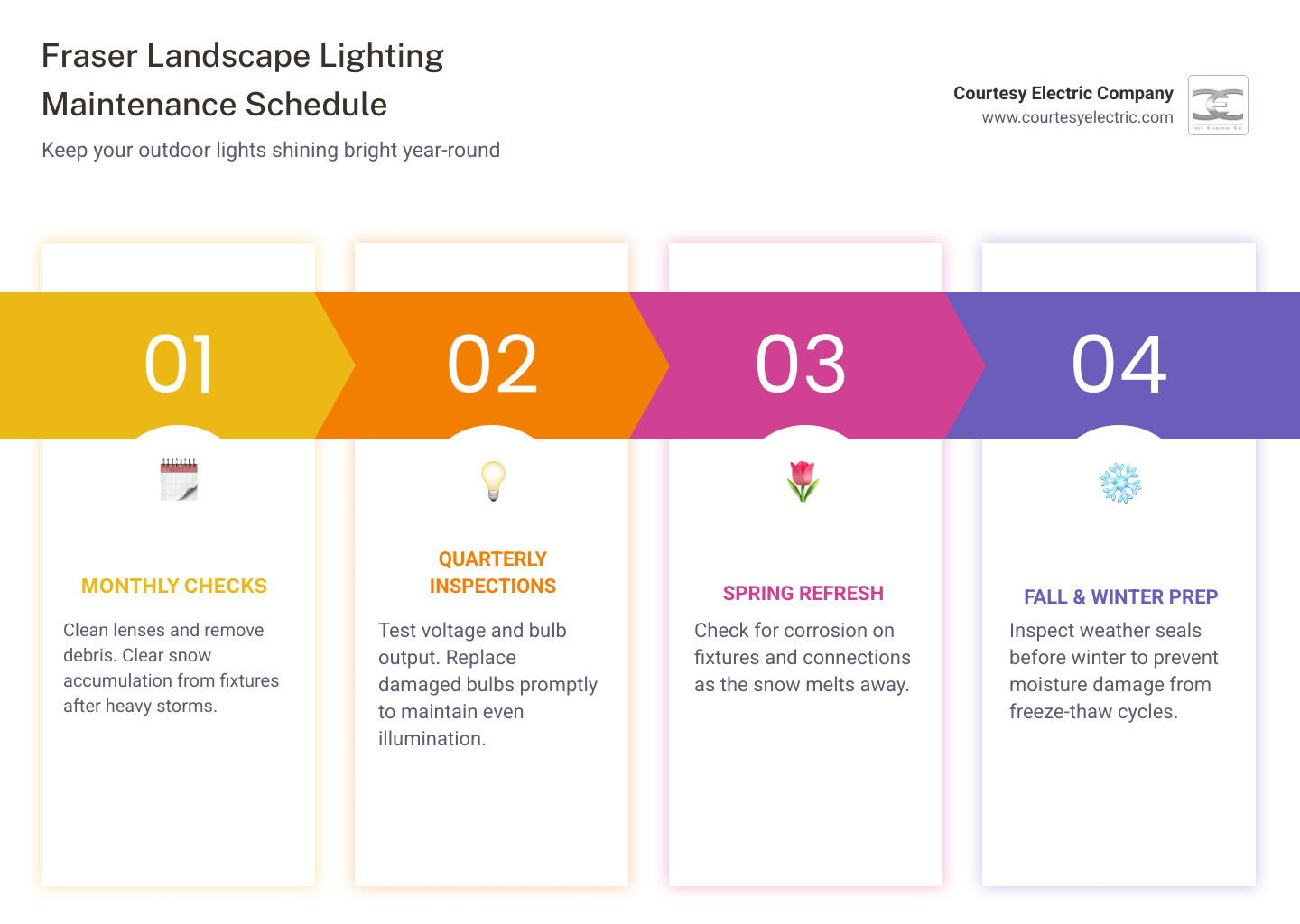
Quick Maintenance Checklist for Fraser Landscape Lighting:

  1. Clean lenses and remove debris monthly during snow season
  2. Inspect weather seals before winter to prevent moisture damage
  3. Check for corrosion on fixtures and connections every spring
  4. Test voltage and bulb output at least twice per year
  5. Clear snow accumulation from fixtures after heavy storms
  6. Replace damaged bulbs promptly to maintain even illumination

Need help with your outdoor electrical systems? Courtesy Electric offers expert residential electrical services to keep your home safe and functional year-round, or contact us for a lighting system evaluation.

I'm David Meyer, Vice President of Courtesy Electric, and over the years I've seen how proper landscape lighting maintenance in Fraser, CO extends system life and prevents emergency repairs during Colorado's harshest months. Understanding the specific challenges of our mountain environment helps homeowners protect their lighting investments and maintain safety through every season.

Infographic showing Fraser landscape lighting maintenance schedule: Monthly tasks include lens cleaning and snow removal; Quarterly tasks include voltage testing and bulb replacement; Seasonal tasks include spring corrosion inspection, fall weather-seal check, and winter snow management - landscape lighting maintenance in fraser, co infographic pillar-4-steps

The Importance of Landscape Lighting Maintenance in Fraser, CO

Maintaining your outdoor lighting in Fraser isn't just about keeping the house looking pretty for the neighbors—though that’s a nice perk! In our high-altitude environment, the elements are constantly working against your electrical components. Fraser is famous for its cold temperatures and significant snow accumulation. When snow piles up on a warm light fixture, it creates a localized freeze-thaw cycle. This moisture can seep into the tiniest cracks, expand as it freezes, and eventually shatter lenses or compromise the internal housing.

Furthermore, the high-altitude UV exposure in Grand County is much more intense than at sea level. This radiation can cause plastic components to become brittle and fade over time. Proper Residential electrical services ensure that your fixtures are made of durable materials, like cast brass, which can withstand these fluctuations far better than cheaper alternatives.

Adhering to local landscape standards means ensuring your property remains safe and accessible. Well-maintained lighting is a primary deterrent for intruders; a dark corner is an invitation, but a well-lit perimeter suggests a home that is occupied and cared for. Beyond security, functional lighting on steps and walkways is vital for preventing slips and falls during our long, icy winters.

Essential Tasks for Landscape Lighting Maintenance in Fraser, CO

To keep your system running at peak performance, we recommend a proactive approach. Regular Electrical Service can catch small issues before they become "I can't see my front door" problems.

Here is a list of essential seasonal tasks for Fraser homeowners:

  • Lens Cleaning: Mineral deposits from irrigation and dust from the dry mountain air can cloud lenses. Wipe them down with a soft cloth and a non-abrasive cleaner to restore brightness.
  • Debris Removal: Pine needles, mulch, and leaves can pile up around fixtures. This isn't just an aesthetic issue; trapped debris holds moisture against the metal and can lead to premature corrosion.
  • Weather-Sealing: Check the gaskets and seals on every fixture. If they look cracked or dry-rotted, they need replacement to prevent snowmelt from entering the socket.
  • Voltage Testing: Over time, wire connections can loosen due to ground shift. Testing the voltage at the furthest fixture ensures the transformer is still delivering the correct power.
  • Fixture Realignment: Snow plows, shovels, and even heavy snow loads can knock lights out of alignment. Re-adjusting the angles ensures you aren't accidentally blinding your neighbors or leaving your walkway in the dark.

For those considering a new setup, following proper installation techniques like using deeper wire trenches can help protect the system from the "heaving" soil common in our region.

Signs Your System Needs Landscape Lighting Maintenance in Fraser, CO

How do you know when it’s time to call in the pros? Your lighting system usually gives off a few "cries for help" before it fails entirely.

  1. Flickering Bulbs: This is rarely just a bad bulb. In Fraser, flickering often indicates a loose connection or a wire that has been nicked by a shovel.
  2. Exposed Wiring: If you see wires poking out of the ground, stop! Soil erosion and frost heave can push wires to the surface. Exposed wires are a trip hazard and are prone to being cut by lawn equipment or chewed by local wildlife.
  3. Dimming Light Output: If your lights look "yellow" or dim, you might have a voltage drop issue or significant corrosion inside the fixture.
  4. Moisture Inside Lenses: If you see fogging or water droplets inside the glass, your seal has failed. This requires immediate professional repair to save the internal electronics.
  5. Tripped Breakers: If your outdoor lighting keeps tripping the GFCI or the main breaker, there is likely a short circuit caused by water ingress.

Maintenance Techniques for Specific Fixture Types

Different lights have different needs. A spotlight pointing at a Douglas fir faces different challenges than a path light buried under a snowbank.

Fixture Type Key Maintenance Focus Fraser-Specific Tip
Spotlights Aiming and Lens Clarity Ensure they aren't buried in "snow storage" areas where plows pile snow.
Uplighting Debris Clearing Remove pine needles from the "well" to prevent heat buildup.
Downlighting Mounting Integrity Check that tree mounts haven't been "grown over" or loosened by wind.
Path Lights Leveling and Height Use extenders if necessary to keep the light head above average snow depth.

When we look at our Featured Projects, we see that the most successful systems are those where the maintenance plan matches the fixture type. For instance, outdoor lighting in mountain towns often uses heavy-duty brass path lights because they can take a hit from a stray snowball without snapping.

Maximizing Efficiency with LED Technology

If you are still using old halogen bulbs, you’re working harder than you need to. One of the best ways to simplify landscape lighting maintenance in Fraser, CO is to switch to LED.

LEDs offer incredible benefits, including:

  • Energy Efficiency: They use up to 80% less energy, which is highly efficient.
  • Heat Reduction: Halogen bulbs get hot enough to bake on mud and mineral deposits, making them harder to clean. LEDs stay cool, which also prevents them from melting holes in the snow and creating ice "igloos" around the fixture.
  • Longevity: A typical LED can last 50,000 hours. In a mountain home, that means you might go years without ever having to climb a ladder to change a bulb.
  • Environmental Impact: Less energy use and fewer discarded bulbs mean a smaller carbon footprint for your mountain retreat.

Professional vs. DIY Maintenance for Fraser Homeowners

We love a good DIY project as much as anyone, but when it comes to electricity and the Fraser climate, there are distinct advantages to hiring a pro.

First, there’s the safety aspect. Working with outdoor electrical systems involves dealing with moisture and ground faults. A professional from Courtesy Electric Company understands the nuances of wiring integrity and how to properly ground a system to prevent shocks.

Second, technical expertise matters. We use specialized tools like voltmeters and wire tracers that most homeowners don't have in their garage. This allows us to find a broken wire underground without digging up your entire lawn.

By choosing professional maintenance, you ensure long-term reliability. We don't just "fix" the light; we look at the whole system to ensure the transformer isn't overloaded and that the timers are adjusted for our specific mountain sunset times. If you're feeling overwhelmed by your outdoor electrical needs, Contact us for help.

Frequently Asked Questions about Fraser Outdoor Lighting

How often should I inspect my landscape lighting in Fraser?

We recommend a thorough inspection twice a year—once in the spring to assess winter damage and once in the fall to prep for the snow. However, a quick monthly "walk-around" at night is a great way to spot burnt-out bulbs or misaligned fixtures.

Does heavy snow damage outdoor light fixtures?

It can. The weight of heavy, wet snow can bend or snap cheaper aluminum fixtures. Additionally, if snow is allowed to sit on a warm fixture, the resulting ice can crack the glass. Using high-quality brass fixtures and clearing snow after major storms is the best defense.

Why are my outdoor lights flickering after a storm?

Flickering after a storm usually means moisture has found its way into a connection point or a fixture housing. It could also indicate that wind has moved a loose wire. It’s best to turn the system off and have an electrician inspect it to prevent a short circuit.

Conclusion

Your outdoor lighting is an investment in your home's beauty and security. In a place as rugged and beautiful as Fraser, your equipment has to be just as tough as the landscape. Regular landscape lighting maintenance in Fraser, CO ensures that your system remains a source of pride rather than a source of frustration.

From protecting your investment to ensuring aesthetic consistency across your property, a little bit of upkeep goes a long way. Whether you need a simple tune-up or a full system overhaul, our Residential lighting solutions are designed to keep your mountain home shining bright, no matter what the Colorado clouds throw at us. Keep those lenses clean, keep those wires buried, and enjoy the magical glow of a well-lit mountain evening!

Don't Be Afraid of the Dark with Fraser's Best Lighting Services

Why Fraser Properties Need Professional Landscape Lighting

landscape lighting in fraser co

Landscape lighting in fraser co transforms mountain properties from invisible after sunset to stunning showcases of architecture and natural beauty. Whether you're looking to improve safety on snowy pathways, highlight your home's unique features, or extend your outdoor living season, professional lighting makes your investment visible 24/7.

Top Fraser Landscape Lighting Services:

  1. Custom Design & Installation - Site evaluation, fixture selection, and professional wiring
  2. LED Technology - Energy-efficient systems rated for high-altitude climate
  3. Architectural Accent Lighting - Uplighting, downlighting, and facade illumination
  4. Pathway & Security Lighting - Motion-activated zones and navigation safety
  5. Smart Controls - Multi-zone systems with smartphone integration
  6. Climate-Rated Materials - Brass and copper fixtures built for temperature swings and snow

For comprehensive electrical solutions beyond outdoor lighting, explore our residential electrical services, or contact us for a consultation on your Fraser property.

Fraser's extreme temperature fluctuations, heavy snowfall, and intense UV exposure demand lighting systems engineered specifically for mountain conditions. Retail-grade fixtures fail within 2-3 years, while professional installations using low-voltage LED technology and weatherproof materials maintain performance for 15-20 years. The difference lies in proper voltage management, copper wiring, hidden connections, and fixtures designed to handle everything from -30°F winter nights to intense summer sun.

I'm David Meyer, and through decades with Courtesy Electric, I've seen how quality landscape lighting in fraser co protects homeowners' investments while creating outdoor spaces they can safely enjoy year-round. My experience powering homes across Colorado has taught me that the right lighting system isn't just about aesthetics-it's about engineering solutions that work when Fraser's weather tests everything.

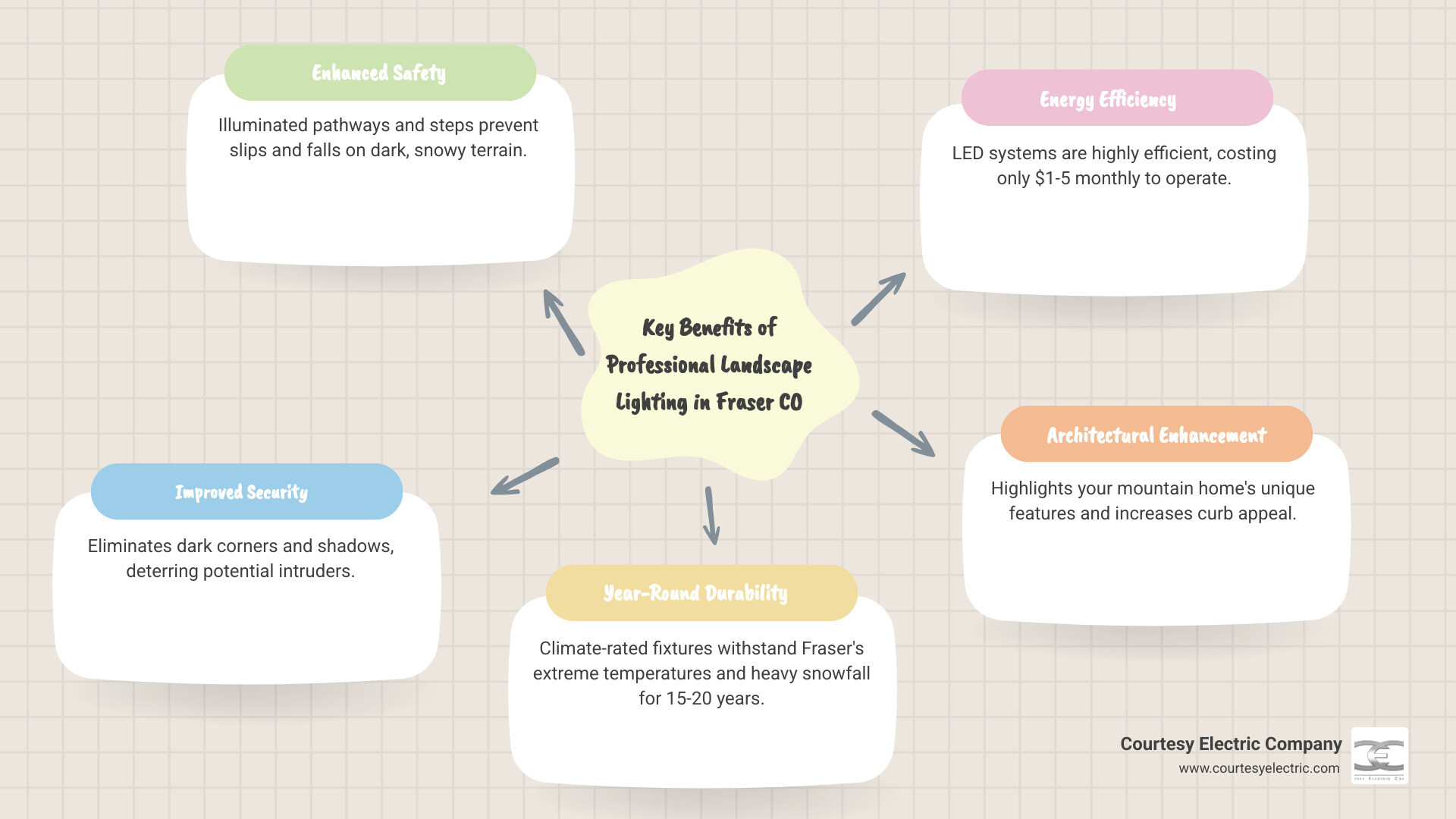
infographic showing the key benefits of professional landscape lighting in Fraser CO including safety enhancement through illuminated pathways and steps, security improvement by eliminating dark corners, year-round durability with climate-rated fixtures lasting 15-20 years, energy efficiency with LED systems, smart control options for multi-zone management, and architectural enhancement highlighting mountain home features - landscape lighting in fraser co infographic mindmap-5-items

The Core Benefits of Landscape Lighting in Fraser CO

When the sun dips behind the Continental Divide, Fraser can get incredibly dark. While we all love the stargazing opportunities our high-altitude home provides, a pitch-black yard can be a bit intimidating—and even a little dangerous. Professional landscape lighting in fraser co isn't just about making your house look like a mountain resort; it's about reclaiming your property after hours.

Safety and Security: Your First Line of Defense

In a town where "Icebox of the Nation" is a badge of honor, we deal with a lot of frozen surfaces. Navigating a dark, icy driveway or a set of stone steps covered in a light dusting of snow is a recipe for a trip to the emergency room. By illuminating walkways, transitions, and stairs, we create a clear path for you and your guests.

Security is another major factor. Most intruders—whether they are of the two-legged variety or the four-legged furry kind (we see you, local bears and moose!)—prefer the cover of darkness. A well-lit exterior eliminates shadowy hiding spots and makes your home a much less appealing target. We often recommend integrating motion-activated zones that can alert you to movement near entry points while keeping the rest of the yard softly bathed in accent light.

Enhancing Usability and Aesthetics

Why should your beautiful deck or patio only be usable for a few hours a day? With the right lighting, your outdoor living spaces become an extension of your home's interior. You can host dinner parties on the patio or enjoy a late-night soak in the hot tub without fumbling for a flashlight.

Our team specializes in residential solutions that highlight the very things that make Fraser properties special. We aren't just sticking lights in the ground; we are painting with light to showcase the textures of your siding, the height of your blue spruces, and the depth of your mountain views. We also prioritize Dark Sky compliance, using shielded fixtures and warm color temperatures to ensure we aren't contributing to light pollution. We want you to see your trees and the Milky Way.

If you're interested in how we help homeowners throughout the Front Range and mountain communities, we’re here to help you design a system that balances beauty with practical utility.

Essential Techniques for Professional Landscape Lighting in Fraser CO

To achieve that "magical glow" you see on luxury estates, we employ several specific techniques:

  • Uplighting: We place fixtures at the base of trees or architectural pillars, directing light upward to create drama and emphasize height.
  • Downlighting: Also known as "moonlighting," we install fixtures high up in trees or under eaves to cast a gentle, natural light downward. This is perfect for illuminating patios or large lawn areas.
  • Spotlighting: Used to draw the eye to a specific focal point, like a piece of outdoor art, a water feature, or a particularly majestic ornamental plant.
  • Cross Lighting: By aiming light from two different sides at a single object, we eliminate harsh shadows and reveal the three-dimensional form of the feature.

Common Focal Points for Fraser Landscapes:

  • Mature Evergreen Trees (Spruce, Pine, Fir)
  • Stone Retaining Walls and Hardscapes
  • Entryway Archways and Pillars
  • Deck Railings and Stair Treads
  • Water Features or Dry Creek Beds
Feature Low-Voltage (12V) Systems Line-Voltage (120V) Systems
Safety Extremely safe; no risk of dangerous shock if a wire is cut. Requires conduit and deep burial; higher risk if damaged.
Energy Use Very low; optimized for LED technology. Higher consumption; less efficient for small accents.
Installation Flexible; wires can be buried just below the surface. Rigid; requires professional trenching and specialized boxes.
Best Use Most residential landscapes and garden beds. Large-scale commercial areas or high-intensity floodlighting.

Customizing Landscape Lighting in Fraser CO for Architectural Features

Every home in the Fraser Valley has its own personality. Some are rustic log cabins, while others are sleek, modern mountain retreats. Our goal is to use electrical-service expertise to emphasize those unique traits.

Façade washing involves placing lights a few feet back from the house to cast a wide, even glow across the exterior. This is great for showing off the craftsmanship of your siding or stonework. For homes with impressive columns or gables, we use column emphasis and soffit downlighting to create vertical lines of light that make the structure feel grander and more welcoming.

We also love playing with shadow creation. By placing a light in front of a gnarled tree or a textured boulder, we can project a dramatic shadow onto a large flat wall, creating a living piece of art that moves with the mountain breeze.

Engineering for the Fraser Climate and LED Technology

Fraser isn't just "any" town. Our climate is one of the most demanding in the lower 48. When we design landscape lighting in fraser co, we have to think like engineers.

Built to Withstand the "Icebox"

Standard plastic or thin aluminum fixtures from a big-box store simply won't survive here. Between the -30°F winter lows and the intense UV rays at 8,500+ feet of elevation, cheap materials become brittle and crack within a season or two.

We exclusively use high-grade materials like solid brass and copper. These metals don't just look better as they age (developing a beautiful patina); they are incredibly durable. Our systems also feature:

  • Weatherproof Seals: Specialized gaskets that prevent moisture from melting snow from entering the fixture.
  • Copper Wiring: High-strand copper wire that remains flexible in freezing temperatures.
  • Heatshrink Connections: We protect every electrical join with waterproof heatshrink to prevent corrosion from road salt or soil moisture.

For more details on the services we provide to ensure your home’s electrical infrastructure is ready for the mountains, reach out.

Why LED is Essential for High-Altitude Environments

If you are still using old halogen bulbs, you are essentially wasting energy. LED technology has revolutionized outdoor lighting, especially in places like Fraser.

  1. Extreme Longevity: Quality LED lamps are rated for 35,000 to 50,000+ hours. In a typical dusk-to-dawn setup, that means you won't be climbing through a snowbank to change a bulb for 15 to 20 years.
  2. Energy Efficiency: LEDs use a fraction of the electricity of traditional bulbs. This allows us to install comprehensive systems without putting a strain on your home's electrical panel.
  3. Natural Light Quality: Gone are the days of "blue" or "harsh" LEDs. Modern fixtures offer warm, inviting color temperatures (usually around 2700K to 3000K) that mimic the glow of an indoor lamp.
  4. Heat Reduction: LEDs remain cool to the touch. This is actually a safety benefit in the summer when dry brush might be near your fixtures.
  5. Environmental Impact: Because they last so much longer, fewer bulbs end up in our local landfills. Plus, they contain no mercury or other hazardous materials.

The Professional Design and Installation Process

Designing a lighting system is part art and part science. When you work with us, we don't just show up and start digging.

Step 1: Site Evaluation and Consultation

We start by walking your property with you. We want to know how you use the space. Do you have a dog that needs a lit area for nighttime bathroom breaks? Do you have a prize-winning garden you want to show off? We look at the topography, the architectural "stars" of the house, and any safety hazards like steep slopes or dark walkways.

Step 2: Custom Design

We create a plan that balances the different techniques we discussed earlier. This includes selecting the right "beam spreads" (how wide the light throws) and "lumen outputs" (how bright the light is). A common mistake in DIY lighting is making everything too bright; we prefer a layered approach that creates depth.

Step 3: Professional Installation

This is where our residential electrical expertise really shines. We bury all wiring deep enough to protect it from aerators and shovels. We use "voltage drop" calculations to ensure the light at the very end of the line is just as bright as the one closest to the transformer.

Step 4: Smart Home Integration and Multi-Zone Control

Modern landscape lighting in fraser co can be as high-tech as you want it to be. We can set up "zones" so that your front walkway stays on all night for safety, while your backyard accent lights turn off at midnight. Many of our systems can be controlled directly from your smartphone, allowing you to dim the lights for a romantic evening or turn them all to full brightness if you hear a strange noise outside.

Frequently Asked Questions about Landscape Lighting in Fraser CO

How long do professional LED landscape lights last?

When we use high-quality components, you can expect the LED lamps themselves to last between 35,000 and 50,000 hours. If your lights run for an average of 8 hours every night, that translates to roughly 15 to 20 years of service. Furthermore, the brass and copper fixtures we install often carry lifetime warranties, meaning the "skeleton" of your system could very well last as long as the house itself.

What is the difference between professional and DIY installations?

The biggest differences are durability and engineering. Retail-grade solar lights or "plug-and-play" kits are often made of plastic and use thin, non-waterproof wiring. They lack proper voltage management, which leads to lights flickering or burning out prematurely. A professional installation uses heavy-duty transformers, copper wiring, and fixtures designed to withstand the crushing weight of snow and the intensity of mountain weather. Plus, we hide all the wires so your yard looks clean and professional.

How does the Fraser climate impact maintenance?

While our systems are "low maintenance," they aren't "no maintenance." Fraser’s heavy snow can sometimes shift fixtures or bury them. We recommend an annual check-up to:

  • Clean the lenses: Dust and hard water spots can dim the light.
  • Vegetation management: Trimming back plants that have grown over the fixtures.
  • Timing adjustments: Updating your timers for the changing seasons (since it gets dark at 4:30 PM in December!).
  • Snow clearance: Ensuring that your main pathway lights aren't buried under a four-foot drift after a big storm.

Conclusion

At Courtesy Electric Company, we take pride in being more than just electricians; we are your local partners in making Fraser a brighter, safer, and more beautiful place to live. From the initial design to the final "night aim" adjustment, our team brings local expertise and quality craftsmanship to every project.

Don't let your property disappear when the sun goes down. Whether you’re in Fraser, Parker, or anywhere along the Front Range, we are ready to help you see your home in a whole new light. For more information on how we support homeowners with top-tier professional residential electrical services, give us a call today. Let's make sure your mountain home shines as bright as the stars above it.

Beyond the Bulb: Unpacking Landscape Lighting in Winter Park

Why Landscape Lighting Matters in Winter Park, CO

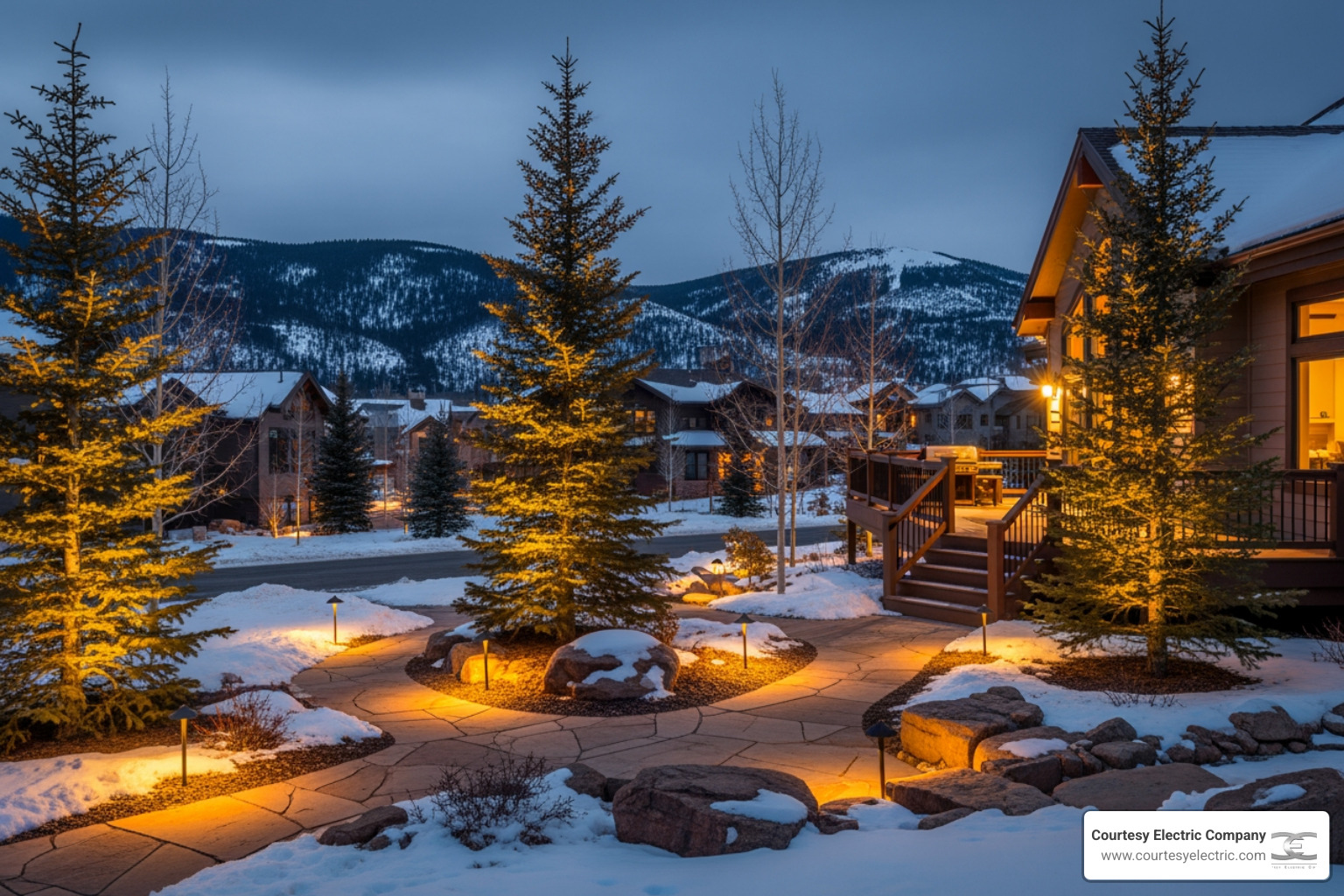
Professionally illuminated mountain home in Winter Park - landscape lighting in winter park co

If you're looking for answers about landscape lighting in Winter Park CO, here's what you need to know:

  • What it is: Landscape lighting uses outdoor fixtures to improve a property's beauty, improve safety, and increase security after dark.
  • Winter Park focus: It involves placing lights to highlight architectural features, illuminate pathways, and showcase the unique Colorado landscape.
  • Benefits: It transforms homes and gardens, extends outdoor living spaces, boosts curb appeal, and provides practical safety and security.

When the sun sets over the Rocky Mountains, your beautiful home in Winter Park, CO, can often disappear into the darkness. This is where landscape lighting in Winter Park CO steps in. More than just adding light, a well-designed outdoor lighting system transforms your property. It brings your home and garden to life after dusk, making it safer, more secure, and visually stunning. Studies show that well-planned exterior illumination can increase property value by up to 20%. It also ranks among the top five most wanted features by new homeowners, highlighting its significant appeal and practical benefits for any residence in the area.

Find how professional lighting can improve your home's exterior with our Residential Electrical Solutions or Contact Us Today to learn more.

As Vice President of Courtesy Electric, I've seen how expertly installed landscape lighting in Winter Park CO lifts homes. My career has taught me the importance of understanding electrical codes and delivering reliable, high-impact projects that truly shine.

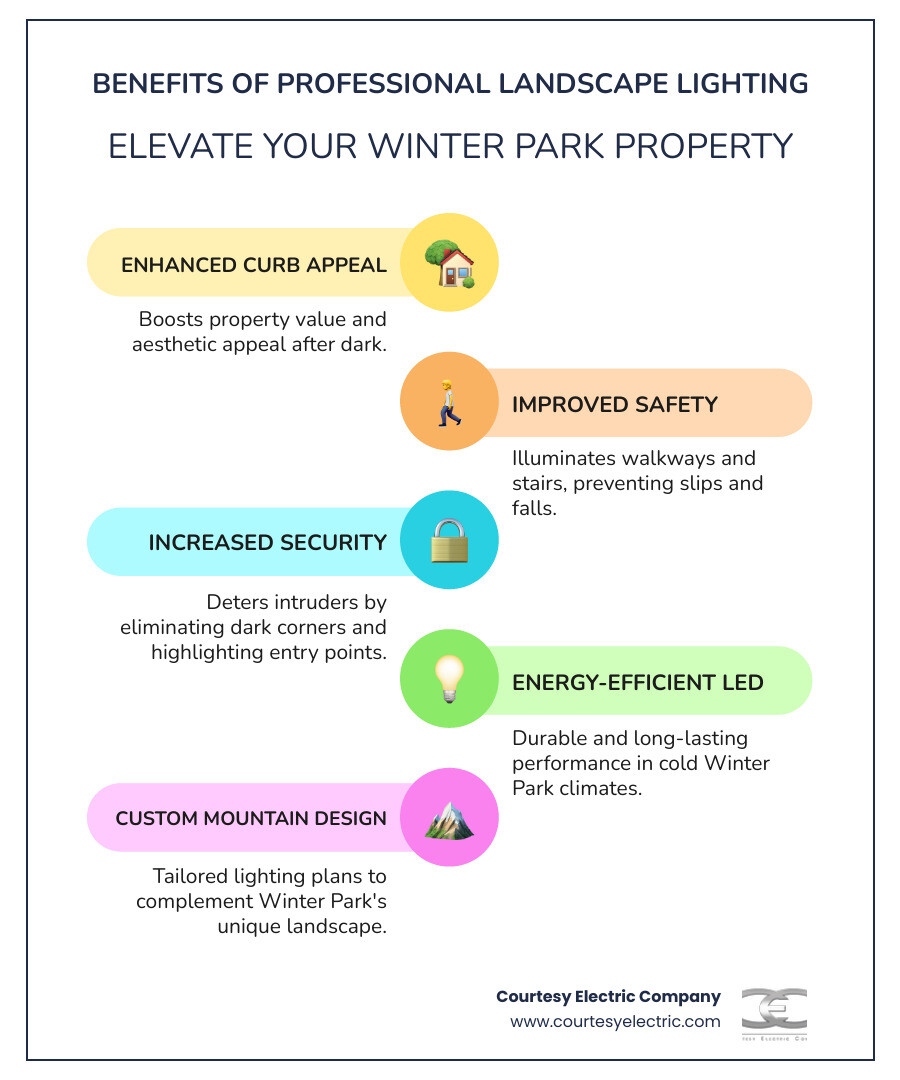
Infographic showing the benefits of professional landscape lighting, including enhanced curb appeal, increased safety, improved security, and extended outdoor living space. The infographic uses simple icons to represent each benefit, such as a house with glowing lights, a person walking safely on a lit path, a spotlight deterring a shadowy figure, and a family enjoying an illuminated patio. - landscape lighting in winter park co

The Benefits of Professional Landscape Lighting in Winter Park CO

Investing in landscape lighting in Winter Park CO is about more than just visibility; it’s about creating an atmosphere. For many homeowners in the Colorado Front Range, our homes are our sanctuaries. We spend significant time and effort on our interiors, but the exterior often vanishes once the sun goes down. Professional illumination ensures that your investment in your home's architecture and landscaping is visible 24 hours a day.

One of the primary advantages is the immediate boost in curb appeal. A home that is bathed in soft, strategic light looks more welcoming and sophisticated. Whether it’s highlighting the rugged texture of a stone facade or the neat silhouette of an aspen tree, lighting adds a layer of depth that paint and plants alone cannot achieve. Furthermore, this aesthetic appeal translates directly into financial gain. With exterior illumination ranking as a top-five feature for new buyers, it makes your property stand out in a competitive market.

Beyond the looks, professional residential electrical solutions provide a functional extension of your living space. In Winter Park, our summers are precious. With the right deck and patio lighting, your outdoor gatherings don't have to end just because the sun has dipped behind the peaks. You can host dinners, read a book on the porch, or enjoy a glass of wine by the fire pit, all under the gentle glow of expertly placed fixtures.

Enhancing Security with Landscape Lighting in Winter Park CO

Security is a major concern for any property owner. A well-lit home is a less attractive target for potential intruders. Statistics suggest that a majority of home break-ins occur under the cover of darkness. By eliminating shadowy areas where a person could hide, you significantly reduce the likelihood of your home being targeted.

Strategic lighting-control allows you to manage your home's security even when you aren't there. We can integrate motion sensors that flood specific areas with light when movement is detected, drawing immediate attention to any unusual activity. This doesn't just deter burglars; it also keeps local wildlife at a distance, which is a practical consideration in our mountain communities.

The peace of mind that comes with a secure home is priceless. Knowing that your entryways, driveways, and dark corners are clearly visible allows you and your family to feel safer at night. It’s not just about stopping a "bad guy"; it’s about the comfort of knowing you can see exactly what’s happening on your property at any given moment.

Improving Safety for Guests and Residents

Safety and security are often mentioned in the same breath, but they serve different purposes. While security protects you from outside threats, safety protects you and your guests from accidents. Colorado terrain can be uneven, and in Winter Park, we often deal with ice, snow, and rocky pathways.

Properly installed pathway lighting and step lights are essential for preventing trips, falls, and the occasional stubbed toe. Imagine a guest arriving at your home on a dark winter evening. Without lighting, navigating a snow-dusted walkway can be treacherous. With professional electrical-service, we can illuminate those hazards, making the journey from the car to the front door safe and inviting.

Driveway illumination is another critical safety feature. It helps drivers steer the boundaries of your property, preventing accidental damage to your landscaping or vehicles. By ensuring that every transition—from street to driveway, and from walkway to porch—is clearly marked with light, you create a safe environment for everyone who visits.

Essential Lighting Techniques for Colorado Landscapes

To achieve a professional look for landscape lighting in Winter Park CO, we employ several specialized techniques. It’s not about how many lights you have, but where you put them and how they interact with the environment. We often look at our featured-projects to show clients how these techniques transform a space.

  1. Uplighting: This is perhaps the most common technique. By placing a fixture at the base of a tree or an architectural pillar and directing the light upward, we create a sense of drama and height. This is particularly effective on the tall evergreens found throughout Winter Park.
  2. Downlighting (Moonlighting): To mimic the natural glow of a full moon, we place fixtures high up in trees or under eaves, directing the light downward. This creates soft, filtered light that is perfect for patios and large garden areas.
  3. Spotlighting: When you have a specific focal point—like a statue, a unique rock formation, or a flag—spotlighting uses a narrow beam to draw the eye directly to that feature.
  4. Cross-lighting: By using two or more lights from different angles to illuminate a single object, we eliminate harsh shadows and reveal the three-dimensional texture of the subject.
  5. Grazing: This involves placing a light source very close to a textured surface, such as a stone wall or a heavy timber post. The light "grazes" the surface, highlighting every nook and cranny.
  6. Washing: For large, flat areas like the side of a house or a long fence, "washing" uses a wide-angle beam to provide a soft, even coat of light, preventing "hot spots" and creating a cohesive look.
  7. Silhouetting: By placing a light behind a plant or object and directing it toward a wall, we create a dark silhouette of the object against a lit background. This is a fantastic way to showcase the interesting shapes of mountain flora.

Choosing the Right Fixtures for Landscape Lighting in Winter Park CO

In our harsh Colorado climate, the quality of your fixtures is just as important as the design. Cheap plastic or thin aluminum fixtures simply won't survive a Winter Park winter. When we plan projects, we prioritize durability and longevity.

  • Materials: We recommend heavy-duty materials like solid brass or copper. These metals don't just resist corrosion; they actually develop a beautiful patina over time that blends into the natural landscape.
  • LED Technology: Modern landscape lighting in Winter Park CO almost exclusively uses LED bulbs. LEDs are incredibly energy-efficient, reducing consumption by up to 80% compared to traditional halogen bulbs. They also last significantly longer, which means fewer trips up a ladder in the middle of January to change a bulb.
  • Low-Voltage Systems: Most residential landscape lighting is low-voltage (usually 12V). This is safer for outdoor use, easier to install without deep trenching that might damage your roots, and more cost-effective to operate.
  • Sealing and IP Ratings: Fixtures must be properly sealed against moisture. We look for high Ingress Protection (IP) ratings to ensure that melting snow and heavy spring rains don't short out your system.

Winter Park isn't just any environment; it's a high-alpine environment. This means our lighting systems face extreme temperature swings, heavy snow loads, and intense UV radiation. Maintenance isn't just a suggestion; it’s a requirement for keeping your system shining bright.

The "freeze-thaw" cycle is particularly brutal. As water melts during the day and freezes at night, it can shift fixtures or even crack inferior materials. Furthermore, the weight of several feet of snow can crush poorly placed lights. We design our systems with these factors in mind, often using "well lights" that sit flush with the ground or heavy-duty shrouds that protect the glass.

Regular services-1 should include a full wiring inspection. Over time, ground settling or curious critters can disturb underground lines. We also recommend an annual cleaning of the fixture lenses. In Colorado, dust and hard water spots can accumulate, significantly reducing the brightness and clarity of your lights.

Feature LED Lighting Halogen Lighting
Energy Efficiency High (80% less energy) Low
Lifespan 50,000+ hours 2,000 - 5,000 hours
Cold Weather Performance Excellent (runs cooler) Poor (heat can crack glass)
Maintenance Needs Very Low High
Environmental Impact Low (no mercury) Moderate
Light Quality Sharp and precise Warm but diffuse

Frequently Asked Questions about Outdoor Illumination

How does the Winter Park climate affect lighting fixtures?

The local climate is one of the biggest challenges for landscape lighting in Winter Park CO. Extreme cold can make some materials brittle, while heavy snow can bury and potentially damage fixtures. This is why we insist on high-quality brass or copper fixtures and professional installation. We also ensure that transformers are mounted in protected areas and that all connections are 100% waterproof to prevent "wicking," where moisture travels up the wire and destroys the internal components.

What are the advantages of using LED for mountain homes?

LEDs are the gold standard for mountain homes. Beyond the energy savings, LEDs perform exceptionally well in cold temperatures. Unlike some bulbs that take time to "warm up," LEDs are instant-on, even at sub-zero temperatures. Because they produce very little heat, they are also less likely to cause the rapid temperature changes that crack glass lenses when hit by cold snow. Finally, their long lifespan is a huge benefit in areas where maintenance can be difficult during the winter months.

How often should a landscape lighting system be serviced?

We generally recommend a professional check-up at least once a year. The best time is usually in the spring, after the snow has melted. This allows us to check for any fixtures that may have been moved by snow removal equipment or shifted by the frost. We’ll clean the lenses, trim back any new plant growth that might be blocking the light, and ensure the timer or smart controller is correctly set for the changing seasons.

Conclusion

Changing your property with landscape lighting in Winter Park CO is an investment in beauty, safety, and security. It allows you to enjoy the majestic Colorado nights to their fullest, providing a warm welcome every time you pull into your driveway. At Courtesy Electric Company, we pride ourselves on providing the highest quality residential electrical services across the Front Range, from Denver to Highlands Ranch and beyond.

Our team of experts understands the unique challenges of mountain lighting. We don't just install bulbs; we design systems that are built to last and designed to impress. Whether you are looking for subtle path lighting or dramatic architectural accents, we have the experience and the high-quality products to bring your vision to life.

Ready to see your home in a new light? Contact us today for a consultation and let us help you transform your property with expert residential landscape lighting. Let’s make your Winter Park home the shining star of the neighborhood.

From Installation to Illumination: Your Guide to Winter Park's Landscape Lighting Services

Why Professional Landscape Lighting Matters in Winter Park

best landscape lighting services in winter park, co

When you're looking for the best landscape lighting services in Winter Park, CO, you want a team that understands both the technical demands of mountain electrical work and the unique beauty of your property. Winter Park homeowners face shorter daylight hours, heavy snow loads, and dramatic temperature swings that put serious stress on outdoor lighting systems. Professional installation ensures your fixtures hold up through the elements while highlighting your home's architecture, improving safety on walkways, and adding security where you need it most.

Top considerations when choosing landscape lighting services in Winter Park:

  • LED technology - Energy-efficient, cold-weather durable, and long-lasting
  • Custom design - Custom to your property's layout, architecture, and landscape features
  • Professional installation - Proper wiring, transformer sizing, and weatherproof mounting
  • Ongoing maintenance - System repairs, fixture replacements, and seasonal adjustments
  • Local expertise - Knowledge of Grand County regulations and mountain climate challenges

Whether you're illuminating stone pathways, uplighting mature trees, or adding security lighting around entry points, the right system transforms your property after dark. Learn more about residential electrical services or contact Courtesy Electric for a consultation.

I'm David Meyer, Vice President of Courtesy Electric, and over the past 50 years our company has handled everything from large-scale electrical infrastructure to specialized installations like landscape lighting across Colorado's Front Range. My hands-on experience in the field gives me a clear understanding of what separates the best landscape lighting services in Winter Park, CO from the rest--quality materials, proper installation, and systems built to last through mountain winters.

Infographic showing the key benefits of professional landscape lighting: enhanced curb appeal and property value, improved safety on walkways and stairs, increased security through strategic illumination, energy-efficient LED technology for cold climates, and custom designs tailored to Winter Park's mountain environment - best landscape lighting services in winter park, co infographic infographic-line-5-steps-colors

Key Features of the Best Landscape Lighting Services in Winter Park, CO

When we talk about the best landscape lighting services in Winter Park, CO, we aren't just talking about sticking a few solar stakes in the ground and hoping for the best. In a high-altitude mountain environment, "good enough" usually doesn't survive the first blizzard. Professional services involve a comprehensive approach that blends artistry with rugged electrical engineering.

A truly professional service begins with a custom design. Every property in Grand County has a unique personality—some are tucked away in dense pines, while others overlook the valley with sweeping architectural lines. We focus on creating a plan that highlights these specific features. This includes selecting the right beam spreads, color temperatures, and fixture placements to create a cohesive "nightscape" rather than just a series of bright spots.

Professional installation is the backbone of any reliable system. This means using the correct gauge of direct-burial wire, ensuring all connections are waterproof, and sizing the transformer correctly to handle the load without voltage drop. Beyond the initial setup, the best services include long-term system maintenance and repair. Mountain life is tough on equipment; wires can be disrupted by shifting soil or local wildlife, and fixtures can be buried under several feet of snow. Having a partner who can troubleshoot and restore functionality quickly is essential. For those looking to integrate their outdoor lights with the rest of their home’s power system, you can explore more about our residential services to see how we handle complex electrical needs.

Why LED is the Standard for Best Landscape Lighting Services in Winter Park, CO

If you are still using halogen bulbs for your outdoor lighting, you are essentially fighting a losing battle against the Colorado climate. LED (Light Emitting Diode) technology has become the gold standard for several reasons, particularly in high-altitude regions like Winter Park.

First and foremost is energy efficiency. LEDs use a fraction of the electricity required by traditional bulbs, which is better for your utility bill and the environment. But in Winter Park, the real "superpower" of LED is its cold-weather performance. Unlike some lighting types that struggle to turn on or flicker in freezing temperatures, LEDs thrive in the cold. They are solid-state electronics, meaning they don't have a fragile filament that can break due to vibration or extreme temperature swings.

Furthermore, LEDs offer incredible longevity. A high-quality LED fixture can last for 50,000 hours or more. In the middle of a Winter Park winter, the last thing you want to do is go outside and try to change a burnt-out bulb in three feet of snow. With LED, that task becomes a rarity. Finally, modern LED technology provides a natural-looking, warm illumination that mimics the soft glow of traditional lighting without the harsh, blue tint often associated with early versions of the tech.

Choosing the Best Landscape Lighting Services in Winter Park, CO for Your Property

With so many options available, how do you narrow down the search? We recommend looking for three specific pillars: fixture quality, technical expertise, and a proven track record.

The mountain environment is unforgiving. Plastic fixtures will crack, and cheap metals will corrode. The best landscape lighting services in Winter Park, CO use heavy-duty materials like solid brass, copper, or aircraft-grade aluminum. These materials develop a beautiful patina over time and can withstand the weight of snow and the moisture of spring runoff.

Technical expertise is equally important. You want a team that understands the "why" behind the "where." Why place a light here? How will the shadows fall? How do we protect the wiring from the elements? A company with a deep background in electrical work—not just landscaping—is often the better choice because they understand the underlying infrastructure. Before you make a decision, it is always a good idea to see our featured projects to get a sense of the quality and creativity we bring to every installation.

Professional Techniques for Safety and Security

Landscape lighting is about more than just looking pretty; it is a functional tool for protecting your property and the people on it. In the mountains, where terrain is often uneven and shadows can be deep, professional lighting techniques are essential for safe navigation.

We use several specific techniques to achieve these goals:

  • Uplighting: Placing fixtures at the base of trees or architectural pillars to direct light upward. This creates a dramatic effect and provides ambient light that helps define the boundaries of your property.
  • Spotlighting: Using a narrow beam to highlight a specific focal point, such as a piece of art, a unique rock formation, or a grand entrance.
  • Downlighting (or Moonlighting): Placing fixtures high up in trees or under eaves to cast a soft, downward glow. This mimics natural moonlight and is excellent for illuminating large areas like patios or driveways without creating glare.
  • Cross Lighting: Aiming two or more lights at a single feature from different angles. This eliminates harsh shadows and reveals the texture and depth of the object.
  • Architectural Accenting: Using subtle "wash" lights to highlight the textures of stone siding or the clean lines of a mountain modern home.

Strategic Illumination for Crime Deterrence

Security experts often note that the best defense is a well-lit perimeter. Most intruders are opportunists; they look for dark corners and hidden entry points where they can work unobserved. Professional landscape lighting eliminates these "blind spots."

By strategically placing lights around the perimeter of your home and at all entry points—including basement windows and side doors—you significantly reduce the appeal of your property to potential intruders. We also recommend integrating motion sensors into your design. A sudden flood of light can startle an intruder and alert you to activity. Furthermore, well-planned lighting ensures that your security cameras can capture clear, high-quality footage at night, which is often impossible in total darkness.

Enhancing Walkway and Entrance Safety

Winter Park is famous for its snow, but that snow often hides ice, uneven stones, and steps. One of the primary reasons homeowners seek out the best landscape lighting services in Winter Park, CO is to prevent slip-and-fall accidents.

Step lighting and path lights are crucial here. We install these fixtures to cast light directly onto the walking surface, ensuring that every tread and transition is visible. This is especially important for guests who may not be familiar with your property's layout. By using low-glare fixtures, we can provide enough light for safety without blinding people as they walk toward the house. To see how these safety features fit into a larger home electrical plan, you can explore our full range of services.

Planning and Local Considerations for Winter Park Projects

Planning a lighting project in a mountain town like Winter Park requires a different mindset than planning one in the suburbs of Denver. The environmental factors here are significant, and they must be accounted for from day one.

The first step is a thorough property layout analysis. We need to look at how the snow drifts, where the plow will push the snow, and where the runoff goes during the spring thaw. Placing a delicate path light right where the snowblower clears the driveway is a recipe for disaster. We also consider the density of the foliage; a design that looks great in the summer might feel sparse in the winter when the deciduous trees have lost their leaves.

Adapting to Winter Park Weather Conditions

In Winter Park, we don't just plan for "weather"; we plan for extremes. This means focusing on:

  1. Snow Accumulation: Fixtures must be tall enough or positioned in a way that they aren't completely buried for five months of the year. In some cases, we use specialized "hats" or shields to prevent snow from sitting directly on the lens.
  2. Moisture Resistance: Between melting snow and heavy spring rains, outdoor electrical components are constantly exposed to moisture. We use high-grade, sealed fixtures and waterproof connectors to prevent short circuits.
  3. Low-Voltage Systems: Most residential landscape lighting uses a 12V or 24V low-voltage system. This is safer for outdoor use and allows for more flexible installation, which is a major plus when navigating the rocky soil of Grand County.
  4. Heavy-Duty Housing: We avoid plastic components that become brittle in the cold. Cast brass or heavy-gauge aluminum is necessary to withstand the physical pressure of heavy, wet snow.

Designing for the Mountain Environment

We believe that landscape lighting should improve the natural environment, not compete with it. This involves highlighting the native beauty of Winter Park—the towering lodgepole pines, the rugged rock outcroppings, and the delicate mountain flora.

Another critical consideration is "Dark Sky" compliance. Many areas in Grand County have regulations designed to reduce light pollution, ensuring that we can all still enjoy the incredible starlight that the mountains offer. This means using "fully shielded" fixtures that direct light downward rather than up into the atmosphere. It's about being a good neighbor and preserving the mountain character we all love. If you're ready to start planning your mountain-friendly lighting system, contact us for a consultation.

Frequently Asked Questions about Landscape Lighting

What are the advantages of using LED lighting in high-altitude climates?

LEDs are the clear winner for high-altitude environments like Winter Park. Their primary advantage is durability; they lack the fragile filaments found in halogen bulbs, making them resistant to the vibrations and temperature fluctuations common in the mountains. They also perform better in the cold, maintaining consistent brightness even when temperatures drop well below zero. From a maintenance perspective, their long lifespan (often 15-20 years of normal use) means you won't be stuck trying to replace bulbs during the harshest months of the year.

How does landscape lighting improve home security?

Landscape lighting acts as a powerful psychological and physical deterrent. Intruders prefer to work in the shadows where they can't be seen by neighbors or security cameras. By illuminating the perimeter, entry points, and dark corners of your yard, you eliminate these hiding spots. Furthermore, strategic lighting allows your security cameras to function at peak performance, providing the clear imagery needed for identification. When combined with motion sensors, a lighting system provides an active layer of defense for your home.

What should I consider when planning a lighting layout?

When planning your layout, start with the "must-haves": safety and security. Identify the walkways, stairs, and entrances that need clear illumination. Once the functional needs are met, move to the aesthetic goals. What are the best features of your home? Is it a stone chimney, a beautiful aspen grove, or a unique water feature? Use techniques like uplighting or silhouetting to bring these features to life. Finally, consider the view from inside the house. You want your outdoor lighting to create a beautiful vista when you are looking out your windows on a snowy night.

Conclusion

At Courtesy Electric Company, we take pride in helping our neighbors across Denver and the Colorado Front Range—from Parker and Highlands Ranch to the high-country homes of Winter Park—bring their properties to life after dark. Lighting is an investment in your home’s beauty, safety, and value. Whether you are interested in cutting-edge smart home technology that allows you to control your lights from your phone, or you simply want a reliable, energy-efficient system that can survive a Grand County winter, we have the expertise to make it happen.

Our team focuses on quality installations and long-term reliability. We understand the infrastructure required to keep a mountain home running smoothly, and we bring that same level of care to every landscape lighting project. If you are ready to transform your property, contact us for your residential electrical needs and let's light up the night together.

The Maintenance Menace: Keeping Your Centennial Home Theater in Peak Condition

Why Home Theaters Maintenance in Centennial, CO Matters for System Longevity

luxury home theater - home theaters maintenance in centennial, co

Home theaters maintenance in centennial, co keeps your entertainment system performing at its best. A well-maintained system delivers crystal-clear sound, vibrant picture quality, and reliable operation for years—while neglect leads to dust buildup, connectivity issues, outdated firmware, and eventually system damage or component failure.

Quick Maintenance Checklist for Centennial Home Theaters:

  1. Monthly: Dust all components with microfiber cloths and check cable connections
  2. Quarterly: Update firmware on receivers, projectors, and streaming devices
  3. Biannually: Inspect ventilation, clean speaker grilles, and test surge protectors
  4. Annually: Schedule professional calibration and system diagnostics

For comprehensive electrical support that keeps your entertainment system powered properly, explore our residential services, or contact Courtesy Electric Company to schedule a consultation.

Your Centennial home theater represents a significant addition to family entertainment and property value. Between Colorado's dry climate creating static and dust, temperature swings affecting electronics, and the complexity of modern AV systems with multiple networked components, regular maintenance isn't optional—it's essential. Components like 4K projectors, AV receivers, and surround sound systems all need attention to maintain peak performance, and small issues caught early prevent major equipment failures down the road.

I'm David Meyer, and while my expertise is in electrical systems that power homes across Colorado, I've worked extensively with the low-voltage wiring and power infrastructure that supports reliable home theaters maintenance in centennial, co. Through my work at Courtesy Electric, I've seen how proper electrical foundation and routine care keep entertainment systems running flawlessly for decades.

Infographic showing the home theater maintenance cycle: Monthly cleaning and inspection, Quarterly software updates and connectivity checks, Biannual ventilation and cable management review, Annual professional calibration and system diagnostics, leading back to Monthly tasks for continuous performance optimization - home theaters maintenance in centennial, co infographic infographic-line-5-steps-dark

Essential Components and Setup Types

Before we dive into the nitty-gritty of keeping things running, we need to understand what we are actually maintaining. A modern home theater isn't just a TV and a couple of speakers; it is a complex ecosystem of high-performance electronics. In Centennial homes, we typically see three main components: the display (4K projectors or massive OLED displays), the "brain" (AV receivers), and the sources (media streamers, Blu-ray players, or gaming consoles).

The display is the centerpiece. Whether you are using a high-end JVC or Epson projector hitting a fixed-frame screen or a sleek 83-inch OLED, the image quality depends heavily on clean optics and stable power. The AV receiver acts as the traffic controller, taking signals from your streamers and pumping high-wattage power to your surround sound systems.

We see a few different setup styles throughout the Colorado Front Range:

  • Dedicated Cinema Rooms: These are windowless spaces with soundproofing and specialized seating. They offer the most immersive experience but require the most maintenance regarding climate control and acoustic tuning.
  • Multi-Purpose Media Spaces: Often found in walk-out basements in neighborhoods like Piney Creek Ranches or Willow Creek, these rooms serve as family rooms by day and theaters by night. Maintenance here often involves managing dust from high-traffic use.
  • Outdoor Entertainment: With Centennial's beautiful summers, outdoor theaters are booming. These require weather-resistant components and much more frequent cleaning due to pollen and debris.

Comparing Dedicated vs. Multi-Purpose Setups

Feature Dedicated Cinema Room Multi-Purpose Media Space
Primary Goal Absolute Immersion Versatility & Socializing
Light Control Total Blackout Challenging (Needs Shades)
Sound Quality Precision-Calibrated Balanced for Room Layout
Maintenance Focus Component Calibration Dust & Cable Protection
Seating Fixed Tiered Rows Sectionals & Lounge Chairs

Optimizing Layout and Ambiance for Performance

You can have the most high-end gear in the world, but if your layout is off, the experience will suffer. Maintaining your theater also means maintaining the "environment." This starts with seating distance and viewing angles. If you’re sitting too close to a 4K screen, you’ll see pixels; too far, and you lose the immersion.

Acoustic panels are another critical element. Over time, these panels can collect dust or even loosen from the walls. Maintaining your acoustic treatments ensures that sound waves are absorbed or diffused correctly, preventing that "echoey" basement sound. Soundproofing is equally important—checking the seals on theater doors helps keep the movie's explosions inside the room and the dishwasher's hum outside.

Lighting is the secret sauce of a great theater. We often recommend integrated lighting control to create "scenes." Maintaining this means ensuring your dimmers are responsive and your motorized shades are lubricated and calibrated. In Centennial, where the sun can be intense, motorized shades aren't just for atmosphere; they protect your high-end screen and furniture from UV damage.

Key Steps for Home Theaters Maintenance in Centennial, CO

When we talk about home theaters maintenance in centennial, co, we are looking at the health of the hardware. The biggest enemy of electronics in Colorado is heat and dust. Because our air is so dry, static electricity can attract dust like a magnet to your AV rack.

Proper ventilation is paramount. If your receiver or amplifier is tucked into a cabinet without airflow, it will cook itself. Part of your maintenance routine should be checking that fans are spinning and vents aren't blocked. Cable management is another big one. Tangled wires aren't just ugly; they can cause signal interference or even become a fire hazard if they get pinched.

Our team at Courtesy Electric often handles low-volt services to ensure that your data and speaker cables are high-quality and properly shielded. We also can't stress enough the importance of power conditioning and surge protection. Colorado is known for its afternoon thunderstorms; a dedicated power conditioner cleans the electrical "noise" from your lines and protects your gear from voltage spikes.

Routine Cleaning for Home Theaters Maintenance in Centennial, CO

Cleaning is the simplest yet most overlooked part of maintenance. Here is how to do it right:

  • Microfiber Cloths: Never use paper towels or old rags. High-quality microfiber is essential for OLED screens and piano-black speaker finishes.
  • Lens Care: If you have a projector, use a dedicated lens blower or a specific lens-cleaning solution. Never use Windex!
  • Dust Accumulation: Use a vacuum with a soft brush attachment for the back of the AV rack. Don't forget the speaker grilles—dust can actually dampen the high-frequency sounds coming from your tweeters.
  • Component Airflow: Ensure there is at least 3 inches of clearance above any heat-generating component.

Software and Connectivity for Home Theaters Maintenance in Centennial, CO

Your theater is basically a giant computer. Firmware updates are released regularly for receivers, smart TVs, and projectors to fix bugs and add features like HDR10+ or improved Dolby Atmos processing.

Network stability is the backbone of your streaming experience. If your Netflix is constantly buffering, it might not be your internet speed; it could be an outdated router or a poorly configured Wi-Fi access point. We help Centennial residents with residential services that include robust home networking to ensure your theater stays connected. Finally, remote programming is key. If you have four different remotes, it’s time to consolidate into a unified control system, which requires its own periodic software "tune-up."

While DIY cleaning is great, an annual professional check-up is the gold standard for home theaters maintenance in centennial, co. A pro will perform audio calibration using specialized microphones to ensure every speaker is hitting your ears at the exact same millisecond. They also handle color balancing, which involves using a colorimeter to ensure your blacks are true black and your reds aren't leaning orange.

We also look at the bigger picture of your home's electrical service. As you add more powerful subwoofers or larger screens, you might be pushing the limits of your room's circuit. We can ensure your theater has a dedicated circuit to prevent your lights from flickering when the bass hits.

Staying aware of trends is also part of long-term maintenance. Currently, we are seeing a shift toward:

  • 8K Resolution: While content is still catching up, the hardware is ready.
  • Dolby Atmos: Moving from 5.1 sound to "object-based" audio that includes ceiling speakers.
  • Smart Home Integration: Connecting your theater to your security, climate, and lighting for a "one-touch" movie night experience.

Frequently Asked Questions about Home Theater Care

What are the essential components of a home theater system?

The basics include a display (TV or projector), a source (streaming box or disc player), an AV receiver to process the signal, and a speaker system (usually at least 5 speakers and one subwoofer). Don't forget the "invisible" components: high-speed HDMI cables and a reliable power surge protector.

How often should professional check-ups be performed?

We recommend a professional diagnostic once a year. This ensures that your calibration hasn't drifted and that your firmware is fully optimized. It’s also a great time to check for any wear and tear on hidden low-voltage wiring.

What are the advantages of using acoustic treatments?

Acoustic treatments aren't just for looks. They stop sound waves from bouncing off hard surfaces like drywall or windows. This makes dialogue much easier to understand and makes the surround sound effects feel more precise and localized.

Conclusion

Maintaining a home theater in Centennial doesn't have to be a "menace" if you stay on top of the small things. By following a regular cleaning schedule, keeping your software updated, and ensuring your electrical foundation is solid, you protect your system and ensure your Friday night movies are always spectacular.

At Courtesy Electric Company, we are passionate about the technical side of entertainment. Whether you need a dedicated circuit for a new subwoofer or a complete overhaul of your surround sound systems wiring, we are here to help. Our goal is to provide the reliability and expert integration that Centennial homeowners expect.

Ready to ensure your system is in peak condition? Contact us today to schedule a consultation for your next electrical or home theater project!

The Blueprint for Fun: Hiring a Home Theater Contractor in Centennial

Why Centennial Homeowners Are Investing in Custom Home Theaters

home theaters system contractor in centennial, co

Finding the right home theaters system contractor in centennial, co transforms how you experience entertainment at home. Here's what to look for:

Key Selection Criteria:

  • HTA Certification - Ensures contractor meets industry standards for complex installations
  • Smart Home Integration - Seamless control of audio, video, lighting, and security from one interface
  • Custom Design Process - Custom solutions that fit your space and lifestyle
  • Professional Installation - Proper wiring during framing, hidden equipment racks, and calibrated audio
  • Service Area Coverage - Verify they serve Centennial and surrounding Front Range communities

Home theater installations in Centennial have surged 15% year-over-year as homeowners prioritize entertainment spaces that rival commercial cinemas. Whether you're finishing a basement near Cherry Creek Reservoir or building a dedicated media room in a new construction home, working with a specialized contractor ensures your system delivers immersive sound, stunning 4K visuals, and intuitive control without the guesswork of DIY approaches.

As Vice President of Courtesy Electric Company, I've worked alongside homeowners and builders for years on electrical infrastructure that powers everything from whole-home automation to advanced entertainment systems, including collaborations with home theaters system contractor in centennial, co professionals on low-voltage wiring and smart integration projects. My hands-on experience with residential systems means I understand what makes these installations succeed-and where shortcuts create problems down the road.

detailed infographic showing home theater planning process from consultation through equipment selection, wiring installation, system calibration, and final walkthrough with timeline milestones - home theaters system contractor in centennial, co

Why Hire a Professional Home Theater System Contractor in Centennial, CO?

The temptation to grab a "home theater in a box" from a big-box store and spend a Saturday afternoon plugging in wires is real. However, there is a massive gulf between a DIY setup and a system engineered by a professional home theaters system contractor in centennial, co.

When we look at residential projects across the Front Range, the most successful ones share a common thread: professional planning. A specialist doesn't just "install" equipment; they optimize the environment. This includes acoustic optimization, where the contractor analyzes the room's shape and materials to ensure sound waves don't bounce off walls in a way that muddies the dialogue or creates "boomy" bass.

Calibration is another critical factor. A professional uses specialized software and microphones to balance surround sound systems, ensuring that the audio hits your ears at the exact millisecond intended by the film’s director. This level of precision is nearly impossible to achieve with a DIY approach.

Furthermore, hiring a professional ensures equipment longevity. By using high-quality low volt infrastructure and proper ventilation in equipment racks, your hardware is protected from overheating and electrical interference. Professionals often adhere to HTA (Home Technology Association) certification standards, which means they follow rigorous guidelines for technical competency and customer service. This gives you peace of mind that the job is done right the first time, avoiding the messy "spaghetti" of wires often found behind DIY TV stands.

Essential Components of a Modern Cinematic Experience

To truly replicate the feeling of a commercial cinema in your Centennial home, you need more than just a big screen. A modern home theater is a symphony of several high-tech components working in harmony.

The Visual Powerhouse

While many homeowners opt for large OLED displays for their incredible contrast and deep blacks, projection systems remain the gold standard for a true "cinema" feel. Modern 4K HDR projectors provide stunning detail and vibrant colors that rival any television.

A pro tip we often share with homeowners involves the screen choice. If your room has some ambient light, a grey projection screen (Ambient Light Rejecting or ALR) is a game-changer. It improves contrast by reflecting only the light from the projector while absorbing light from other sources, like windows or lamps.

Immersive Audio

The "surround sound" of yesterday has been replaced by object-based audio, most notably Dolby Atmos. This technology adds height channels to the mix. Instead of sound just moving left to right or front to back, it moves in a three-dimensional space. Imagine the sound of a helicopter flying directly over your head—that's the power of a 5.1.2 or 7.2.4 Atmos setup. To maintain a clean aesthetic, we often recommend in-wall and in-ceiling speakers that disappear into the room's architecture while delivering punchy, clear audio.

The Brains of the Operation

All these components connect to an AV Receiver or Processor. This unit acts as the traffic controller, taking signals from your Apple TV, Blu-ray player, or gaming console and sending the video to the screen and the audio to the speakers.

Essential Component Checklist:

  • Display: 4K HDR Projector or 77"+ OLED TV
  • Screen: Fixed-frame or motorized ALR screen (for projectors)
  • Audio: Dolby Atmos-enabled receiver and matched speaker set
  • Sources: High-speed streaming devices and 4K UHD players
  • Infrastructure: Category 6 (Cat6) data cabling and high-speed HDMI 2.1 cables
  • Acoustics: Sound-absorbing panels and bass traps

Tailoring Solutions for Centennial Homes

Every home in Centennial is unique, from the sprawling estates in Lone Tree to the cozy remodels in Parker. A reputable home theaters system contractor in centennial, co doesn't believe in one-size-fits-all. They tailor the solution to the specific architecture of your home and how you plan to use the space.

Custom Solutions from a Home Theater System Contractor in Centennial, CO

If you are working on a basement finishing project, you have a "blank canvas." This is the ideal time to plan for a dedicated media room. We often work with builders during the framing phase to run wires through the studs before the drywall goes up. This allows for completely hidden equipment.

However, not every home has a spare room for a dedicated theater. Many Centennial residents prefer multi-purpose spaces—a living room that serves as a family gathering spot by day and a cinematic hub by night. In these cases, we focus on equipment concealment. Motorized screens can drop from the ceiling, and speakers can be painted to match the walls. You can see examples of these versatile setups in our featured projects gallery.

Smart Home Integration and Connectivity

A home theater shouldn't exist in a vacuum. It should be part of a cohesive smart home ecosystem. Imagine pressing a "Movie" button on a universal remote or your smartphone, and the lighting control system dims the lights, the motorized shades close, the temperature drops two degrees, and the projector hums to life.

This level of integration requires a robust enterprise-grade network. With approximately 60% of Centennial homeowners requesting smart features, ensuring your Wi-Fi is dead-zone free is essential. We also look at the electrical service requirements to ensure your theater has dedicated circuits, preventing the lights from flickering when the subwoofer kicks in during an explosion. For added security and convenience, many clients also integrate their home security cameras into the theater display, allowing them to see who is at the front door without leaving their seat.

The Installation Process: From Consultation to Calibration

Understanding the timeline of a home theater project helps manage expectations. Typically, a custom installation takes between 4 to 8 weeks from the initial handshake to the first movie night.

Feature 4K Projection System Large-Format OLED TV
Max Screen Size 100" to 150"+ Typically up to 83" or 97"
Light Control Best in dark/dim rooms Excellent in all lighting
Contrast High (with ALR screens) Infinite (perfect blacks)
Immersive Feel High (Cinematic) Moderate (Standard TV feel)
Installation Ceiling mount + Screen Wall mount

Phase 1: Consultation and Design

The process begins with an in-home assessment. The contractor looks at the room dimensions, seating positions, and ambient light. This is where you discuss your vision and how the system will integrate with your lifestyle.

Phase 2: Rough-In (The Dirty Work)

For new builds or major renovations, this happens after framing but before drywall. The "low-volt" team runs all the speaker wires, HDMI cables, and network lines. We often reference our single family residential portfolio for examples of how clean, organized pre-wiring sets the stage for a flawless finish.

Phase 3: Trim and Equipment Installation

Once the walls are painted, the fun begins. The screen is mounted, speakers are installed, and the equipment rack is populated. This rack is often placed in a mechanical room or a ventilated closet to keep the "brains" of the system out of sight.

Phase 4: Calibration and Handover

The final step is the most important. The contractor uses software to calibrate the audio and video. They will also program your universal remote or smart home app, ensuring that operating the system is as simple as possible.

Frequently Asked Questions about Home Theater Installation

What are the benefits of a home theater system contractor in Centennial, CO for new builds?

Working with a contractor during a new build is the most efficient way to get a high-end system. It allows for "future-proofing"—running extra conduits so you can easily upgrade cables in 10 years without tearing down walls. It also ensures that the structural integrity of the ceiling can support heavy projectors or motorized screens.

How do contractors hide messy wires and equipment?

The secret is the "mechanical room rack." Instead of having a stack of boxes under your TV, all the equipment (receivers, streamers, amplifiers) is housed in a professional rack in a closet or basement. A single wire runs to the display, and everything is controlled via radio frequency (RF) or Wi-Fi, meaning you don't need a "line of sight" for the remote to work.

What is the difference between 4K projection and OLED displays?

It really comes down to size versus light control. If you want a 120-inch screen that fills your field of vision, projection is the way to go. If you are installing a system in a bright living room with lots of windows and want the absolute best color and contrast for daytime viewing, a large OLED TV is often the better choice.

Conclusion

Building a home theater is about more than just buying gear; it's about creating a destination within your home for family and friends to gather. Whether you are looking for a dedicated cinema room or a smart, integrated media space in your living room, the expertise of a professional home theaters system contractor in centennial, co is invaluable.

At Courtesy Electric Company, we take pride in providing the electrical backbone for these incredible spaces across the Denver Metro area and the Front Range. From Parker to Highlands Ranch, we understand the local building codes and the high standards our neighbors expect. Our commitment to quality craftsmanship ensures that your home theater isn't just fun—it's safe, reliable, and built to last.

Ready to turn your basement or living room into the ultimate entertainment hub? Schedule your home theater consultation with us today and let's start planning your blueprint for fun.

How to Get the Best Home Theater Services in Centennial Without the Drama

Essential Components of Modern Home Theaters in Centennial CO

Luxury home theater room with large screen, surround speakers, and comfortable seating - home theaters in centennial co

In the rapidly growing communities of Centennial, CO, the home has become more than just a place to rest—it is a sanctuary for entertainment and relaxation. As technology advances, the traditional living room setup is being replaced by sophisticated, immersive environments that rival the local cinema. Building a world-class entertainment hub requires a meticulous approach to design and technology. Modern home theaters in Centennial CO are sophisticated ecosystems where every piece of hardware must play nicely with the others. Think of it as a symphony; if the violinist is out of tune, the whole performance suffers. Whether you are converting a basement in Highlands Ranch or upgrading a media room in Parker, the goal is to create a seamless experience that transports you into the story.

The Visual Centerpiece: 4K/8K Projectors and OLED Displays

The "wow" factor starts with the image. For dedicated theaters, 4K and even 8K projectors are the gold standard, offering a level of detail that was once reserved for professional screening rooms. High-end projectors paired with a grey projection screen can improve contrast significantly, especially in rooms where you can’t achieve total darkness. These screens are designed to reject ambient light, ensuring that the deep blacks and vibrant colors remain crisp even if there is a bit of light leakage. If you prefer a more traditional setup for a multi-purpose room, an LG OLED C3 77-inch or larger display offers perfect blacks and vibrant colors that make movies pop. The self-lit pixels of an OLED screen provide an infinite contrast ratio, which is essential for the dark, moody scenes found in modern cinematography.

The Audio Engine: Surround Sound and AV Receivers

Sound is 50% of the movie-going experience, providing the emotional weight and spatial awareness that draws you into the action. A true cinematic setup uses surround sound systems that envelop the listener in a 360-degree soundstage. This often includes a 5.1.2 or 7.2.4 Dolby Atmos configuration, which adds height channels (in-ceiling speakers) to make it feel like a helicopter is actually flying over your head or rain is falling from above. Powering these speakers requires a robust AV receiver, such as a Yamaha RXA4A, which acts as the brain of the operation. This device handles the complex task of switching between media streamers, gaming consoles, and Blu-ray players while ensuring that the audio signal is processed with the highest fidelity possible.

The Invisible Infrastructure: Low Volt Cabling

Behind the walls, low volt cabling is the central nervous system of your theater. High-speed HDMI cables capable of 48Gbps bandwidth are necessary for 8K content, while Cat6 or Cat6a networking ensures lag-free streaming from services like Netflix or Disney+. Heavy-gauge speaker wire is also essential to prevent signal loss over long distances. In Centennial, we often see homeowners forget that their Wi-Fi needs to be enterprise-grade to handle 4K streaming across multiple devices simultaneously. Proper structured cabling ensures that your "Smart Home" doesn't become a "Frustrating Home," providing a stable foundation for all your high-tech components.

Designing the Ideal Space: Layout, Acoustics, and Lighting

Designing a theater is as much about physics as it is about aesthetics. You could buy the most expensive speakers in the world, but if you put them in a glass-walled room with marble floors, they’ll sound like they are inside a tin can. The interaction between sound waves and the surfaces in your room determines the clarity of dialogue and the impact of special effects.

Optimizing Acoustics for Home Theaters in Centennial CO

Acoustic treatments are the unsung heroes of the theater world. We use sound-absorbing fabric panels to catch mid-to-high frequency reflections that cause "slap echo," which can make voices sound muddy. Additionally, "bass traps" are placed in the corners to prevent low-end frequencies from becoming "boomy" or overwhelming the rest of the audio. For residential spaces in Centennial, soundproofing is also a major consideration. This involves using specialized drywall, acoustic sealants, and solid-core doors to ensure that the explosions from Top Gun don't wake up the kids in the bedroom next door. Professional speaker placement—calibrated to your primary seating position—ensures that every seat in the house is the "best seat," with sound arriving at your ears at the perfect time.

Smart Lighting and Ambiance

Lighting is what sets the mood and completes the cinematic change. A lighting control system allows you to transition from "Cleaning Mode" (full brightness) to "Movie Mode" (lights dimmed, path lights at 10%) with a single button press. This level of automation adds a layer of luxury and convenience that defines modern living.

  • Dimmable LEDs: Essential for creating that soft glow and avoiding harsh shadows on the screen.
  • Motorized Shades: These are a must-have for Centennial homes with large windows, blocking out the intense Colorado sun to prevent screen glare and protect your furniture from UV damage.
  • Star Ceilings: For those wanting a touch of whimsy, fiber-optic star ceilings can mimic the night sky, creating a truly magical atmosphere for family movie nights.
  • Path Lighting: Low-profile LED strips along the floor or stairs ensure safety when someone needs to grab a snack in the middle of the film.

Choosing the Right Setup for Your Centennial Lifestyle

Not every home needs a windowless "bat cave." Many homeowners in the Denver metro area prefer a space that can adapt to their daily lives, whether that means hosting a Super Bowl party or a quiet evening with a film. Understanding the difference between a dedicated theater and a multi-purpose media room is the first step in the planning process.

Feature Dedicated Home Theater Multi-Purpose Media Room
Seating Tiered theater loungers for optimal sightlines Sectional sofa or recliners for social comfort
Lighting Total light control (blackout conditions) Natural light with motorized shades for daytime use
Screen Large projector screen (100"+) Large OLED or QLED TV (65"-85")
Acoustics Heavy acoustic treatment for precision Balanced, hidden treatments for aesthetics
Primary Use Immersive movie watching and gaming Sports, gaming, and general social gatherings
Atmosphere Cinematic and private Open, airy, and integrated with the home

Outdoor Entertainment

Living in Colorado means we love our patios and outdoor spaces. High-performance outdoor-rated TVs, which are designed to be much brighter than indoor models to combat direct sunlight, can turn your backyard into an oasis. When paired with concert-quality audio systems—often featuring subwoofers buried in the landscape—these systems extend your living space well into the evening. When combined with professional LED landscape lighting, your outdoor theater becomes the ultimate destination for summer nights in Centennial.

The industry moves fast, with new innovations appearing every year. Currently, we are seeing a massive shift toward Dolby Atmos and 8K resolution, providing unprecedented levels of detail and immersion. Another growing trend is the "invisible theater"—using speakers that are plastered over and painted to be completely hidden from view, or screens that drop down from a hidden slot in the ceiling only when needed. Advanced automation now allows for "Josh.ai" voice control, a privacy-focused AI that understands natural language. You can simply say, "Josh, let's watch a movie," and the system will automatically close the shades, dim the lights, and fire up the projector, creating a truly frictionless experience.

Why Professional Installation Outperforms DIY

professional rack cable management - home theaters in centennial co

We’ve all seen it: a tangle of "spaghetti" wires behind a TV stand that looks like a fire hazard and makes troubleshooting impossible. While DIY is tempting for some, professional installation ensures your system is safe, reliable, and aesthetically pleasing. A professional installer brings years of experience in cable management, thermal cooling, and signal integrity.

System Calibration and Safety

A professional doesn't just plug things in; they calibrate them to the specific environment. This involves using specialized microphones and software to measure the room's acoustics and adjusting the receiver's output to compensate for furniture, wall angles, and floor coverings. Furthermore, from an electrical service standpoint, we ensure that your theater has dedicated circuits. High-end amplifiers and subwoofers can pull significant power; if they share a circuit with your kitchen appliances or a microwave, you’re going to be resetting breakers in the middle of the climactic scene. We also implement professional-grade surge protection and power conditioning to protect your sensitive electronics from Colorado's frequent lightning storms and power fluctuations.

Advanced Integration and Maintenance for Home Theaters in Centennial CO

A theater shouldn't be an island. It should live in harmony with your home connectivity. This means ensuring your networking is robust enough to handle software updates for your smart devices and that your control system is intuitive for every family member to use. We recommend regular professional check-ups to ensure your hardware's longevity. Dusting out projector fans, checking cable connections, and updating firmware can add years to your equipment's life, ensuring that your investment continues to perform at its peak for a decade or more.

Frequently Asked Questions

What are the essential components of a home theater system?

At a minimum, you need a high-quality display (such as a 4K projector or an OLED TV), a source device (like a 4K Blu-ray player or a high-end streaming device), an AV receiver to process audio and video signals, and a 5.1 speaker system. A 5.1 system consists of five speakers—front left, front right, center, and two surrounds—plus one subwoofer for deep bass. For the best results in home theaters in Centennial CO, we also recommend integrated lighting control and acoustic panels to manage sound reflections.

How can I design the ideal home theater space?

Start with the "Golden Triangle" principle: the relationship between your screen size, your speaker placement, and your primary seating position. Ensure you have a clear line of sight to the screen and that your speakers are positioned at ear level for the most realistic soundstage. It is also vital to address windows with motorized shades to maintain picture quality during the day and to use acoustic treatments to prevent echoes. Planning for proper ventilation for your equipment rack is another critical step that is often overlooked.

What are the benefits of hiring a professional for installation?

Safety, performance, and reliability are the primary benefits. Professionals handle the complex low-voltage wiring, ensure your electrical panel can handle the increased load, and perform the fine-tuned calibration that makes a system go from "okay" to "breathtaking." It also gives homeowners peace of mind knowing the job is done to code and that the system is protected against power surges. Additionally, a professional can integrate your theater into a broader smart home ecosystem for a truly seamless experience.

Conclusion

Creating the perfect home theater doesn't have to be a dramatic ordeal. By focusing on quality components, thoughtful room design, and professional integration, you can transform any room into a world-class cinema that provides years of enjoyment for your family and friends. Whether you are in Centennial, Parker, or Highlands Ranch, the goal is the same: a system that works every time you press "play."

At Courtesy Electric Company, we take pride in providing the foundational electrical and smart home infrastructure that makes these experiences possible. From pre-wiring a new build to upgrading your current home's power capacity to handle high-end audio-visual equipment, we are here to help. Contact us today to discuss your project and experience the best surround sound systems supported by expert electrical craftsmanship and a commitment to quality.

Bringing the Big Screen Home: Professional Home Theater Installation in Granby

Changing Your Entertainment: Home Theaters Installation in Granby, CO

modern luxury home theater - home theaters installation in granby, co

For those seeking home theaters installation in Granby, CO, here’s what professional services offer:

  • Expert Design & Setup: Custom plans for optimal visual and audio experiences.
  • Component Integration: Seamless connection of screens, projectors, sound systems, and smart devices.
  • Acoustic Optimization: Addressing room acoustics for clear, immersive sound.
  • Wire Concealment: Clean, professional installation with hidden cables.
  • Smart Home Ready: Integration with existing automation systems for easy control.
  • Time-Saving: Professionals handle complex setups efficiently, typically within 1-2 days for advanced systems.
  • Peace of Mind: Warranties, support, and adherence to safety standards.

Creating an immersive entertainment space at home is a dream for many Granby, CO homeowners. You want that big-screen magic, crystal-clear sound, and seamless control, but setting up a high-quality system can be complex. Dealing with wires, compatibility issues, and optimizing sound can be frustrating. That's where professional home theaters installation in Granby, CO, makes all the difference. Experts help you transform any room into a captivating media haven, ensuring every component works together for an unparalleled experience. They bring the latest technology to your doorstep, making your home the ultimate destination for movies, sports, and gaming.

As Vice President of Courtesy Electric, David Meyer brings decades of hands-on electrical expertise to every project, including advanced home theaters installation in Granby, CO. His experience in powering modern homes ensures seamless integration of all your entertainment technology.

Infographic detailing the process and benefits of professional home theater installation in Granby, CO, including key components, installation steps, and integration with smart home technology. - home theaters installation in granby, co infographic mindmap-5-items

Essential Components for Home Theaters Installation in Granby, CO

When we talk about a true cinematic experience, we are looking at more than just a big TV and a couple of speakers. A comprehensive home theaters installation in Granby, CO involves a symphony of high-end components working in perfect harmony. At Courtesy Electric Company, we believe the foundation of any great system starts with the infrastructure—the low-volt wiring and electrical-service capacity that keeps everything running smoothly without interference.

The essential "ingredients" for your Granby media room typically include:

  • Visual Display: Either a large-format 4K LED/OLED TV or a high-end projector and screen combo.
  • Audio System: A dedicated AV receiver and a surround sound systems setup (like 5.1, 7.1, or the immersive Dolby Atmos).
  • Source Devices: 4K Blu-ray players, media streamers (Apple TV, Roku), or gaming consoles.
  • Control System: A universal remote or a centralized smart home hub.
  • Protection: High-quality surge protection and power conditioners to shield your investment from mountain power fluctuations.

Visual Displays and Projectors

The centerpiece of your home theaters installation in Granby, CO is the visual display. In residential settings, you generally have two paths: a massive flat-panel TV or a front projector system.

For many Granby homes with large, dedicated basement spaces, a front projector is the gold standard. When selecting a projector, we consider "screen gain"—how much light the screen reflects back to you—and ambient light levels. If your room has windows that aren't fully light-controlled, a high-brightness projector or an Ambient Light Rejecting (ALR) screen is a must.

If you prefer the punchy colors and deep blacks of a 4K TV, 60-inch to 85-inch models are popular choices. Regardless of the screen type, professional mounting is critical. We ensure the bracket is securely anchored and the sightlines are perfect so you aren't straining your neck during a three-hour epic.

Audio Excellence and Acoustics

If the picture is the soul of the theater, the sound is its heart. A standard TV speaker simply cannot replicate the roar of a jet engine or the subtle rustle of leaves in a suspenseful thriller. For a top-tier home theaters installation in Granby, CO, we often recommend surround sound systems that include in-wall or in-ceiling speakers for a sleek, "invisible" look.

Acoustics play a massive role here. High-end equipment in a room with bare walls and hard floors will sound echoey and harsh. We address this through:

  • Speaker Placement: Precisely angling speakers to create a "sweet spot" at the seating area.
  • Subwoofer Calibration: Ensuring the bass is felt but doesn't rattle the windows or sound "muddy."
  • Acoustic Treatments: Using panels or bass traps to absorb unwanted reflections.
  • Soundproofing: Keeping the movie's explosions inside the theater and the rest of the house quiet.

The Professional Installation Process and Timeline

We know you're excited to start your movie marathon, but a quality home theaters installation in Granby, CO requires a methodical approach. It’s not just about plugging in HDMI cables; it’s about engineering a system that lasts for years.

The timeline for an installation can vary. A simple setup—like mounting a TV and connecting a soundbar—might take 2–4 hours. However, more advanced systems involving custom low-volt wiring, wall-mounted speakers, and multi-device syncing typically require 1–2 full days of work.

Our process follows these key stages:

  1. Consultation: We discuss your vision, the room's layout, and your equipment preferences.
  2. Design Phase: We map out speaker locations, seating sightlines, and wiring paths.
  3. Infrastructure: We handle the electrical-service needs, including dedicated circuits if necessary to prevent circuit breakers from tripping during high-intensity scenes.
  4. Installation: Mounting hardware, pulling cables, and installing components.
  5. Calibration & Testing: This is where the magic happens. We fine-tune the audio levels and video settings to ensure peak performance.

Planning Your Home Theaters Installation in Granby, CO

Proper planning is the difference between a "room with a TV" and a "private cinema." For homeowners, we recommend considering the room layout early. Where will the "money seat" be? Are there windows that will cause glare?

Seating arrangements are more than just choosing comfy chairs; they dictate the audio delay settings and the screen height. We also help with equipment sourcing. While some clients like to pick out their own gear, many prefer that we provide a full-service solution, ensuring every component is compatible and fits the project timeline.

Smart Home Automation and Integration

A modern theater should be easy to use. You shouldn't need five different remotes just to start a movie. As part of our home theaters installation in Granby, CO, we can integrate your system with lighting-control and smart home platforms.

Imagine pressing a single "Movie" button on your phone or tablet:

  • The projector hums to life.
  • The lighting-control system dims the lights to 10%.
  • The motorized shades close.
  • The home-security system ensures the front door is locked.
  • The smart thermostat adjusts to a cozy temperature.

This level of centralized control makes the technology disappear, leaving you with nothing but pure entertainment.

Best Practices for a Secure and High-Performing System

In the age of connected devices, your home theater is part of your home network. This means security and stability are just as important as sound quality. A poorly secured network can lead to buffering during your favorite show or, worse, a security vulnerability.

We follow National Electrical Contractors Association standards to ensure your installation is safe and up to code. For the digital side, we recommend:

  • WPA3 Encryption: The latest standard for Wi-Fi security.
  • Dedicated Firewalls: Protecting your smart devices from outside threats.
  • Firmware Updates: Regularly updating your receiver, projector, and streamers to patch security holes and improve performance.

Optimizing Your Home Theaters Installation in Granby, CO

To keep your system running at its best, we focus on the "unsexy" but vital details:

  • Ventilation: AV components generate a lot of heat. We ensure your equipment rack or cabinet has adequate airflow to prevent hardware failure.
  • Cable Management: No "rat's nests" allowed. We use professional labeling and routing to make future upgrades easy.
  • Dedicated Power Lines: For high-end amplifiers and projectors, we often recommend a dedicated circuit to reduce electrical interference and provide stable power.
  • Interference Reduction: Properly shielding low-volt signal cables from high-voltage power lines to prevent "hum" in your speakers.

Professional vs. DIY Installation

We get it—the DIY bug is real. You can buy a "home theater in a box" at a big-box store, but there’s a massive gap between a DIY weekend project and a professional home theaters installation in Granby, CO.

Professionals bring:

  • Expertise: Knowing exactly where to place a subwoofer to avoid "dead zones."
  • Warranty: We stand behind our work and the equipment we install.
  • Precision Calibration: Using specialized microphones and software to tune the room.
  • Seamless Aesthetics: Hiding every wire and integrating speakers into the architecture of your home.
  • Long-Term Reliability: Ensuring the system is robust enough to handle years of daily use without glitching.

Frequently Asked Questions

Do I need to purchase equipment before the installer arrives?

Not necessarily! While some homeowners already have a TV or favorite pair of speakers, we often provide full-service solutions. We can handle the hardware sourcing, ensuring that every piece—from the HDMI cables to the amplifier—is compatible and high-quality. If you do buy your own gear, just let us know so we can perform a compatibility check before the installation day.

What are the red flags when hiring an installer?

When searching for home theaters installation in Granby, CO, watch out for:

  • Lack of Insurance: Never hire an uninsured contractor to work in your home.
  • Non-Transparent Pricing: You should receive a clear, itemized estimate.
  • No Portfolio: A reputable pro should be able to show you photos of previous work.
  • Pushy Upselling: The focus should be on what you need, not just the most expensive gear.
  • Licensing Gaps: Ensure they are qualified to handle the electrical aspects of the job.

How does room acoustics affect the experience?

Room acoustics are arguably more important than the speakers themselves. Hard surfaces like glass windows and hardwood floors cause sound to bounce around, creating "reflections" that make dialogue hard to understand. We use professional acoustic treatments, strategic speaker placement, and digital room correction to ensure audio clarity. By managing bass traps and sound reflections, we make sure you hear the movie exactly as the director intended.

Conclusion

At Courtesy Electric Company, we are passionate about helping you bring the cinematic experience into your living room or dedicated media space. Our team combines deep technical knowledge of electrical-service infrastructure with a love for high-performance audio and video. Whether you are looking for a simple TV mount or a fully automated, high-end cinema, we have the expertise to make it happen.

Are you ready to lift your home entertainment? Contact us today for a consultation and let's start planning your dream setup. Transform your home with a custom surround sound system and enjoy the big screen like never before!

Beyond the Credits: Ensuring Your Granby Home Theater Lasts

Why Regular Maintenance Matters for Your Mountain Home Theater

luxury home theater in a mountain home - home theaters maintenance in granby, co

Home theaters maintenance in granby, co is essential for protecting your investment and ensuring peak performance in Colorado's unique mountain environment. Whether you're dealing with dust from high-altitude air, power fluctuations during winter storms, or humidity swings between seasons, your AV equipment needs consistent care to deliver the cinema experience you expect.

Quick Answer: What Home Theater Maintenance Do You Need in Granby?

  • Monthly: Dust vents and speakers, inspect remote batteries, check cable connections
  • Quarterly: Clean projector lenses, verify surge protection, test all inputs
  • Annually: Professional calibration, firmware updates, electrical connection inspection
  • As Needed: HVAC filter changes for equipment cooling, surge protector replacement

If you're looking to upgrade your audio experience, consider professional surround sound systems that are built to last. For expert installation and maintenance support, schedule a consultation with Courtesy Electric today.

Granby's high altitude, dramatic temperature swings, and dry air create challenges that coastal or lower-elevation systems never face. Your receiver runs hotter when cooling fans work harder in thinner air. Static electricity from low humidity can damage sensitive electronics. Dust accumulates faster on projector filters. And power surges during mountain storms can fry components if they're not properly protected.

While many providers understand these regional demands, many homeowners don't realize that installation is just the beginning. Without regular maintenance, even the highest-quality components will underperform, break down prematurely, or fail when you need them most—right before movie night or the big game.

This guide walks you through the essential maintenance tasks that keep your home theater running smoothly year-round, from simple monthly checks you can do yourself to seasonal calibrations that require professional expertise. You'll learn what to watch for, when to call in help, and how Granby's environment specifically impacts your equipment.

I'm David Meyer, Vice President of Courtesy Electric, and while our roots are in electrical contracting, we've seen how proper low-voltage wiring and electrical infrastructure form the backbone of reliable home theaters maintenance in granby, co. Over 50 years serving Colorado, we've learned that the best entertainment systems are built on solid electrical foundations and maintained with the same care.

Infographic showing home theater maintenance lifecycle: Monthly cleaning and inspections, Quarterly lens and connection maintenance, Annual professional calibration and firmware updates, As-needed surge protection and climate control, with icons for each stage and Granby-specific environmental factors like altitude, dust, and power stability - home theaters maintenance in granby, co infographic step-infographic-4-steps

Essential Components and Routine Home Theaters Maintenance in Granby, CO

A high-end home theater is a complex ecosystem of hardware and software. In Granby, where the elevation hits nearly 8,000 feet, these components are under more stress than they would be at sea level. Maintaining them requires a systematic approach to each part of the chain.

AV Receivers and Amplifiers

The AV receiver is the "brain" of your system. It processes video signals and powers your surround-sound-systems. Because these units generate significant heat, air circulation is critical. In our thin mountain air, cooling is less efficient. We recommend checking that your AV rack has at least three inches of clearance on all sides and that any cooling fans are spinning freely and are free of dust.

Projector Lenses and Screens

If you use a projector, the lens is your window to the cinematic world. Dust is the enemy of image clarity. Using a microfiber cloth and specialized lens cleaner is vital, but so is checking the internal filters. A clogged filter leads to overheating, which can drastically shorten the life of an expensive projector bulb.

Low-Voltage Wiring and Connectivity

The low-volt wiring behind your walls and equipment rack is the nervous system of your theater. Over time, vibrations from heavy bass or simple thermal expansion and contraction (common in Granby’s climate) can loosen HDMI and speaker wire connections. Industry experts often highlight that "simple fixes" like loose cables are frequently the culprit behind system "failures."

Speaker Calibration

Speakers don't just stay perfect forever. Components like capacitors in crossovers can age, and the physical positioning of speakers might shift slightly. Regular recalibration ensures that the "sweet spot" remains exactly where your favorite recliner is located.

Monthly Tasks for Home Theaters Maintenance in Granby, CO

You don't need a degree in engineering to keep things running smoothly. Every month, we suggest homeowners perform these quick checks:

  • Dusting Vents: Use a canister of compressed air or a soft brush to clear the intake vents on your receiver, gaming consoles, and projector.
  • Lens Care: Visually inspect the projector lens for smudges or dust.
  • Safety Checks: Ensure no residential hazards like frayed power cords are present.
  • Remote Inspection: Check for leaking batteries in remotes that aren't used often.

Seasonal Calibration and Software Updates

As the seasons change in Grand County, so should your maintenance focus.

  • Firmware Updates: Manufacturers frequently release updates that fix bugs and improve HDR or audio processing.
  • Lighting Sync: If you have lighting-control integrated with your theater, ensure the "scenes" still trigger correctly when you press play.
  • Connection Tightening: Give every cable a gentle "snug" check to ensure it's fully seated.

Environmental Factors Affecting Mountain Home Theaters

Living in Granby means dealing with environmental factors that can be tough on electronics. Understanding these can help you prevent a mid-winter breakdown.

High Altitude and Cooling Efficiency

At 7,935 feet, the air is significantly thinner than at sea level. This means there are fewer air molecules to carry heat away from your components. Many high-end projectors actually have a "High Altitude Mode" that increases fan speed to compensate. If you haven't enabled this, your equipment might be running dangerously hot.

Humidity and Static Electricity

Granby is notoriously dry, especially in the winter. Low humidity leads to static electricity buildup. A single static discharge when you touch your receiver can, in rare cases, "fry" a circuit board. Maintaining a balanced indoor humidity level is actually a hidden form of home theater maintenance.

Electrical Stability and Power Surges

Mountain towns often face "dirty power" or fluctuations during heavy snowfalls. Consistent electrical-service is vital. A sudden drop in voltage (brownout) can be just as damaging as a surge. We always recommend high-quality power conditioners, not just cheap power strips, to level out these fluctuations.

Protecting Your System from Granby’s Climate

To combat these factors, we suggest:

  • Airflow Optimization: Never stack components directly on top of each other.
  • Surge Protection: Use a whole-home surge protector integrated into your home-security or main panel.
  • Dust Mitigation: Use central-vac-systems with HEPA filters to clean the room, reducing the amount of airborne particles that can settle in your gear.
  • Local Expertise: Professional home service providers can help with general home environment checks that indirectly protect your theater.

Recognizing Signs of Wear and Performance Issues

How do you know when home theaters maintenance in granby, co has moved from "preventative" to "urgent"? Your system will usually tell you, provided you know what to listen and look for.

Audio Distortion and Spatial Drifting

If you notice that dialogue sounds "muffled" or that the sound seems to be coming only from the front even during an action sequence, your surround-sound-systems may have lost its calibration or a speaker wire may be failing.

Image Discoloration and Dimming

Projector bulbs don't usually just "pop"; they dim slowly over time. If your image looks yellowed or lacks the "punch" it once had, it's time for a bulb replacement and a professional cleaning of the optical path.

Signal Lag and Connectivity Drops

In low-volt data, "sparkles" on the screen or a screen that occasionally goes black for a second are classic signs of a failing HDMI cable or a port that has been stressed by a heavy, unsupported cable.

Troubleshooting Home Theaters Maintenance in Granby, CO

Before calling a pro, check the basics:

  • The "Power Cycle": Unplug the entire system for 60 seconds to clear the cache on smart components.
  • Input Check: Ensure the receiver hasn't accidentally been switched to a different zone or input.
  • Remote Reset: Sometimes the "smart" remote just needs a resync with its hub.

If these don't work, it may be a hardware failure that requires professional diagnosis.

The Benefits of Professional Maintenance and Energy Efficiency

While DIY dusting is great, there are distinct advantages to having a professional technician look at your system once a year.

Feature DIY Maintenance Professional Maintenance
Cleaning Surface dusting Internal vacuuming & lens polishing
Calibration Auto-setup mic Manual SPL meter & EQ tuning
Wiring Visual check Voltage & signal integrity testing
Software Basic updates Beta-testing & network optimization
Longevity Moderate improvement Maximum component lifespan

Energy Efficiency and Performance

Properly maintained equipment runs cooler and more efficiently. A projector with a clean filter doesn't have to run its fans at maximum RPM, saving electricity and reducing noise. Furthermore, professional calibration ensures your amplifiers aren't "clipping" or working harder than necessary to produce clear sound, which saves energy and prevents hardware burnout.

Frequently Asked Questions about Granby Home Theater Care

How does Granby’s altitude affect my projector?

Thinner air provides less cooling. Most projectors have a "High Altitude Mode" that increases fan speed. If you don't use this, the internal temperature can rise, leading to a shorter bulb life and potential damage to the LCD or DLP chips.

Can I perform my own home theater wiring repairs?

For basic speaker wire, yes. However, for low-volt HDMI or Cat6 data lines, DIY repairs are difficult. These cables require specialized termination tools to maintain signal integrity. Incomplete or poor connections can lead to data loss and "ghosting" in your 4K image.

What are the signs that my surround sound needs recalibration?

If the dialogue is hard to hear even when the volume is up, or if the "surround" effects feel like they are "puddling" in one corner of the room rather than moving seamlessly around you, it's time for a recalibration.

Conclusion

Your home theater is more than just a collection of electronics; it’s your gateway to relaxation and family time in the heart of the Rockies. By staying on top of home theaters maintenance in granby, co, you ensure that your system can handle everything from the dry summer heat to the snowy winter power fluctuations.

At Courtesy Electric Company, we believe that every great home theater starts with a rock-solid electrical foundation. Whether you need to stabilize your power with a generator or ensure your low-voltage infrastructure is up to the task, we are here to help.

Ready to take your cinema experience to the next level? Enhance your home cinema with professional surround sound systems and rest easy knowing your system is backed by decades of Colorado expertise. Contact us today to schedule an inspection of your home’s electrical and entertainment systems. Let’s make sure your next movie night is uninterrupted and spectacular.

The Secret to Long-Lasting Battery Storage in Granby, Colorado

Understanding Battery Storage Maintenance in Granby, CO

battery storage maintenance in granby, co

When we talk about battery storage maintenance in granby, co, we are really talking about protecting a sophisticated piece of technology from a very unsophisticated environment. Granby is beautiful, but it is tough on equipment. Most modern homes in our area use lithium-ion technology-the same high-density power source found in your smartphone, but scaled up to run a whole house.

At Courtesy Electric, we specialize in advanced systems like the FranklinWH energy storage solution. These units are designed to be "set it and forget it," but the reality of mountain living means "forgetting it" can lead to shorter lifespans. High altitude is not just about thinner air for humans; it affects how heat dissipates from electrical components. When you combine that with Granby's notorious temperature fluctuations-where it might be 60°F at noon and -10°F by midnight-your battery chemistry is constantly working to stay stable.

Effective residential electrical solutions focus on preventive care. By staying ahead of the curve, we ensure that your system maintains its energy efficiency. Think of it like a high-performance vehicle; you would not drive a truck over Berthoud Pass for three years without changing the oil. Your battery storage system deserves the same level of respect.

Common Battery Types in Grand County

While lithium-ion is the king of modern residential storage due to its depth of discharge and compact size, it is not the only player in town. Depending on when your system was installed, you might encounter several different types:

  • Lithium Iron Phosphate (LFP): The gold standard for modern home backups like the FranklinWH. They are safer, last longer, and handle temperature changes better than older lithium chemistries.
  • Solar-Integrated Storage: These are systems specifically designed to "DC-couple" with your solar panels, allowing for maximum efficiency by keeping the power in its native DC form as long as possible.
  • Lead-Acid and Deep Cycle Variants: Often found in older off-grid cabins or standard backup setups. These require much more hands-on maintenance, including checking electrolyte levels and ensuring they are not "sulfating" from sitting at a low charge.
  • Performance Thresholds: Every battery has a "cliff." Once a battery drops below a certain voltage (often around 12.4V for lead-acid components), permanent damage can occur. Professional maintenance ensures your system never hits that danger zone.

Essential Steps for Maintaining Your Energy Storage System

Maintaining a battery system involves a mix of high-tech monitoring and old-school "eyes-on" inspection. We always tell our neighbors in Granby that while you can do some of this yourself, having a professional touch is vital for safety.

First, visual inspections are your first line of defense. We look for "white fuzz" or corrosion on terminals, which indicates acid leaks or moisture intrusion. We also check cable integrity—mountain rodents love the taste of wire insulation, and a single chewed cable can lead to a ground fault that shuts down your entire backup system.

Second, firmware updates are the silent heroes of maintenance. Manufacturers like FranklinWH or Generac constantly release software updates that optimize how the battery charges and discharges based on new data. If your system isn't connected to the internet or hasn't been updated, you might be leaving 10-15% of your capacity on the table.

Finally, professional electrical service is required to check the "tightness" of the system. Over time, the heating and cooling of wires (thermal cycling) can actually loosen the screws holding your wires in place. A loose wire creates heat, and heat is the enemy of battery life.

Professional Battery Storage Maintenance in Granby, CO

When we come out for a service call, we don't just look at the box and leave. A true professional maintenance plan includes:

  1. Bi-Annual Outage Tests: We simulate a grid failure to see exactly how the system reacts. Does it pick up the load in milliseconds, or is there a lag? This is the only way to be 100% sure you won't be in the dark during a blizzard.
  2. 6-Point Safety Inspections: We check the mounting brackets (important in shifting mountain soils), venting, internal temperatures, breaker health, and surge protection.
  3. System Cleaning: Dust and debris can clog the cooling fans of your inverter. We clean these out to ensure the system doesn't overheat during heavy use.
  4. Quarterly Remote Monitoring: We can log in every three months to confirm your battery is free of alerts and that the "state of charge" is healthy. This allows us to catch a failing cell before it takes down the whole battery bank.

Granby is a "high-stress" environment for electronics. The high altitude means there are fewer air molecules to carry heat away from your equipment. If your battery is working hard to power your well pump and electric range during an outage, it can get hot. Without proper ventilation and thermal management, that heat degrades the internal chemistry.

Extreme cold is the other side of the coin. Most batteries see a spike in their self-discharge rates when the mercury drops. If a battery is stored in an unheated garage in Grand County, it could lose a significant portion of its charge just trying to stay warm. We often recommend installing batteries in conditioned spaces or using specialized thermal blankets and heaters designed for the Rockies.

For those looking to understand how to prep their homes for these shifts, we provide resources for homeowners that cover everything from ventilation requirements to seasonal adjustments.

Signs of a Malfunctioning Battery Storage System

You shouldn't wait for a power outage to find out your battery is unhappy. Keep an eye out for these "red flags":

  • Warning Lights: Most modern systems have an LED ring or status light. If it’s anything other than the "all clear" color (usually green or blue), call us immediately.
  • Slow Response Times: If your lights flicker for several seconds before the battery kicks in during a brownout, your inverter or "transfer switch" may be struggling.
  • Physical Swelling: If the casing of the battery looks "pregnant" or bowed out, this is a major safety hazard. This indicates internal gassing and requires immediate professional intervention.
  • Capacity Loss: If you used to be able to run your whole house for 10 hours on a charge, but now you’re only getting 6 hours, your cells are degrading or out of balance.
  • Unexpected Shutdowns: If the system turns itself off even when the grid is active, it’s likely a "ground fault" or an internal safety trip.

The Benefits of Routine Service for Solar and Storage

The math is simple: regular maintenance is a proactive alternative to a full system replacement. By prioritizing battery storage maintenance in granby, co, you are maximizing your system's longevity. A well-maintained lithium system can last 10 to 15 years, but a neglected one might start failing at year seven.

Beyond the technical benefits, there is the safety assurance. Batteries store a massive amount of energy. If connections are loose or cells are damaged, there is a risk of electrical fire. Routine service ensures that all safety protocols—like rapid shutdown and arc-fault protection—are functioning perfectly. This gives you the peace of mind to enjoy your mountain home, knowing your smart home tech and electrical services are in top shape.

How Maintenance Contributes to Solar Longevity

Your battery and your solar panels are a team. If the battery is struggling, it can actually put "back-pressure" on your solar inverter.

  • Inverter Health: The inverter is the "brain" that converts sun into usable power. Maintenance ensures it isn't working overtime to compensate for a weak battery.
  • Animal Damage Mitigation: As mentioned, squirrels and pack rats are a real threat in Grand County. We check the conduit and "critter guards" to make sure no one is nesting behind your panels or inside your battery cabinet.
  • Weather Resilience: We check the seals on all outdoor equipment. Granby's wind-driven snow can find its way into the smallest cracks, leading to moisture buildup and eventual short circuits.

Frequently Asked Questions about Battery Maintenance

How often should battery storage systems be inspected in Granby?

We recommend a "Two-Plus-Four" approach. You should have an in-person professional inspection twice a year (ideally once before the winter snow hits and once in late spring). Supplement this with quarterly remote monitoring where a technician checks your system's data logs for any "silent" errors or firmware needs.

What are the risks of neglecting battery maintenance?

The biggest risk is unexpected failure. There is nothing worse than the grid going down during a January blizzard only to realize your battery didn't charge because of a loose wire. Additionally, neglecting maintenance can void your manufacturer warranty. Most companies require proof of professional service to honor their 10-year performance guarantees. Finally, there is the risk of efficiency drops, where you generate solar power that you can't actually store because your battery is underperforming.

Where can I find qualified technicians in Grand County?

Not every electrician is a battery expert. You need someone who understands "Energy Storage Systems" (ESS) and the specific codes required for mountain installations. Look for certified installers who have specialized diagnostic tools—like thermal cameras and cell balancers. If you need a team that knows Granby's unique climate inside and out, contact a professional at our office.

Conclusion: Powering Your Granby Lifestyle

At Courtesy Electric Company, we believe that energy independence is the ultimate luxury for a mountain homeowner. Whether you are looking for a robust backup for your primary residence or a reliable system for a vacation rental, battery storage maintenance in granby, co is the secret to making that dream a reality.

We’ve spent 50 years perfecting our craft across the Colorado Front Range and the high country. From FranklinWH installations to SPAN smart panels that let you control your backup power from your phone, we provide the expertise needed to steer the challenges of our local environment. Don’t wait for the next big storm to wonder if your batteries are ready. Schedule your electrical service today and let us help you keep the lights on, no matter what the Colorado weather throws your way.

Don't Get Zapped: Maintaining Your Battery Storage in Winter Park, CO

Why Battery Storage Maintenance in Winter Park, CO Matters More Than You Think

battery storage maintenance in winter park, co

Battery storage maintenance in Winter Park, CO is essential for keeping your home powered through cold snaps and heavy snow. Winter Park's high-altitude climate—with temperatures regularly dropping below freezing—puts unique stress on battery systems that can reduce performance, shorten lifespan, and even cause permanent damage if not properly managed.

Quick Answer: Essential Winter Maintenance Steps

  1. Keep batteries between 41°F and 77°F for optimal performance
  2. Clear snow and debris from air intakes and exhaust vents monthly
  3. Check charge levels regularly—cold weather increases self-discharge rates
  4. Inspect for moisture around terminals and connections
  5. Monitor system alerts for temperature warnings or error codes

Winter Park sits at over 9,000 feet elevation, where temperatures can plunge well below zero and snow accumulates from October through May. According to Colorado climate data, the Front Range receives an average of 56.5 inches of snow annually, and these conditions can significantly impact battery storage performance. Cold temperatures slow the chemical reactions inside batteries, reducing available capacity by 10-30% depending on the severity. Batteries stored below 40°F experience impaired performance, and subzero conditions below -15°F can crack battery casings and cause substantial charge loss.

Learn more about residential electrical services or schedule a maintenance check today.

I'm David Meyer, Vice President of Courtesy Electric, and I've spent years working on cutting-edge battery wall and backup energy systems across Colorado's challenging climate. Through hands-on experience with battery storage maintenance in Winter Park, CO, I've seen how proper winter care protects both your investment and your energy independence.

infographic showing optimal battery storage temperature ranges, winter performance impacts, monthly maintenance checklist including snow clearance and charge monitoring, and warning signs like rapid discharge or error codes - battery storage maintenance in winter park, co infographic infographic-line-5-steps-colors

Essential Steps for Battery Storage Maintenance in Winter Park, CO

When the snow starts piling up in Grand County, your battery storage system becomes your home’s lifeline. At Courtesy Electric Company, we’ve found that a proactive approach to residential maintenance is the difference between a cozy home during a blackout and a cold, dark night.

The first step in battery storage maintenance in Winter Park, CO is ensuring your system is physically protected. Whether you have a Tesla Powerwall, a FranklinWH system, or a Generac PWRcell, the hardware needs to be kept dry and unobstructed. Snow is a master at finding its way into tight spaces, and as it melts and refreezes, it can cause expansion damage to electrical conduits and housing.

Winterization Toolkit

Before the first major storm hits, we recommend gathering a few basic tools:

  • Soft-bristled brush: For clearing snow from unit casings without scratching the finish.
  • Voltmeter: To manually check charge levels if your app-based monitoring goes offline.
  • Microfiber cloths: For wiping down terminals and removing moisture.
  • Non-conductive lubricant: To protect exposed metal connections from oxidation.

Terminal cleaning is a critical,, part of winter prep. Cold air is often dry, but the transition from snowy outdoor air to a heated garage can create condensation. This moisture leads to corrosion on battery terminals, which increases electrical resistance and forces your system to work harder, generating unnecessary heat and wasting energy.

If you aren't comfortable opening your system's access panels, it’s best to schedule a professional inspection to ensure all internal connections are torqued to manufacturer specifications.

Best Practices for Battery Storage Maintenance in Winter Park, CO

To get the most out of your investment, you need to respect the chemistry inside the box. Most modern lithium-ion and LiFePO4 (Lithium Iron Phosphate) batteries have a "sweet spot" for operation.

  • Temperature Regulation: The ideal storage range is between 41°F and 77°F. In Winter Park, this almost always means your battery should be installed in a conditioned space like a basement or an insulated garage. If your system is in an unheated area, consider adding specialized battery blankets or ensuring the room is properly insulated.
  • Ventilation Requirements: While we want to keep the batteries warm, we cannot suffocate them. Systems like the Powerwall 3 or FranklinWH require specific airflow to manage internal heat during heavy discharge cycles. Ensure that your insulation efforts don't block the air intake or exhaust ports.
  • Firmware Updates: Manufacturers frequently release software updates designed specifically to improve cold-weather charging algorithms. Ensure your system is connected to your home Wi-Fi so it can download these "winter mode" updates automatically.
  • Charging Habits: In the winter, try to keep your battery's state of charge (SoC) higher than you would in the summer. A battery at 10% charge is much more vulnerable to freezing damage than one at 90%.

If you’re unsure if your current setup meets these environmental standards, you should contact our team for a site evaluation.

Signs You Need Professional Battery Storage Maintenance in Winter Park, CO

How do you know if the Colorado cold is winning the battle against your backup system? Keep an eye out for these red flags:

  1. Rapid Discharge: If your battery is losing 20% of its charge overnight while under a minimal load, the cold may be causing excessive internal resistance.
  2. Error Codes: Most modern systems will display specific codes for "Low Temperature Charging Fault" or "Internal Resistance High." Don't ignore these; they are designed to prevent permanent cell damage.
  3. Physical Casing Damage: Check for cracks in the ABS plastic or metal housing. Subzero temperatures (below -15°F) can cause materials to become brittle and fail under the weight of snow or internal pressure.
  4. Ice Buildup: If you see ice forming directly on the battery unit or its cooling fins, your thermal management system may have failed.
  5. Moisture and Corrosion: Use a flashlight to look for "white fuzz" or greenish buildup around wires. This is a sign that snow melt is getting where it shouldn't.

For homeowners in the Front Range, these issues can often be covered under warranty, provided you have maintained the system according to the manufacturer’s guidelines.

Understanding the Impact of Colorado’s Cold on Energy Storage

To master battery storage maintenance in Winter Park, CO, you have to understand the science of the "Cold Soak." When a battery sits in a freezing environment, the liquid or gel electrolyte inside becomes more viscous (thicker). This slows down the movement of ions between the anode and the cathode.

Battery Performance: 77°F vs. 0°F

Feature Performance at 77°F (Ideal) Performance at 0°F (Winter Park Peak)
Available Capacity 100% 60% - 70%
Charging Speed High / Normal Very Low / Restricted
Internal Resistance Minimal High
Self-Discharge Rate 2-3% per month 5-10% per month (if BMS is active)
Risk of Damage None High (if charging while frozen)

One of the most dangerous phenomena in cold-weather battery care is "lithium plating." If you attempt to fast-charge a lithium battery when its internal temperature is below 24°F, the lithium ions can't move into the anode fast enough. Instead, they coat the surface of the anode in a metallic form. This can lead to internal short circuits, permanent capacity loss, and in extreme cases, a fire hazard.

This is why high-quality systems like Battle Born or Tesla have built-in protections that won't allow a charge if the internal temperature is too low. However, relying on these protections daily can shorten the overall lifespan of the system. Proactive battery storage maintenance in Winter Park, CO involves keeping the system warm enough that these emergency shut-offs never have to engage.

How to Prepare Your Battery System for Heavy Snowfall

Winter Park is famous for its "Champagne Powder," but that light, fluffy snow can be a heavy burden for your electrical infrastructure. When a big storm is forecasted for the Front Range or the mountains, your preparation should start outside.

Air Intake and Exhaust Clearance Most home battery systems use active cooling (fans). If snow drifts block the intake or exhaust vents, the system can overheat—yes, even in the winter! When the battery works hard to power your heaters during an outage, it generates internal heat. If that heat can't escape because of a snowbank, the system will throttle its power output or shut down entirely.

Structural Protection If your battery is mounted on an exterior wall, ensure it has a "snow roof" or protective overhang. The weight of several feet of snow sliding off a roof can easily shear a battery unit right off the wall or crush the electrical-service conduits.

Backup Power Readiness Check your solar panels. While we focus on the battery, in Winter Park, an average of 56.5 inches of snow falls annually. If your panels are covered in snow, your battery won't recharge. Use a soft roof rake to gently clear your panels so they can provide the "trickle charge" your battery needs to stay healthy through the winter.

Frequently Asked Questions

What is the ideal temperature for home battery storage?

The "Goldilocks" zone for most residential batteries is between 41°F and 77°F. While many units are rated to operate down to -4°F, they do so at significantly reduced efficiency. If the internal temperature drops below 40°F, you will notice "de-rating," where the system limits how much power you can pull from it to protect the cells. This is why we almost always recommend indoor or insulated garage installations for our Winter Park clients.

Can snow accumulation damage my battery system?

Yes, in three ways: weight, moisture, and airflow. Heavy snow can physically damage the mounting brackets or conduits. As snow melts, it can introduce moisture into the electronics, leading to short circuits. Finally, snow drifts can block essential cooling vents, causing the system to trigger a high-temperature shutdown even in sub-zero weather. Regular clearing is a must.

How does subzero weather affect battery lifespan?

Extreme cold is a silent killer for batteries. Beyond the immediate loss of capacity, subzero temperatures (specifically below -15°F) can cause the ABS plastic casing of some batteries to crack. Furthermore, if a battery is left completely discharged in subzero weather, the electrolyte can freeze, leading to internal structural failure of the cells. Keeping your battery at least 50% charged during extreme cold snaps provides a "thermal mass" that helps prevent freezing.

Conclusion

Living in Winter Park means embracing the cold, but your battery storage system doesn't have to suffer for it. By following these steps for battery storage maintenance in Winter Park, CO, you ensure that your home remains a sanctuary of warmth and light, no matter what the Colorado sky throws at you.

From monitoring your state of charge to ensuring your vents are clear of snow, these small habits protect a significant investment in your home's resilience. At Courtesy Electric Company, we pride ourselves on our local expertise. We understand the Front Range weather patterns because we live and work here too.

Don't wait for the next blizzard to find out if your backup system is up to the task. Whether you need a routine winter check-up, a firmware update, or a complete system winterization, we are here to help.

Contact Courtesy Electric Company today for professional battery storage maintenance in Winter Park, CO and keep your energy independence "frozen-proof" all season long.

Centennial's Power Play: Finding the Right Battery Storage Contractor

Powering Your Home: An Introduction to Battery Storage in Centennial, CO

battery storage installation in centennial, co

Are you considering battery storage installation in Centennial, CO? Homeowners in Centennial are increasingly seeking ways to secure their energy supply and achieve greater independence. With power outages becoming more common—reports show a 64% increase from 2011-2021 compared to the previous decade—having a reliable backup plan is more important than ever. A home battery backup system allows you to store electricity from the grid or your solar panels, ensuring your essential appliances stay powered when the unexpected happens. This guide will walk you through everything you need to know about integrating a robust battery system into your Centennial home.

If you're looking for quick answers on the benefits of battery storage installation in Centennial, CO, here's what you need to know:

  • Backup Power: Keeps your home running during power outages, ensuring essential appliances remain operational.
  • Energy Efficiency: Reduces reliance on the grid during peak hours, optimizing energy usage.
  • Energy Independence: Provides greater control over your home's energy supply, reducing vulnerability to grid issues.
  • Solar Maximization: Stores surplus energy from solar panels for use after sunset or on cloudy days, increasing self-sufficiency.
  • Environmental Impact: Reduces carbon emissions by relying more on stored renewable energy.
  • Grid Support: Depending on your utility program options, stored energy may be able to support the grid during high demand.

As David Meyer, Vice President of Courtesy Electric, I've seen the increasing demand for reliable energy solutions, including expert battery storage installation in Centennial, CO. My background in the field and passion for advanced electrical infrastructure drive our commitment to providing cutting-edge backup energy systems for homes and communities.

Infographic explaining how home battery storage works - battery storage installation in centennial, co infographic checklist-notebook

Why Consider Battery Storage Installation in Centennial, CO?

The landscape of energy in Colorado is changing. While we enjoy beautiful sunny days, our electrical infrastructure is under more pressure than ever. Between the surging demand for electricity and the increasing frequency of weather-related events, the grid is feeling the strain. In fact, power outages have increased by a staggering 64% over the last decade. For a Centennial family, a power outage isn't just an inconvenience; it can mean spoiled food, a freezing house in the winter, or the inability to work from home.

Investing in battery storage installation in Centennial, CO is about more than just keeping the lights on. It is a comprehensive Residential energy solution that provides peace of mind. By installing a system that can store energy, you create a "buffer" between your home and the utility company. This setup is incredibly eco-friendly because it allows you to use energy more efficiently, reducing the need for the grid to fire up high-emission "peaker" plants during times of high demand.

Maximizing Solar Energy with Battery Storage Installation in Centennial, CO

If you already have solar panels, you know the feeling of pride when the sun is shining and your meter is spinning backward. But what happens at 8:00 PM when you’re running the dishwasher and the sun has long since set? Without a battery, you’re back to buying power from the grid.

For Homeowners in Centennial, a battery system acts as a reservoir for that surplus power. Instead of sending all your extra renewable energy back to the utility for a small credit, you keep it. This allows you to power your home with clean, renewable energy 24/7. It significantly shrinks your carbon footprint and ensures you are getting the absolute most out of your solar investment. Sustainable living in the Front Range has never been more achievable.

Reducing Grid Reliance and Optimizing Energy Usage

Even if you don't have solar panels, battery storage installation in Centennial, CO can be a strategic advantage. Many utility companies use "time-of-use" (TOU) rate plans. This means electricity demand is much higher during the late afternoon and early evening—precisely when most families are home cooking dinner and doing laundry.

With a smart Electrical Service and battery setup, we can program your system to charge from the grid when rates are lowest (usually in the middle of the night) and discharge to power your home when demand is highest. This "load shifting" strategy improves your home's energy efficiency and can lead to improved energy management. Furthermore, participating in certain utility programs might even allow you to earn credits by helping the grid stay stable during peak periods.

Leading Technologies for Home Energy Storage

When it comes to choosing the right hardware for your home, the options have never been better. We specialize in installing the industry's most reliable and advanced systems.

One of the most popular choices is the Tesla Powerwall 3. This system is built for performance and intelligent energy management. It includes features like "Storm Watch" mode that can prepare the system ahead of severe weather so you have more backup capacity when you need it.

Another excellent option is the SolarEdge Home Battery. These units are known for their strong efficiency and safety standards. They are designed to work seamlessly with SolarEdge inverters and are highly "stackable," meaning we can add more capacity if your energy needs grow in the future. We also frequently work with FranklinWH systems, which offer robust whole-home backup capabilities.

Feature Tesla Powerwall 3 SolarEdge Home Battery FranklinWH
Usable Capacity 13.5 kWh 9.7 kWh (per module) 13.6 kWh
Continuous Power 11.5 kW (on-grid) Up to 5 kW 10 kW
Installation Wall or Floor Wall or Floor Wall or Floor
Warranty 10 Years 10 Years 12 Years

Smart Integration with SPAN Panels

To truly master your home's energy, we often recommend pairing your battery with a SPAN smart electrical panel. Traditional panels are "dumb"—they just sit there and distribute power. A SPAN panel gives you total Services control via a smartphone app.

Imagine being in the middle of a power outage. With a SPAN panel, you can see exactly how much power your refrigerator is using versus your heating and cooling system. If your battery is getting low, you can remotely turn off non-essential circuits (like the guest bedroom or the dryer) to extend your backup time for the essentials. This level of load management helps you make the most of every kilowatt stored.

For homeowners who want a more holistic approach to comfort and energy planning, it can also be helpful to coordinate with your HVAC provider so your equipment settings and electrical loads are aligned. Learn more here: HVAC SERVICES.

The Step-by-Step Process for Battery Storage Installation in Centennial, CO

We believe in a "measure twice, cut once" philosophy. Our process for battery storage installation in Centennial, CO is designed to be seamless and stress-free for our neighbors in the Communities we serve.

  1. Site Evaluation: We start with a thorough assessment of your current electrical system. We look at your main panel, your energy usage history, and where the battery can be safely mounted (usually in a garage or on an exterior wall).
  2. System Design: Based on your goals—whether it’s whole-home backup or just keeping the lights and fridge on—we design a custom configuration.
  3. Permitting: Centennial has specific building and electrical codes. We handle all the paperwork, pulling the necessary permits to ensure your system is 100% legal and safe.
  4. Electrical Wiring & Installation: Our licensed electricians mount the battery units, install the necessary transfer switches or smart panels, and handle all the high-voltage wiring.
  5. System Testing & Commissioning: We don't just flip a switch and leave. We simulate a power outage to make sure the system kicks in instantly and show you how to use the monitoring software.

One of the best parts about being in Colorado is the support for renewable energy. While the initial transition is significant, there are several ways to support the transition. You can learn more About these options during our consultation, but here are the heavy hitters:

  • Federal Tax Credit (ITC): Under current federal law, homeowners may be eligible for a tax credit for the installation. This is a significant incentive that supports your transition to renewable energy.
  • Xcel Energy Battery Programs: For those in Xcel territory, there are often specific "Renewable Battery Connect" programs that provide incentives in exchange for allowing the utility to occasionally use a bit of your stored energy during grid emergencies.
  • State and Local Initiatives: Programs like the Denver Climate Action initiatives (which sometimes extend or have equivalents in surrounding areas) can provide additional support for renewable energy adoption.

Maintenance and Longevity of Your Backup System

One of the reasons we love modern lithium-ion batteries is that they are remarkably low-maintenance. Unlike gas-powered generators, there are no spark plugs to change, no oil to check, and no fuel to store. However, a little care goes a long way.

Most home batteries are rated for a lifespan of 10 to 15 years, often maintaining about 70% of their capacity even at the end of that period. To ensure yours lasts as long as possible, we recommend:

  • Annual Visual Checks: Ensure the area around the battery is clear of debris and that all connections look secure.
  • Firmware Updates: Most systems like the Tesla Powerwall connect to your Wi-Fi and update their software automatically, improving performance and safety protocols over time.
  • Temperature Regulation: While these units are weather-resistant and NEMA-rated for outdoor use, keeping them in a tempered environment like a garage can help optimize their chemistry.

Frequently Asked Questions about Centennial Battery Storage

How long does a home battery last during an outage?

This depends entirely on your "essential loads" and the capacity of the battery. A single 13.5 kWh battery can typically run a refrigerator, Wi-Fi, lights, and a few outlets for 24 hours or more. If you are conservative with your energy consumption, it can last much longer. If you have multiple batteries and a solar array to recharge them during the day, you can stay powered indefinitely.

Can I install a battery without solar panels?

Yes! This is a common misconception. You can install a "standalone" battery that charges from the grid. This is perfect for homeowners who want protection against power outages or those who want to use time-of-use management to manage their energy usage more effectively.

What qualifications should a Centennial installer have?

You should always look for a licensed and insured electrical contractor. Furthermore, look for "Certified Premier Installers" for specific brands like Tesla. This ensures the technicians have undergone specialized training and that your manufacturer's warranty will be fully honored. Local experience is also key because we understand the specific permitting requirements of Arapahoe County and the City of Centennial.

Conclusion

Taking control of your home’s energy is a "power play" that pays dividends in safety, efficiency, and sustainability. Whether you are looking to maximize your solar panels or simply want the peace of mind that your family won't be left in the dark during the next Colorado blizzard, battery storage installation in Centennial, CO is the answer.

At Courtesy Electric Company, we have built our reputation on quality, integrity, and dependability since 1976. We live and work in the same communities you do, from Parker to Highlands Ranch and everywhere in between. Our team is ready to help you design a system that fits your home and your lifestyle perfectly.

Ready to take the next step toward energy independence? Contact us today to schedule your consultation. Secure your home's energy future with professional battery storage installation and join the hundreds of Centennial homeowners who are already enjoying the benefits of a smarter, more resilient home.

Local Heroes: Finding the Best Battery Storage Installers in Fraser

Why Battery Storage Installation in Fraser, CO is a Game Changer

residential battery storage system - battery storage installation in fraser, co

Homeowners in Fraser, CO, are increasingly looking for ways to secure their power supply and manage rising utility costs. The idea of living without constant worry about power outages, especially in our unique mountain climate, is becoming a top priority. A battery storage installation in Fraser, CO offers a reliable solution, providing energy independence and grid resilience. This technology lets you capture and store excess energy, ensuring your home stays powered when the grid goes down or electricity prices surge. It's about more than just backup; it's about smart energy management for a comfortable, efficient home.

Ready to take control of your energy? Explore our residential services or get a free consultation today.

If you're looking for battery storage installation in Fraser, CO, consider these essential factors:

  • Local Expertise: Partner with installers who understand Fraser's unique mountain climate and local building codes.
  • Proven Experience: Choose companies with a strong track record in solar and battery system integration.
  • Permitting & Regulations: Ensure your installer handles all necessary local permits and utility interconnection agreements.
  • Incentives: Inquire about federal tax credits or any state and local rebates that can reduce your investment.
  • Battery Options: Discuss available battery systems like Tesla Powerwall, Solaredge, or Enphase to find the best fit for your needs.

I'm David Meyer, Vice President of Courtesy Electric, and I've spent my career ensuring homes and infrastructure stay powered. My passion lies in leading the charge toward modern electrical solutions, especially in cutting-edge areas like battery storage installation in Fraser, CO.

Infographic detailing key considerations for battery storage installation in Fraser, CO, including local expertise, experience, permits, incentives, and battery options. - battery storage installation in fraser, co infographic pillar-5-steps

Living in Fraser means embracing the "Icebox of the Nation" lifestyle, but it also means dealing with a grid that is constantly challenged by heavy snowfall, high winds, and extreme temperatures. When a winter storm rolls through Grand County, grid stability isn't just a luxury—it’s a safety requirement. We’ve seen how battery storage installation in Fraser, CO transforms a home from a passive consumer of electricity into an autonomous energy powerhouse.

For many homeowners, the primary draw is backup power. When the lines go down on Highway 40, a battery system kicks in instantly, keeping your furnace running and your pipes from freezing. But the benefits go deeper than just emergency use. Through "peak shaving," these systems allow you to avoid high utility rates. By storing energy during low-demand periods (or from your solar panels) and discharging it when rates are highest, you effectively take control of your monthly overhead.

Beyond the individual home, these installations support our wider communities. By reducing the strain on the local grid during peak times, we contribute to a more resilient infrastructure for everyone in the Fraser Valley. It’s a sustainable, forward-thinking approach that aligns perfectly with the environmental values we hold dear in the Colorado mountains.

Essential Components of a Mountain-Ready Storage System

Not all battery systems are created equal, especially when they have to live at 8,500 feet. A professional battery storage installation in Fraser, CO requires specialized components that can handle the altitude and the cold.

At the heart of a modern setup is the battery chemistry. Most top-tier systems now use Lithium Iron Phosphate (LFP) technology, which is prized for its long lifespan and safety. We often work with stackable energy units that allow you to scale capacity over time; a small cabin might only need 5 kWh to 10 kWh, while a large custom home might require 40 kWh or more to maintain full energy autonomy.

There are two primary ways to integrate these into your electrical service:

  1. AC-Coupled Systems: A strong option for retrofitting. If you already have solar panels, an AC-coupled battery can often be added without replacing your existing inverter. It converts the AC power from your home back into DC to store it, and then back to AC when you need it.
  2. DC-Coupled Systems: Often used in new builds, these are highly efficient because the energy stays in DC form from the panels all the way to the battery, reducing conversion losses.

For builders working on new mountain modern homes, integrating smart power controllers is essential. These "brains" of the system allow for sophisticated discharge management. Through smartphone apps, you can watch your homes energy flow in real-time and decide whether to save your stored power for a predicted storm or use it to offset tonight's dinner-time energy spike.

Customizing Your Battery Storage Installation in Fraser, CO

Every home has a different "energy fingerprint." Before we pick up a wrench, we perform a deep energy load analysis. We look at your high-draw applianceswell pumps, heat tapes, and kitchen rangesto determine what needs to stay on during an outage.

Our services focus on backup circuit prioritization. You might not need to power your entire guest wing during a blackout, but keeping the refrigerator and the internet router alive is non-negotiable. By customizing which circuits the battery supports, we ensure your stored energy lasts as long as possible.

Fraser’s climate presents technical problems that "flatland" installers often overlook. Batteries are like humans; they don't perform well when they are shivering. Most lithium-ion batteries see a drop in efficiency when temperatures dip below freezing. This is why we prioritize battery preconditioning and thermal management systems. These internal heaters keep the battery cells at an optimal temperature, ensuring they can charge and discharge even when it’s -20°F outside.

When it comes to about the area, altitude adaptations are also critical. The thinner air at high elevations provides less cooling for electrical components. We ensure that all inverters and controllers are rated for high-altitude performance to prevent overheating and premature failure. We also implement ice prevention for conduits and use heavy-duty, weatherproof enclosures to protect exterior equipment from the relentless Colorado sun and blowing snow.

Technical Requirements for Battery Storage Installation in Fraser, CO

The "behind-the-scenes" work is just as important as the hardware. A proper battery storage installation in Fraser, CO involves several layers of bureaucracy and safety standards:

  • Permit Acquisition: Fraser and Grand County have specific building and electrical codes. We handle the submission of detailed plans to ensure everything is above board.
  • Utility Interconnection: Your utility company (often Mountain Parks Electric in this region) needs to approve the system to ensure it won't back-feed into the grid during a repair, which is a major safety hazard for line workers.
  • Safety Shutoff Systems: We install rapid shutdown devices and emergency disconnects to meet National Electrical Code (NEC) requirements.
  • HOA Approvals: Many neighborhoods in the Fraser Valley have strict aesthetic guidelines. We help provide the documentation needed to show that the installation meets home security and visual standards.
  • Warranty Standards: We ensure all work meets the manufacturer's warranty standards so your investment is protected for the next 10 to 25 years.

Maximizing Long-Term Benefits and Integration

The transition to a "smart home" doesn't stop at the battery. For many of our clients, a battery is the missing link that brings their entire home ecosystem together. For example, combining a battery with lighting control systems allows the home to automatically dim non-essential lights during a power outage, stretching your battery life by hours.

There is also a massive synergy with EV charging. By using your battery to store solar energy during the day, you can charge your electric vehicle at night with sun power, rather than pulling from the grid. This integration with low volt systems and high-power chargers is a practical way to build energy independence.

Feature Grid-Only Power Solar + Battery Storage
Outage Protection No power until grid is fixed Instant backup for critical loads
Energy Management Limited control Greater control over when stored power is used
Sustainability Depends on utility fuel mix Supports clean, renewable energy use
Home Modernization Standard Adds smart-home resilience and flexibility
Grid Resilience Low Can reduce peak-time strain; may operate "islanded"

In addition to daily performance benefits, many homeowners appreciate that modern storage systems are designed with long service life, strong manufacturer warranties, and app-based monitoring to keep everything running smoothly.

Frequently Asked Questions about Fraser Energy Storage

How does extreme cold affect battery performance in Fraser?

Cold temperatures can slow down the chemical reactions inside a battery. However, modern systems designed for Colorado include insulated housings and internal heating elements. These features ensure that the battery maintains its capacity and performance even in sub-zero temperatures.

Can battery storage be added to an existing solar array?

Absolutely. Using AC-coupling technology, we can integrate a battery into almost any existing solar setup. We handle the ISP hookup for monitoring and ensure the new battery inverter communicates perfectly with your old solar inverter.

What are the maintenance requirements for home batteries?

Home batteries are remarkably low-maintenance. They don't have moving parts like a generator. Most maintenance involves remote software updates and occasional visual inspections to ensure enclosures are clear of debris or snow. You can easily schedule service for a routine health check to ensure all connection points are tight and the thermal management system is functioning correctly.

Conclusion

At Courtesy Electric Company, we take pride in being the local experts for battery storage installation in Fraser, CO. From battery storage systems to smart electrical panel integration and generator pairing, we provide the tools you need for true energy autonomy. We don't just install equipment; we build resilient systems that protect your family and your home.

Whether you are looking to improve reliability during outages or simply want the peace of mind that comes with a warm, powered home during a blizzard, we are here to help. Our team serves Denver, the Front Range, and the mountain communities with the highest standards of electrical excellence.

Contact our experts today to discuss your needs, or schedule your battery storage installation in Fraser, CO and start your journey toward a more sustainable, independent future.

Fraser's Finest: Discovering the Best Generator Contractors

Why Reliable Backup Power Matters in Fraser, CO

best generators services in fraser, co

Best generators services in Fraser, CO provide essential power protection for mountain homes facing frequent winter outages, high-altitude challenges, and extreme weather conditions that can leave families without heat, water, or critical systems for days.

Top Generator Service Providers in Fraser, CO:

  1. Certified Sales and Service Providers - Certified sales and service covering Grand County, Fraser, Winter Park, and surrounding areas
  2. Licensed electrical contractors - Offering installation, maintenance, and emergency repair for standby and portable systems
  3. Authorized brand dealers - Specializing in generator solutions with local parts and service support

Living at 8,574 feet elevation means Fraser residents face unique power challenges. Winter storms regularly knock out grid power, sometimes for extended periods. When temperatures drop below zero and snow piles up, a reliable backup generator isn't just convenient-it's essential for protecting your home from frozen pipes, preserving food, and keeping your family safe and comfortable. Professional generator services ensure your system starts automatically when the power goes out, runs efficiently in thin mountain air, and receives the maintenance needed to perform when you need it most.

I'm David Meyer, and through my work at Courtesy Electric, I've helped countless Colorado homeowners steer the complexities of backup power systems and understand what it takes to deliver reliable best generators services in Fraser, CO that perform in harsh mountain conditions. With 50 years of powering homes and communities across Colorado, we understand exactly what mountain residents need from their backup power systems.

infographic showing generator selection process including sizing calculation based on essential circuits, fuel type comparison for high altitude, and annual maintenance schedule with inspection checklist - best generators services in fraser, co infographic pillar-3-steps

If you're ready to protect your Fraser home with professional backup power, explore our comprehensive electrical services or schedule a consultation to discuss your specific needs.

Key Features for Mountain-Region Generators

When we talk about the best generators services in Fraser, CO, we have to address the "elephant in the room": the altitude. Fraser isn't just any mountain town; it’s one of the coldest spots in the lower 48 states. This extreme environment dictates exactly what features your generator needs to survive and thrive.

High-Altitude Considerations

At over 8,500 feet, the air is thinner. Engines—whether they are in your car or your generator—need oxygen to burn fuel. In high-altitude regions like Fraser and the surrounding Grand County, generators often experience "derating," which means they produce less power than they would at sea level. When we help homeowners select a unit, we always account for this power loss to ensure the generator isn't overworked.

Cold Weather Kits

In a place where winter temperatures can plummet well below zero, a standard generator might struggle to start. The best generators services in Fraser, CO will always recommend a "Cold Weather Kit." These kits typically include battery warmers and oil heaters. Think of it like an electric blanket for your generator; it keeps the vital components warm enough so that when the grid fails in a blizzard, the engine turns over instantly.

Fuel Types and Reliability

Most residential standby generators in the Fraser Valley run on Liquid Propane (LP) or Natural Gas. LP is particularly popular in more remote mountain properties where natural gas lines might not reach. Propane has a long shelf life and doesn't degrade like gasoline, making it an excellent choice for emergency preparedness.

The Role of Transfer Switches

A generator is only as good as its connection to your home. A professional installation includes a transfer switch, which acts as a traffic cop for your electricity. It safely disconnects your home from the utility grid and connects it to the generator. This prevents "backfeeding," which is incredibly dangerous for utility workers trying to repair the lines.

Choosing the Best Generators Services in Fraser, CO

Selecting a contractor for your generator project is a big decision. You aren't just buying a piece of machinery; you're investing in a long-term relationship for safety and maintenance. In our region, local expertise is the difference between a system that works and one that fails when the snow starts falling.

Working with builders and homeowners across the Front Range and mountain corridors, we've seen that the most reputable services share a few common traits:

  • Factory training and authorization: They should be authorized by the generator manufacturers they service. This helps ensure access to genuine parts and model-specific training.
  • Single-trip readiness: The best providers often keep their trucks stocked with common replacement parts so repairs can be completed efficiently.
  • Warranty support: A local pro will help you steer warranty requirements and documentation so your investment stays protected.

Sizing Your System with the Best Generators Services in Fraser, CO

One of the most common mistakes is buying a generator that is too small for the home's needs. A professional services-1 provider will perform a detailed load assessment.

We look at your "essential circuits"-the things you absolutely cannot live without during a Fraser winter. This usually includes:

  • Your furnace or boiler (freeze protection is #1!)
  • Well pumps (if you aren't on city water)
  • Refrigerators and freezers
  • Security systems and basic lighting

A small generator (5,000 to 8,000 watts) can usually handle these essentials. However, if you want "whole-house" power-meaning you can run your oven, dryer, and every light in the house-you'll likely need a unit providing 10,000 to 22,000 watts or more.

Reliable Maintenance from the Best Generators Services in Fraser, CO

A generator is a lot like a car; if it sits in the driveway for a year without an oil change or a test run, it might not start when you need it. Regular maintenance is the heartbeat of a reliable backup system.

Industry standards suggest:

  • Monthly Exercises: Most modern standby units are programmed to run for 10-20 minutes once a week or month to keep the engine lubricated.
  • Annual Service: This involves changing the oil, replacing spark plugs, and checking the battery.
  • 200-Hour Interval: If you experience a major outage and the generator runs for several days straight, it needs to be serviced every 200 hours of run time.

For those who like to be prepared, using a Parts Lookup tool can help you identify exactly what filters or plugs your specific model requires, though we always recommend professional service to maintain your warranty. You can easily schedule routine check-ups to ensure you're never left in the dark.

Standby vs. Portable: Selecting the Right Backup Power

In Fraser, you generally have two paths to take: a permanently installed standby generator or a high-quality portable unit. Both have their place, but the experience of using them is very different.

Feature Standby Generator Portable Generator
Start-up Automatic (within seconds) Manual (requires setup/pull-start)
Fuel Source Natural Gas or Propane Gasoline or Propane
Power Capacity High (Whole house) Moderate (Essential circuits)
Convenience Set it and forget it Requires moving/plugging in
Installation Professional required Minimal (Transfer switch recommended)
Best For Primary residences, cold climates Small cabins, temporary use

For many of our projects, we find that standby units are the preferred choice for a permanent home in Fraser. When a pipe-freezing cold snap hits at 2:00 AM, most people don't want to be outside in the snow dragging a portable generator out of the garage and fumbling with frozen gasoline cans.

Integrating Renewable Energy and Emergency Preparedness

The future of backup power in Colorado is increasingly "hybrid." Many residents are looking at how to integrate solar power and battery storage with their generator systems. This creates a "layered" defense against power outages.

For example, a Franklin battery storage system can handle short flickers in power or provide silent energy during the night. If the outage lasts for days and the batteries run low, the generator kicks in to recharge the batteries and power the heavy loads. This integration is part of modern plans for energy-efficient mountain homes.

We often discuss these advancements on our blog, as they represent a major shift toward self-sufficiency. In Fraser, being self-sufficient isn't just a trend—it's a way of life. Emergency preparedness means having a plan for your well pump, your heating system, and your communication lines.

Frequently Asked Questions about Generator Services

How often should my generator be serviced in Fraser?

In our climate, we recommend a professional inspection at least once a year. The extreme temperature swings in Grand County can be hard on batteries and rubber seals. If you’ve had a particularly active winter where the generator ran for more than 24–48 hours total, it’s wise to check the oil levels and air filters immediately after the storm clears.

Do I need a permit for generator installation in Grand County?

Yes. Installing a permanent standby generator involves both electrical and gas plumbing work. Local regulations in Fraser and Grand County require permits to ensure the installation meets safety codes. This protects you from fire hazards and ensures that the exhaust is properly vented away from your home's windows and doors. Professional installers handle this paperwork as part of the service.

What are the signs my generator needs professional repair?

Don't wait for a blackout to find out your generator is broken. Watch for these red flags:

  • Warning Lights: Most modern units have a status light (usually green for "OK" and red or yellow for "Service Needed").
  • Starting Issues: If the unit struggles to turn over during its weekly exercise, the battery likely needs replacement.
  • Unusual Noises: Clunking or high-pitched squealing often indicates a mechanical issue with the alternator or engine.
  • Fluid Leaks: Puddles of oil or coolant under the unit are a sign of failing gaskets or hoses.

Conclusion

Living in the Fraser Valley offers some of the most beautiful scenery in the world, but it demands respect for the elements. Ensuring you have the best generators services in Fraser, CO is about more than just convenience—it's about the security of knowing your home will remain a warm sanctuary no matter what the Colorado sky throws at it.

At Courtesy Electric Company, we take pride in being a trusted partner for Colorado residents. From selecting the right Generac or Cummins unit to professional installation and long-term maintenance, we are here to help.

If you are ready to take the next step in home protection, we invite you to browse our sales options or contact our team today. Let us provide the Expert electrical-service for Fraser residents that you can rely on for the next 50 years.

Buyer's Guide: Best Generators in Fraser Co

Why Generators in Fraser Co Are Critical for Mountain Living

standby generator at mountain home in winter - generators in fraser co

Generators in Fraser Co are essential for homeowners and ranchers facing frequent power outages caused by harsh mountain weather, heavy snowfall, and remote grid infrastructure. Courtesy Electric provides comprehensive support for mountain residents, ensuring your property is prepared for any conditions.

Generator Solutions for Fraser Residents:

  • Professional Installation - Expert setup of standby and portable systems custom to high-altitude environments
  • System Maintenance - Routine checks to ensure reliability during extreme winter temperatures
  • Custom Sizing - Precise calculations to match your home's specific power requirements
  • Fuel Versatility - Options for propane, natural gas, or tri-fuel models to suit your property's resources

Generator Types Available:

  • Standby generators (Generac, Cummins) for automatic whole-home backup
  • Portable generators for flexibility and targeted power
  • Tri-fuel and dual-fuel models for maximum fuel choice

When winter storms knock out power in Grand County, you need backup systems that protect your heating, well pump, and essential appliances. The combination of high elevation, remote location, and severe weather makes Fraser particularly vulnerable to extended outages that can threaten both comfort and property.

I'm David Meyer, Vice President of Courtesy Electric, and over our 50 years serving Colorado communities, we've installed countless backup power systems in mountain properties where reliable electricity isn't optional—it's essential for safety and survival during generators in Fraser Co conditions.

infographic showing how standby generators automatically detect power outages, start within seconds, power essential home systems through a transfer switch, and run on propane or natural gas until grid power returns - generators in fraser co

Why Reliable Generators in Fraser Co are Essential

Living in the Fraser Valley means embracing one of the most beautiful—and most demanding—climates in the United States. Often cited as the "Icebox of the Nation," Fraser experiences extreme cold and heavy snow loads that put immense pressure on the local electrical grid. When you are looking for generators in Fraser Co, you aren't just shopping for a convenience; you are investing in a lifeline.

The mountain climate and remote geography of Grand County mean that when the power goes out, it might stay out for a while. Utility crews have to steer treacherous mountain passes and deep snow to reach downed lines. This grid vulnerability makes backup power a cornerstone of property resilience.

For many residents, a power outage is more than just sitting in the dark. It’s a race against the clock to keep pipes from freezing. Without electricity, your furnace or boiler’s circulation pumps stop working. Furthermore, many homes and ranches in the area rely on private wells. If the power is out, your well pump is out, leaving you without running water for drinking, sanitation, or livestock. Investing in electrical service that includes a robust generator system ensures that your home remains a warm, functional sanctuary regardless of the weather outside. Courtesy Electric specializes in providing these critical services to mountain communities like Fraser, ensuring your home is protected year-round.

Choosing the Right Type of Backup Power

Selecting the right generator involves balancing your power needs, your fuel availability, and how much "hands-on" work you want to do when a storm hits. In Fraser, where a blizzard can make it difficult to even walk to the shed, the type of unit you choose matters significantly.

Feature Portable Generator Standby Generator Tri-Fuel Generator
Activation Manual start & plug-in Automatic detection Manual start & plug-in
Fuel Source Gasoline (usually) Propane or Natural Gas Gas, Propane, or Natural Gas
Power Output Smaller loads (3k–10k Watts) Whole-home (10k–26k+ Watts) Versatile (variable)
Installation Minimal (Transfer Switch) Permanent / Professional Minimal (Transfer Switch)
Maintenance High (fuel stabilization) Scheduled / Automatic Moderate

Standby Generators in Fraser Co for Whole-Home Power

For the ultimate peace of mind, standby generators in Fraser Co are the gold standard. These units are permanently installed outside your home, much like an air conditioning condenser. They are connected directly to your home's electrical panel via an automatic transfer switch (ATS).

When the grid fails, the standby unit (often from trusted brands like Generac or Cummins) detects the loss of voltage and starts automatically, usually within seconds. This seamless transition is vital for residents who may be away from their property or for those who don't want to wrestle with a heavy portable unit in three feet of snow. These systems typically run on propane—which is widely available in Grand County—or natural gas.

For those looking to maximize their energy independence, we often see residents pairing these systems with battery storage in granby co to create a hybrid system that can manage peak loads even more efficiently. Standby units come with weather-proof enclosures specifically designed to handle the high-altitude UV rays and heavy snow common in the Fraser Valley.

Portable and Tri-Fuel Options for Ranches

If you are managing a ranch or have more modest power requirements, portable or tri-fuel options might be the better fit. High-quality portable units are available in a wide range of capacities, typically ranging from 3,500W to 12,500W.

Tri-fuel generators are particularly popular in rural Grand County because they offer the flexibility to run on gasoline, propane, or natural gas. This is a huge advantage if one fuel source becomes scarce during a prolonged emergency. However, portables require a manual transfer switch to safely power your home's circuits. You’ll also need to keep a fresh supply of fuel on hand and be prepared to move the unit into place and plug it in during a storm.

Sizing and Installation Requirements for Grand County

Calculating the correct size for your generator is the most critical step in the process. If the unit is too small, you risk damaging your appliances or the generator itself. If it’s too large, you’re wasting fuel and reducing the overall efficiency of your backup plan.

To determine your needs, we look at "Essential Loads" versus "Total Loads."

  1. Essential Loads: This includes your well pump (often 240V and requiring a high "surge" wattage to start), furnace blower, refrigerator, and a few lights.
  2. Total Loads: This adds in "luxury" items like your electric range, hot tub, or clothes dryer.

Most typical homes in Fraser require at least a 10kW to 15kW unit to cover the basics, while larger ranches or homes with high-draw appliances may need 20kW to 26kW. Our team at Courtesy Electric specializes in residential electrical services that ensure your electrical panel can handle the added capacity of a generator and that all transfer switches are installed to code.

In Grand County, local building codes and permit requirements are strictly enforced to ensure safety. Generators must be properly grounded, and exhaust must be vented away from windows and soffits to prevent carbon monoxide poisoning. Professional wiring is not just a recommendation; it’s a safety requirement to prevent "backfeeding," which can be fatal to utility workers repairing the lines.

Maintenance Tips for Harsh Mountain Winters

A generator is only as good as its last maintenance check. In Fraser, the environment is particularly tough on mechanical equipment. Cold temperatures can thicken oil, and snow can block intake vents.

To ensure your generators in Fraser Co perform when you need them most, follow these mountain-specific tips:

  • Install a Cold Weather Kit: This includes battery warmers and oil heaters that activate when temperatures drop, ensuring the engine can crank in sub-zero weather.
  • Clear the Snow: After every significant snowfall, ensure the area around your generator is clear. The unit needs to "breathe" to stay cool and prevent exhaust from backing up.
  • Annual Professional Servicing: Just like your car, a generator needs oil changes, filter replacements, and spark plug checks. Learn more about our team and how we help homeowners keep their systems in peak condition.
  • Monthly Exercise: Most standby units are programmed to run for 10-12 minutes once a week or month. This keeps the seals lubricated and ensures the battery stays charged.
  • Fuel Stabilization: If you use a portable gasoline generator, always use a fuel stabilizer. Gasoline can degrade in as little as 30 days, clogging the carburetor.

Frequently Asked Questions

What are the best generators in Fraser Co for winter?

The best units for Fraser are standby generators with air-cooled engines and factory-installed cold-weather accessories. Brands like Generac and Cummins are favorites because they offer high-altitude kits that adjust the fuel-to-air ratio for our thin mountain air. If you're looking for a portable option, tri-fuel models that can run on propane are ideal, as propane doesn't "go bad" like gasoline does. If you need help deciding, contact us for more information.

How do I maintain generators in Fraser Co?

Maintenance in Fraser is all about combatting the cold and snow. You should perform a "monthly exercise" of the unit, keep a clear path for exhaust, and check oil levels after every 24-48 hours of continuous use during an outage. Professional inspections once a year are highly recommended to check battery health and electrical connections.

How do I calculate the wattage I need?

Start by looking at the labels on your most important appliances. Pay close attention to the "starting watts" or "surge watts"—this is the extra kick of power needed to get a motor (like your well pump or fridge compressor) running. Add these up for all essential items. For example, a well pump might need 1,500 running watts but 4,000 starting watts. Your generator must be able to handle that peak surge.

Conclusion

At Courtesy Electric Company, we understand that living in the Fraser Valley requires a different level of preparedness. Whether you are looking for a permanent standby solution or need to upgrade your panel for a portable unit, we bring local expertise and a commitment to quality to every project. We are proud to bring our expertise to Grand County, offering the same reliable service we provide across the Front Range. Don't wait for the next blizzard to find out your backup plan isn't up to the task. Secure your peace of mind and protect your mountain home today.

Schedule your professional electrical service today and let us help you find the perfect power solution for your needs.

Smooth Running: Expert Generator Maintenance for Fraser Homes

Why Backup Power Reliability Matters in Fraser's Mountain Climate

generator maintenance - generators maintenance in fraser, co

Generators maintenance in Fraser, CO keeps your home powered through winter storms, summer lightning strikes, and the unpredictable outages that come with mountain living. At 8,574 feet elevation, Fraser experiences extreme temperature swings and heavy snow loads that put extra stress on backup power systems—meaning your generator needs regular attention to work when you need it most.

If you're looking for generators maintenance in Fraser, CO, here's what you need to know:

  • Annual service is recommended, or after 200 hours of run time
  • Professional maintenance includes oil changes, filter replacements, battery testing, and load verification
  • Monthly exercise runs (without load) keep internal components lubricated
  • Signs you need service now: difficulty starting, strange noises, fluid leaks, or warning lights
  • Local technicians understand Fraser's altitude and cold-weather requirements

When power goes out in Fraser—whether from a blizzard knocking down lines or summer monsoons triggering grid failures—your generator becomes your home's lifeline. It protects your pipes from freezing, keeps your refrigerator running, and maintains comfortable temperatures for your family. But a generator that hasn't been properly maintained won't start when you flip that transfer switch, leaving you scrambling in the dark.

Regular maintenance extends your system's lifespan, prevents costly emergency repairs, and ensures your investment performs reliably year after year. The altitude, temperature extremes, and shorter exercise cycles common in mountain environments mean Fraser generators work harder than those at lower elevations—and need more attentive care.

If you need help with your residential electrical systems, including comprehensive generator care, contact Courtesy Electric to schedule a maintenance visit with certified technicians who understand Fraser's unique power challenges.

I'm David Meyer, and over my years leading Courtesy Electric through Colorado's demanding climate conditions, I've seen how critical proper generators maintenance in Fraser, CO is for mountain homeowners who depend on uninterrupted power. We've serviced backup systems across Grand County and know exactly what Fraser's environment demands from your equipment.

Infographic showing annual generator maintenance cycle including monthly exercise runs, seasonal inspections, oil and filter changes every 200 hours or annually, battery testing, coolant checks, load bank testing, and transfer switch verification specific to Fraser's high-altitude cold-weather conditions - generators maintenance in fraser, co infographic infographic-line-5-steps-dark

Why Regular Generators Maintenance in Fraser, CO is Essential

Living in "The Icebox of the Nation" isn't just a catchy nickname; it’s a reality that impacts every mechanical system in your home. Fraser’s unique geography creates a set of challenges that make generators maintenance in Fraser, CO a non-negotiable part of homeownership.

Fraser Altitude and Cold Weather Performance

At over 8,500 feet, the air is thinner. This means internal combustion engines—which power your generator—operate differently than they do at sea level. The air-to-fuel ratio must be precise. Furthermore, Fraser’s legendary winters mean your generator often has to start in sub-zero temperatures. Without regular maintenance, the oil can become too viscous, and the battery can lose the "cranking amps" necessary to turn the engine over when the grid goes down.

System Longevity and Preventing Breakdowns

A standby generator is a significant investment. Like a car, it requires fluid changes and part inspections to reach its full life expectancy. Regular residential maintenance helps identify small issues—like a fraying belt or a tiny coolant leak—before they turn into a catastrophic engine failure during a blizzard.

Freeze Protection and Electrical Safety

In the mountains, a power outage isn't just an inconvenience; it’s a threat to your home's infrastructure. If your generator fails to kick in, your furnace stops. Within hours, pipes can begin to freeze and burst. Proper maintenance ensures the freeze protection systems within the generator itself (like oil warmers and battery heaters) are functioning correctly. This keeps the unit ready to provide the electrical service your home depends on for safety.

Engine Efficiency and Component Wear

Thinner air means the engine works harder to produce the same amount of power. This leads to faster component wear. We often find that spark plugs in high-altitude generators carbon up faster, and air filters need more frequent cleaning due to the dry, dusty mountain summers. Keeping these components clean ensures the engine runs efficiently, consuming less fuel and producing cleaner power for your sensitive electronics.

Step-by-Step Guide to Professional Generator Care

When we arrive for a generators maintenance in Fraser, CO service call, we follow a rigorous protocol. While some homeowners are handy, the complexity of modern standby systems requires a professional touch to ensure the warranty remains valid and the system is safe.

The Professional Maintenance Process

  1. Oil and Filter Change: Just like your vehicle, a generator needs fresh oil. In our climate, we often recommend synthetic oils that flow better in extreme cold.
  2. Air Filter Replacement: We ensure the engine can breathe, which is vital at high altitudes.
  3. Spark Plug Inspection: We check for proper gap and signs of engine health.
  4. Battery Testing: This is the #1 reason generators fail to start. We check the voltage and the "cold cranking amps" (CCA).
  5. Coolant Check: For larger, liquid-cooled units, we verify the antifreeze levels and its "freeze point" to ensure it won't gel up when the temperature drops to -30°F.

Standby vs. Portable Maintenance Needs

It is important to understand that different types of generators require different levels of care.

Feature Standby Generator Portable Generator
Service Interval Annual or every 200 hours Every 50-100 hours of use
Fuel System Natural Gas/Propane (low maintenance) Gasoline (requires stabilizer/draining)
Exercise Automatic weekly/monthly Manual (must be started by owner)
Cooling Air or Liquid cooled Mostly Air cooled
Battery Integrated trickle charger Manual charging required

Essential Tasks for Generators Maintenance in Fraser, CO

Beyond the basics, we focus on mountain-specific needs:

  • Fuel Quality: For those using diesel or propane tanks, we check for moisture or contaminants.
  • Control Board Diagnostics: We run a full diagnostic on the digital controller to check for "fault codes" that might not be visible to the homeowner.
  • Terminal Cleaning: Battery terminals in our dry climate can still develop oxidation, which hinders starting.
  • Debris Removal: We ensure that snow, pine needles, and rodent nests are cleared from the enclosure. Mice love the warmth of a generator, but they can wreak havoc on wiring.

Advanced Testing for Generators Maintenance in Fraser, CO

For the ultimate peace of mind, we perform Load Bank Testing. This involves connecting the generator to a machine that simulates the full electrical load of your house. It forces the generator to run at its maximum capacity, ensuring it won't overheat or stall when it’s actually needed. We also verify the Transfer Switch—the device that safely disconnects you from the grid and connects you to the generator—to ensure it transitions smoothly and safely.

When to Schedule Your Service

Timing is everything when it comes to generators maintenance in Fraser, CO. You don't want to realize you need service during the first major snow dump in October.

  • The Annual Rule: At a minimum, your generator needs a full professional service once a year.
  • The 200-Hour Rule: If we have a particularly rough winter with frequent outages, your generator might hit 200 hours of run time in just a few months. Once you hit that 200-hour mark, the oil is spent and needs to be changed immediately.
  • Monthly Exercise: Most modern standby units are programmed to "exercise" themselves once a week or once a month for about 12 minutes. Homeowners should listen for this. If you don't hear your generator running its weekly test, it's time to call us.
  • Seasonal Readiness: We recommend scheduling your service in late summer or early fall. This ensures your system is primed and ready before the "Fraser freezer" sets in.

Recognizing Signs Your System Needs Repair

Sometimes, a generator will try to tell you it’s struggling before it completely fails. Being an observant homeowner can save you from a dark, cold night.

  1. Strange Noises: Clunking, whining, or surging sounds are indicators of mechanical or electrical stress.
  2. Fluid Leaks: If you see puddles of oil or colored coolant under the unit, call for services immediately.
  3. Starting Delays: If the generator cranks for a long time before firing up, the battery or the fuel system is likely failing.
  4. Warning Lights: Most units have a status light (usually green for "ready"). If you see a yellow or red light, the system has detected an error.
  5. Fuel Odors: While a slight smell is normal during operation, a strong smell of gas or propane when the unit is off could indicate a dangerous leak.
  6. Visible Corrosion: Fraser’s salt and moisture can lead to rust on the enclosure or internal components, which can eventually lead to structural or electrical failure.

Frequently Asked Questions about Generator Upkeep

Can I perform maintenance myself?

While we encourage homeowners to perform basic visual inspections and clear snow away from the intake vents, most generators maintenance in Fraser, CO should be handled by a professional. Standby generators involve high-voltage electricity, pressurized fuel lines, and complex engine mechanics. Furthermore, many manufacturers require proof of professional service to honor warranty claims. Safety is the priority; an improperly serviced generator can pose a fire risk or lead to carbon monoxide poisoning.

What are the risks of skipping service?

The biggest risk is unexpected failure. A generator is a "dormant" technology—it sits idle for 99% of its life. During that idle time, seals can dry out, batteries can drain, and fuel can degrade. If you skip service, the engine could seize the moment it tries to start under load. This results in a much more expensive engine replacement rather than a simple maintenance visit.

What should a service plan include?

A quality service plan for a Fraser home should be comprehensive. It should include:

  • Full fluid and filter replacement.
  • Battery health assessment.
  • Remote monitoring setup (so you get an alert on your phone if the unit fails).
  • Priority scheduling for emergency repairs.
  • A multi-point inspection of the transfer switch and home integration.

Conclusion

At Courtesy Electric Company, we know that your generator is more than just a piece of machinery; it is your insurance policy against the elements. Our team of expert technicians specializes in the high-altitude electrical service required to keep Fraser homes safe and warm. We provide top-tier installations and maintenance for Generac and Cummins systems, ensuring that when the lights go out in Grand County, yours stay on.

Don't wait for the next blizzard to test your backup power. Whether you need a routine check-up or a complex repair, we are here to help.

Contact Courtesy Electric today for a consultation and ensure your home is ready for whatever the Colorado mountains throw your way.